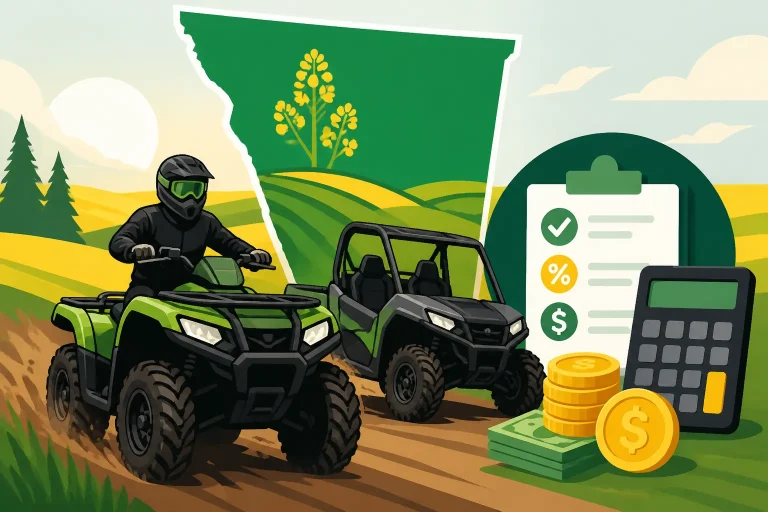
Why the Used-Goods Exemption Misses Saskatchewan Quads
Buying a used quad privately can look like a simple cash-and-bill-of-sale transaction, but Saskatchewan’s used-goods exemption may not remove the provincial sales tax. The key is how the machine is classified, not just whether it is second-hand or sold by an individual. Here’s what buyers and sellers should understand before agreeing on a price, and what to confirm before the deal is final.
Why the used-goods exemption does not automatically apply
Saskatchewan has a general exemption for some used goods sold privately. It is easy to hear about that rule and assume any second-hand item bought from another person is tax-free. That assumption can leave a quad buyer with an unexpected tax obligation.
The problem is that a quad is not treated like an ordinary household item. Saskatchewan’s tax rules treat all-terrain vehicles as recreational vehicles, a category that has its own rules. The general used-goods exemption does not automatically cover recreational vehicles, so a private sale does not become exempt from provincial sales tax simply because the machine is used or the seller is not a dealer.
That distinction matters whether the machine is a sport quad, a utility ATV or a side-by-side. The sales-tax question is about the type of item being sold and the applicable tax rules, not just the age of the machine, the seller’s identity or the fact that there is no provincial ATV registration.
| Situation | What to keep in mind |
|---|---|
| Used quad bought from a dealer | The dealer generally handles the applicable sales taxes as part of the sale. Ask for an itemized invoice. |
| Used quad bought privately | Do not assume the general used-goods exemption applies. Check how the buyer must report and pay PST. |
| A used household item bought privately | Different rules may apply. Do not use those rules as a shortcut for classifying a quad. |
| Quad bought from outside Saskatchewan | The buyer may still have Saskatchewan tax obligations. Check the rules for the purchase and where the machine will be used. |
| Quad received as a gift or inheritance | A change in ownership without an ordinary sale price does not necessarily settle the tax question. Confirm whether an exemption applies. |
Saskatchewan’s provincial sales tax, or PST, is separate from the federal goods and services tax, or GST. A dealer sale may involve both taxes, while a private transaction can have a different GST result depending on the circumstances. Do not treat “no GST charged” as proof that there is no PST to deal with.
The general background is useful, but it is not enough to decide a quad transaction. Saskatchewan Used Goods Exemption Does Not Apply explains the distinction, while Saskatchewan Tax on a Private ATV Sale addresses the private-sale issue more directly.
The tax category matters more than the seller’s label
People often describe a private sale as “just used property” or say the machine is “not registered, so there’s no tax.” Neither description determines whether PST applies.
A seller can be a private individual, the quad can be several years old, and the sale can happen without a dealer or registration office involved. Those facts describe how the transaction happens. They do not change the item’s tax category.
Likewise, calling the sale a gift, a farm sale or a cash sale does not by itself make the transaction exempt. The relevant questions include what is being transferred, who is making the transfer, what was paid or provided in exchange, and whether a specific exemption applies.
This is why buyers should avoid borrowing rules from unrelated purchases. Rules for used furniture, personal effects, passenger vehicles or other kinds of property may not apply to an ATV. Even two items sold by private individuals can be treated differently for tax purposes.
Why the $5,000 threshold can cause confusion
Some private-sale tax rules use a threshold, and buyers may hear that a purchase below a certain amount escapes PST. A threshold associated with one type of private sale should not be assumed to apply to every kind of used property.
The question is not simply, “Is the price below the threshold?” It is, “Does that threshold apply to this type of item and this kind of transaction?” A quad’s treatment as a recreational vehicle means the buyer should check the specific rule for recreational vehicles rather than applying a threshold discussed for other property.
If the purchase price is low, that still does not prove the sale is exempt. If the machine is old or needs repairs, that may affect its value, but it does not automatically change its tax classification either. For a low-priced or unusual transaction, confirm the current treatment with Saskatchewan’s tax authority before relying on an exemption.
Why “used” and “exempt” are not the same thing
“Used” describes the machine’s condition or ownership history. “Exempt” describes a legal tax treatment. The first does not guarantee the second.
That difference is easy to miss because many everyday private sales involve used goods and may qualify for an exemption. Buyers can understandably expect the same result when they purchase an ATV. But sales-tax rules often draw lines between types of property, and a recreational vehicle may fall outside a general rule that covers other used items.
For a broader overview of how a private transaction should be documented, see Saskatchewan Bills of Sale for a Quad. A bill of sale supports the record of the transaction; it does not make an otherwise taxable purchase exempt.
What the buyer should do in a private sale
A private sale may feel informal, but the buyer should treat the tax question as part of the purchase rather than an afterthought. The safest approach is to identify the machine, establish the transaction details, and confirm how PST must be handled before money changes hands.
- Identify the machine accurately. Record the make, model, year if known, and serial or vehicle identification number. Confirm whether the item is an ATV, a side-by-side or another kind of machine. Classification can matter.
- Write down the full deal. Note the agreed price and anything else exchanged, such as another machine, equipment or services. Keep the details consistent across the bill of sale and payment records.
- Ask how PST applies. Do not rely on the seller’s memory or a rule they used for a different item. Check Saskatchewan’s current guidance for a private sale of a recreational vehicle.
- Confirm who must report and pay. A private seller may not collect tax like a dealer. That does not necessarily mean the buyer has no responsibility. Ask the relevant tax authority how the buyer should report and remit any amount owing.
- Keep supporting documents. Save the bill of sale, proof of payment, messages about the agreed price and any tax guidance or correspondence you rely on.
- Budget before you commit. If tax is payable, include it in the total cost rather than treating the advertised price as the complete outlay.
The buyer should be especially careful when the seller says, “There’s no tax because it’s private.” That may be true for some types of transactions, but it is not a reliable rule for a quad. A seller can be acting in good faith and still misunderstand the tax treatment.
The reverse can also happen: a seller may ask the buyer to pay an amount described as PST without being responsible for collecting or remitting it. Ask for a clear explanation and verify the proper process. Avoid paying an added tax amount to a private seller without knowing whether the seller is authorized or required to collect it.
A bill of sale should state the parties, date, machine details, price and any other agreed terms. If there are multiple buyers or the machine is being bought through an estate, partnership or business, record who is acquiring it. Tax treatment may depend on the facts, so keep the paperwork clear. What Your Bill of Sale Needs to Cover and Saskatchewan Paperwork for a Buyer can help with the documentation side.
Dealer purchase, private sale and out-of-province purchase
The same quad can come with different paperwork depending on where it is bought. Tax handling is one of the practical differences between a dealership transaction and a private sale.
At a dealer, taxes and other charges usually appear on an invoice. The dealer is responsible for handling the taxes it is required to collect, and the buyer can review the charges before completing the purchase. Ask for a written, itemized out-the-door figure so the machine price, taxes, freight, setup and other charges are not blurred together.
In a private sale, there may be no dealer invoice and no seller collecting Saskatchewan PST. The buyer should not read the lack of a tax line as confirmation that the tax does not apply. Instead, the buyer should find out whether self-assessment is required and what information must be provided.
An out-of-province purchase creates another layer. A seller in another province may apply that province’s rules, and the paperwork may not address Saskatchewan’s tax obligations. The buyer should check the Saskatchewan treatment separately, particularly if the machine is being brought into the province for use here. Saskatchewan Tax on an Out-of-Province Purchase covers the broader issue, and Saskatchewan Paperwork for a New Resident is useful when the machine is part of a move.
| Purchase route | Tax and paperwork questions to ask |
|---|---|
| Saskatchewan dealer | Which taxes are included on the invoice? Are the charges itemized? Is the dealer collecting the applicable PST? |
| Saskatchewan private seller | Does PST apply to this recreational vehicle sale? If so, how does the buyer report and pay it? |
| Seller outside Saskatchewan | What tax was charged by the seller, and does the buyer have a separate Saskatchewan obligation? |
| Gift or inheritance | Does the transfer qualify for a specific exemption, and what documents are needed to support it? |
| Auction or business sale | Who is treated as the seller, and which tax rules apply to the transaction structure? |
A machine’s lack of a Saskatchewan registration document does not answer these questions. Saskatchewan does not issue a provincial ATV registration in the same way it registers some other vehicles. Ownership paperwork and tax compliance are separate matters. See Saskatchewan Does Not Register ATVs for the registration distinction and Saskatchewan Proof of Ownership Without a Registry for ownership records.
How the purchase price and paperwork affect your records
Tax questions are easier to resolve when the sale is documented accurately. A bill of sale is not only useful if ownership is later questioned; it also gives the buyer a record of what was purchased, from whom and for what consideration.
Write the actual agreed price. Do not put a lower figure on the bill of sale to reduce tax, and do not accept a seller’s suggestion to describe a purchase as a gift when money or something else of value changed hands. Inaccurate records can create problems if the buyer later needs to establish what was paid or explain the transaction.
If the quad is sold with accessories, a trailer, spare parts or another machine, list what is included and how the parties valued the package. Do not assume that assigning a separate value to each part changes the tax treatment. The classification and valuation rules still need to be checked.
Where the machine is sold below what similar machines might fetch, keep a straightforward explanation. It may have mechanical defects, missing parts, high hours, damage or an incomplete service history. Photos, inspection notes and messages can help show why the parties agreed on that amount. But a bargain price does not automatically create an exemption.
A useful record set includes:
- A signed bill of sale with the buyer’s and seller’s names and contact details.
- The machine’s make, model and serial or vehicle identification number.
- The transaction date and actual purchase price.
- A description of accessories or other property included in the deal.
- Proof of payment, such as a receipt or a record of an electronic transfer.
- Any written description of known defects or repairs.
- Notes on how the buyer confirmed the tax treatment.
If there are two buyers, make sure both names appear as intended. If a company or farm business is acquiring the quad, confirm which legal entity is buying it and retain the records with the business paperwork. Putting Two Names on One Bill of Sale and Saskatchewan Paperwork for a Business Machine address situations where a simple one-name receipt may not be enough.
Tax paperwork should be kept apart from assumptions about plates or insurance. A municipal plate, if one is available where the machine will be used, does not serve as proof that PST was paid. Insurance documents do not establish the purchase’s tax status either. Each requirement has its own purpose.
Common mistakes that lead to confusion
The most common mistake is applying the rule for ordinary used goods to a recreational vehicle without checking the category. Several other shortcuts can be just as misleading.
Assuming a private seller means no PST
A private seller may not collect tax at the time of sale. That is a statement about the seller’s role in the transaction, not a conclusion about whether the buyer has a tax obligation. Ask what the buyer must do rather than stopping at “the seller isn’t a dealer.”
Assuming a low sale price creates an exemption
A low price may matter under some tax rules, but it is not a universal exemption. A threshold for another type of property should not be applied to a quad unless the current rule expressly covers it.
Assuming no registration means no tax
Registration and sales tax are different systems. A province’s decision not to issue a registration document for ATVs does not automatically remove a sales-tax requirement. The lack of a registration-based collection step may mean the buyer needs to pay attention to the tax process rather than assuming it has been handled.
Treating a gift as automatically tax-free
A genuine gift may be treated differently from a sale, but the word “gift” does not settle the question. If the recipient provides money, property or another benefit in return, or if the transfer occurs as part of a larger arrangement, the facts may affect the outcome. Ask what documentation is needed to support any exemption.
Confusing GST with PST
A private seller who is not making a taxable supply in the course of business may not charge GST in the way a dealer does. That does not answer the separate PST question. Check each tax independently instead of treating “no tax” as one combined decision.
Relying on a forum post or another buyer’s experience
A friend may have completed a similar sale without being asked for tax at the time. That does not prove the transaction was exempt or that the same result applies to your purchase. The machines, transaction structures and rules may differ. Use the facts of your deal and current official instructions.
Waiting until after the sale to ask
Once the money has changed hands, it can be harder to get missing details from the seller. Confirm the process before paying, and make sure the bill of sale contains the information you may need. A short check beforehand is usually easier than reconstructing a transaction later.
A practical checklist before you buy
Before handing over a deposit or full payment, separate the deal into three questions: what you are buying, what the total cost will be, and what records you will retain.
Confirm the machine. Match the description and serial number on the quad to the bill of sale. If the serial number is difficult to read, have the seller show it clearly and document it before payment. A mismatch can complicate both ownership and tax records.
Confirm the seller’s authority. Ask whether the seller is the owner and whether another person, lender or estate has an interest in the machine. A bill of sale cannot resolve a lien or ownership dispute by itself. Saskatchewan Liens on an Unregistered Machine and Buying From a Private Seller in Saskatchewan offer related checks.
Confirm the tax treatment. Ask specifically about PST on a used recreational vehicle bought privately. Do not ask only whether “used goods” are taxable, because that broad question may get an answer based on a different kind of item. If the transaction has unusual details, explain them when asking for guidance.
Confirm the total cost. Consider the purchase price, tax if applicable, insurance, repairs, transport and any local permit or plate costs. A private sale can have a lower advertised price than a dealer sale but still require money for taxes, inspection or deferred maintenance. For a broader ownership budget, see Saskatchewan Cost of Ownership Year One.
Confirm the paperwork. Get a signed bill of sale and proof of payment. Keep copies in a place you can access after the machine is moved or stored. If tax must be reported later, the records will help support the transaction details.
Do not let the tax question replace the mechanical inspection. Tax compliance will not tell you whether the machine is safe or worth the asking price. Check the frame, drivetrain, suspension, tires, brakes, lights and signs of water or impact damage. Ask for service records and compare the hours or kilometres with the machine’s condition. What Used Quad Buyers Inspect First at a Farm Gate and Checking a Serial Number Before Cash Changes Hands cover two useful parts of the purchase process.
A careful buyer does not need to turn a private sale into a complicated negotiation. The goal is simply to avoid treating a tax exemption as automatic, document the real deal, and confirm the correct process before the seller is hard to reach.
Frequently Asked Questions
Is a used quad exempt from PST because it is sold privately?
Not automatically. A quad is treated as a recreational vehicle, and the general used-goods exemption does not automatically cover it. Check the specific current rule for the transaction.
Does a low purchase price mean no tax is due?
Not necessarily. A threshold that applies to some private sales may not apply to recreational vehicles. Confirm that the threshold covers a quad before relying on it.
Does the buyer pay PST to the private seller?
Do not assume that. A private seller may not collect tax as a dealer would, but the buyer may still need to report and pay PST. Confirm the correct process with Saskatchewan’s tax authority.
Does the lack of provincial ATV registration remove the tax obligation?
No. Registration and sales tax are separate matters. The fact that Saskatchewan does not register ATVs does not by itself establish that a purchase is tax-exempt.
Disclaimer
This article is for general informational purposes only and does not constitute professional advice. Laws, prices and regulations vary by location and change over time. Consult a qualified professional for guidance on your specific situation.