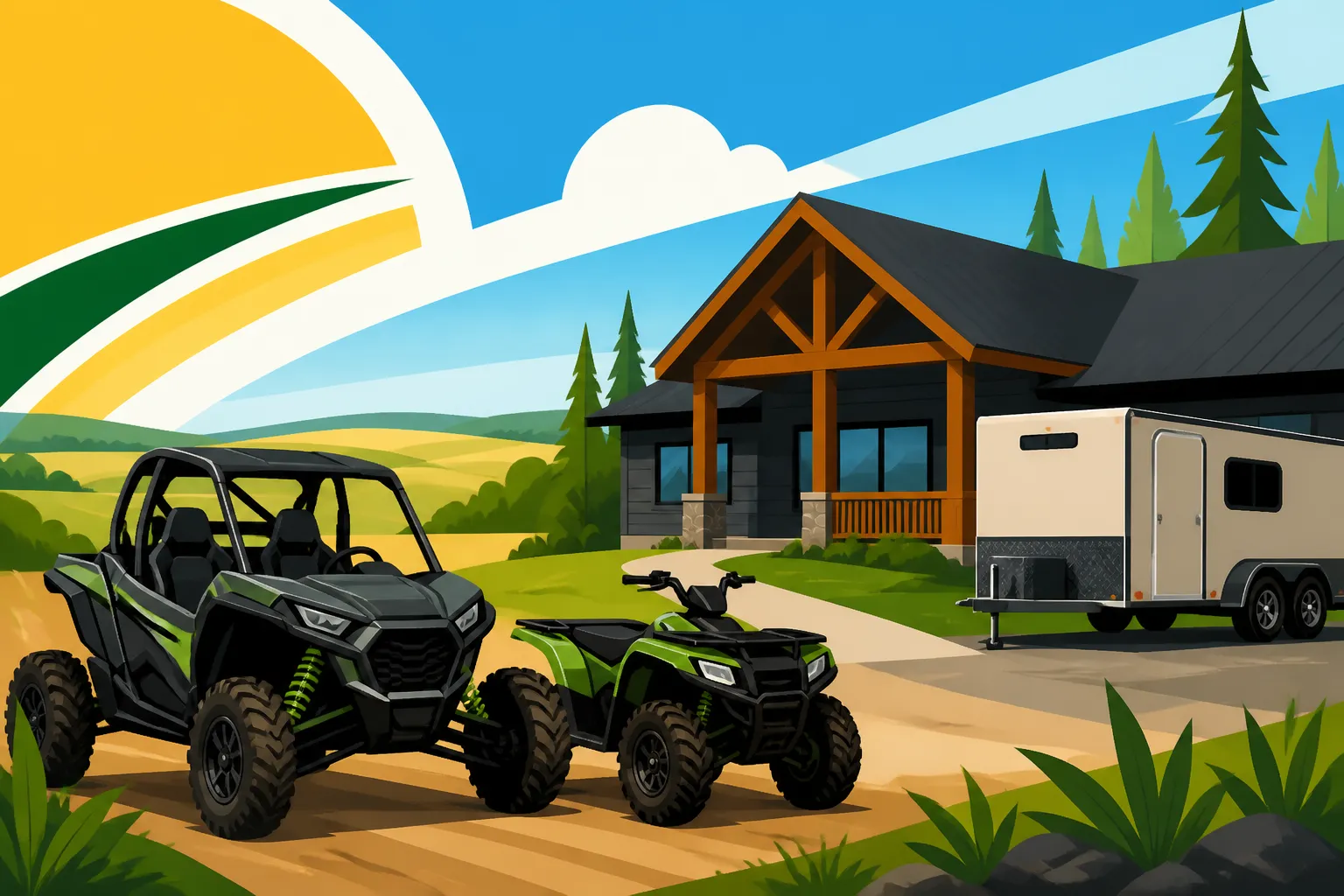
Saskatchewan Lodging That Welcomes Trailers
A trailer can turn a promising Saskatchewan ATV weekend into a frustrating one if the lodging has nowhere safe to park it, the access road is awkward to navigate, or the riding area is farther away than expected. This guide helps you choose a practical base, check trailer logistics before booking, and plan around trail access, local rules, and the realities of travelling with a machine.
Choose a lodging base around the riding area
The best place to stay is not always the closest town on a map. Consider the whole trip: where you will unload, whether the route suits your truck and trailer, what services you need, and whether the riding area is open to the kind of machine and travel you have planned.
Start with the destination, not the hotel search
Saskatchewan riding areas are spread across the province, and nearby accommodation can range from campgrounds and cabins to motels and private rentals. Begin by identifying the area you want to ride, then look for lodging within a drive you are comfortable making with a trailer. A route that seems short in kilometres can feel long if it includes gravel, narrow access roads, or frequent stops.
For example, a group heading to the Candle Lake area may want to compare stays around Candle Lake, Christopher Lake, and Prince Albert rather than searching only for a property directly beside a trail. Those places offer different trade-offs in distance, supplies, and the kind of parking you may find. Before booking, check the current riding access and whether your planned route is actually available to ATVs or UTVs. Nearby accommodation does not automatically mean nearby legal riding.
If you are considering the Prince Albert region, include trail access, fuel stops, and your unloading point in the plan—not just the overnight address. [Saskatchewan Riding Near Prince Albert] can help you think through the area, while [Saskatchewan Riding Near Candle Lake] and [Saskatchewan Riding Near Christopher Lake] are useful starting points for comparing nearby destinations.
Match the lodging style to your group
A motel may be convenient for a short trip when you mainly need beds, a shower, and a place to eat nearby. A campground or cabin can suit a longer stay, particularly if your group wants outdoor space and expects to spend time maintaining or cleaning machines. A private rental may offer more room, but parking capacity and permission to bring a trailer need to be confirmed directly with the host.
Think honestly about the routines your group will have. If you are leaving early, returning dusty, and carrying helmets, muddy boots, fuel containers, and riding gear, a compact room with limited storage may feel cramped. A cabin with outdoor space may be more comfortable, but only if the access road and parking area work for your truck and trailer.
For a larger group, ask whether vehicles and trailers can be parked together. Some properties may have space for a truck but not the full combination of truck, trailer, and ATV or UTV. If different riders are arriving separately, confirm whether the site can accommodate all vehicles without blocking other guests or public access.
Look beyond the word “near”
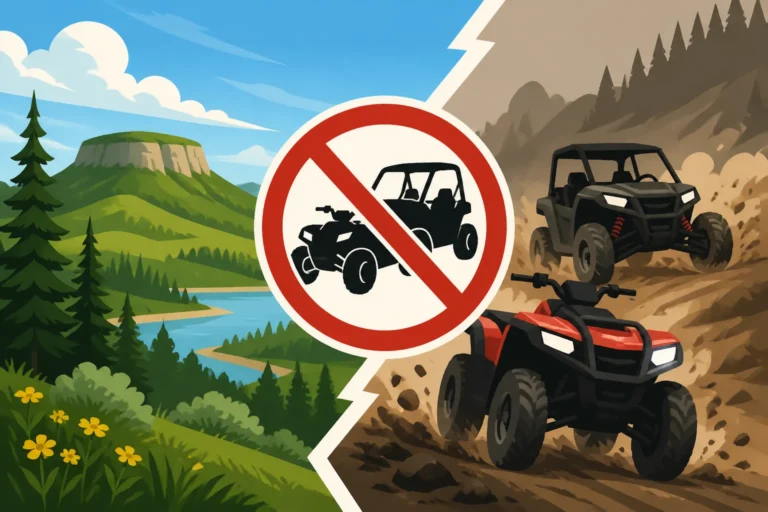
A map pin does not tell you whether a property is close to a usable trailhead, whether a road is suitable for towing, or whether you can legally ride from the property to the trail. In Saskatchewan, municipal bylaws, park rules, land access, and trail arrangements can differ from one location to another.
Use a map to understand the geography, then check the details with the lodging provider and the relevant riding-area office or club. onX Offroad can be one tool for reviewing a planned route and organizing map information, but do not treat a line on a screen as permission to cross land or proof that a trail is open. Confirm access with the appropriate land manager or local contact.
If you are comparing several places to stay, make a short list of the trailhead or unloading area, lodging address, fuel options, and any road or access questions. [Saskatchewan Trailheads With Trailer Parking] and [Saskatchewan Lodging That Welcomes Trailers] are relevant planning topics to keep in view while you compare locations.
Confirm trailer and machine arrangements before booking
“Trailer friendly” can mean very different things to different property owners. One host may mean there is a driveway; another may mean there is enough room to turn around, unhitch, and leave the trailer securely parked. Ask specific questions before paying a deposit.
Ask concrete parking questions
Describe your setup as accurately as you can. Give the host the approximate length of your truck and trailer together, whether you plan to unhitch, and how many machines you are bringing. If you have a wide side-by-side trailer or a long enclosed trailer, mention that too. A vague question such as “Is there trailer parking?” can lead to an answer that does not match your needs.
Ask whether the parking area is on the property, whether it is level and firm, and whether you will need to reverse into a tight space. Find out if the trailer can remain attached overnight or if you must leave it in a separate area. If the site has a shared driveway or limited parking, ask how many other guests may be using the same space.
It is also worth confirming whether the property has any restrictions on ATV or UTV storage. Some hosts may be comfortable with a parked trailer but not with machines being brought onto a lawn, washed on site, or worked on in a parking area. Get permission before arrival rather than assuming that outdoor equipment is automatically welcome.
Clarify unloading, washing, and security
A safe place to park the trailer does not necessarily mean you can unload machines there. Ask where unloading is allowed, whether the ground can support the trailer, and whether there is enough room to manoeuvre without blocking other vehicles. If the lodging cannot accommodate unloading, identify a suitable public or designated staging location before the trip.
Ask about machine washing before you plan to use a hose or pressure washer. In sensitive areas and parks, cleaning a machine before a ride can be part of preventing the spread of invasive species, but that does not mean every lodging property offers a wash station. A host may also have water-use restrictions or concerns about mud and drainage. [Saskatchewan Riding Areas With Wash Stations] is a useful topic to check when choosing a riding destination.
Security deserves a direct conversation. Ask whether the trailer will be visible from the accommodation, whether there is a well-lit parking area, and whether the property has any rules about storing keys or equipment. Do not assume that a locked gate, camera, or fenced yard is available unless the provider confirms it. Keep your own machine records and insurance details organized; [Saskatchewan Theft Recovery Without a Registry] and [Saskatchewan Insurance Claims Without a Plate] explore paperwork considerations that can matter if a machine is lost or damaged.
Get important details in writing
If a host confirms trailer parking, unloading, or machine storage by phone, ask them to include the arrangement in a booking message. A short written confirmation can prevent awkward surprises at check-in, especially if the person answering the original inquiry is not the person greeting you.
Keep the message specific: “We will arrive with a pickup and a trailer approximately this long, carrying two machines. We plan to park the trailer overnight and unload only in the area you approved.” This gives the host a chance to correct a misunderstanding before you are on the road.
Be especially careful with private rentals and smaller campgrounds where space is limited. A host may be happy to accommodate you but need to direct you to a different parking spot or arrival route. Confirm the check-in process, gate access, and any quiet-hour rules if you expect to arrive after a long tow.
| Question to ask | Why it matters | What to confirm |
|---|---|---|
| Can my truck and trailer fit on site? | Parking descriptions can be vague | Approximate combined length and width |
| Can I leave the trailer attached? | Unhitching may require extra room | Whether overnight attached parking is permitted |
| Where may I unload the machines? | Parking access is not necessarily unloading permission | A specific approved spot |
| Is the access road suitable for towing? | Narrow or soft approaches can create problems | Road surface, turning space, and any restrictions |
| Can I wash or maintain a machine? | Property rules and drainage may limit this | Permission, facilities, and any conditions |
| Is the trailer area secure? | Security features vary by property | Lighting, access, visibility, and locking arrangements |
Plan routes, access, and local rules
Once you have lodging and parking sorted out, check the route between your accommodation and the riding area. This is where a relaxed weekend can become stressful: a rider may assume they can ride directly from the property, only to discover that the route uses a road or land where ATV travel is restricted.
Do not assume you can ride from your door
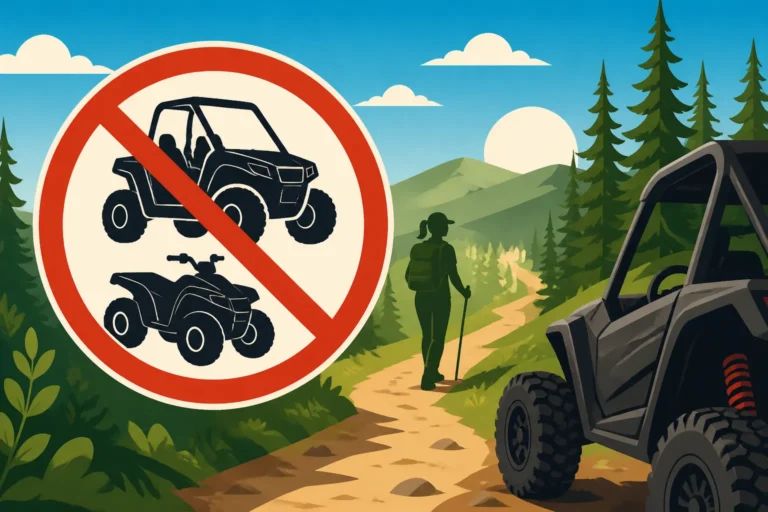
Ask whether the accommodation is connected to a legal ATV route. Even if the property is close to a trail, you may need to trailer your machine to an approved staging area. A short stretch through town, along a road, or across private land can have its own rules. Get permission before using private property, and check applicable municipal bylaws before riding on local roads or ditches.
The same care applies to provincial parks and club trails. A trail shown on a map may have designated use periods or other restrictions, and park rules can differ from rules on nearby land. Review the relevant information before setting out. [Saskatchewan Park Regulations for Machines] and [Saskatchewan Crown Land Access Rules] are useful topics to consult when your plans involve those areas.
If your route changes during the weekend, stop and check before continuing. A detour around mud, a closed trail, or a damaged bridge may lead onto land where you do not have permission. Having a map is helpful, but it does not replace signs, posted closures, or permission from the landholder.
Build in time for towing and trailhead logistics
Allow extra time for turns, gravel roads, fuel stops, and unloading. A route that takes little time in a passenger car may take longer with a trailer, particularly if you are unfamiliar with the road or need to stop to check directions. Before leaving, confirm where trailers may be parked at the trailhead and whether there is enough space for your group.
For a weekend near a busy recreation area, arrive early enough to unload without rushing. Agree on a meeting point in case vehicles arrive separately. If the trailhead has limited parking, have a backup plan that does not involve leaving a trailer where it blocks traffic or access for other visitors.
onX Offroad may help with route planning and keeping riding information organized, especially when your group is comparing possible approaches to an area. Use it alongside local information and verify details before riding. Save essential directions and contact information in a form you can access if mobile coverage is weak; [Saskatchewan Riding Areas With Cell Service] can prompt you to consider connectivity as part of the trip plan.
Check access and conditions shortly before departure
Trail and land access can change with weather, fire risk, maintenance, or local decisions. A route that worked during a previous visit may not be suitable now. Check current notices from the park, municipality, land manager, or trail organization responsible for the area, and look for closure information before towing north or south.
Weather matters even when the lodging itself is easy to reach. Heavy rain can make some routes difficult, while dry conditions can bring dust and fire-related concerns. Follow posted signs and any active restrictions. [Saskatchewan Wildfire Season Rules for Riders] and [Saskatchewan Trail Closures After a Storm] are useful reminders to make a last-minute conditions check part of the plan.
If you are riding in a group, decide who will check for updates and share changes with everyone. Keep the lodging address, trailhead location, and a backup plan accessible. If access is closed, do not treat the closure as a minor inconvenience to work around; switch to a lawful alternative or change the day’s plan.
Make the stay comfortable for riders and hosts
Good lodging logistics are not only about getting the trailer through the gate. They are also about keeping machines, gear, and group routines from becoming a headache for you or the people sharing the property.
Pack for the property you booked
Before departure, ask what the accommodation provides and what you need to bring. A cabin may have basic kitchen equipment but limited drying space; a motel may have no outdoor area for gear. Bring storage bins or bags for muddy clothing, spare gloves, helmets, and tools, and keep oily or dirty items away from bedding and interior furniture.
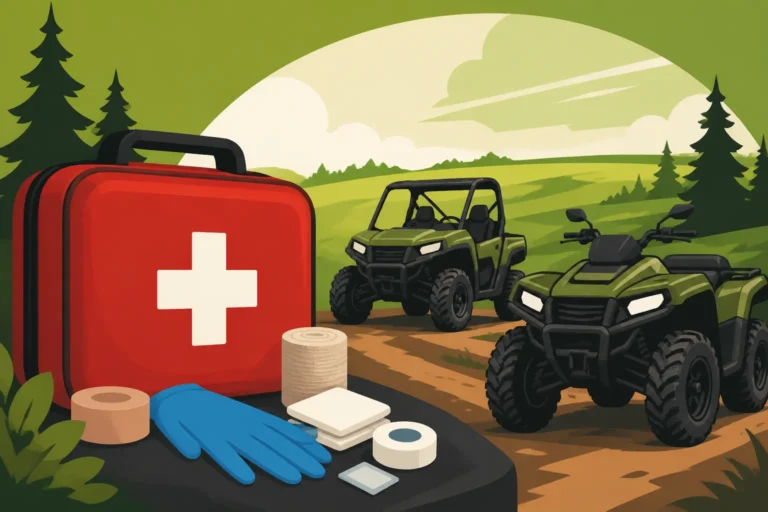
If you expect cold mornings or a long day in the bush, pack layers and practical footwear rather than relying on what you wear in the truck. Keep a small first-aid kit, drinking water, and basic machine supplies accessible without unloading the entire trailer. For a northern or remote ride, [First Aid Kit for a Long Northern Loop] and [Packing for a Cold Morning at Moose Mountain] offer useful prompts for what to keep close at hand.
A little organization also makes shared spaces easier. Label gear bags, assign each rider a place for boots and helmets, and agree on where muddy equipment will go. That simple conversation can save time at the end of a tiring day.
Be considerate with machines and neighbours
Keep machines and trailers within the areas the property owner has approved. Avoid unnecessary engine noise early in the morning or late at night, and do not use a parking lot or yard for repairs unless you have permission. If mud or dust is unavoidable, ask about the host’s expectations before bringing machines onto the property.
Respect quiet hours and local rules, particularly in resort communities where other guests may be there for a different kind of getaway. A machine that is legal to operate in one setting may not be permitted on a nearby street or access road. [Saskatchewan Municipalities With ATV Bylaws] can help remind riders that local rules are not uniform across the province.
At the end of your stay, leave the parking area as you found it. Remove tie-downs, packaging, and debris, and report any damage promptly. Being a thoughtful guest can make it easier for future riders to find accommodations that welcome trailers and machines.
Use a simple pre-booking checklist
Before confirming a reservation, make sure the answers to the practical questions are clear. If one key detail is uncertain—especially parking, unloading permission, or access—ask again in writing. It is much easier to compare another property from home than to improvise after arriving with a loaded trailer.
- Confirm the full truck-and-trailer setup fits.
- Ask whether you can unhitch or must keep the trailer attached.
- Get explicit permission and directions for unloading.
- Check whether machines may be stored on site overnight.
- Confirm access-road conditions and arrival instructions.
- Identify the legal route or trailhead you will use.
- Check current trail, park, municipal, and land-access information.
- Save the lodging contact and backup plan before leaving.
A few clear questions can make the difference between a smooth arrival and a stressful first evening. Plan the parking as carefully as the ride, verify local access instead of making assumptions, and choose lodging that suits both your group and your equipment.
Disclaimer
This article is for general informational purposes only and does not constitute professional advice. Laws, prices and regulations vary by location and change over time. Consult a qualified professional for guidance on your specific situation.