Hiking Trails Closed to Machines
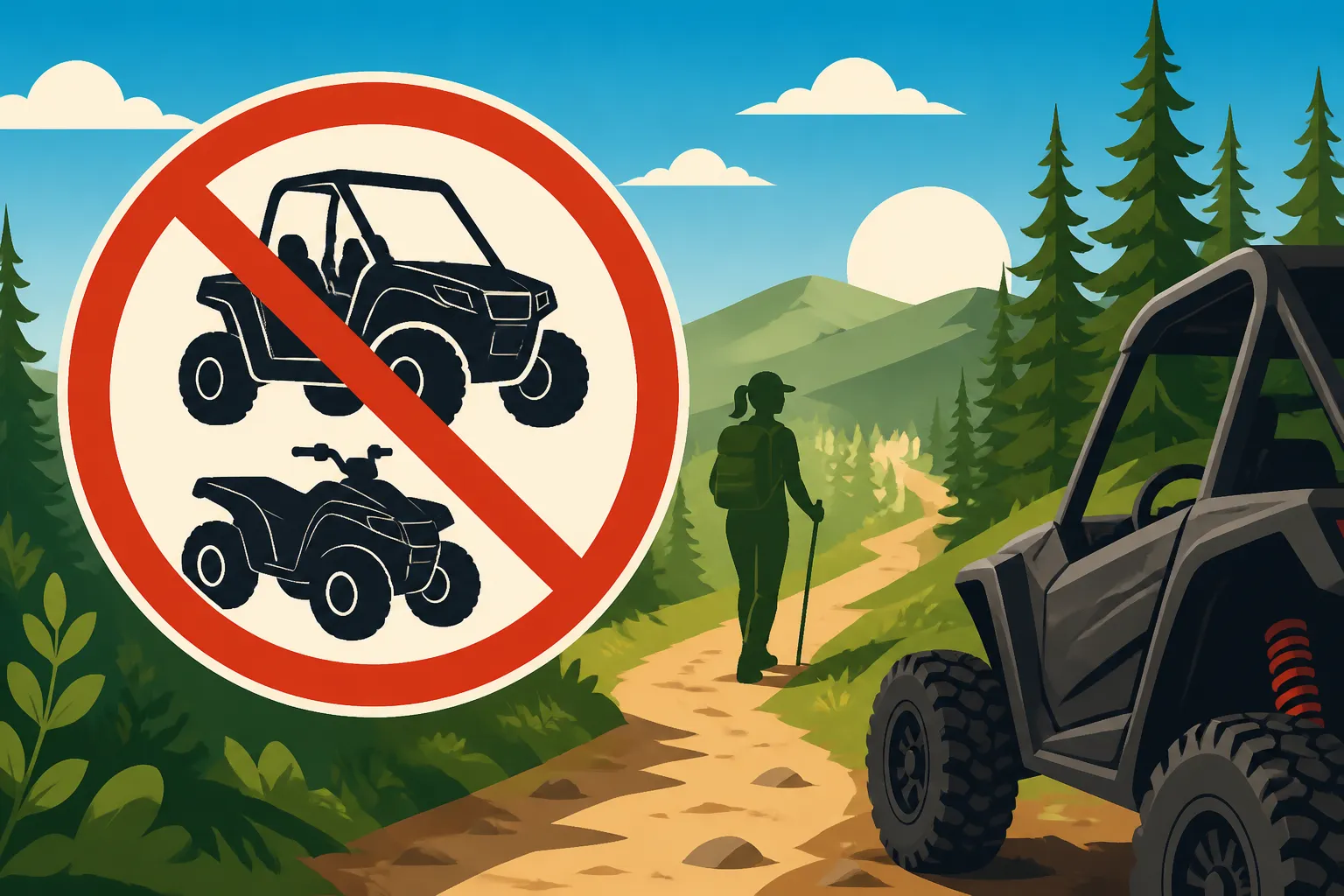
A trail that looks wide enough for a quad is not necessarily open to one. In Saskatchewan parks, hiking routes and machine routes can be separate, and riding onto a footpath can damage the trail, create a safety risk, or violate park rules. This guide explains how to tell which routes are closed to machines and what to check before unloading.
Why hiking trails are closed to ATVs and UTVs
A hiking trail is not automatically a shared trail
A path may look firm, broad, or easy to follow, but appearance does not determine whether an ATV or UTV can use it. Hiking trails are generally intended for people travelling on foot. They may pass through narrow bush, near sensitive ground, or close to campsites and other places where motorized traffic would create conflicts.
The key distinction is designation. If a park identifies a route as a hiking trail, do not treat it as a machine trail unless the park’s rules specifically say motorized use is permitted there. Saskatchewan parks can designate particular routes for machines while keeping other trails closed. That is why [Saskatchewan Parks With Designated Trails Only] is an important principle for planning: access to some trails does not mean access to every trail in the park.
This can be frustrating when a hiking path appears to connect two permitted riding areas. It may seem like a short detour would save time, especially if the route is already packed down. But riding a closed footpath can still cause damage and may put you in conflict with hikers, cyclists, or park staff. Stick to the routes identified for your type of machine.
Closures protect people, land, and the riding opportunity
Hiking trails are often narrower than ATV routes and may have turns, slopes, or sightlines designed for walking rather than motorized traffic. A hiker coming around a bend may not expect a quad. A machine can also widen a path, churn up soft sections, damage vegetation, and leave ruts that collect water or become harder to repair.
These impacts are not limited to wilderness areas. A short unauthorized ride near a campground, beach, or trailhead can affect other visitors’ experience and create pressure for additional restrictions. When riders stay on designated routes, they help protect access to the routes that are open.
If a trail is marked closed to machines, respect the closure even if you see tire tracks. Tracks may be old, may have been left by an authorized maintenance vehicle, or may reflect someone else’s mistake. They are not permission.
How to tell whether a route is open to machines
Check park information before you unload
Start with information for the specific park and the specific route you plan to ride. Rules can vary between parks, and a trail that permits machines in one area may be hiking-only elsewhere. Look for designated machine trails, posted closures, maps, and any instructions about where machines may travel or park.
If the information is unclear, contact the park office before your trip rather than trying to interpret the route at the trailhead. Ask whether the route is open to your type of machine, whether there are seasonal restrictions, and whether you need to complete an acknowledgement or permit process. [Saskatchewan Park Regulations for Machines] is a useful companion topic when you are checking what rules apply.
A navigation app can help you keep track of your location, but it should not be treated as proof that a route is legally open. For example, onX Offroad may be useful as a supplementary mapping tool when planning a route, but compare what it shows with current park information and signs. A mapped line is not the same thing as permission to ride it.
Read signs at the entrance and along the trail
At the trailhead, pause long enough to read the signs rather than unloading first and sorting out the rules later. A sign may identify a route as hiking-only, show a closure, or direct machines to a different trail. Look for additional signs at junctions, where a route branches, or where a shared access road meets a footpath.
If a sign is missing, damaged, or difficult to understand, do not assume that the route is open. Check the park map or ask staff. When you are in a group, make sure everyone understands the route plan before setting off; it is easy for one rider to follow the wrong track while the rest of the group continues ahead.
| What you see | What to do |
|---|---|
| A sign identifies a hiking trail or says machines are prohibited | Keep the machine off that route |
| A map identifies a designated machine trail | Use only the route and areas the map permits |
| A junction has unclear or conflicting signs | Stop and confirm with park staff before continuing |
| A navigation app shows a trail without clear park designation | Treat the app as a planning aid, not authorization |
| Tire tracks appear on a closed or uncertain route | Do not use the tracks as evidence that riding is allowed |
For trip planning, onX Offroad can be one source of route context, but it should not replace official park signs or guidance. If a map app and a posted closure appear to disagree, follow the closure and ask the park office to clarify.
What to do when trails connect or appear to overlap
Do not use a hiking trail as a shortcut
A common mistake is assuming that a short stretch of footpath is acceptable if it connects two machine routes. That short link can still be a prohibited section. It can also put you unexpectedly among hikers or lead you into an area where turning around is difficult.
Before riding, trace the route from the unloading point to your intended destination. Check every connection and junction, not just the main trail. If a legal route does not connect the places you hoped to visit, choose a different riding plan rather than cutting across a closed path. [Roads Closed to Machines Inside a Park] can also help clarify why access roads and trails should not be assumed open simply because they look passable.
A phone map can be helpful for orientation, but it is sensible to carry a second navigation option for areas with poor service. If you use onX Offroad, save or review your route before you leave an area with reliable reception, then use official park information to confirm which segments are permitted.
Stop when you reach an uncertain junction
If you arrive at a fork and cannot tell which route is designated for machines, stop before entering either branch. Check for signs, compare your location with park materials, and contact staff if the answer is still unclear. Riding farther in to “see where it goes” can turn a simple question into a closure violation or a difficult turnaround.
When riding with others, agree on a simple rule: if the route designation is uncertain, nobody proceeds until the group has checked. This is especially helpful when riders are following someone else’s tracks or a downloaded route, because those cues can lead the group onto a path that is not open to machines.
You can also ask the park office about route changes or closures before you travel. [Saskatchewan Trail Conditions Before You Haul] offers another useful planning prompt: conditions and access can change, so a route that was open on a previous visit should not be assumed open today.
A practical pre-ride checklist
Confirm access, permits, and trail conditions
Before leaving home, identify the park, the designated machine route, and your intended unloading point. Confirm that your machine is allowed on the route and check whether the park requires an acknowledgement form, permit, or other step before riding. Requirements can differ between parks, so do not rely on what applied at your last destination.
Some Saskatchewan parks require visitors to complete a use acknowledgement before using designated machine trails. Check the park’s current instructions and complete any required step before setting out; [Saskatchewan Park Use Acknowledgement Forms] explains why this paperwork belongs on the pre-ride checklist. Keep any required proof or confirmation accessible in case staff ask to see it.
| Before the ride | Why it matters |
|---|---|
| Confirm which trails are designated for machines | Prevents accidental use of hiking-only routes |
| Check current closures and conditions | Access can change, and signs may be updated |
| Review park-specific permit or acknowledgement instructions | Requirements may differ between parks |
| Note the unloading area and legal route connections | Helps avoid using a footpath as a shortcut |
| Brief everyone in the group | Reduces wrong turns and confusion at junctions |
If you discover a closure after unloading
If a trail sign shows that a route is closed to machines, do not ride past it to look for another sign or a way around. Turn back and use a designated route. If you have already entered a hiking trail by mistake, stop when it is safe, turn around carefully, and return by the shortest practical route without continuing deeper into the closed area.
If the route is blocked or confusing, contact park staff for direction rather than crossing vegetation or creating a new path. For questions about what an officer may check at a trailhead, see [What a Park Officer Checks at a Trailhead]. Staying calm, following instructions, and explaining that you are seeking clarification is better than arguing from an app map or pointing to tracks left by other riders.
Plan your day around the routes that are clearly open. A little checking before the ride can prevent a frustrating stop, protect hiking areas, and help keep designated machine trails available for responsible use.
Disclaimer
This article is for general informational purposes only and does not constitute professional advice. Laws, prices and regulations vary by location and change over time. Consult a qualified professional for guidance on your specific situation.