Campgrounds Closed to Machines
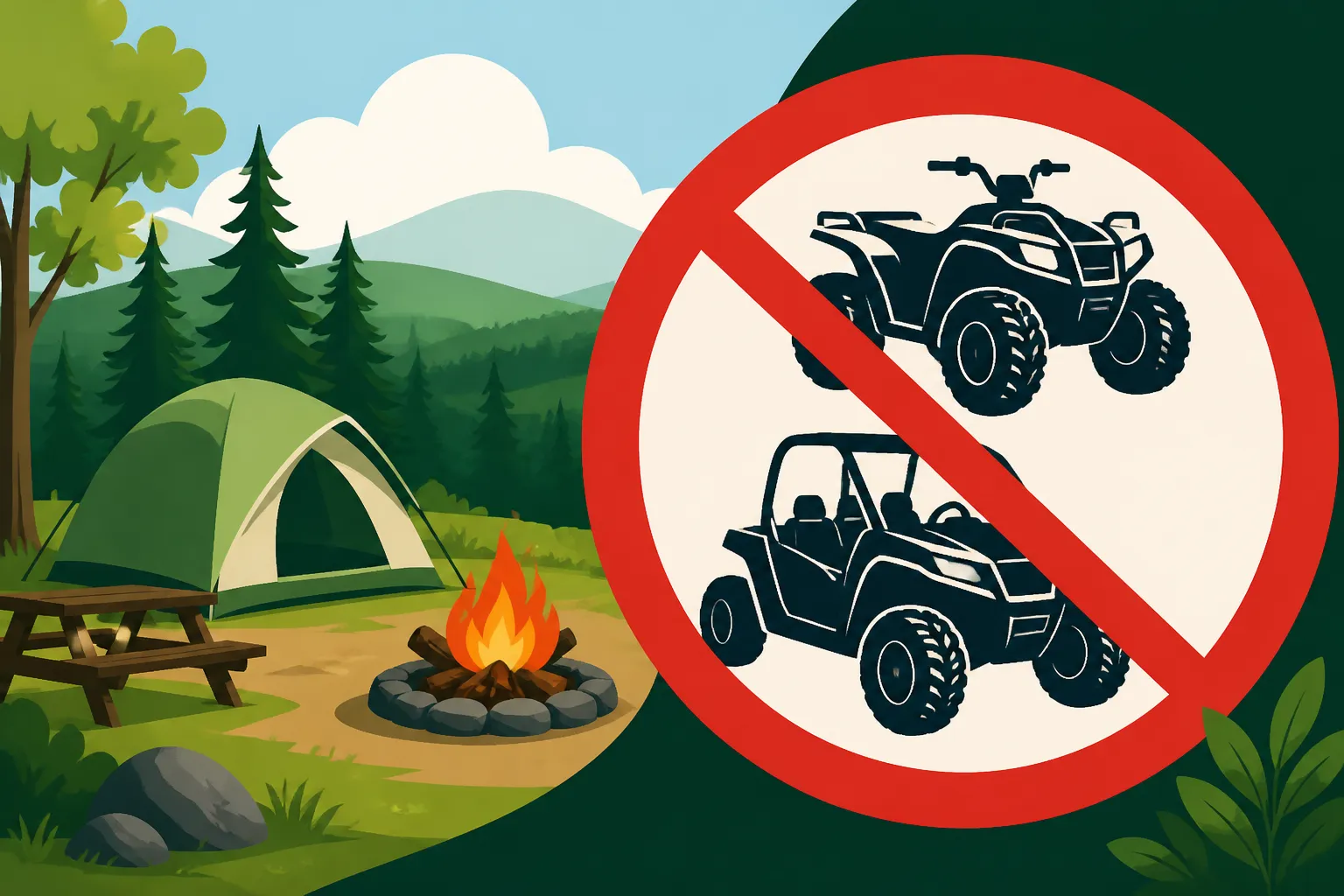
A campground can look like the easiest place to unload, park, or ride through on an ATV or side-by-side, but park boundaries do not make every road machine-accessible. In Saskatchewan, campground areas are generally off-limits to off-road machines unless signs or specific park rules say otherwise. This guide explains how to plan your route, handle access and parking, and avoid an expensive wrong turn.
What “campgrounds closed to machines” means
A campground is not an ATV trail
A provincial park may have designated trails where ATVs or UTVs are permitted, while its campground remains closed to them. The permission to ride in one part of a park does not automatically extend to nearby camping loops, access roads, beaches, or paths between facilities.
That distinction can be easy to miss when you arrive with a trailer. A road through a campground may look like a convenient connection to a trailhead, but it may be intended for cars, service vehicles, and campers—not recreational machines. A route that saves a few minutes can put you in a restricted area, disturb people at their sites, or create a safety problem where children and pedestrians are moving around.
Treat each area according to its posted rules. Look for signs at the entrance, trail junctions, and campground access points, and check the park’s current information before you unload. The broader rules are worth reviewing in [Saskatchewan Park Regulations for Machines] and [Saskatchewan Parks With Designated Trails Only].
What areas may be restricted
“Campground” can refer to more than the individual campsite pads. Depending on the park’s layout and rules, restrictions may cover internal campground roads, washroom and shower areas, playgrounds, picnic areas, and pedestrian paths. A nearby parking lot or service road should not be assumed open to ATVs just because it is paved or gravelled.
Other park areas may have their own restrictions. A hiking trail is not an ATV route, and a boat launch or beach access road may not be open to machines. For a clearer picture of the boundaries, read [Hiking Trails Closed to Machines], [Boat Launches Closed to Machines], and [Roads Closed to Machines Inside a Park].
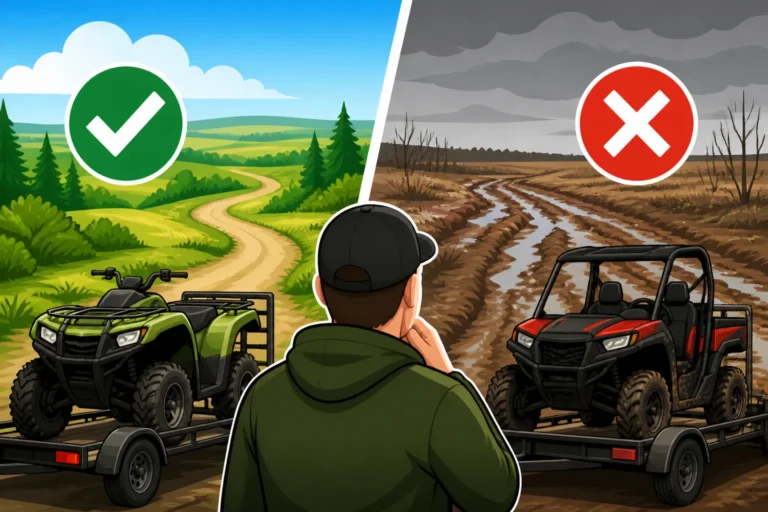
The practical test is not whether the route looks rideable. It is whether that route is specifically permitted. When a sign is unclear, stop and check with park staff rather than guessing. Keep in mind that an open trail may still lead close to a closed campground without giving you permission to ride through it.
Plan arrival, unloading, and parking before you ride
Find a permitted unloading area
Before towing to a park, identify where you are allowed to leave your truck and trailer and unload your machine. Do not assume the campground parking area, boat-launch lot, or roadside shoulder is suitable. A trailhead may have a designated unloading area, but space and access arrangements can vary.
Planning this detail ahead of time avoids a frustrating arrival: you reach the park, see the trail on a map, and then discover there is nowhere permitted to unload nearby. Check park information and signs for designated access points, parking instructions, and any restrictions on trailers. [Trailering to an Unloading Area] is a useful related topic if you are working out the logistics.
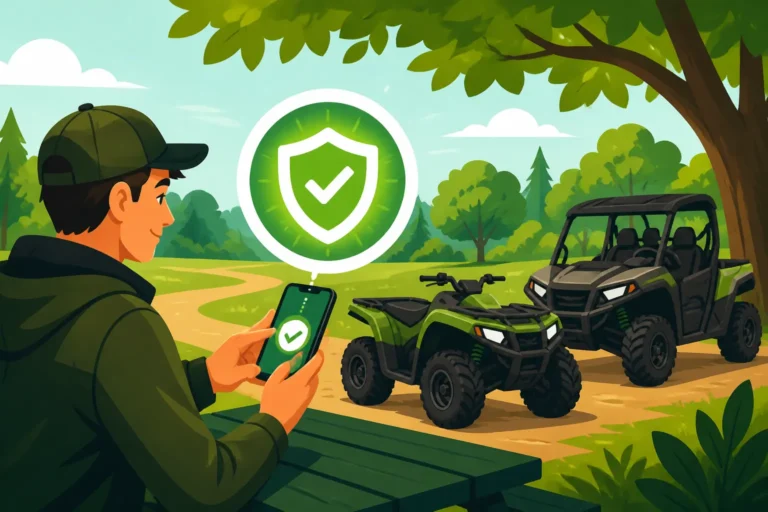
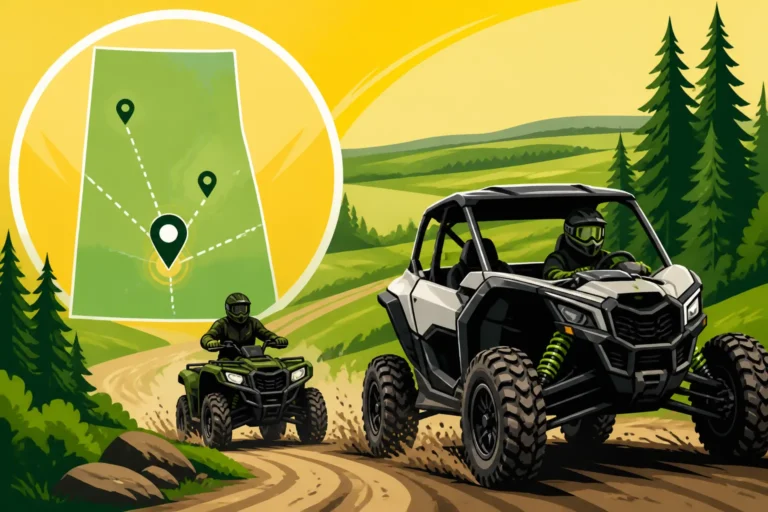
A mapping app can help you understand how trails, roads, and access points relate to one another. For example, onX Offroad may help with route planning, but a mapped line is not proof that a route is legally open or that you may unload there. Compare any map with park signs and official park information before riding. If a trail appears to pass near a campground, plan a route that avoids entering it unless access is clearly allowed.
Keep your machine out of campground traffic
Once unloaded, use the permitted route to reach the trail. Do not ride through campground loops to meet friends, carry equipment to a site, or avoid a longer route unless the park expressly allows it. Even a short trip can surprise people walking between campsites or playing near their vehicles.
If your campsite is inside a campground, leave the ATV or UTV parked where the park permits and walk to it, or use another approved arrangement. Avoid idling near occupied campsites, revving the engine, or using a campground road as a warm-up area. These choices are not only considerate; they also reduce the chance of conflicting with posted restrictions.
Before you travel, make sure the group understands the route. A lead rider can stop at trail junctions and confirm that everyone is following the permitted path. If someone takes a wrong turn, stop and retrace the route rather than continuing through a restricted area to find a shortcut.
Check permits, signs, and park-specific conditions
Confirm what the park requires
Some Saskatchewan parks have designated ATV trails and require riders to complete park-specific steps before using them. That may include obtaining a permit, attending an information session, signing an acknowledgement form, or displaying a permit as directed. Requirements can differ between parks, so do not assume that permission or paperwork from one location applies at another.
Check the park’s current instructions before leaving home. If a permit is required, find out where it is issued and where it must be displayed. The process is explained further in [Saskatchewan Park Use Acknowledgement Forms] and [Where to Display Your Park Trail Permit]. A permitted trail does not mean the rest of the park is open to machines, so keep following signs after you have completed the permit steps.
Bring proof of insurance if the park or an officer asks for it. Also confirm that the machine and riders meet the applicable rules. You can review [Saskatchewan Insurance Proof on a Trailhead]—or, more directly, [Saskatchewan Insurance Proof on a Park Officer] is not a listed topic, so use the available guide [Liability Insurance Produced on Demand in a Park] for park-related insurance context.
Use maps as a planning aid, not permission
A trail map can help you spot route connections, estimate where a ride begins, and avoid accidentally planning a route through a campground. onX Offroad can be one planning aid for viewing mapped routes, but map coverage and access information should be treated as a starting point. A digital line cannot replace posted signs, park directions, or confirmation from staff.
If you use onX Offroad or another mapping tool, look closely at the trail’s beginning and end. Ask whether you can reach it from a legal unloading area without crossing a campground, beach, or closed road. Save or download route information before leaving areas with limited cell service, and carry a backup map when riding somewhere unfamiliar. These habits are especially useful when a group is following a route from different devices.
Use the following checklist before you unload:
| What to check | Why it matters | What to do |
|---|---|---|
| Campground boundary | A permitted trail may be close to a restricted camping area | Follow signs and stay out of campground loops unless access is clearly allowed |
| Trail access | A mapped route may not have a legal connection from your parking spot | Confirm the approved route from the unloading area |
| Parking and trailer space | Not every lot is intended for trailers or machine unloading | Check park directions and use a designated area |
| Permit requirements | Rules can vary by park and trail | Complete required steps before riding |
| Insurance and rider rules | Park staff or an officer may ask for proof or compliance | Carry required documents and review applicable rules |
| Route changes or closures | A familiar route may be affected by current conditions | Check park notices and follow signs on arrival |
What to do if a route is unclear
Stop before entering a restricted area
If you reach a sign that is missing, hard to read, or inconsistent with your map, stop somewhere safe and check before continuing. Do not ride past a “closed” or “no machines” sign because another rider has gone through, or because the route appears on a mapping app. Ask park staff or contact the park office for clarification.
When no staff member is immediately available, choose the clearly permitted route or turn back. That may cost a little time, but it is much better than crossing a campground, disturbing campers, or receiving a ticket. If you are riding with a group, tell everyone why you stopped and keep the group together while you confirm the route.
For a general idea of what staff may check, see [What a Park Officer Checks at a Trailhead]. It is also sensible to read [Saskatchewan Permit Questions Riders Ask] before your trip if you are unsure about permits, display requirements, or where to get answers.
Be considerate around people and campsites
Even where machine use is permitted on a designated trail, be prepared for people walking, children playing, and vehicles entering or leaving campsites. Slow down where visibility is limited, follow posted speed limits, and give pedestrians plenty of room. Avoid unnecessary engine noise near campsites, especially early in the morning or later in the evening.
If a route runs near a campground, stay on the marked trail and do not widen the route to pass another machine. Keep dust, noise, and exhaust away from occupied sites when you can. If the trail is busy, wait for a clear space rather than weaving between parked vehicles or cutting across a picnic area.
A good park ride starts with knowing where you can go—and where you need to leave the machine parked. Check the rules for the specific park, use approved unloading areas, and follow signs even when a shortcut looks obvious. That small amount of planning makes the ride smoother for your group and for the people camping nearby.
Disclaimer
This article is for general informational purposes only and does not constitute professional advice. Laws, prices and regulations vary by location and change over time. Consult a qualified professional for guidance on your specific situation.