Why Narrow Hills Stayed Closed Until 2026
Narrow Hills’ closure frustrated riders who had already planned a trip, booked a campsite or hauled a machine north, only to find that wildfire damage made access unsafe. The delay was about more than waiting for flames to disappear: burned trees, damaged trails, changing ground conditions and the need for careful inspections all mattered. Here’s why reopening took time and how to plan a return responsibly.
Why the wildfire led to a long closure
A fire can leave hazards long after the flames are gone
The Shoe Fire affected a vast area, and its impact did not end when active fire was no longer the immediate concern. After a major wildfire, burned or weakened trees can fall without warning. A standing tree may look intact from the trail but have damaged roots or a compromised trunk. Wind, rain and snow can make those hazards worse.
For ATV and UTV riders, this matters because trails often pass through wooded areas and narrow corridors. A fallen tree can block a route, while a damaged tree above it can make clearing the route dangerous. Riders may also have limited room to turn around, especially if they are towing a trailer or travelling with a group.
The fire footprint and the safe riding area are not always the same thing. Some sections may show little visible damage but still be difficult to reach or inspect. Other areas may have burned intensely, leaving unstable trees, exposed roots or debris across the trail. The scale of the fire described in The Shoe Fire Burned 500,000 Hectares in 2025 helps explain why checking every trail and access point could not be treated as a quick cleanup job.
The trail surface and drainage can change after a fire
Fire can affect the ground beneath a trail as well as the trees around it. Vegetation that once slowed rainwater may be gone, allowing runoff to move more quickly across slopes and through low areas. That can wash out trail surfaces, expose rocks and roots, or carry sediment into nearby drainage areas.
A route that looked passable before the fire may no longer be suitable for a heavy side-by-side or a group of ATVs. A damaged culvert or eroded crossing can be difficult to spot from a seat. Even a short washout can create a rollover risk or leave riders stranded on the far side of an obstacle.
This is one reason a closure can remain in place even when a trail appears open at first glance. A safe reopening requires more than confirming that there is no flame or smoke. Staff need to assess whether riders can travel through the area without creating unreasonable risks or worsening damage. The broader considerations are covered in Saskatchewan Wildfire Closures and Riding.
What reopening requires beyond putting out the fire
Inspections, repairs and access checks take time
Before a riding area can reopen, managers may need to inspect trails, bridges, culverts, signs, parking areas and access roads. The work can include identifying unstable trees, clearing debris, repairing washouts and checking whether vehicles used for emergency response can reach the area.
These tasks often happen across a large landscape, not just at the most popular trailhead. A route may connect several trail sections, and a damaged crossing or blocked connector can prevent a safe loop. If a closure covers multiple routes, reopening only one segment may not make the overall network practical or safe for riders.
Repair work also has to be sequenced sensibly. Crews may need to remove hazards before equipment can reach a damaged crossing. Some areas may require additional assessment before heavy machinery is used, particularly where ground conditions or drainage are sensitive. The repair and recovery process after a major event is explored in Recovery Funding After a Fire.
Managers must balance recreation with recovery
A burned landscape needs time to recover. Vegetation helps stabilize soil, and repeated vehicle traffic can disturb fragile ground, spread sediment or widen damaged routes. Even riders who stay on an established trail can contribute to further wear if the trail edge is soft or the surface has been weakened.
Closing an area can also protect workers and emergency crews while they assess damage or complete repairs. A rider entering a closed section may encounter hazards without warning, interfere with work, or make it harder for crews to respond safely. A closure is therefore not simply a signal that the park is inconvenient to visit; it is a way to manage risks while conditions are being checked.
Wildfire season can bring separate restrictions, including temporary limits on access or activities. Those rules can apply even when a particular trail has not visibly burned. Review Saskatchewan Wildfire Season Rules for Riders and Saskatchewan Wildfire Season Dates before setting out, especially if your plans depend on Crown land or routes beyond a designated trail network.
| Issue after a major wildfire | Why it can delay riding access |
|---|---|
| Unstable or burned trees | Trees and limbs may fall onto trails or riders without much warning |
| Erosion and runoff | Trail surfaces, slopes and crossings may be weakened or washed out |
| Damaged infrastructure | Culverts, bridges, signs and access roads may need inspection or repair |
| Ongoing recovery work | Crews need safe access and room to work |
| Environmental sensitivity | Soft or exposed ground can be damaged by vehicle traffic |
| Changing restrictions | Fire-related access rules can change separately from trail repairs |
What riders should check before returning to Narrow Hills
Confirm the exact area and route status
A broad statement that a park is reopening does not necessarily mean every trail, road or facility is available. Check the current information for the specific trail network, access road, staging area and facilities you plan to use. Look for conditions on the day you travel, not only information saved when you first made your plans.
The designated network at Narrow Hills is commonly described as having roughly 50 kilometres of trails, but mileage alone does not tell you whether a particular section is open, connected or suitable for your machine. For route background, see Narrow Hills Provincial Park ATV Trails and Narrow Hills’ 50 Kilometres in Saskatchewan. Then verify the latest official notices before unloading.
A trail map app such as onX Offroad can help you review route options and orient yourself, particularly when you are comparing access points or planning a loop. Treat it as a planning aid rather than confirmation that a trail is legally open. A mapped route may not reflect a new closure, a washout or a temporary restriction, so official park and government notices should take priority.
Build a flexible plan and a safe turnaround option
When an area is recovering, avoid building a full day around one route with no alternative. Identify another legal riding area, confirm where you can park and unload, and allow time to turn around if you find a closure or unsafe condition. For a group ride, agree on a meeting point and a backup plan before anyone leaves the staging area.
If you use onX Offroad or another mapping tool, save the route information you need before entering areas with unreliable cell coverage. Carry a paper map or another offline navigation option as well. Neither a phone map nor a downloaded track replaces posted signs or current closure information, but having more than one way to orient yourself can help if a route is blocked.
Check Saskatchewan Trail Conditions Before You Haul before making a long drive. Also review Saskatchewan Trail Closures After a Storm, since heavy rain or other weather can create new hazards even after fire-related work is complete. If notices are unclear, contact the relevant park office or local authority rather than assuming a familiar route has reopened.
How to ride responsibly in a recovering area
Stay on open, designated routes
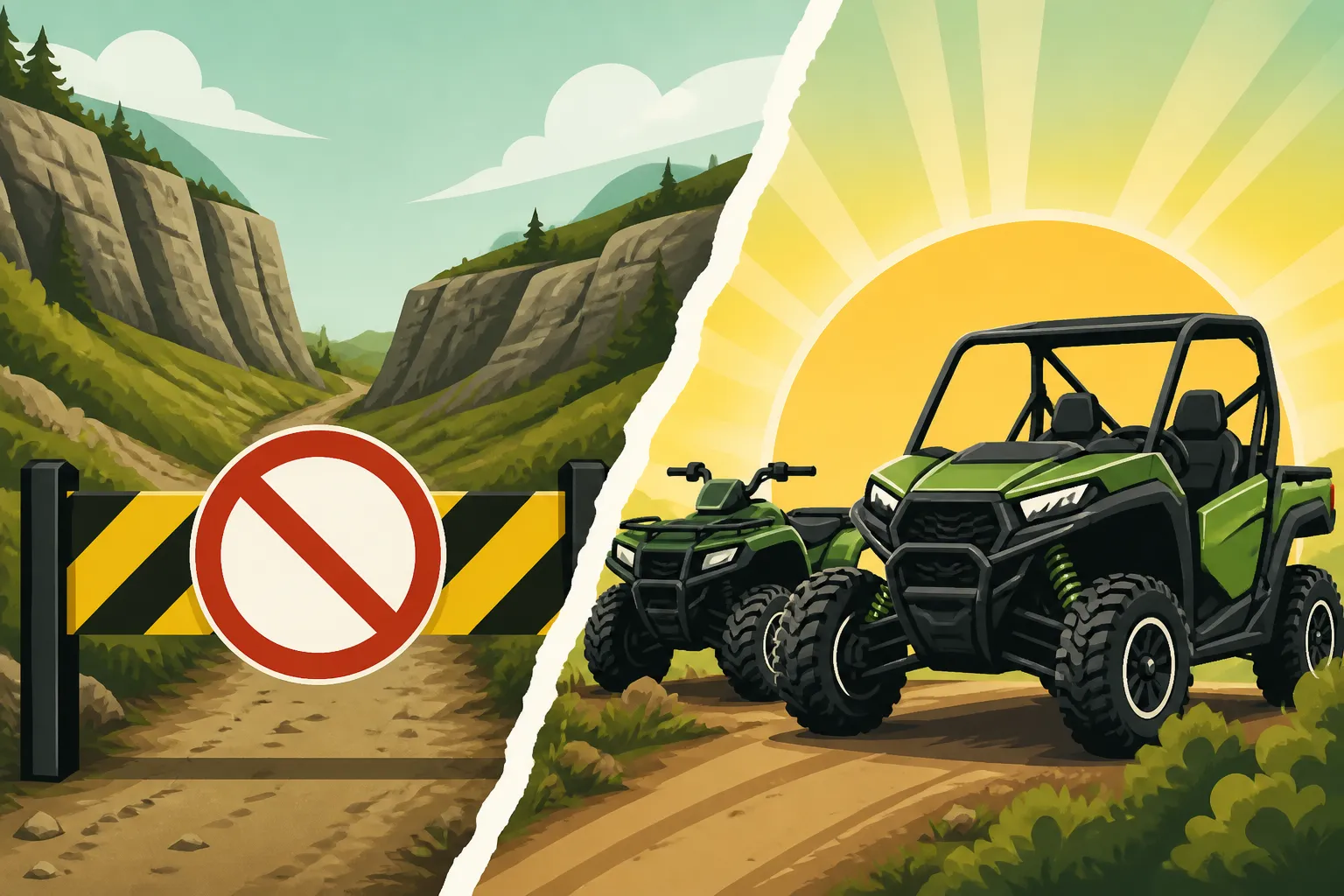
Once access is permitted, stay on the routes that are clearly designated for your machine. Do not bypass a closure by cutting around a barrier, riding through a burned area or creating a new track. An apparent shortcut can cross unstable ground, damage recovering vegetation or lead you into a section that has not been inspected.
Pay attention to signs at the trailhead and along the route. If a trail is marked closed, turn around even if the surface looks rideable. A barrier may be protecting a work site, a damaged crossing or a hazard that is not visible from the trail entrance. If signs are missing or contradictory, choose the safer option and confirm access before proceeding.
This is also where good group habits matter. Keep enough space between machines to avoid crowding a narrow route, and do not stop where other riders cannot see you. If you encounter a fallen tree, washout or unstable-looking section, do not try to force a passage simply because the rest of the group has already arrived.
Be prepared to change plans
Recovery landscapes can be unpredictable. A route that was open during a previous visit may be closed later for repairs, weather impacts or additional assessment. Before travelling, check for updated notices, pack for a longer day than planned and make sure someone knows your route and expected return time.
Keep your machine in a condition suited to the terrain, and bring basic recovery and first-aid supplies appropriate to your group. A phone may not have reliable service throughout a remote riding area, so do not make emergency communication depend on a single device. Give yourself enough fuel and daylight to turn around without rushing.
Most of all, treat a closure as useful information, not an invitation to find another way in. The reason Narrow Hills stayed closed for an extended period was that safe access depended on more than extinguishing the fire. Trees, trails, drainage, infrastructure and the surrounding landscape all needed attention. Waiting for those checks and repairs helps protect both riders and the area they have come to enjoy.
Disclaimer
This article is for general informational purposes only and does not constitute professional advice. Laws, prices and regulations vary by location and change over time. Consult a qualified professional for guidance on your specific situation.