Riders 12 to 16 Need Supervision in a Park
A family ride can become stressful when a young rider reaches a park gate and nobody is sure whether they can ride independently. In Saskatchewan, riders aged 12 to 16 may need supervision, and park rules can add conditions beyond the general rules for operating an ATV. This guide explains what to check before you unload, who may supervise, and how to plan a safer ride.
What supervision means for young ATV riders in Saskatchewan parks
The age rule is only one part of the answer
Saskatchewan’s ATV rules include age-related conditions, and park riding can bring additional requirements into the picture. A young person who is old enough to ride in some circumstances should not assume that means they can ride alone on every trail or in every park. The setting matters, as do the rider’s age, the machine, and the applicable rules.
That distinction is easy to miss when a family is planning a weekend. A 14-year-old might have ridden on private land with a parent nearby, but a provincial park ride is not automatically governed by the same permissions or expectations. Before leaving home, check both the general rules and the specific requirements for the park and trails you intend to use. [Saskatchewan ATV Age Requirements] explains the broader age rules, while [Saskatchewan Park Regulations for Machines] is a useful place to explore park-specific restrictions.
The title age range, 12 to 16, is a practical prompt to verify supervision—not a reason to guess at an exact cutoff or assume every park treats every situation identically. Check the current park information, signs at the trailhead, and any instructions from park staff. If the rider is near an age threshold, clarify the rule before the trip rather than relying on what another family remembers.
Supervision should be active, not just nearby
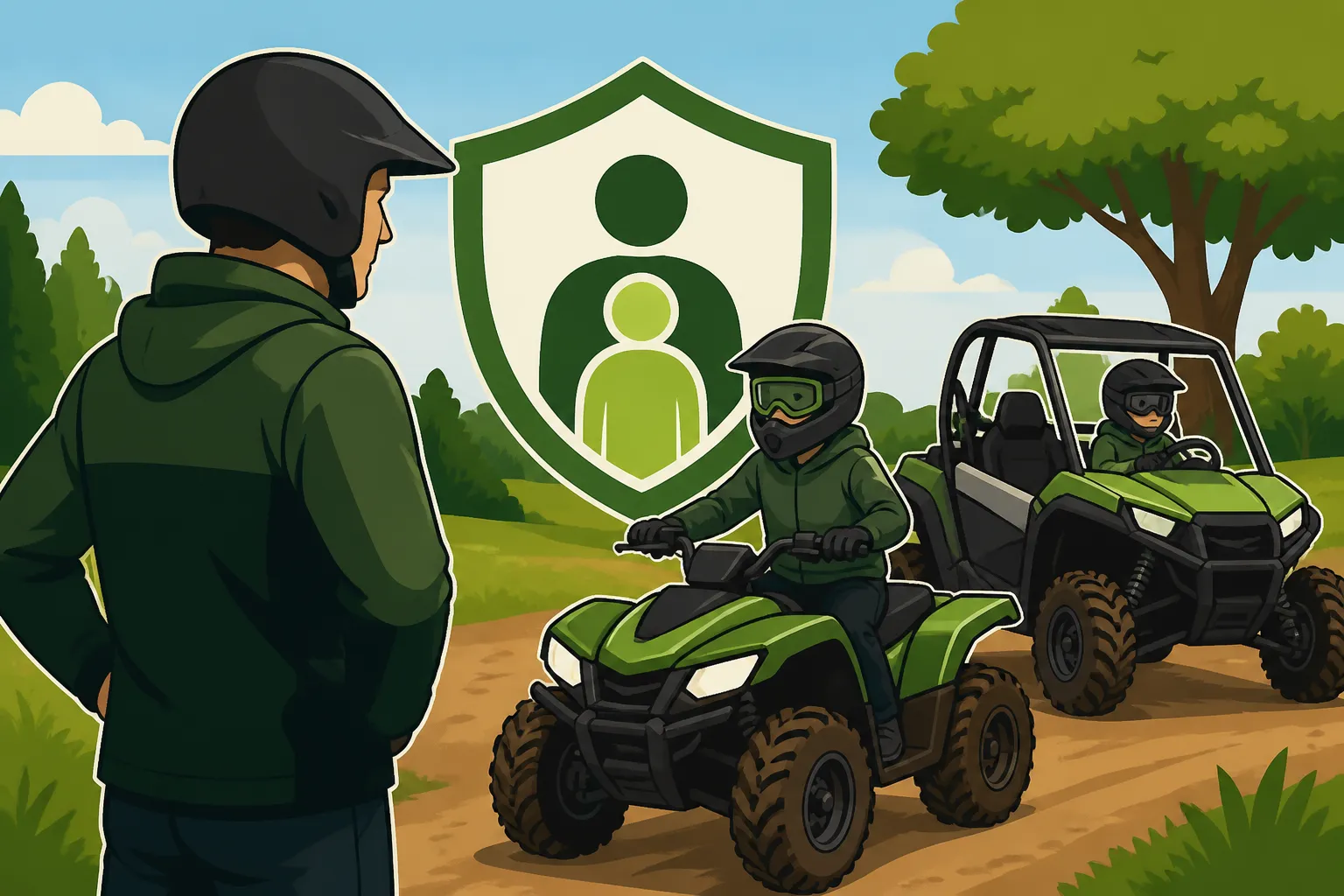
In everyday conversation, “supervision” can sound like an adult simply being somewhere on the property. On a trail, that is not a safe assumption. The supervising person should be able to keep track of the young rider, respond if something goes wrong, and help them make sound choices around other machines, changing terrain, and unexpected hazards.
For example, an adult riding far ahead around a bend may not be in a position to help a young rider who stalls, takes a wrong turn, or gets stuck in soft ground. A more sensible plan is to keep the group together, use a pace the youngest rider can manage, and decide in advance where everyone will stop if the group becomes separated. The adult should also be prepared to change the route or turn back if conditions are beyond the young rider’s ability.
Supervision also means modelling good trail behaviour. A parent or other responsible adult can demonstrate how to slow down near other trail users, give space to wildlife, avoid riding around closures, and stop before a confusing junction. The young rider learns more from those repeated decisions than from a quick reminder at the truck.
Who can supervise and what to confirm before riding
Confirm the supervisor requirement for the ride
Do not assume that any accompanying adult automatically meets the legal definition of a supervisor. Saskatchewan’s rules can set qualifications for a supervisor, and requirements may depend on the rider’s age and whether a recognized training course applies. The safest approach is to check the exact condition that applies to your young rider before setting out. [The Supervisor Needs a Licence Held 365 Days] and [How a Safety Course Replaces a Supervisor] cover two important parts of that broader question.
It also helps to separate three things that families sometimes blend together: the young rider’s eligibility, the supervisor’s qualifications, and the park’s own operating conditions. A rider may satisfy one requirement but still need to meet another. For instance, meeting a general age condition does not necessarily settle whether the park requires a particular form of supervision, a permit, insurance proof, or use only on designated trails.
When you call or contact a park office, be specific. Give the rider’s age, the type of machine, the park and trail area, and whether the young person has completed any relevant training. Ask who may supervise, whether the adult must ride on a separate machine or can accompany the youth another way, and whether any park conditions apply. Getting a clear answer is much easier than sorting it out at the trailhead with helmets on and the trailer blocking the parking area.
Check the park’s rules, permits, and trail status
Saskatchewan parks are not interchangeable. A family planning a ride at Moose Mountain Provincial Park, for example, should check the park’s trail information and instructions for that riding area; a trip to Narrow Hills Provincial Park or Great Blue Heron Provincial Park calls for the same park-by-park check. Confirm which routes are open to machines and whether a permit, acknowledgement form, or other step is required. [Saskatchewan Parks With Designated Trails Only] offers useful context on why a trail being visible on a map does not automatically mean it is open to ATVs.
A map app can help you understand the area and keep your group oriented, but it should not be treated as proof that a route is legally open. Some riders use onX Offroad to review routes and plan navigation. If you use it, compare what you see with official park information and signs on the ground; a route shown on a map is not a substitute for checking closures, permitted machine use, or a young rider’s supervision requirements.
Before you head out, use a short checklist:
- Confirm the age and supervision rules that apply to the young rider.
- Verify that the proposed trails allow the type of ATV or UTV you plan to ride.
- Check whether the park requires permits, forms, or insurance proof.
- Review trail closures and any temporary notices.
- Agree on a group pace, stopping points, and what to do if someone becomes separated.
Planning a ride that works for a young rider
Choose a route for the least experienced person
The most enjoyable family route is not necessarily the longest one. A young rider may be capable and confident, but fatigue, rough ground, traffic on shared trails, or a sudden change in weather can make a modest route feel demanding. Start with a manageable outing, allow extra time for breaks, and avoid planning a ride that only works if everyone moves quickly.
Before the group leaves the staging area, talk through the route in plain language. Point out expected turns, places where the group will pause, and any sections where riders should slow down or wait for the adult. If the route forks, agree that nobody rides ahead through the junction until the group is together. A simple routine—stop at each major crossing and wait for the last rider—can prevent a small gap from becoming a navigation problem.
Use navigation as a backup, not as the whole plan. onX Offroad or another mapping tool may help you follow a route, but download or otherwise prepare for the possibility of weak cell service. Carry a paper map or write down key junctions when the area is unfamiliar. A phone can be useful, but it should not be the only thing keeping the group oriented.
| Before the ride | What to check | Why it matters |
|---|---|---|
| Rider eligibility | Age-related rules and any applicable training conditions | Being old enough to ride does not answer every supervision question |
| Adult supervisor | Qualifications required for the young rider’s situation | An accompanying adult may not automatically meet the rule |
| Park access | Open routes, machine restrictions, and trail closures | A mapped route may not be an authorized ATV trail |
| Park requirements | Permits, forms, and insurance information | Requirements can differ by park and riding area |
| Group plan | Pace, regrouping points, and separation procedure | Young riders need a clear plan they can remember |
Match the machine and gear to the rider
A young rider needs a machine they can control comfortably, not simply one that is available. Before the ride, check that the rider can reach and operate the controls, sit securely, and manage the machine at a slow pace. If they struggle to stop smoothly, turn, or keep a steady line in a safe practice area, a busy trail is not the place to work through those basics.
Protective equipment matters just as much as route choice. Confirm the rider has a properly fitting helmet and any required eye protection, and that clothing and footwear suit the weather and trail conditions. A helmet that shifts, goggles that fog, or gloves that make controls difficult to use can turn a manageable ride into a frustrating one. [Saskatchewan Helmet and Eye Protection Rules] provides more background on those requirements.
Before starting, inspect the machine and make sure the young rider understands the controls they will use, including braking, throttle, and how to shut the machine off. Explain what to do if the ATV stalls or the rider feels unsure: stop in a safe place, remain with the machine, and signal the supervising adult rather than trying to solve the problem alone. That small conversation can help a nervous rider feel supported without encouraging them to push beyond their comfort.
Common mistakes families can avoid
Treating private-land experience as proof of park readiness
A young person who rides confidently on a familiar farm or private property has useful experience, but it does not automatically prepare them for a park trail. Park routes can have unfamiliar intersections, other riders, changing surfaces, posted restrictions, and conditions that are harder to predict. The adult should assess the specific ride—not just the young rider’s general confidence.
Permission and access rules can also differ between land types. A family should not assume that permission to ride on private property gives them permission to use nearby park land or a trail crossing. For general land-access context, see [Saskatchewan Private Land Permission] and [Saskatchewan Crown Land Access Rules]. Always follow posted signs and obtain any permission required before entering land.
Another common mistake is letting the group split up because the older riders want to move faster. If the young rider is expected to remain under supervision, the group plan should make that possible throughout the ride. Keep the adult close enough to respond, choose a route the whole group can ride, and be willing to shorten the outing. A shorter trip that ends safely is better than a long ride that leaves a child overwhelmed.
Assuming a familiar park has no new rules to check
Families who return to the same riding area may be tempted to skip the pre-ride checks. But trails can close, conditions can change, and signage or park instructions may be updated. Even if the supervision rule itself is familiar, confirm that the route is open and that all required steps are complete for this visit.
If the group is travelling to a different park, give yourselves time to ask questions before unloading. Park staff or an official information channel can help clarify whether a route is designated for machines, what paperwork is needed, and what supervision conditions apply. You can also review a navigation app such as onX Offroad for general orientation, while treating official park information as the authority on access and closures.
Finally, explain the plan to the young rider rather than discussing every detail only with the adults. Tell them who they are expected to stay near, where the group will regroup, and what to do if they cannot see the supervisor. A young rider who understands the plan is more likely to pause and ask for help instead of continuing alone.
For a broader look at how the rules fit together, [Saskatchewan Rules of Operation on a Trail] and [Proof Shown to a Peace Officer] can help families prepare for questions about operating requirements and what riders may need to show.
Disclaimer
This article is for general informational purposes only and does not constitute professional advice. Laws, prices and regulations vary by location and change over time. Consult a qualified professional for guidance on your specific situation.