The 1989 Birth-Date Rule Is a Snowmobile Rule
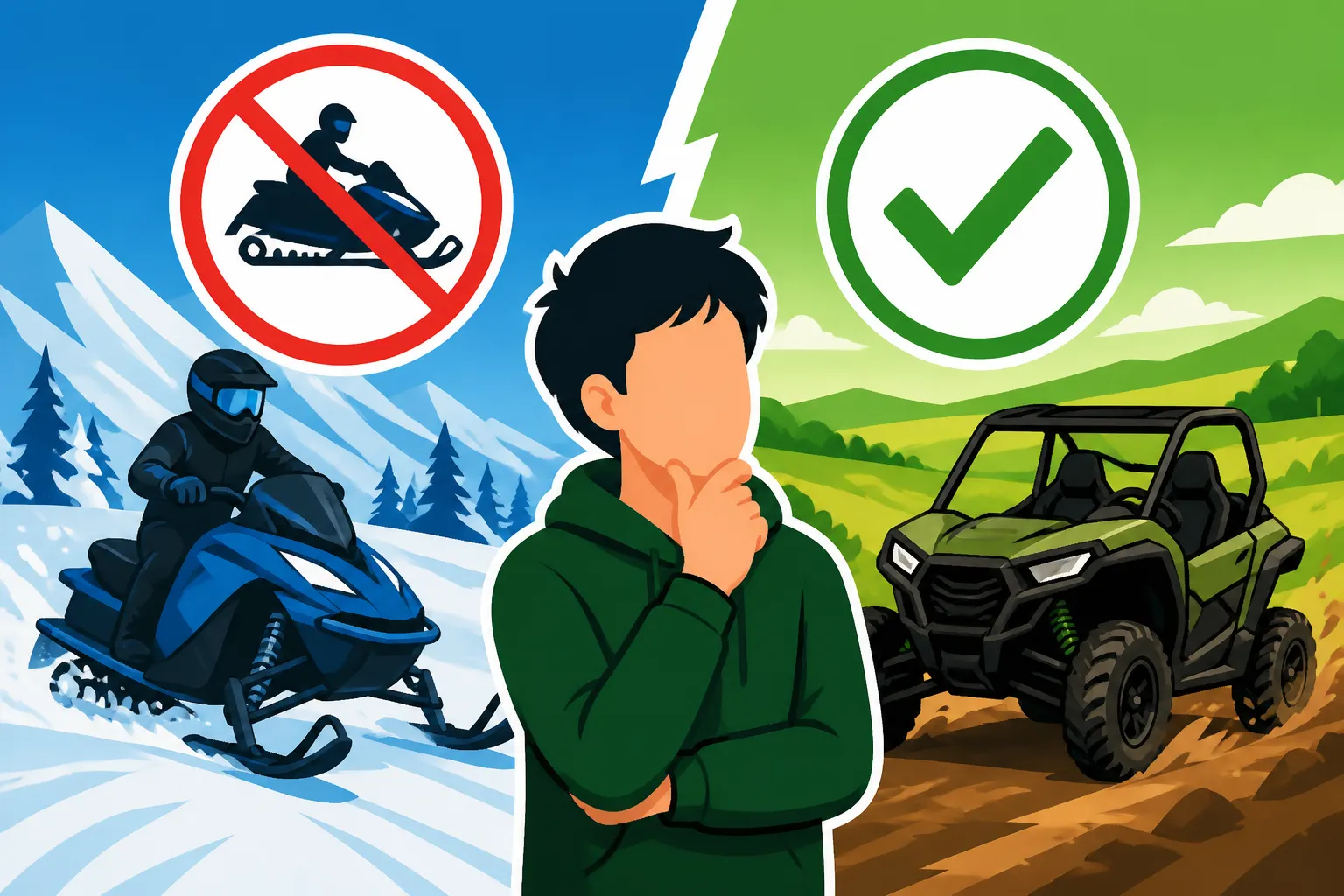
Saskatchewan’s 1989 birth-date rule can cause confusion when you’re planning an ATV or UTV ride, especially if you’re visiting from another province. The key distinction is the machine: the cutoff belongs to Saskatchewan’s snowmobile rules, not its ATV rider rules. Here’s what that means, and what to check instead before riding a quad or side-by-side.
What the 1989 birth-date rule applies to
The birth-date cutoff is associated with Saskatchewan’s snowmobile operator training requirement. It is not a general rule for every off-road vehicle, and it does not automatically apply to an ATV or UTV rider. A person who meets the snowmobile age cutoff may need to meet the applicable snowmobile training requirement to operate a snowmobile.
That distinction matters because similar-looking rules can govern different machines. A snowmobile and an ATV may both be used off road, but Saskatchewan’s laws do not treat them as interchangeable for licensing, training, registration or operating requirements. The snowmobile cutoff does not become an ATV rule just because someone rides both kinds of machines.
If you are planning to use a snowmobile, confirm the current cutoff, training requirement and accepted proof with the appropriate official source before riding. Don’t assume that an ATV course certificate automatically meets a snowmobile requirement, or that a snowmobile certificate changes the rules for operating an ATV.
For context, Saskatchewan Snowmobile Registration Compared covers how snowmobile requirements differ from ATV paperwork. The two machines can have different obligations even when they are owned by the same person or used on the same property.
| Question | Snowmobile | ATV or UTV |
|---|---|---|
| Does the 1989 birth-date cutoff apply? | It is associated with the snowmobile training rule. Confirm the current boundary and proof requirements before riding. | No. The cutoff is not the ATV or UTV age rule. |
| What should a rider check first? | The snowmobile-specific training and operating requirements. | The ATV-specific age, supervision, training, insurance and access rules. |
| Does a certificate for one machine automatically cover the other? | Do not assume so. Check which course and proof are accepted for snowmobile use. | Do not assume so. Check the requirements for the ATV or UTV being operated. |
| Do visitors follow the same distinction? | Check the rules that apply to snowmobiles in Saskatchewan. | Check Saskatchewan’s ATV rules and any local land or trail conditions. |
The table is a starting point, not a substitute for confirming the rule that applies to your exact situation. A rider’s age, machine type, location and reason for riding can all affect the answer.
What ATV and UTV riders need to check instead
Saskatchewan’s ATV rules focus on rider age and the conditions under which a younger person may operate a machine. They do not use the snowmobile birth-date cutoff as a shortcut for deciding whether someone can ride a quad or side-by-side.
Age, supervision and training
For ATV use, start by checking the rider’s age. Saskatchewan generally sets an age floor for operating an ATV, with a limited pathway for some younger riders. That pathway is tied to requirements such as supervision or approved training—not whether the rider was born before or after 1989. The details matter, so don’t treat one condition as a substitute for another.
A 16-year-old and an adult do not need to assess their eligibility using the snowmobile cutoff. A younger rider should not assume that being old enough to sit on a machine means they can operate it independently. Check the specific requirements for age, supervision and any accepted training before handing over the controls.
The relevant overview is Saskatchewan ATV Age Requirements. If a younger rider may rely on a training option, confirm that the course is approved for the purpose and that the rider has the required proof. Which ATV Training Courses the Administrator Has Approved is useful when you need to distinguish an accepted course from general safety instruction.
A parent or supervisor should also be clear about their own responsibilities. Meeting a course requirement or arranging supervision does not remove the need to follow the other operating rules. Depending on the circumstances, the supervising person may have duties of their own.
Driver’s licence and insurance
Age and training are only part of the check. Saskatchewan has ATV-specific requirements that can include a driver’s licence or a permitted exception, as well as insurance. A rider should not infer that the snowmobile birth-date rule grants permission to operate an ATV, or that satisfying an ATV training condition removes an insurance requirement.
Before riding, check the rules that apply to the operator and the machine. Make sure the coverage is valid for the intended use, and know how to show proof if asked. The practical distinction is straightforward: snowmobile training rules answer a snowmobile question; ATV licence, age and insurance rules answer ATV questions. For more on coverage, see Saskatchewan Insurance Requirements for Riders.
The machine and the place you ride
A legal operator still needs lawful access to the riding area. Permission, posted restrictions, park rules, municipal bylaws and land status can all affect where an ATV or UTV may go. A rider who meets the age and training requirements can still be stopped from riding in a particular place.
This is especially important for visitors. A permit or plate issued by a town or municipality may be specific to that area and may not function as province-wide permission. Likewise, the absence of a provincial ATV registration requirement does not mean every road, trail or piece of land is open to riding. Saskatchewan Has No ATV Registration to Buy explains the registration distinction; check the access rules separately for the location you plan to use.
Visitors, mixed-machine households and common mistakes
The cutoff can be confusing when a household has several riders or several types of off-road machines. One person may operate a snowmobile in winter and an ATV in summer, while a visitor may bring a machine from another province. The safest approach is to sort the questions by vehicle and activity instead of trying to apply one rule across the whole fleet.
If you ride both snowmobiles and ATVs
Keep the requirements separate. A snowmobile rider should confirm the snowmobile training rule and any proof that must be carried or produced. An ATV rider should check the ATV rules for age, supervision, training, licence and insurance. A course or document may be relevant to one machine without satisfying the requirements for another.
This also applies to a side-by-side. A UTV may look more like a small vehicle than a quad, but its appearance does not make the snowmobile cutoff relevant. Check how the specific machine is classified and which ATV rules apply to its operation.
If you are visiting Saskatchewan
Do not assume that a birth-date rule or training card from your home province settles the Saskatchewan question. Visitors need to check the rules that apply while operating in Saskatchewan, including local access restrictions and insurance. The applicable requirements can depend on the machine and the riding location, not just where the rider lives or where the machine was purchased.
Visitors from different provinces may have different paperwork or licensing questions. These resources address common cases: Saskatchewan Rules for a Visiting Alberta Rider and Saskatchewan Rules for a Visiting Manitoba Rider. If you are bringing an ATV, also review Saskatchewan Proof of Ownership on the Trail. Proof that you own a machine is a separate issue from whether you may operate it in a particular place.
Mistakes to avoid
The most common mistake is treating “born in 1989 or later” as a universal off-road age or training test. It is not. Another is assuming that a snowmobile certificate automatically qualifies a person to ride an ATV, or that ATV training takes care of a snowmobile obligation.
Other avoidable errors include:
- Checking only the rider’s age and overlooking supervision or training conditions.
- Assuming a municipal permit authorizes riding outside the municipality that issued it.
- Treating lack of provincial ATV registration as permission to ride anywhere.
- Relying on a visiting rider’s home-province paperwork without checking Saskatchewan requirements.
- Leaving insurance proof or ownership documents behind because the machine has no provincial plate.
- Assuming a rule for one machine carries over to a different machine in the same garage.
A short pre-ride check can prevent most of these problems:
- Identify the machine as a snowmobile, ATV or UTV.
- Check the operator requirements for that machine, including age, supervision, licence and training where relevant.
- Confirm the required insurance and how to show proof.
- Verify that the land, trail, road or park permits the planned use.
- Carry relevant documents and follow any local permit or display instructions.
- If the rule is unclear, confirm it with the responsible official office before setting out.
The practical takeaway is simple: the 1989 birth-date rule is a snowmobile rule. For an ATV or UTV, use the ATV-specific age and operating requirements, and check access rules for the place you intend to ride. Keeping those questions separate is more reliable than trying to apply one cutoff to every off-road machine.
Disclaimer
This article is for general informational purposes only and does not constitute professional advice. Laws, prices and regulations vary by location and change over time. Consult a qualified professional for guidance on your specific situation.