Visitors May Ride on a Home Province Licence
A visitor planning to ride an ATV or UTV in Saskatchewan may wonder whether a home-province licence or machine plate will carry over. The short answer: a valid home-province driver’s licence can meet the operator-licence requirement, but it does not override Saskatchewan riding rules or replace local permits and insurance.
What a home-province licence does and does not cover
Saskatchewan does not issue provincial registration or plates for ATVs. That means there is no provincial ATV registration system for a visitor’s home registration to reciprocate with. The practical question is usually whether the rider has a valid driver’s licence and whether the machine and riding location meet Saskatchewan requirements.
A valid driver’s licence from your home province can satisfy the licence requirement for an eligible rider. It does not give permission to ride everywhere, make an ATV street legal, or waive Saskatchewan’s rules for age, supervision, insurance, equipment and road crossings. A licence for a car is not a permit to use a particular trail or municipal road.
It also helps to separate three things that are often called a “licence”:
| Document or authorization | What it relates to | What it does not do |
|---|---|---|
| Home-province driver’s licence | The rider’s authority to operate, subject to Saskatchewan rules | Grant access to private land, a park trail or a restricted road |
| Home-province machine registration or plate | The machine’s status under the rules where it is registered | Create a Saskatchewan provincial ATV registration or blanket Saskatchewan riding permission |
| Local plate, permit or trail authorization | Access under a municipality’s or riding area’s rules | Make the machine legal in every other municipality or riding area |
Saskatchewan’s ATV rules apply while you ride in the province, even if you and your machine are from elsewhere. Start with Saskatchewan’s Licence Rule Before the Exceptions and check Saskatchewan Rules for a Visiting Alberta Rider if you are coming from Alberta; visitors from other jurisdictions should make the same distinction between home documents and Saskatchewan operating rules.
Check who may operate the machine
For an adult visitor, the first practical check is whether the driver’s licence is valid and appropriate for that rider. Do not assume that showing a home-province licence resolves every question. Saskatchewan’s age and supervision rules still apply, and a rider’s age can change what is allowed.
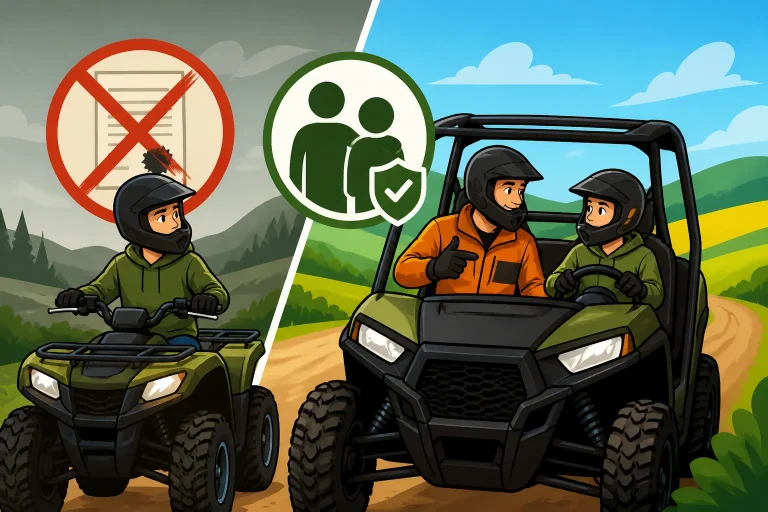
Younger riders may face additional conditions. Saskatchewan has rules for riders under 16, including provisions for eligible riders aged 12 and older to ride with a qualifying supervisor or, where applicable, with approved training. The exact route depends on the rider’s age and circumstances. A parent’s presence alone should not be treated as proof that a supervision requirement is met. Review Saskatchewan ATV Age Requirements and Saskatchewan Rules for a 12-Year-Old Rider before bringing a child on a trip.
A visitor should also check whether the machine is designed for the number of people riding it. A passenger is not automatically allowed just because the machine has a seat or because the home province permits passengers. Saskatchewan has rules limiting passengers to machines designed to carry them. See Saskatchewan Passengers Only on Designed Machines if you plan to ride two-up or bring a passenger in a side-by-side.
The same principle applies to road use. A home-province licence does not make an ATV or UTV legal on a Saskatchewan highway, grid road or town street. Road and ditch use depends on provincial rules and, in some places, local bylaws. Before riding near a roadway, check Saskatchewan ATV Road Rules Explained and look up Saskatchewan Bylaw Lookups Before You Ride.
Understand insurance, machine papers and local permits
A visiting rider should confirm insurance before unloading. Saskatchewan’s insurance requirements apply to visitors too. Carry proof that can be shown if requested, and ask your insurer or broker whether the policy covers the machine while it is being operated in Saskatchewan, including the kind of riding you plan to do. Do not rely on a home-province plate or registration document as proof of insurance. For the visitor-specific details, see Saskatchewan Insurance Rules for Visitors.
Keep useful ownership and machine information with you. A bill of sale, registration document from home, insurance papers and a clear record of the machine’s serial number can help establish who owns it and identify it if there is a problem. These documents do not create a Saskatchewan registration, but they can make roadside questions or an insurance claim easier to address. Saskatchewan Proof of Ownership on the Trail explains what to carry when the province has no ATV registry.
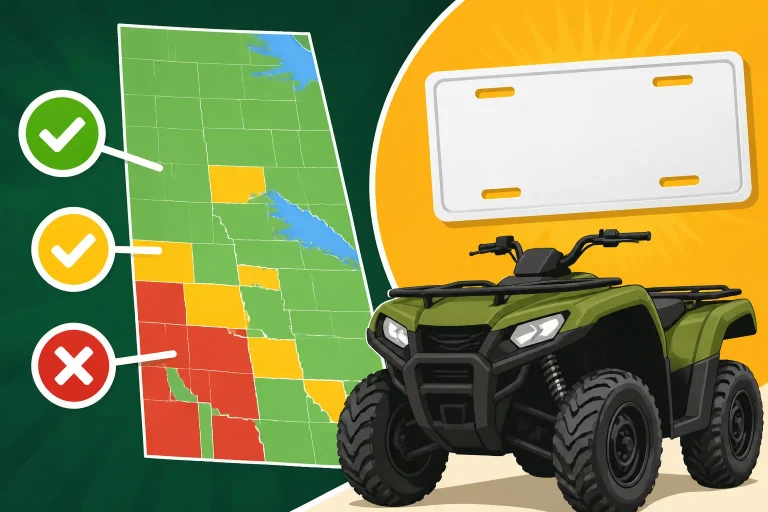
Some municipalities operate local ATV plate or permit schemes. Those are not provincial registrations, and their rules can be limited to that municipality or a defined area. A visitor should ask whether a local plate is required, whether non-residents can obtain one, and which roads or trails it covers. Do not assume that a permit from one community works in the next. See Saskatchewan Municipal ATV Plates Explained and Riding in a Municipality With No Plate Scheme.
Parks and designated riding areas have their own access requirements as well. A park trail permit, where required, is separate from a driver’s licence, insurance and municipal authorization. Some permits may be available without a charge, but riders still need to follow the area’s process and restrictions. Check Saskatchewan Park Trail Permits Are Free for the park context, then confirm current instructions with the park office before travelling.
Crown land access is not a blanket right to ride anywhere. Land status, posted closures, administrator orders, occupied land and any required permission can affect whether a route is open. A valid home-province licence does not replace landowner or leaseholder consent. Review Saskatchewan Crown Land Access Rules and confirm conditions for the specific riding area.
A visitor’s pre-ride checklist
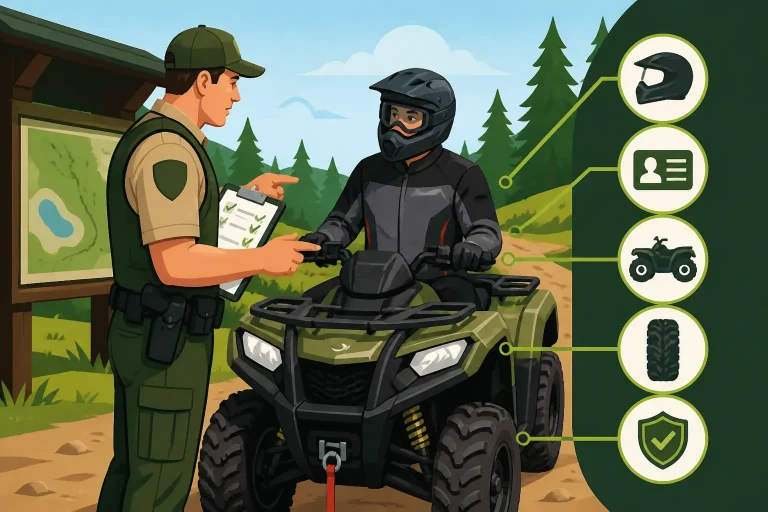
A little checking before the trip can prevent a wasted haul or an avoidable ticket. Use this sequence when planning a ride:
- Confirm the rider’s eligibility. Make sure the home-province driver’s licence is valid, then check Saskatchewan age, supervision and passenger rules for everyone riding.
- Confirm insurance. Ask the insurer whether the policy applies in Saskatchewan and covers the intended use. Carry proof that is easy to access.
- Gather ownership details. Bring the home registration paperwork if the machine has it, proof of purchase or ownership, and a readable record of its serial number.
- Identify the exact riding area. A trail, ditch, road or park may each have different restrictions. Check the municipality or land manager responsible for the place you intend to ride.
- Ask about local plates and permits. Find out whether the area has a local scheme, who may obtain its authorization, and where that authorization is valid.
- Check route and land access. Confirm that the trail is open and that any required permission has been obtained. Do not assume a route is legal because it appears on a map or has been used before.
- Review equipment and operating rules. Check helmet, lighting, crossing and other applicable requirements before leaving the staging area.
If you are travelling through more than one community, repeat the local check for each one. A municipality’s plate scheme is not a province-wide pass, and a park permit does not authorize riding on unrelated municipal roads. Likewise, being properly licensed and insured does not provide permission to cross private land or enter a closed area.
A useful rule of thumb is to treat the home-province licence as evidence about the rider, not as an all-purpose riding authorization. It can meet the operator-licence requirement for an eligible visitor, while Saskatchewan law and the rules of the place being ridden determine where and how the machine may be used. When a local rule is unclear, contact the municipality, park office or land manager before unloading.
Disclaimer
This article is for general informational purposes only and does not constitute professional advice. Laws, prices and regulations vary by location and change over time. Consult a qualified professional for guidance on your specific situation.