Saskatchewan Rules for a Ten-Year-Old Rider
A ten-year-old may be eager to drive the family quad, but Saskatchewan’s age rules are a firm limit in many riding settings. The key distinction is between operating an ATV or UTV and riding as a passenger, and between places covered by provincial rules and land that may be exempt. Here is how to assess what a child can do before a ride.
Can a ten-year-old operate an ATV or UTV in Saskatchewan?
In places and situations covered by Saskatchewan’s All Terrain Vehicles Act, a ten-year-old is too young to operate an ATV or UTV. The Act’s exception for younger operators begins at age 12. An adult escort, a safety course, parental permission, or a suitable youth-sized machine does not lower that age threshold.
This is an important point because the exception for riders aged 12 and older can be misunderstood as permission for any child who has adult supervision. It is not. The rider must meet the minimum age for the exception before the escort or course provision becomes relevant. For more on the general rule, see Saskatchewan ATV Age Requirements and Saskatchewan’s Exception for Riders 12 and Over.
| Situation | What it means for a ten-year-old |
|---|---|
| Operating on a road or other area covered by the Act | The age-12 exception does not apply, so the child cannot operate there |
| Operating with an adult escort | Supervision does not make a ten-year-old eligible under the age exception |
| Completing an approved safety course | A course does not override the minimum age |
| Riding as a passenger | May be possible only if the machine is designed for a passenger and the location’s rules allow it |
| Riding on private land | The Act may not apply in some qualifying situations, but private ownership alone does not settle the question |
The same age issue can arise with both ATVs and UTVs. A side-by-side’s steering wheel, seat belts, doors, or larger size do not automatically make it permissible for a ten-year-old to operate. Check how the machine and the riding location are treated under the applicable rules rather than assuming a UTV is exempt from ATV requirements.
Why adult supervision and training are not enough
Saskatchewan’s younger-rider provisions are not a general “children may ride with an adult” rule. They set a minimum age before the exception can be used. A ten-year-old therefore cannot become eligible simply because a parent is beside them, another adult is leading the group, or the child has taken a course.
For riders who have reached the eligible age, supervision and training may matter in different ways. The Act provides for an escort under specified conditions, and an approved safety course can affect whether a supervisor is required. The course option is not a substitute for meeting the age threshold. See How a Safety Course Replaces a Supervisor for the distinction.
A parent who wants a child to gain experience can still focus on safety without putting the child in the operator’s seat where the law prohibits it. That may mean practicing basic skills in an appropriate setting only if local rules and the landowner permit it, or letting the child ride as a passenger on a machine designed for two people.
Passenger rides are different from operating
A child who cannot legally operate a machine in a particular setting may still be able to ride as a passenger. But passenger status is not automatic permission. The machine must be designed for a passenger, the child must have a proper seat and foot support, and the location’s rules must allow passenger travel.
A one-person ATV is not made into a two-person machine by adding a second seat, carrying a child on the rack, or having the child sit in front of the operator. The passenger should use the designated seat and passenger footrests, and follow the manufacturer’s instructions. On a UTV, use the intended seat and restraint system. Do not carry a child in a cargo box or on an exterior step.
For road and trail riding, check the relevant rules before setting out. Saskatchewan limits passengers to machines designed to carry them, and other requirements may apply to the operator, equipment, and route. The details are covered in Saskatchewan Rules for a Child Passenger and Saskatchewan Passengers Only on Designed Machines.
Practical passenger checks include:
- Confirm that the manufacturer identifies the machine as suitable for a passenger.
- Make sure the child can sit securely and reach the footrests, if the machine has them.
- Use the machine’s intended seat belt or other restraint where fitted.
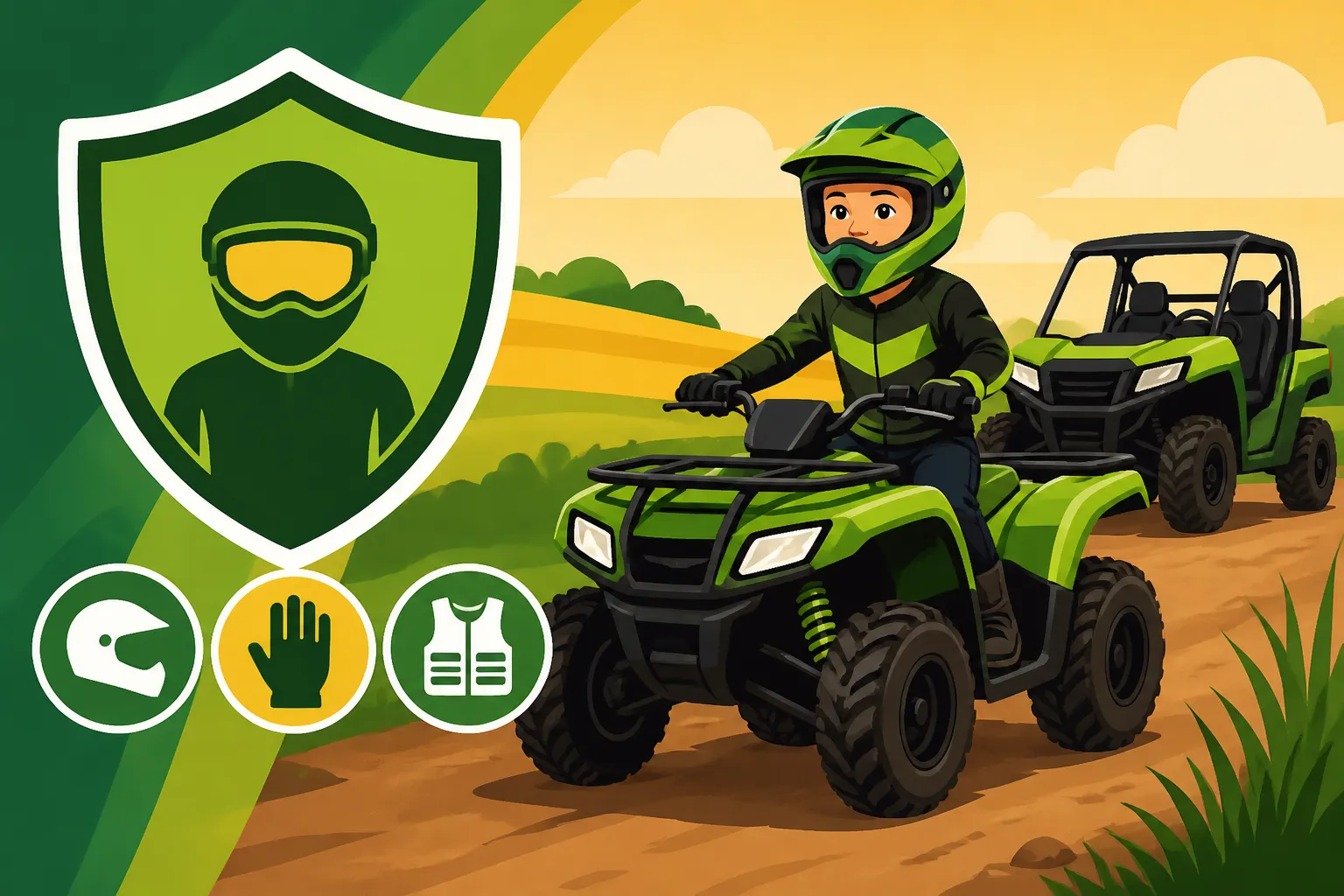
- Fit a helmet that is intended for ATV use, secure its strap, and provide appropriate eye protection.
- Keep the child’s hands and feet away from wheels, hot parts, and moving components.
- Do not assume a short trip, slow speed, or familiar route makes an unsuitable passenger position safe.
A passenger’s age does not authorize the driver to break other rules. The operator must still be legally allowed to drive there, and the machine must be permitted on that route. A child passenger should not be used as a workaround for an age restriction on operating.
Where the rules apply and what private land changes
The legal answer can depend on where the machine is being used. Roads, public land, designated trails, municipal routes, and park areas can be subject to provincial rules, local bylaws, or site-specific conditions. A child’s age restriction should be treated as applying wherever the Act governs operation; a parent’s consent does not waive it.
Private land requires more care. Some situations involving machines used on qualifying private property may fall outside the Act, but “it is private land” is not, by itself, a reliable legal test. The owner’s permission, the nature of the land, whether the machine is being used only there, and whether the route connects to a road or public area can all matter. A private driveway, farmyard, or cabin lot should not be assumed to create a broad exemption.
If you are considering private-property riding, check the specific circumstances against Saskatchewan Private Land Exemptions. Get permission from the landowner when needed, keep the machine off roads and public trails unless the operator is eligible, and do not treat a private-land exemption as permission to continue onto a public route.
Municipalities and parks may also have rules that are more specific than the general provincial rule. A route that looks like a trail may be on public land, within a park, or controlled by a municipality. Before taking a child and machine to a new location, confirm whether ATVs and UTVs are allowed there, what conditions apply, and whether children may operate or ride as passengers. See Saskatchewan Rules for Riding a Town Street and Saskatchewan Provincial Park Machine Rules.
A quick location check helps avoid the common mistake of making a decision based only on the machine or the child’s skill:
- Identify the exact land and route, including any road, ditch, trail, park, or municipal section.
- Find out which provincial, municipal, park, or landowner rules apply there.
- Confirm whether the child would be operating or riding as a passenger.
- If relying on a private-land exemption, verify that the specific use qualifies before riding.
- Keep the child off any route where the age requirement does not permit them to operate.
Safer options for a ten-year-old
When a ten-year-old is not eligible to operate in the intended riding area, the clearest option is not to let them drive there. Choose a legal, age-appropriate activity instead: ride as a passenger on a properly designed machine where allowed, or wait until the child meets the age requirement before considering operation in regulated areas.
Do not choose a machine based on engine size alone. A small ATV can still be powerful, and a child’s reach, strength, judgment, and ability to control the vehicle matter. Follow the manufacturer’s age and size guidance, but remember that manufacturer recommendations cannot make an otherwise prohibited ride legal.
For a passenger outing, plan around the child rather than squeezing them into an adult ride. Keep the route conservative, avoid rough ground that could throw the passenger off balance, and stop if the child is uncomfortable or cannot maintain a secure position. A passenger should know how to communicate with the operator and should not be expected to help steer or control the machine.
Before taking a ten-year-old out, make a short checklist:
- Is the child operating or riding as a passenger?
- Is the machine designed for the child’s role?
- Is the specific location covered by the Act, a bylaw, park rule, or landowner condition?
- If the ride is on private land, has the relevant exemption been confirmed rather than assumed?
- Are the child’s helmet, eye protection, clothing, and restraints appropriate?
- Is the adult operator legally permitted to ride there and prepared to keep the trip within the rules?
If a dealer, club, park office, municipality, or landowner gives advice, ask about the exact location and activity. “Can a child ride here?” may mean passenger travel to one person and operating to another. State the child’s age, whether they will drive, the machine type, and the planned route so the answer addresses the real situation.
Saskatchewan’s age-12 exception is the practical dividing line for younger operators under the provincial rules. A ten-year-old’s confidence, training, or adult escort does not move that line. Treat operation and passenger travel as separate questions, verify the location’s rules, and use private-land exemptions only when the specific circumstances qualify.
Disclaimer
This article is for general informational purposes only and does not constitute professional advice. Laws, prices and regulations vary by location and change over time. Consult a qualified professional for guidance on your specific situation.