What an Officer Can Ask to See on a Grid Road
Riding your ATV or UTV on Saskatchewan's vast network of grid roads offers incredible access to our beautiful province, but it also means you're operating on public roadways where rules apply. Many riders feel a knot in their stomach wondering what an officer might ask for during a stop, especially with no provincial registration for quads. This guide will clear up that confusion, detailing exactly what documents, equipment, and knowledge you need to carry to ensure you're always prepared and riding legally.
The Unique Landscape of Saskatchewan's Grid Roads
Saskatchewan's grid roads are the backbone of rural transportation, often running straight for miles, sectioning off agricultural land, and connecting communities. Unlike trails or private land, these are public roads, even if they're gravel or dirt. This distinction is crucial because operating an ATV or UTV on a public thoroughfare, including these grid roads, means you are subject to the province's All Terrain Vehicles Act and other traffic laws. It's not like riding in your back forty; you're sharing the road, directly or indirectly, with other vehicles, and peace officers have the authority to enforce regulations.
Understanding where you can and cannot ride on a grid road is essential. Generally, the Act allows for riding in the ditch adjacent to the travelled portion, subject to certain conditions like maintaining a distance of at least two metres from the travelled portion of the highway. However, municipalities often have bylaws that can either permit or prohibit ATV use on their local roads and ditches, so what's legal in one rural municipality might not be in the next. Always check local bylaws for the area you're planning to ride in.
What Exactly is a Grid Road?
When we talk about "grid roads" in Saskatchewan, we're generally referring to the vast network of gravel or dirt roads that form the province's unique grid system. These roads are typically maintained by rural municipalities and serve primarily to connect farms, ranches, and small towns. They are public highways, even if they aren't paved, and are often signed with names or numbers. Unlike private trails, they are open to general traffic, including cars, trucks, and farm equipment. Because they are public, they fall under the purview of provincial legislation, specifically The All Terrain Vehicles Act, when it comes to regulating ATV and UTV use.
The temptation to use these roads for quick travel between fields, access to hunting grounds, or just a leisurely cruise can be strong. However, it's vital to remember that these aren't playgrounds. You're expected to follow rules of the road that apply to all vehicles, even if the enforcement is slightly different for ATVs. The sheer volume of these roads means they are a common place for riders to encounter law enforcement, making compliance awareness paramount.
Why Grid Roads are Different from Trails or Private Land
Riding your quad on your own farm property or on a designated, signed trail within a provincial park is a very different scenario from operating on a public grid road. On private land, the primary rules are those set by the landowner, usually concerning trespass and liability. On designated trails, there are specific regulations governing use, often administered by a park authority or trail club. But a grid road, as a public highway, brings a more comprehensive set of legal obligations.
For starters, a peace officer can stop any vehicle, including an ATV, operating on a public road to ensure compliance with the law. This means being ready to produce documents and demonstrate adherence to safety standards. Furthermore, rules like speed limits, ditch riding restrictions, and specific times for night operation become strictly enforceable. While you might feel more isolated on a quiet gravel road, the legal framework is much broader and more stringent than when you're simply riding across a field or enjoying a dedicated recreation area.
Essential Documents a Peace Officer May Request
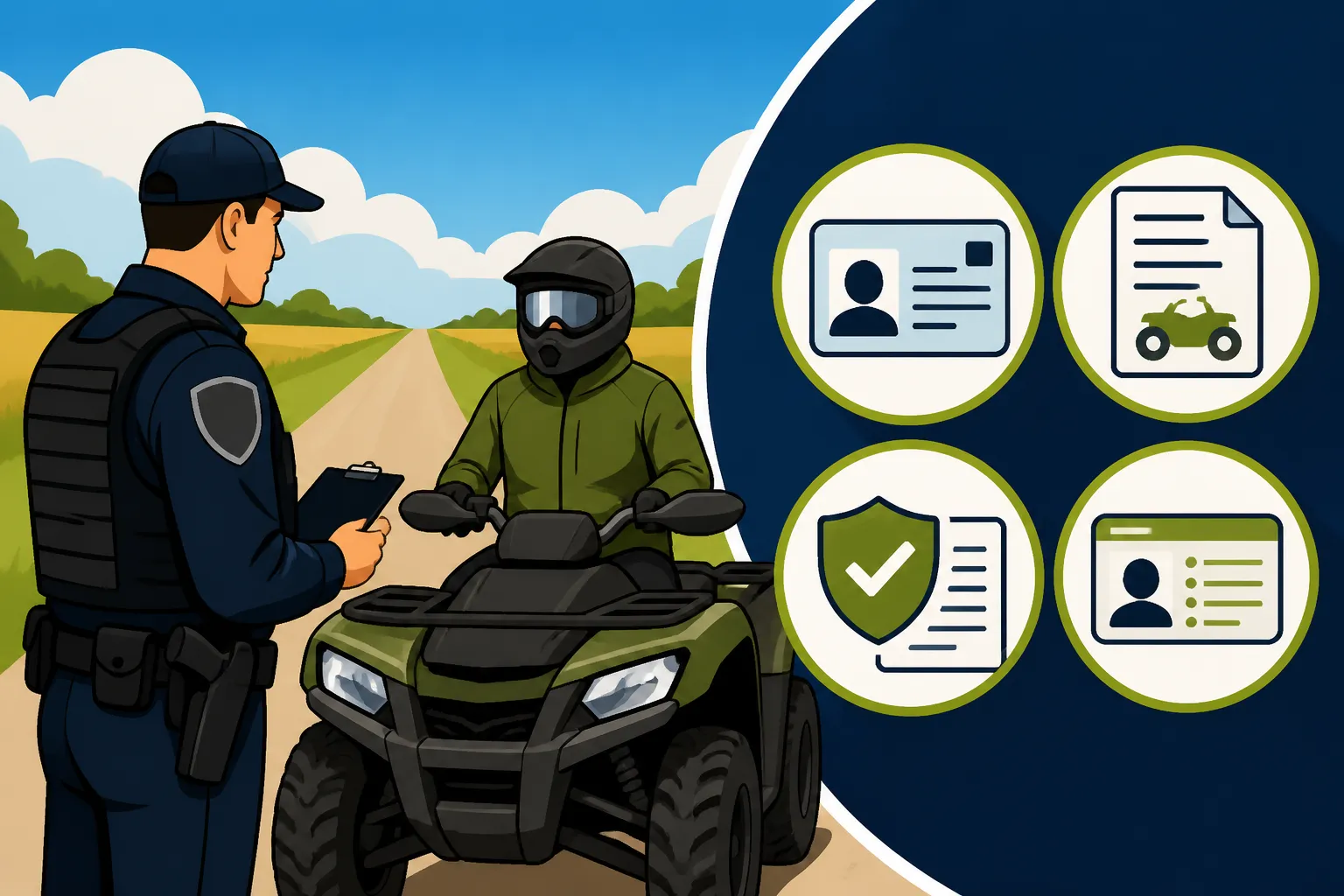
If a peace officer pulls you over on a grid road, they're typically looking for a few key pieces of information and documentation. Since Saskatchewan has a unique approach to ATV regulation, particularly when it comes to registration, it's easy for riders to feel uncertain. However, by understanding and preparing for these requests, you can ensure a smooth interaction and avoid potential headaches.
Because [Saskatchewan Has No ATV Plate or Decal] that's provincially issued, and [Saskatchewan Does Not Register ATVs] in the same way cars are registered, proof of ownership becomes a critical document, alongside your personal identification and insurance. It’s also crucial to remember that what an officer asks to see is directly tied to the laws governing ATV operation on public land.
Your Driver's Licence
First and foremost, a peace officer will almost certainly ask for your driver's licence. This is non-negotiable for anyone operating an ATV or UTV on a public road, which includes grid roads. [Saskatchewan Requires a Driver's Licence] for operators of these machines on public property. This isn't just a suggestion; it's a legal requirement. The licence must be valid and appropriate for the class of vehicle.
If you are a younger rider, or supervising one, the rules become even more specific. Riders under 16 have certain restrictions, including requiring supervision by an adult who has held a valid driver's licence for at least 365 days. The officer will want to see both the young rider's and the supervisor's licences to confirm compliance. Having your physical licence readily available, not just a photo on your phone, is essential for quick verification. Forgetting or not having a valid licence can lead to significant fines and even potential impoundment of the machine, as it demonstrates a fundamental non-compliance with safe and legal operation.
Proof of Ownership
This is where things can get a little tricky for ATV and UTV owners in Saskatchewan, precisely because there isn't a provincial registry for these machines. You won't have a registration certificate or a "title" to show. Instead, your best and often only proof of ownership will be your original bill of sale. [Saskatchewan Bills of Sale Do the Work] of establishing ownership, acting as the primary documentation for your machine.
When a peace officer asks for proof of ownership, they are trying to confirm that the machine you are operating actually belongs to you, or that you have permission to use it. This helps combat theft and ensures accountability. A comprehensive bill of sale should include:
- The full names and addresses of both the buyer and seller.
- The date of sale.
- The purchase price.
- A clear description of the ATV/UTV, including make, model, year, and crucially, the Vehicle Identification Number (VIN) or serial number.
- Signatures of both parties.
It's a good idea to keep a copy of this important document with you when you ride. While digital copies on your phone might be accepted in some situations, a physical, laminated copy or a clear photocopy can prevent any ambiguity. For those who need to create or verify a solid bill of sale, services like LawDepot can provide reliable templates that cover all the necessary legal elements. This can be particularly useful when buying a used machine from a private seller, as [How to Prove You Own an ATV in Saskatchewan] often boils down to a well-documented transaction.
Proof of Insurance
Another critical document an officer will ask for is proof of insurance. Just because ATVs aren't provincially registered doesn't mean they're exempt from insurance requirements on public land. [Saskatchewan ATV Insurance Requirements] mandate that every ATV operating on a public highway (which includes grid roads) must have at least a minimum amount of liability insurance. This protects you and others in the event of an accident.
Your insurance company will provide you with an insurance card or a certificate of insurance. This document will typically list your name, the machine's details (make, model, VIN), the policy number, and the coverage dates. Like your driver's licence, having this physical card or a clear, accessible copy is paramount. [Saskatchewan Insurance Proof on the Trail] is a real requirement, and not being able to produce it can result in a fine. Ensure your policy is active and covers the machine you're operating. If you own multiple ATVs or UTVs, make sure the proof you're carrying corresponds to the specific machine you're riding that day.
Serial Number (VIN) Verification
While not a document you carry, the Vehicle Identification Number (VIN) or serial number on your ATV or UTV is something an officer will likely check. This number uniquely identifies your machine and helps them confirm that the machine matches your proof of ownership and isn't reported as stolen. Officers are trained to locate these numbers, which are typically stamped into the frame of the vehicle.
It's a good practice to know where your VIN is located on your machine and ensure it's clean and legible. If your machine is very old or heavily used, the VIN might be obscured by mud, rust, or damage. Taking a moment to ensure it's visible before you head out can save time and potential frustration during a stop. This verification process is a routine part of [Saskatchewan Equipment Checks by Officers] and helps maintain the integrity of vehicle ownership records, even without a central registry.
Mandatory Safety Equipment and Operational Rules
Beyond documents, an officer will also be looking to ensure your ATV or UTV is equipped with the necessary safety gear and that you are operating it according to the rules. These regulations are in place for the safety of the operator, passengers, and other road users. Being fully compliant means more than just having the right papers; it means adhering to the operational standards set out in the Act.
Helmets and Eye Protection
One of the most visible and consistently enforced safety requirements for ATV and UTV riders in Saskatchewan is the use of proper head and eye protection. Both the operator and any passengers are legally required to wear an approved helmet and appropriate eye protection. [Saskatchewan Helmet and Eye Protection Rules] are quite clear on this.
An approved helmet typically means one that meets recognized safety standards, often indicated by a sticker from organizations like DOT, Snell, or ECE. It must be securely fastened. For eye protection, shatterproof goggles or a face shield on the helmet are generally acceptable. Regular eyeglasses or sunglasses don't usually qualify as sufficient eye protection on their own. This isn't a suggestion; it's a rule designed to prevent serious injury in the event of an accident. An officer will not hesitate to issue a fine if they observe you or your passenger riding without the correct safety gear.
Machine-Specific Safety Equipment
Your ATV or UTV itself also needs to meet certain basic equipment standards, especially when operating on public roads or trails. While the list isn't as extensive as for a highway vehicle, there are a few key items:
- Headlights and Taillights: If you plan to ride at night or during periods of reduced visibility (like fog or heavy rain), your machine must have functioning headlights and taillights. [Saskatchewan Lighting Requirements on a Machine] dictate that these lights must be on during the half-hour before sunset and the half-hour after sunrise, or whenever visibility is poor.
- Brakes: Your ATV or UTV must have functioning brakes capable of bringing the machine to a safe and controlled stop.
- Muffler and Spark Arrestor: Your machine should have a muffler that keeps noise levels within acceptable limits, and it should be equipped with a spark arrestor to prevent the ignition of dry grasses or other combustible materials, especially crucial during fire season.
These requirements are about safe operation and environmental responsibility. An officer might conduct a quick check of these items, especially if they have reason to suspect a deficiency.
Adhering to Operational Rules and Age Restrictions
When riding on grid roads, you're not just dealing with equipment and documents; you're also expected to follow specific operational rules. This includes rules around speed, where you can ride, and who can operate the machine.
- Speed Limits: While it might seem like the wide-open spaces of a grid road invite higher speeds, there are limits. [Saskatchewan's 80 km/h Speed Limit] applies to ATVs on municipal roads, and local bylaws might impose even lower limits. Officers will enforce these, especially near intersections or inhabited areas.
- Ditch Riding: As mentioned, riding in the ditch is generally allowed, but you must stay at least [2 Metres From the Travelled Portion] of the highway. Riding directly on the main part of the road is generally prohibited, except for specific circumstances like crossing.
- Age Requirements: Saskatchewan has strict age requirements for ATV operators. Generally, riders must be 16 years of age or older to operate an ATV unsupervised on public land. There are exceptions for riders between 12 and 16, but they must be under the direct supervision of an adult who meets specific criteria, including holding a valid driver's licence for at least one year. [Saskatchewan ATV Age Requirements] are rigorously enforced for safety reasons.
- Passengers: An ATV or UTV can only carry a passenger if it is specifically designed by the manufacturer to do so. A single-rider machine cannot legally carry a passenger on public roads.
An officer observing any of these operational infractions can issue a ticket, even if all your documents are in order. The goal is to ensure safe and responsible recreation for everyone.
What Happens If You're Unprepared or Non-Compliant
Facing a peace officer on a grid road without the necessary documents or equipment can quickly turn a pleasant ride into a stressful and costly ordeal. The consequences of non-compliance are not trivial and can range from fines to the impoundment of your machine. It’s a strong reminder of why preparation is key.
Potential Fines and Penalties
The most immediate consequence of failing to meet the requirements is a fine. For example, operating an ATV without a valid driver's licence, without proper insurance, or without a helmet can each carry a specific fine. These aren't just minor slaps on the wrist; they can be substantial, and accumulating multiple infractions in one stop can quickly add up. For instance, if you're riding without a licence, no insurance, and no helmet, you could face three separate tickets, each with its own financial penalty.
Beyond monetary fines, more serious or repeated infractions could lead to other penalties, such as points against your driver's licence or even a temporary suspension of your driving privileges. While the province doesn't register ATVs, your personal driver's licence is still very much on the line when you operate one on public roads.
Machine Seizure and Impoundment
In more severe cases of non-compliance, a peace officer has the authority to seize and impound your ATV or UTV. This can happen for serious offences like operating while disqualified, impaired driving, or if the machine is suspected of being stolen and you cannot provide adequate proof of ownership. If you're riding an ATV without a licence and have no way to legally remove it from the grid road, the officer might also deem it necessary to impound it for safety.
Getting a seized machine back can be a complicated, time-consuming, and expensive process. You would typically need to prove ownership, pay any outstanding fines, and cover towing and storage fees. This is where a proper bill of sale, perhaps drafted using a service like LawDepot, becomes even more critical. Without clear documentation, proving the machine is yours can be a significant hurdle. [Saskatchewan Seizure and Impoundment Rules] are in place for serious reasons, and it's best to avoid them entirely by being compliant from the outset.
Proactive Steps for Compliant Riding
Given the potential headaches and costs associated with non-compliance, taking a proactive approach to ATV and UTV riding on Saskatchewan's grid roads is always the best strategy.
- Carry Your Papers: Always ensure you have your valid driver's licence, proof of insurance, and a copy of your bill of sale physically with you, perhaps in a waterproof bag on your machine or in your riding jacket. [Carrying Papers on a Grid Road] isn't just a suggestion; it's a smart practice.
- Inspect Your Machine: Before each ride, do a quick check of your machine. Are your lights working? Are the brakes functional? Is your spark arrestor intact? Is your helmet in good condition?
- Know the Rules: Familiarize yourself with The All Terrain Vehicles Act and any local municipal bylaws for the area you plan to ride in. Understanding [Saskatchewan Crown Land Prohibition Regulations], ditch riding rules, and speed limits can prevent accidental infractions.
- Proper Documentation for Purchases: When buying a used ATV, insist on a thorough bill of sale. Using templates from resources like LawDepot can help ensure all necessary information is included, protecting you as the buyer and providing solid proof of ownership if ever required by law enforcement.
- Keep Your Insurance Current: Ensure your liability insurance policy for your ATV or UTV is always up to date and that you carry the most recent proof of coverage.
By being diligent and prepared, you can enjoy the freedom of Saskatchewan's grid roads without the worry of unexpected encounters with law enforcement.
| Document/Item | Purpose | Why an Officer Asks | Where to Get It / Find It |
|---|---|---|---|
| Driver's Licence | Personal ID, legal authorization to operate | Confirms operator is qualified and licensed | Issued by SGI |
| Proof of Ownership | Verifies legal owner, deters theft | Confirms machine is legally yours or borrowed | Bill of sale (e.g., LawDepot template) |
| Proof of Insurance | Confirms required liability coverage | Ensures financial protection in case of an accident | Issued by your insurance provider |
| VIN / Serial No. | Unique machine identifier | Matches machine to ownership papers, checks theft | Stamped on machine frame, usually visible |
| Helmet | Head protection | Mandatory safety equipment for all riders | Purchased from ATV retailers |
| Eye Protection | Eye protection | Mandatory safety equipment for all riders | Goggles or helmet face shield |
Disclaimer
This article is for general informational purposes only and does not constitute professional advice. Laws, prices and regulations vary by location and change over time. Consult a qualified professional for guidance on your specific situation.