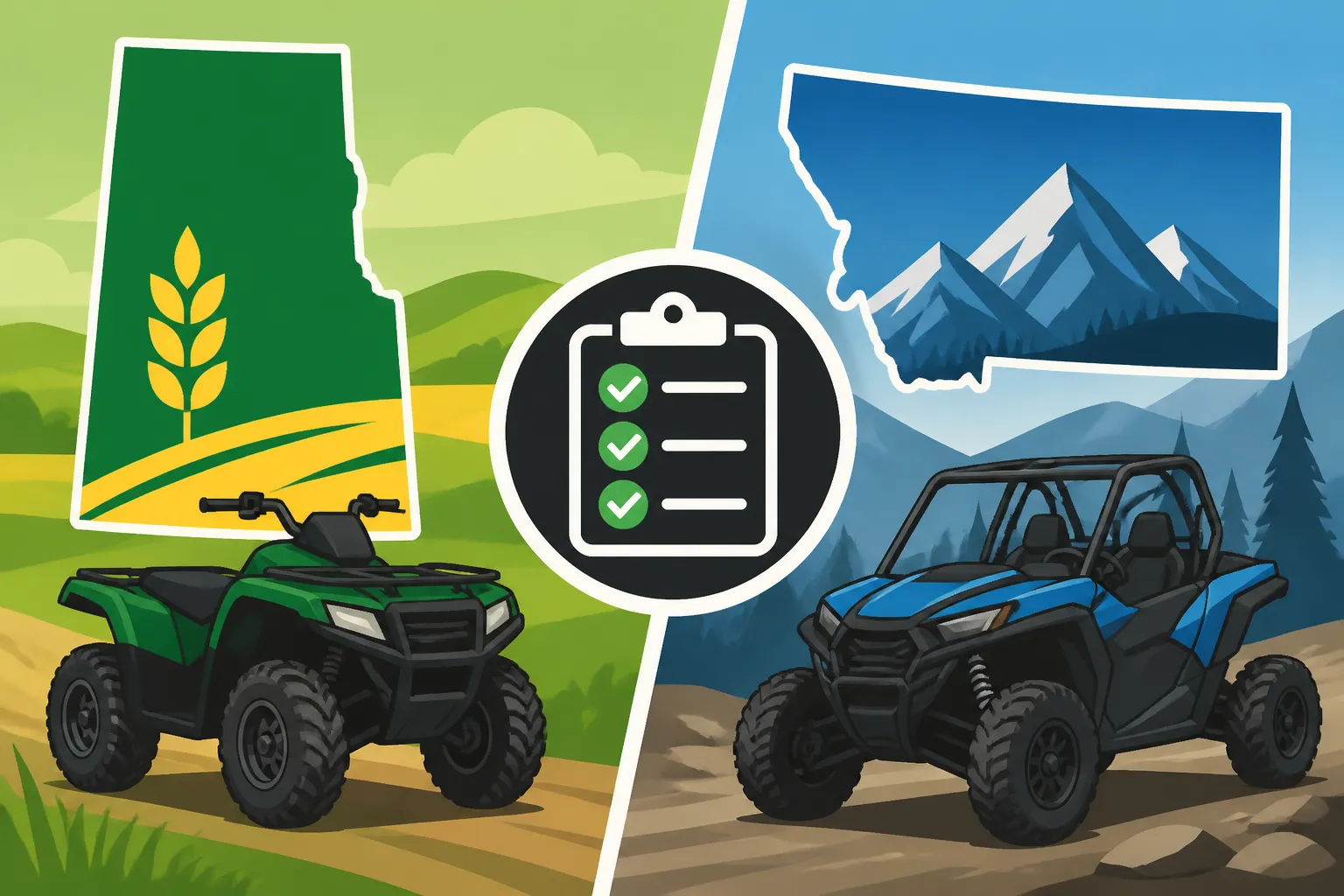
Saskatchewan Registration Compared to Montana
If you're an ATV or UTV enthusiast looking to ride in Saskatchewan, especially if you're accustomed to a more structured system like the one in Montana, you're likely to find yourself scratching your head. The distinct differences in how these two jurisdictions approach off-road vehicle registration can lead to significant confusion, and this guide aims to unravel those complexities so you know exactly what to expect on the Prairies.
The Saskatchewan Approach to ATV Registration: A Distinct Absence
One of the most striking differences a rider from Montana will immediately notice when looking into Saskatchewan's ATV rules is the complete lack of a provincial registration system for All-Terrain Vehicles. This isn't an oversight or a temporary situation; it's a fundamental aspect of how the province has chosen to manage these machines. Many riders coming from places with centralized registries find this hard to believe, often asking, "So, where do I get my plate?" The simple answer is: there isn't one from the province.
Why Saskatchewan Doesn't Register ATVs Provincially
Historically, Saskatchewan has taken a unique path with ATV regulation. Unlike snowmobiles, which have a robust provincial registration system complete with annual fees and liability insurance, ATVs have never been brought under a similar umbrella. This means there's no central provincial database of ATV owners, no official provincial license plate or decal to affix to your machine, and no provincial "title" document issued by a government body that proves ownership. It's a system that can feel bewildering if you're used to the formality of other jurisdictions. The absence of a provincial registry means that when a peace officer pulls you over, they aren't going to ask for a registration document from the province because it simply doesn't exist for your quad or side-by-side. This also impacts things like theft recovery, as there's no centralized provincial record to cross-reference. For many years, riders have grappled with this unique setup. You can dive deeper into this topic by reading [Saskatchewan Does Not Register ATVs] and [Why Saskatchewan Never Built a Quad Registry].
What Serves as "Proof of Ownership" in Saskatchewan
Given the absence of a provincial registration, the bill of sale becomes the absolute cornerstone of ATV ownership in Saskatchewan. Think of it as your machine's birth certificate, family tree, and passport all rolled into one. When you buy an ATV, whether it's brand new from a dealer or a used machine from a private seller at a farm gate, a comprehensive bill of sale is not just recommended—it's essential. This document needs to clearly detail the buyer and seller's information, the date of sale, the purchase price, and, critically, the Vehicle Identification Number (VIN) of the machine. Without a properly executed bill of sale, proving you own your ATV can become incredibly difficult, especially in disputes, insurance claims, or if you ever need to sell it yourself. Many riders use templates to ensure all the necessary information is included. Resources like LawDepot can provide customizable bill of sale forms, making it easier to ensure you're covered whether you're buying or selling. It's your primary legal record, and officers will expect you to be able to produce it as [How to Prove You Own an ATV in Saskatchewan]. For more information, check out [Saskatchewan Bills of Sale Do the Work].
Municipal Exceptions: Local Plates and Permits
While the province itself doesn't issue ATV registrations, some local governments in Saskatchewan have stepped up to fill the void, particularly in areas popular for recreational riding. Certain rural municipalities (RMs) and villages, often those with lake communities or active trail networks, have implemented their own local bylaws requiring a municipal plate or permit to ride within their specific boundaries. These aren't provincial registrations, and they don't give you free rein across the entire province, but they are crucial if you plan to ride in one of these designated areas. For example, popular spots like Candle Lake or the District of Lakeland have their own permit schemes. These local plates typically come with a fee and a set of local rules governing where and when you can ride within that specific jurisdiction. It's vital to research the specific bylaws of any RM or village you plan to visit, as what's permitted in one area might be prohibited in another. Failing to have the required municipal permit in one of these areas can result in fines. This patchwork system can certainly add to the confusion for new riders, which is why it's worth understanding [Saskatchewan Municipal Plate Schemes] and [Which Municipalities Run Their Own Plate Scheme].
Montana's Structured Registration System for ATVs
Crossing the border south into Montana, you'll encounter a completely different regulatory landscape for ATVs and UTVs. Montana operates a much more conventional and centralized system, which is what many riders from other Canadian provinces or U.S. states might typically expect.
Montana's Department of Justice and OHV Registration
In Montana, Off-Highway Vehicles (OHVs), which include ATVs and UTVs, are registered through the Department of Justice, much like cars and trucks. This means there's a formal process to follow, involving specific documentation and adherence to state regulations. When you purchase an OHV in Montana, you are generally required to register it and obtain a permanent OHV decal. This decal is then prominently displayed on the machine. This centralized registration serves multiple purposes. It creates a state-level record of ownership, which is invaluable for law enforcement, and the fees collected from registration often go directly towards funding OHV programs, including trail maintenance, development, and safety initiatives across the state. It's a clear, straightforward system designed to manage and support responsible OHV use.
How Montana's System Provides Proof of Ownership and Identity
Unlike Saskatchewan's reliance on a bill of sale, Montana's registration system issues an official title certificate. This title is a government-issued document that legally establishes who owns the ATV or UTV. When you buy or sell a machine in Montana, the title is transferred, ensuring a clear chain of ownership. This system provides a robust mechanism for proving who the legal owner is, which is incredibly useful in cases of theft, disputes, or even during routine stops by law enforcement. An officer in Montana can quickly run the registration number or VIN to confirm ownership, check for liens, or determine if the machine has been reported stolen. This stands in stark contrast to Saskatchewan, where such a centralized check isn't possible at the provincial level, making a comprehensive bill of sale, perhaps drafted using a template from a service like LawDepot, all the more critical for establishing your legal rights to the machine.
Annual Renewals and Fees in Montana
Montana's OHV registration typically involves an annual or biennial renewal process. This means that once you register your ATV or UTV, you'll receive renewal notices and be required to pay a recurring fee to keep your registration current. These fees are a vital part of the funding model for Montana's OHV program. They help maintain existing trails, develop new riding areas, provide safety education, and support administrative costs. For Montana riders, these renewals are a routine part of ATV ownership, ensuring that the infrastructure and resources for off-highway recreation remain robust. This financial aspect is another significant divergence from Saskatchewan, where, outside of specific municipal permits, there are no annual provincial fees associated with ATV ownership or riding.
Practical Implications for Riders: Crossing the Border
The fundamental differences in ATV registration between Saskatchewan and Montana have very real consequences for riders traveling between these two jurisdictions. It's not just about paperwork; it's about understanding legal requirements, proof of ownership, and how law enforcement will interact with you.
What a Montana Rider Needs to Know When Visiting Saskatchewan
If you're rolling your rig up from Montana into Saskatchewan for some riding, it’s crucial to understand that your Montana registration and decals are not "required" in Saskatchewan, nor do they confer any special status or exemption from Saskatchewan's operating rules. The province doesn't have a reciprocal agreement for ATV registration because it doesn't have one itself! However, while you won't need a provincial plate, you absolutely need to carry proof of ownership (like your Montana title or a solid bill of sale) and, more importantly, proof of liability insurance. [Saskatchewan Insurance Requirements for Riders] are non-negotiable, and officers can and will ask for it. Also, be prepared for Saskatchewan's other strict operating rules, including age restrictions, mandatory helmet use, and rules about ditch riding or road crossings. Your home state's rules won't apply here. It's worth noting that if you ever decide to sell your machine in Saskatchewan, having a well-documented ownership history, even if from Montana, is key. Creating a new bill of sale using a tool like LawDepot, for instance, can simplify the local transaction. Take a look at [Saskatchewan Rules for an Out-of-Province Machine] for more details.
What a Saskatchewan Rider Needs to Know When Visiting Montana
Conversely, if you're a Saskatchewan rider planning to head south to experience Montana's trails, you'll need to prepare for their registration requirements. Since Saskatchewan doesn't issue titles or provincial registrations for ATVs, you'll need to contact Montana's Department of Justice (or the relevant OHV agency) well in advance to understand their specific requirements for out-of-state visitors. You'll likely need to present your robust bill of sale as primary proof of ownership to obtain a temporary permit or full registration in Montana. This can sometimes be a bit of a hurdle, as some jurisdictions prefer a title. Always have your [Saskatchewan Bills of Sale for a Quad] on hand. Failing to register your ATV in Montana when required can lead to fines and legal issues. Beyond registration, remember to familiarize yourself with Montana's operating rules, which will undoubtedly differ from what you're used to back home.
Law Enforcement and Identifying Machines
The differences in registration systems also have implications for law enforcement and machine identification. In Montana, an officer can quickly check a registration database using the license plate/decal number or VIN to verify ownership and check for stolen vehicles. This provides a clear paper trail and aids significantly in theft recovery. In Saskatchewan, without a provincial registry, law enforcement relies heavily on the VIN and the physical bill of sale. If your ATV is stolen in Saskatchewan, recovery efforts can be more challenging because there's no central provincial database to flag the VIN. This places a greater burden on owners to keep meticulous records and to report thefts promptly to the police, often needing to provide all documentation themselves. Read up on [Saskatchewan Stolen Machine Reports] and [Searching for a Stolen Quad Without a Registry] to understand the nuances of this system.
Here's a quick summary of the key differences:
| Feature | Saskatchewan (Provincial) | Montana (State) |
|---|---|---|
| Registration Body | None (Provincial); some Municipalities | Department of Justice (State) |
| Official Title | No provincial title issued | State title certificate issued |
| Plate/Decal | No provincial plate/decal; some Municipal plates | Permanent OHV decal required |
| Proof of Ownership | Bill of Sale (paramount) | Title Certificate; Bill of Sale also important |
| Annual Renewal/Fees | No provincial fees; some Municipal fees | Annual or biennial renewal fees |
| Database for Law Enforcement | No provincial database; VIN is key | Centralized state database |
| Theft Recovery Aid | Relies on VIN and police reports | Registration database and VIN |
Ultimately, understanding these fundamental differences is paramount for anyone planning to ride an ATV or UTV in either Saskatchewan or Montana, especially if you're crossing the border. While Saskatchewan's system might seem less formal, it carries its own set of responsibilities, primarily centered around meticulous record-keeping. Whether you're a local rider or a visitor, being prepared with the right documentation and knowledge of local rules will ensure a smoother, more enjoyable, and legally compliant off-road experience.
Disclaimer
This article is for general informational purposes only and does not constitute professional advice. Laws, prices and regulations vary by location and change over time. Consult a qualified professional for guidance on your specific situation.