Saskatchewan Rules for Riding a Frozen River
The allure of crossing a frozen river in Saskatchewan on your ATV or UTV can be incredibly strong, offering direct routes and unique views you just can't get otherwise. However, it's a decision fraught with both legal complexities and very real dangers that many riders overlook, often with severe consequences. This guide aims to clear up the confusion surrounding riding on frozen water bodies, specifically rivers, in Saskatchewan, ensuring you understand the rules, the risks, and how to stay safe.
Understanding Saskatchewan's "Winter Water Body Exception" for ATVs
It's a common misconception that all frozen lakes and rivers are free game for ATV and UTV riders once the ice sets in. While Saskatchewan's The All Terrain Vehicles Act generally restricts where you can ride, there's a specific "winter water body exception" that many pin their hopes on. This exception is critical to understand, as it's not a blanket permission slip but a carefully carved out allowance with significant caveats. Essentially, it permits operation on the frozen surface of a lake, river, or other body of water during the winter season unless that specific water body is otherwise prohibited by regulation or order.
This distinction is crucial because it means that while the Act doesn't outright ban you from every frozen river, other rules can still step in to prevent it. For instance, if a frozen river runs through Crown land that has been specifically closed to ATVs by an administrator's order, or if it's within the boundaries of a provincial park that restricts off-road vehicle use, that exception doesn't apply. You can't just assume an open invitation just because it's winter. The spirit of the law acknowledges traditional winter travel and recreation, but it absolutely prioritizes safety and environmental protection.
Think of it like this: the province isn't trying to stop all winter fun, but they are absolutely trying to prevent riders from unknowingly venturing into dangerous or protected areas. A frozen river might seem like a natural path, but it's important to remember that it's still part of a larger ecosystem, and often, part of a regulated land base. Always do your homework on the specific area you plan to ride, especially if it's not a well-known, established winter trail. Ignoring this nuanced exception can lead to fines, or worse, putting yourself in a perilous situation.
Decoding the Exception: What "Winter Season" Truly Means
When the Act talks about the "winter season," it’s not just a vague feeling of cold in the air or the first dusting of snow. It refers to the period when the water bodies are reliably frozen to a depth that should support activity. However, the Act itself doesn't define specific dates, which leaves a lot up to interpretation and, more importantly, personal responsibility. This ambiguity can be a real frustration for riders eager to hit the ice, because what feels "wintery" to one person might be dangerously thin ice to another.
The reality is that ice conditions vary dramatically across Saskatchewan, even within the same river system. A narrow, fast-flowing section of a river will freeze differently and often less reliably than a wider, slower section or a nearby lake. Early in the season or during unexpected warm spells, what looks like solid ice might be incredibly unstable. This is where the emphasis shifts from a legal definition to practical, life-saving caution. There's no provincial agency that will declare a river "open" for ATV use. It's on you, the rider, to make that judgment call.
This is why, despite the exception, many experienced riders will still approach frozen rivers with extreme trepidation, especially at the beginning and end of winter. Just because the calendar says "winter" doesn't mean Mother Nature got the memo about safe ice. You could be riding on what feels like solid ground one moment and find yourself in open water the next, particularly where currents are strong or where natural springs emerge. This uncertainty is precisely why relying on the "winter water body exception" needs to be balanced with an abundance of real-world caution.
Why Rivers Are Different From Lakes for Ice Riding
While both lakes and rivers can freeze over in Saskatchewan, their underlying characteristics mean vastly different ice conditions, and thus, different risks for ATV and UTV riders. A frozen lake, particularly a shallow one, often develops a more uniform and predictable ice sheet. Currents are minimal or non-existent, and once the cold sets in, the ice tends to thicken more consistently across the surface. This isn't to say lakes are without risk, but they are generally more stable than rivers.
Rivers, on the other hand, are dynamic environments. They have currents, often strong ones, that constantly erode ice from beneath. This means ice thickness can vary wildly, sometimes within just a few feet. You might have a foot of solid ice in one spot and mere inches of slush or open water just a short distance away, especially around bends, rapids, narrows, or where tributaries join. Bridges, culverts, and dams also create turbulence and prevent consistent ice formation. [Saskatchewan Rules for Riding a Frozen Lake] might offer some general ice safety advice, but it's vital to remember that a river multiplies those risks significantly.
Furthermore, rivers can carry debris like logs and rocks, which can become trapped in the ice, creating weak spots or hidden obstacles that can damage your machine or cause a dangerous fall. Snow cover also insulates ice, slowing its growth and concealing hazards. The constant movement of water below the surface makes rivers inherently more dangerous for ice travel, demanding a much higher degree of caution and constant vigilance from any rider contemplating using them as a route. A smart rider will always assume a river's ice is less stable than a lake's, regardless of how cold it's been.
Safety First: Assessing Ice Conditions Before You Ride
The number one rule for riding on any frozen water body, but especially a river, is that no ice is 100% safe. This isn't just a cautionary tale; it's a hard truth. Even after weeks of deep freeze, currents, varying depths, and underwater obstacles can create treacherous conditions. Before you even think about putting a tire on a frozen river, you need to conduct a thorough and ongoing assessment of the ice conditions. This isn't a one-time check; it's something you should be doing continuously as you move.
This is where relying on local knowledge and good old common sense becomes paramount. Talk to people who live in the area, particularly ice fishermen, trappers, or long-time residents who understand the local river systems. They often have the best insights into where the strong currents are, where springs come up, and which spots never truly freeze solid. Never be the first one out on the ice in a given season, and never assume that just because someone else crossed yesterday, it's safe today. Conditions can change rapidly with temperature fluctuations, snowfalls, or even slight shifts in water levels.
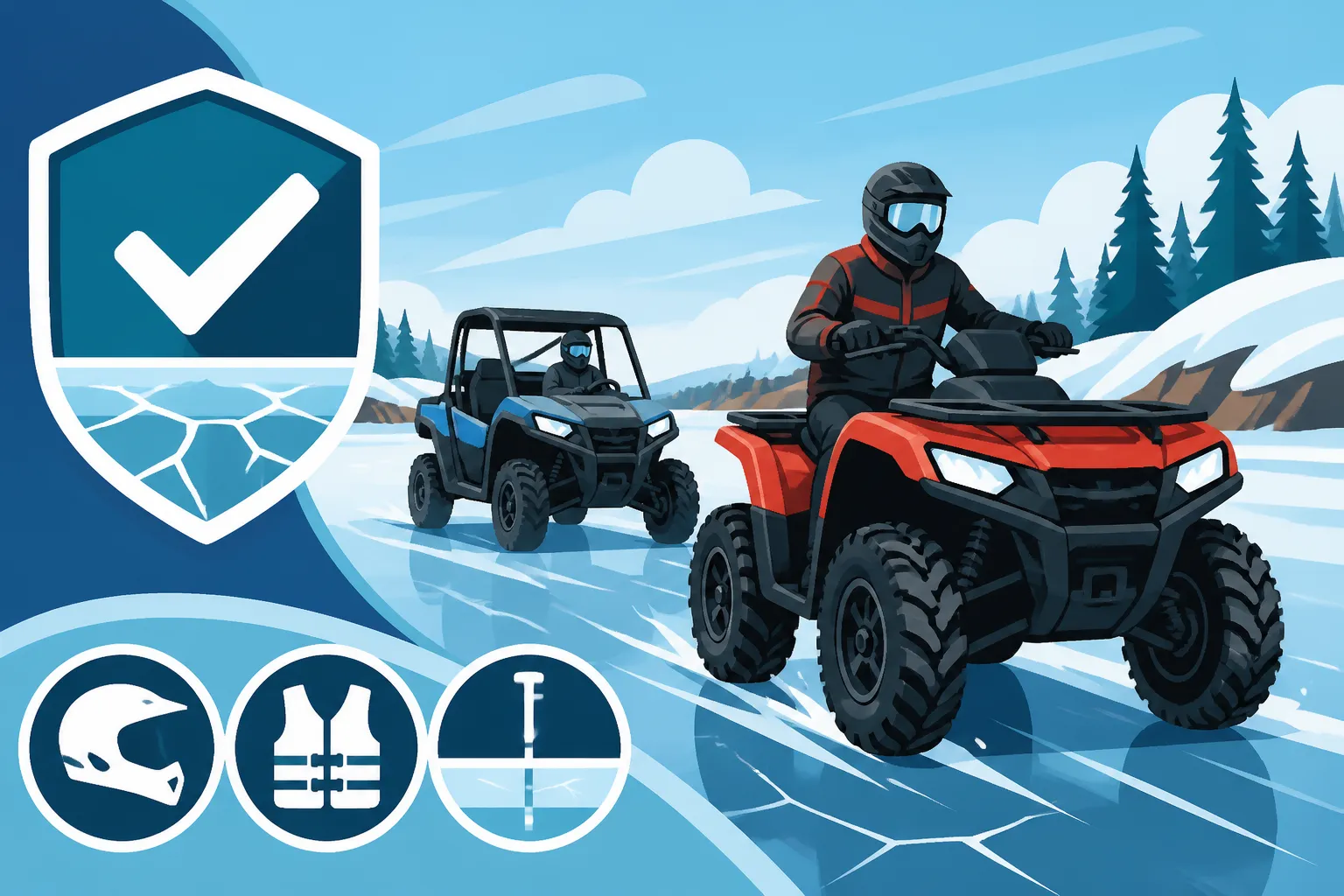
You should also equip yourself with proper ice safety gear. This includes ice picks (worn around your neck), a throw rope, and a fully charged cell phone in a waterproof bag. It's also highly advisable to wear a floatation suit, which can provide crucial insulation and buoyancy if you do break through. Riding with a partner is also a non-negotiable safety measure; if one of you goes in, the other can initiate rescue. Your gear from SuperATV might make your quad tough, but it won't keep you from going through thin ice. [Saskatchewan Helmet and Eye Protection Rules] are essential for general riding, but on ice, the stakes are even higher.
Essential Ice Thickness Guidelines for ATVs and UTVs
When it comes to ice thickness, there are general guidelines to follow, but these should always be treated as minimums and never as absolute guarantees, especially on a river. The quality of the ice (clear blue vs. slushy white), the presence of currents, and the load distribution of your machine all play a role. A general rule of thumb for ATVs and UTVs is that you need a significant amount of clear, hard ice. Slush ice, white ice, or ice that has refrozen after a thaw is considerably weaker.
For a single ATV, most safety experts recommend at least 5-7 inches (12-18 cm) of clear, solid ice. For UTVs, which are heavier and have a larger footprint, you should be looking for 8-10 inches (20-25 cm) or more. If you plan to carry any significant loads or pull a small trailer, you'll need even more thickness. Never forget that river ice is dynamic; it's constantly forming and eroding. This table provides a basic guideline, but always err on the side of caution.
| Activity | Minimum Clear, Hard Ice Thickness | Notes |
|---|---|---|
| Foot Travel | 4 inches (10 cm) | Single person, walking only. |
| Ice Fishing (groups) | 5-7 inches (12-18 cm) | Groups of people, permanent shelters, gear. |
| Single ATV/Snowmobile | 5-7 inches (12-18 cm) | Always check continuously, especially on rivers. |
| Small UTV/Side-by-Side | 8-10 inches (20-25 cm) | Heavier machines require more thickness. |
| Light Pickup Truck | 12-15 inches (30-38 cm) | Not recommended for public access, professional use only. |
When measuring ice, never rely on a single spot. Use an ice auger to drill holes strategically, especially along your intended path and near banks or known current areas. Check for changes in ice colour, cracks, or pressure ridges, all of which indicate potential weakness. Riding a SuperATV-equipped machine might feel invincible, but no amount of aftermarket parts can overcome the laws of physics on thin ice.
How Currents, Springs, and Structures Weaken Ice
Rivers are dynamic bodies of water, and their inherent characteristics make riding on frozen surfaces far more complex and dangerous than a static lake. Currents are perhaps the biggest factor. Even under thick ice, a strong current can erode the underside of the ice sheet, creating dangerously thin spots that are completely invisible from above. These areas can appear solid but are mere shells, waiting to collapse under weight. Fast-moving sections, rapids, and river bends are notorious for having unpredictable and dangerous ice conditions.
Then there are springs and underwater structures. Natural springs, which bring warmer groundwater to the surface, can create localized weak spots or even open water, even in the coldest temperatures. These areas often have no visible indication on the surface, making them incredibly treacherous. Similarly, man-made structures like bridge pilings, dam foundations, and even submerged rock formations can cause turbulence and prevent consistent ice formation. Heat radiating from concrete or steel structures can also melt ice around them.
Environmental factors also play a role. Heavy snowfalls can insulate the ice, preventing it from thickening. They also obscure visual cues, hiding weak spots, open leads, or recent breakthroughs. Furthermore, fluctuations in water levels, often due to upstream dam operations or ice jams, can stress the ice, creating cracks and pressure ridges that compromise its integrity. The "winter water body exception" in [Saskatchewan's All Terrain Vehicles Act] doesn't magically override these natural dangers; it simply offers a legal possibility that must always be weighed against severe practical risks.
Legal Requirements and Best Practices for Riding on Frozen Rivers
While the The All Terrain Vehicles Act allows for riding on frozen water bodies under certain conditions, this isn't a free-for-all. All other general rules of operation still apply. This includes requirements for proper licensing, age restrictions, supervision, and insurance. Just because you're on ice doesn't mean you can disregard the law. Ignoring these basic regulations not only puts you at legal risk but also reflects a broader disregard for safety that is amplified on a dangerous surface like a frozen river.
For example, you still need a valid driver's licence to operate an ATV or UTV in Saskatchewan, unless specific exemptions apply (like riding on private land). The age requirements for riders, including the rule that riders under 16 must be supervised by a licensed adult who has held their licence for at least 365 days, absolutely apply on frozen water. [Saskatchewan ATV Age Requirements] don't vanish just because you're off a traditional trail. If a peace officer encounters you on a frozen river, they will be looking for compliance with these fundamental rules.
Beyond the specific Act, you also need to consider broader legal implications. If you're riding on a frozen river that crosses or borders private land, you could still be subject to trespass laws if you access it from private property without permission. Always know your entry and exit points and ensure you have legal access. The "exception" for frozen water bodies doesn't grant you carte blanche to ignore land access rules to reach the river.
Driver's Licence, Age, and Supervision Rules on Ice
It's a common misconception that because you're "off-road" on a frozen river, the standard rules about driver's licences and age requirements for ATV operation don't apply. This is absolutely incorrect. Saskatchewan's The All Terrain Vehicles Act is clear: a person operating an ATV on a public area (which includes frozen rivers unless otherwise specified as private) must hold a valid driver's licence. This isn't just a formality; it ensures a baseline level of competency and understanding of road rules that translate to safe operation, even in an off-road context.
If you're caught operating an ATV on a frozen river without a valid licence, you could face significant fines and penalties. Furthermore, if you are involved in an incident, your insurance might be voided if you were operating illegally. [Do You Need a Licence for an ATV in Saskatchewan?] provides more detail, but the takeaway is simple: carry your licence.
For youth riders, the rules are equally stringent, if not more so. A person under the age of 16 cannot operate an ATV unless they are 12 years of age or older AND are supervised by an adult who holds a valid driver's licence and has done so for at least 365 days. The supervisor must be in a position to take immediate control of the ATV, or in some cases, riding on a separate ATV directly accompanying the youth. There are also exceptions for youth who have completed an approved safety course, but these are specific. [Saskatchewan Rules for a 12-Year-Old Rider] are not suspended just because it's winter and the ground is frozen. These rules are in place for a reason: to protect young, inexperienced riders from harm, a risk that is significantly elevated on unstable river ice.
Insurance and Liability: What Happens If You Break Through?
Beyond the immediate danger, one of the most significant considerations when riding on a frozen river is insurance and liability. Saskatchewan law mandates that every ATV and UTV operator must carry a minimum of $200,000 in third-party liability insurance. This isn't just a good idea; it's a legal requirement. [Saskatchewan Minimum Insurance Requirement] is a rule that applies year-round, on trails, ditches, and yes, frozen water bodies.
Imagine the worst-case scenario: you break through the ice on a frozen river. What if your machine sinks and causes environmental damage, like a fuel leak? Or what if, in your attempt to get out, you damage someone else's property (like a nearby ice fishing shack) or injure another person who was on the ice? Without adequate insurance, you could be personally liable for massive costs, including environmental cleanup, property damage, and medical expenses. The financial repercussions alone could be devastating.
Even if you have insurance, always review your policy carefully. Some policies might have exclusions for certain types of high-risk activity, or for operating in prohibited areas. While the "winter water body exception" exists, if you're found to be operating negligently (e.g., ignoring clear signs of thin ice, riding intoxicated, or in a closed area), your insurer might deny a claim. [Saskatchewan Insurance Proof on the Trail] is something a peace officer can ask for, and you'll want it to be valid and cover your specific scenario on the ice. The responsibility for ensuring you're covered rests squarely on your shoulders.
The Dangers of Night Riding on Frozen Rivers
Riding an ATV or UTV at night is inherently more dangerous due to reduced visibility, even on familiar terrain. On a frozen river, these dangers are magnified exponentially. All the hazards you might spot during the day—pressure ridges, cracks, slushy spots, or areas of weaker ice—become incredibly difficult, if not impossible, to see in the dark, even with the best lighting.
While your machine might have powerful headlights, they can often create a tunnel vision effect, making it hard to perceive the full scope of your surroundings or subtle changes in ice conditions. Shadows can play tricks on your eyes, and reflective surfaces like ice or snow can exacerbate glare. [Saskatchewan Lighting Rules at Night] ensure you have proper illumination, but they can't erase the fundamental challenges of night riding on such a treacherous surface. Even a SuperATV light bar might not give you the full picture of the ice ahead.
Furthermore, if you were to break through the ice at night, a rescue becomes significantly more complicated and dangerous. It's harder for others to find you, and the extreme cold combined with darkness dramatically increases the risk of hypothermia. Emergency services also face greater challenges operating in such conditions. For these reasons, many experienced winter riders will strictly avoid night riding on frozen rivers, opting instead for daylight hours when visibility is at its peak and potential hazards are more easily identified. It's a simple risk-reduction strategy that can literally save your life.
Navigating the Grey Areas: Enforcement and Fines
Despite the "winter water body exception," enforcement on frozen rivers can be a bit of a grey area for riders, largely because conditions and local regulations vary so much. Peace officers, including RCMP, conservation officers, and municipal bylaw officers, have the authority to enforce The All Terrain Vehicles Act on frozen water bodies. Their primary concern will always be safety, followed closely by adherence to the law and protection of the environment.
If an officer determines you are operating an ATV or UTV unsafely, negligently, or in violation of any section of the Act, they absolutely can issue a ticket. This could be for anything from lacking proper insurance or a driver's licence to operating in a manner that endangers others or yourself. The fines under the Act can be substantial, with a maximum of [Saskatchewan Fines Capped at $1,000] for a single offence. These aren't just minor inconveniences; they can hit your wallet hard and potentially lead to further legal complications.
It's important to remember that ignorance of the law is not a defence. It's your responsibility as the operator to know and abide by all applicable rules, including any specific local bylaws or Crown land orders that might affect the frozen river you're on. Just because you see tracks on the ice doesn't mean it's legal or safe. Always assume that if you're operating outside of established, safe practices, you could face enforcement.
Officer Discretion and What They Look For
When a peace officer encounters ATV or UTV riders on a frozen river, they exercise a certain degree of discretion, but their decisions are heavily guided by safety and the law. They're not just looking for a simple "yes" or "no" to the "winter water body exception"; they're assessing the entire situation. One of the first things they'll likely consider is your overall conduct. Are you riding recklessly? Are you speeding? Are you obviously endangering yourself or others by riding on visibly thin or broken ice? Irresponsible behaviour will certainly draw their attention.
Beyond conduct, officers will verify compliance with the basics: Do you have a valid driver's licence? Is your ATV or UTV properly insured with [Saskatchewan Minimum Insurance Requirement]? Are there any underage or unsupervised riders? [Saskatchewan Rules for a 14-Year-Old Rider] means that even a teenager riding alone or without proper supervision on a frozen river could lead to a ticket for both the youth and the responsible adult. They'll also be looking for proper safety gear, particularly helmets and eye protection, which are mandatory.
Officers also look for signs of environmental damage or trespass. If you accessed the river by cutting through private property without permission, or if your actions are causing damage to the riverbank or surrounding area, you could face additional charges beyond the ATV Act. Their goal is to ensure public safety and responsible use of shared natural resources, and they have the training to spot potential hazards and violations that an eager rider might overlook.
Accident Reporting and Consequences of Breaking Through
Breaking through the ice on a frozen river is a terrifying and potentially fatal experience. If it happens, your first priority, assuming you're safe, is to report the incident. [Saskatchewan Accident Reporting Duties] specify that any accident causing injury, death, or property damage exceeding a certain amount must be reported to a peace officer. Even if no one is injured, if your machine sinks and could pose an environmental hazard (e.g., leaking fuel or oil), it absolutely needs to be reported. Ignoring it could lead to much more serious charges later.
The consequences of breaking through can extend far beyond the immediate danger and potential fines. There's the cost of recovering your machine, which can be incredibly expensive and complex, often requiring specialized dive teams and equipment. Then there's the environmental cleanup. If fuel or oil leaks into the river, you could be held liable for the cleanup costs, which can quickly run into thousands, or even tens of thousands, of dollars. Your insurance might cover some of this, but as discussed earlier, operating negligently could void your coverage.
Furthermore, if your actions lead to a rescue operation, you might be charged for the costs associated with it, especially if it's determined you were being reckless or violating known safety guidelines. The personal impact—the trauma, the potential for injury, and the financial burden—far outweighs any perceived convenience or thrill of riding on a frozen river without proper precautions. It's a stark reminder that the "winter water body exception" comes with an immense personal responsibility.
Disclaimer
This article is for general informational purposes only and does not constitute professional advice. Laws, prices and regulations vary by location and change over time. Consult a qualified professional for guidance on your specific situation.