The Free Permit You Get After an Info Session
A trip to a Saskatchewan park can get confusing when riders hear that a trail permit is free but also learn they may need to attend an information session first. The key is that a no-cost permit is still tied to a specific park’s process and riding rules. This guide explains what the session and permit do, what to check before you unload, and what they do not authorize.
What the free permit is for
A free park trail permit is permission to use designated ATV routes under the park’s requirements. It is not the same thing as registering your ATV with the province, buying a municipal plate, or getting general permission to ride anywhere in Saskatchewan.
That distinction matters because permits are tied to particular places and conditions. A permit connected to riding at Moose Mountain Provincial Park, for example, does not automatically cover a ride at another park, on Crown land, or on a rural municipality’s roads. Before setting out, check the rules for the exact riding area and the machine you plan to bring. The process described in [Saskatchewan Free Permits at Moose Mountain] and [Saskatchewan Free Permits at Great Blue Heron] is park-specific, not a province-wide ATV pass.
Why an information session can come before a permit
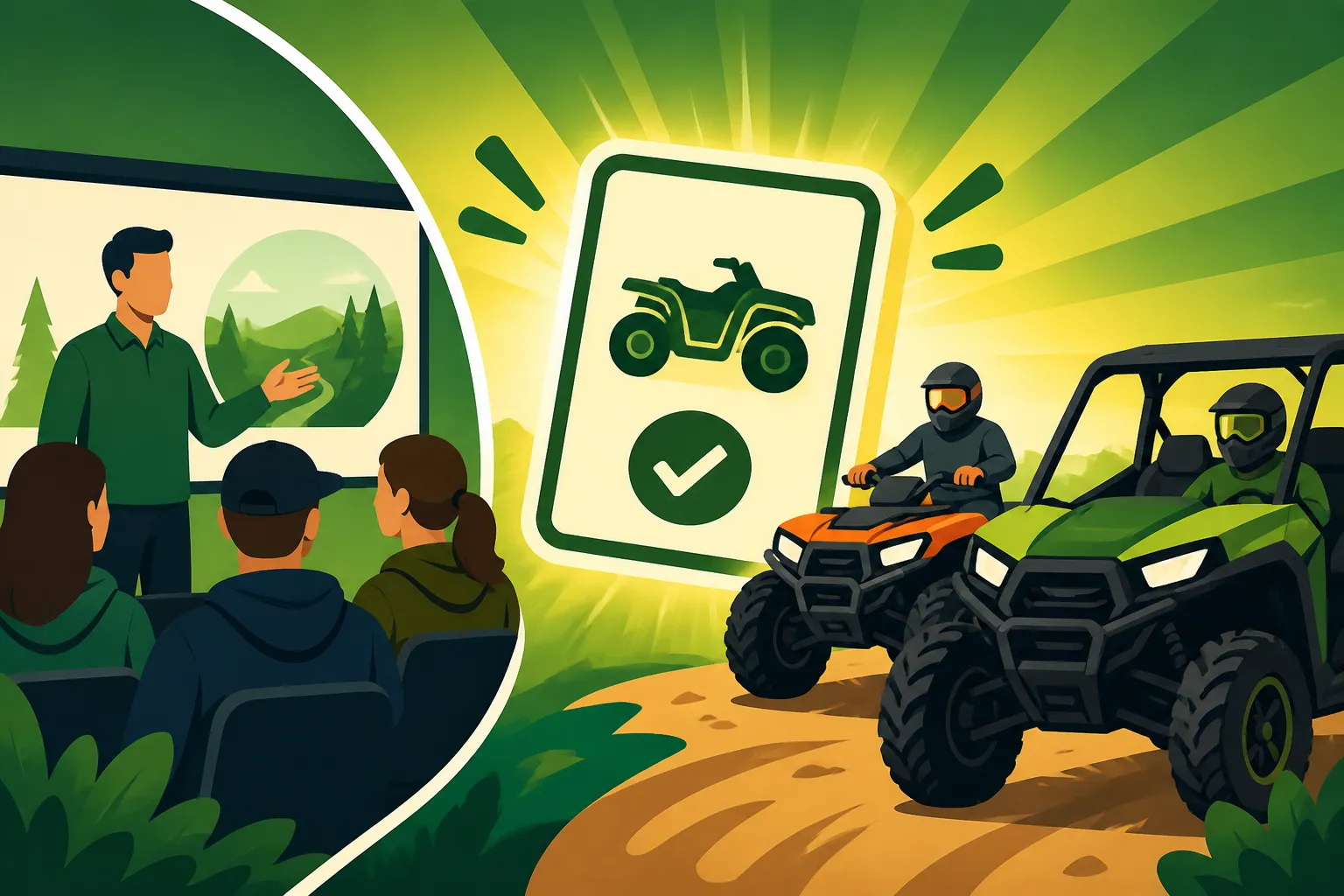
The information session is a chance to go over the park’s requirements before riding. That can include where machines are allowed, which routes are closed to machines, how to display the permit, what paperwork to carry, and what conduct is expected on shared trails. The session helps prevent an easy-to-make mistake: assuming that a permit means every road, trail, beach, or campground in the park is open to ATVs.
It also gives riders a chance to ask about practical details that are easy to miss when planning from home. For instance, you might know the trailhead you want to use but not realize the route has a seasonal restriction, or that a nearby road is open to vehicles while a hiking trail beside it is closed to machines. A quick conversation with park staff can clarify which route applies to your trip.
Treat the session as part of preparing to ride, not as a formality to rush through. If you arrive with your machine already unloaded and your group eager to go, it is tempting to skim the instructions. But a few minutes spent confirming the route, permit display, and insurance expectations can prevent a frustrating stop later.
What the permit does not replace
A park trail permit does not replace insurance, safe riding equipment, or any other rule that applies to the rider and machine. You may still need to show proof of liability insurance, follow age and supervision rules, wear the required helmet and eye protection, and obey restrictions on passengers and lighting. Park access rules sit alongside the general requirements explained in [Saskatchewan Park Regulations for Machines].
Nor should a free permit be mistaken for a provincial registration document. Saskatchewan does not issue a province-wide ATV plate in the way some riders may expect. A municipal plate scheme, where one exists, serves a different purpose and may have its own local boundaries and conditions. For the broader distinction, see [Saskatchewan Has No Provincial Trail Pass] and [Saskatchewan Municipal ATV Plates Explained].
| Item | What it generally does | What it does not automatically do |
|---|---|---|
| Park trail permit | Allows eligible riding on designated routes under that park’s rules | Grant access to every trail or another park |
| Information session | Explains local requirements and helps riders understand the process | Replace the permit or other legal requirements |
| ATV insurance | Provides coverage under the terms of the policy | Make a closed route open to riding |
| Municipal plate | May meet a local bylaw requirement within the municipality | Act as a province-wide registration or park permit |
| Trail map or navigation app | Helps with planning and route awareness | Confirm legal access by itself |
How to prepare for the information session
A little preparation makes the session more useful, especially if you are travelling with family or a group. You do not need to arrive with an elaborate binder. The goal is to know what you are bringing, where you hope to ride, and what questions could affect your day.
Check the park’s process before leaving home
Confirm whether the information session is required for the permit you want, where it takes place, and whether the permit is collected or issued afterward. Park procedures can differ, so avoid assuming that a process used at one location will work at another. The details in [The Info Session That Comes Before Your Permit] and [How to Get a Saskatchewan Park Trail Permit] are useful starting points for understanding why the session and permit are linked.
Make a short list of questions before you go. Ask which routes are open to your type of machine, where the permit should be displayed, whether all riders need to attend, and what proof of insurance is expected. If your group includes young riders, ask about supervision and age requirements rather than relying on what applies in another riding area.
If you are driving a long distance, confirm the location and timing with the park office before loading the trailer. A session that takes place at a particular office or campground may not be available at the trailhead you planned to use. That small detail can save you from arriving at the wrong place with a full trailer and no clear way to complete the process.
Bring the information staff may need
Have the machine details and insurance information easy to access. The person attending may need to identify the machine or confirm that you understand the park’s requirements. Carry proof of insurance in a format you can retrieve without searching through a crowded phone gallery or glove box. The park-specific guidance in [Saskatchewan Insurance Proof at a Park Office] can help you think through what to have ready.
If you are riding as a group, decide who will handle the permit process and make sure that person can answer basic questions about the machines and riders. That does not mean one rider can automatically complete every requirement for everyone; confirm the park’s process. It does mean avoiding a last-minute scramble when several people are waiting and nobody knows whose insurance document is whose.
It is also sensible to keep your ownership paperwork with you, especially if the ATV was recently purchased or borrowed. A bill of sale is not a park permit, but it may help establish who owns the machine if questions arise. For the general paperwork issue, see [Saskatchewan Proof of Ownership on the Trail].
Ask about the route, not just the paperwork
The permit is only one part of a good ride plan. Ask which routes are currently designated for machines, whether any closures or conditions affect your intended loop, and how the park expects riders to handle intersections with roads or other trails. Conditions can change with weather, maintenance, or land-management decisions, so a route shown on an old map should not be treated as a guarantee of access.
Navigation tools can help you keep track of where you are, but they do not decide whether a route is legally open. Riders who use onX Offroad or another mapping tool should compare the route with the park’s directions and posted signs. A line on a screen can be helpful for orientation while still being outdated, incomplete, or unrelated to the park’s permit boundaries.
This is particularly important when a route appears to connect with a road, a neighbouring trail system, or land outside the park. Stop and confirm before continuing. When in doubt, return to a clearly designated route or contact park staff rather than assuming that a visible track means public access.
Using the permit correctly on the ride
Once you have completed the required process and received the permit, take a moment to understand its conditions before riding away. A permit is useful only if it is valid for the place, machine, and use it covers, and if you follow the instructions attached to it.
Display and carry the permit as directed
Find out whether the permit must be displayed on the machine, carried by the operator, or handled in another way. Do not guess based on how another rider has attached a sticker or paper. If the permit comes with specific placement instructions, follow them so it can be seen when required and is less likely to be lost in mud or rain.
Keep digital or paper copies of related documents accessible, but do not assume a phone image will satisfy every requirement unless the park confirms that it will. Phones run out of battery, screens can be hard to read in bright light, and a document buried in an email can take longer to find than expected. A practical setup is to keep the permit where instructed and store insurance details somewhere you can retrieve quickly.
If your group separates, make sure each operator understands what they need to carry or show. The rider who attended the session may know the rules, but that knowledge does not automatically transfer to everyone else. Before moving out, take a minute to explain the route limits and any park-specific instructions.
Stay on designated routes and respect closures
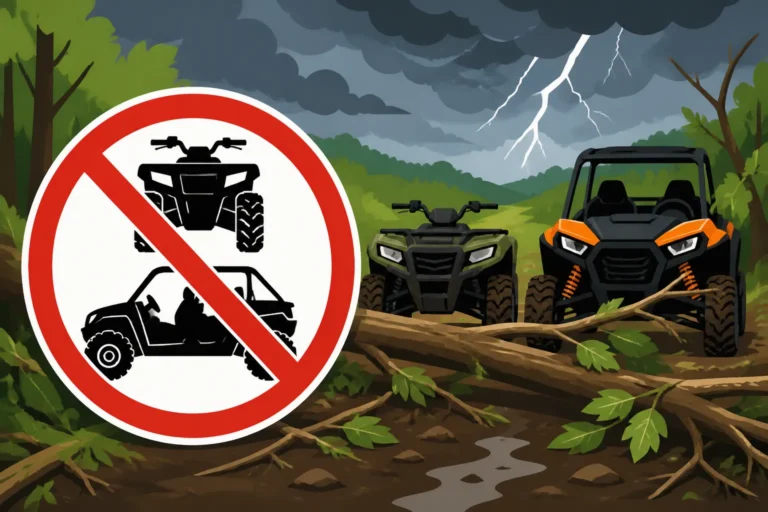
A free permit does not turn an undesignated track into an approved ATV trail. Stay on routes identified by the park, obey signs, and do not ride around a barrier or closure simply because the ground looks passable. A route can be closed for reasons that are not obvious from the seat of a machine, including trail damage, wildlife concerns, visitor safety, or land protection.
The same caution applies to connecting paths. A track that looks like a shortcut may cross a hiking route, a sensitive area, or land with different access rules. Check the route before you take it, and turn around if signs or staff instructions indicate that machines are not permitted. The park’s designated route information should take priority over a line saved in an app.
onX Offroad can be useful for keeping your bearings and reviewing a planned route, but use it as a navigation aid rather than proof of permission. Compare what the app shows with park information and signs at the site. If the information conflicts, pause and ask before riding farther.
Keep the permit separate from other riding permissions
A park permit does not necessarily authorize riding on land outside the park. If your planned route crosses a municipal road, Crown land, private property, or a grazing lease, the rules for that land may be different. Permission from a landholder may be required, and municipal bylaws can restrict riding on particular roads or areas.
That is why a ride that appears continuous on a map can involve several different access rules. A park trail may lead toward a road, but that does not mean the road is open to ATVs. Likewise, a municipal plate does not automatically grant access to park trails. Before combining areas, check the requirements for each segment rather than treating the permit as a general pass.
If you are mapping the route in onX Offroad, mark the park boundary and any transition points where access rules may change. Then check those points against official information and posted signs. This extra step is more reliable than discovering the boundary only after your group has reached it.
Common questions riders ask
Is the permit really free
Some Saskatchewan park trail permit processes are described as free, including the park-specific processes covered by [Saskatchewan Park Trail Permits Are Free]. Free does not mean automatic: an information session, acknowledgment form, or other park process may still be required. Confirm the process for the location you plan to ride, because a permit’s availability and conditions are tied to the park.
Also remember that a no-cost permit does not mean the whole outing costs nothing. You may still have travel, fuel, insurance, equipment, or accommodation expenses. Those costs are separate from the permit itself and do not change what the permit authorizes.
Does one permit work at every Saskatchewan park
Do not assume so. A permit associated with one park should be treated as valid only for the place and conditions identified by that park. Check separately before riding at another park, even if the trails appear connected or the permit process sounds similar. Saskatchewan Parks With Designated Trails Only is a helpful reminder that machine access can be limited to specific routes.
Can a mapping app tell me whether I am allowed to ride there
A mapping app can assist with planning, but it is not a substitute for current park instructions, signs, or permission. onX Offroad may help you orient yourself and review a route, but a map display alone does not establish that a trail is open or that your permit covers it. Confirm access with the park and follow posted directions once you arrive.
What should I do if the session or permit instructions are unclear
Ask the park staff member handling the process to explain the requirement before you head out. Clarify whether the permit is for each machine or rider, where it needs to be displayed, what insurance proof to carry, and which trail routes are approved. If you cannot get a clear answer, pause your plan and contact the park office rather than relying on assumptions.
A free permit can make a park ride easier to arrange, but the real value is knowing exactly where it applies and what the park expects. Attend the required session, keep the permit and insurance information accessible, and treat maps as planning tools rather than permission. That way, you can spend less time sorting out paperwork at the trailhead and more time riding the routes that are actually open.
Disclaimer
This article is for general informational purposes only and does not constitute professional advice. Laws, prices and regulations vary by location and change over time. Consult a qualified professional for guidance on your specific situation.