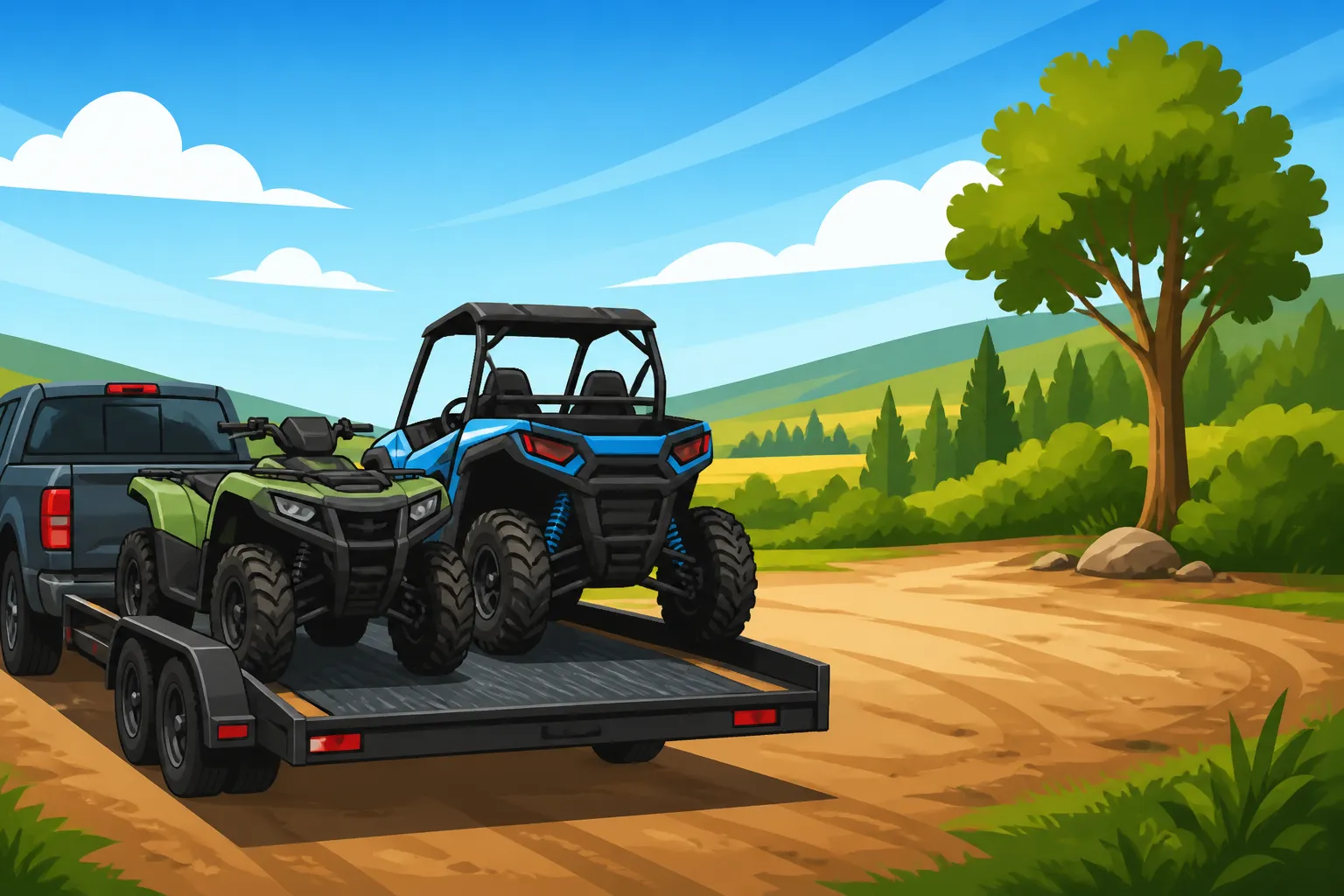
Trailering to an Unloading Area
Trailering an ATV or UTV to a Saskatchewan riding area can save a long, tiring ride on roads, but the trip can go sideways before you even unload: the access point may not allow trailer parking, the trail may be closed, or the machine may need a permit. This guide walks through how to choose a legal unloading area, prepare your rig, and check the rules before you haul.
Choose an unloading area before you leave
Confirm that the trailhead accepts trailers
A trail on a map is not automatically a place where you can park a truck and trailer. Before setting out, look for a designated staging or unloading area and confirm that parking is allowed for the length of time you expect to ride. A roadside pullout, campground, boat launch, or nearby business may look convenient but still be unsuitable for trailer parking or ATV access.
Think through the whole arrival, not just the final destination. Can you turn around with your trailer attached? Is there room to unload without blocking other vehicles? Will your truck and trailer fit in a marked stall, or will they take up several spaces? These questions matter especially on busy weekends, when a few poorly parked rigs can block access for other riders, campers, or emergency vehicles.
Use park information, local trail-club details, and posted signs to confirm where you can stage. If you are heading to a provincial park, check the rules for that park and the specific trail system rather than assuming every road or open area is available to machines. [Saskatchewan Trailheads With Trailer Parking] is a useful related topic to check while planning. For a broader planning checklist, see [Saskatchewan Trail Conditions Before You Haul].
Check that you can legally ride from that point
A legal place to park does not necessarily mean you may ride out from there. Some riding areas have designated routes, seasonal restrictions, or access rules that change between nearby land parcels. In parks, machines may be limited to trails specifically designated for them. On Crown land, access can depend on closures, land status, and whether permission is needed for occupied land.
If your plan depends on connecting a parking spot to a trail by riding along a road, ditch, or unmarked track, verify that connection first. Do not assume a short distance is exempt from the rules. It is often safer to choose an unloading location that sits directly beside an authorized trail than to improvise a route after arrival.
Before you haul, check the relevant land manager’s notices and any posted restrictions at the access point. [Saskatchewan Parks With Designated Trails Only] explains why trail designation matters, while [Saskatchewan Crown Land Access Rules] is relevant when your route involves Crown land. A mapping app such as onX Offroad can help you study the general layout and spot possible access points, but treat it as a planning aid—not proof that a road, trail, or parking area is currently open to your machine.
| Planning question | What to confirm | Why it matters |
|---|---|---|
| Is trailer parking allowed? | Designated staging area, parking signs, or land-manager guidance | Prevents blocking access or parking where it is not permitted |
| Can you ride from the unloading area? | Authorized trail connection and current access rules | A parking area may not provide legal access to every nearby route |
| Is the trail open? | Seasonal notices, closures, and local conditions | Fire, weather, maintenance, or land-use restrictions may affect access |
| Does the location require a permit? | Park or local requirements for riders and machines | Permit rules can differ between areas |
| Can your rig turn around? | Trailer length, turning space, and exit route | Reduces backing, congestion, and the chance of getting stuck |
Prepare the truck, trailer, and machines
Inspect the trailer before loading
A trailer that worked perfectly on the last trip can still have a problem you only discover at the trailhead. Before leaving home, inspect the tires for visible damage and check their inflation according to the trailer and tire guidance. Make sure the hitch is secured, the coupler is locked, the safety chains are attached correctly, and the lights work when connected to the tow vehicle.
Check the deck, ramps, tie-down points, and any removable gates. Look for loose boards, cracked welds, bent hardware, or sharp edges that could damage a strap. If you use ramps, make sure they are secured against slipping during loading. A slightly awkward ramp setup in a driveway is much easier to fix than one on a soft shoulder with traffic passing nearby.
It also helps to confirm that your truck and trailer combination is suitable for the load. Include the weight of the machines, fuel, tools, riding gear, spare parts, and anything stored in the truck bed or trailer. If you are unsure about the load or towing setup, consult the vehicle and trailer documentation or a qualified professional rather than guessing. The machine is not the only thing that adds weight.
Load and secure each machine carefully
Load on firm, level ground whenever possible. Keep bystanders—especially children—out of the loading area, and use a spotter if visibility is limited. Follow the machine and trailer manufacturers’ instructions for loading direction and tie-down points. Avoid attaching straps to parts that can bend, move, or be damaged under tension.
Secure each ATV or UTV so it cannot roll, bounce, or shift during braking and turns. Use suitable tie-downs in good condition, and check that the machine’s suspension and straps are not being compressed or routed in a way that could cause damage. Do not rely only on the parking brake, transmission, or a single strap to keep a machine in place.
After the first short stretch of driving, pull over somewhere safe and recheck the straps and trailer connection. Straps can settle as the load moves, especially over rough pavement or gravel. Check again before leaving a fuel stop or reaching a gravel road. That small pause can catch a loosened strap before it becomes a roadside problem.
Check access rules, permits, and trail conditions
Verify rules for the exact riding area
Saskatchewan riding rules are not identical everywhere. A route may cross a provincial park, municipal area, private land, or Crown land, and each part can have different restrictions. A club trail may have specific access conditions, while a park may limit machines to designated trails or require riders to complete a permit or acknowledgement process.
Do not assume that a permit for one riding area applies somewhere else. Confirm which permit, if any, applies to your destination, where to obtain it, and whether it must be displayed or carried. Park offices, official park information, local municipalities, and trail organizations can help clarify details before you arrive. For a park-focused planning refresher, see [Saskatchewan Park Trail Permits Are Free] and [How to Get a Saskatchewan Park Trail Permit].
If you use onX Offroad to review a route, compare what you see with the land manager’s current information and on-site signs. A digital map can help with orientation, but it may not reflect a temporary closure, a changed trail connection, a private boundary, or a local restriction. Keep a paper or offline backup where coverage may be unreliable, and be prepared to turn around if signs or official notices indicate that access is closed.
Check for closures and changing conditions
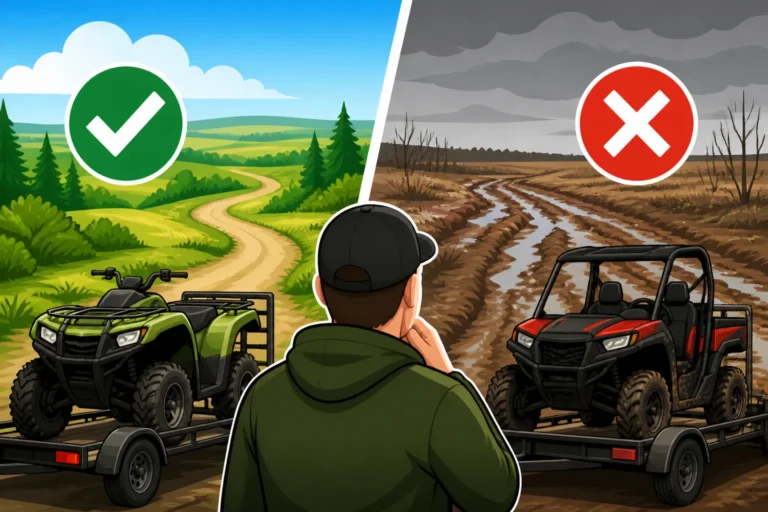
Trail access can change with weather, maintenance, fire danger, and land-management decisions. A route that was open on your last visit may be closed now. Heavy rain can leave soft ground, washouts, or damaged approaches; wildfire-related restrictions can affect broad areas; and local crews may temporarily close a section for repairs.
Check conditions shortly before departure, not only when you first start planning. If you are travelling a long distance, check again before loading the machines. When possible, contact the park office or local trail group with a specific question: “Is this unloading area open to truck-and-trailer parking, and is the connecting ATV trail open?” Specific questions are more useful than asking whether the general area is “open.”
Respect signs at the trailhead even if your map shows a route continuing beyond them. Do not move barriers, ride around a closure, or leave the designated trail to get around mud or damage. Those shortcuts can cause further harm and jeopardize access for everyone. [Saskatchewan Trail Closures After a Storm] and [Saskatchewan Wildfire Season Rules for Riders] are relevant when weather or fire conditions may affect a planned trip.
Make unloading and departure safer
Use a simple arrival routine
When you arrive, take a moment to assess the site before unloading. Look for posted signs, soft ground, traffic, other trailers, and enough room to operate the ramps. If the designated area is full, do not block a road or access lane while waiting for a space. Choose another authorized location or change your plan.
A predictable routine helps prevent rushed mistakes. You might use this order:
- Park in the designated area and keep access routes clear.
- Check signs for restrictions, closures, or permit instructions.
- Position the truck and trailer on firm, reasonably level ground.
- Keep people clear of the ramp and machine path.
- Unload one machine at a time, following the manufacturer’s guidance.
- Secure ramps and loose equipment before moving the truck or trailer.
- Confirm that each rider has the required protective equipment, documents, and communication plan.
Avoid unloading on a slope or in a spot where a machine could roll toward traffic, water, or another person. If the site is muddy, uneven, crowded, or too narrow for safe unloading, it is better to relocate than to force the setup.
Leave the area as carefully as you found it
Before riding away, secure the truck and trailer, remove loose gear from the staging area, and make sure nothing has been left on the ground. Keep fuel containers, tools, and personal belongings stored safely. If you will leave the tow vehicle for several hours, consider whether it is parked in a permitted area and whether it could interfere with others who arrive later.
At the end of the ride, inspect the machines before loading. Remove packed mud and vegetation where practical, and check for damage, leaks, or debris around hot components. Cleaning the machine before moving to another riding area can also help reduce the spread of invasive species. Follow any wash-station or cleaning directions posted at the location.
Give other users room when loading up. A large trailer can make a staging area feel crowded, especially if several groups return at once. Load methodically, avoid leaving machines running near people, and do not leave ramps or equipment where someone could trip over them. The courtesy that makes a trailhead pleasant at the start of a ride matters just as much at the end. See [Saskatchewan Trail Etiquette Locals Expect] for more on sharing riding areas responsibly.
Build a repeatable pre-trip checklist
A short checklist is especially useful when a group is travelling in several vehicles. Confirm the destination, parking permission, trail access, closures, permit requirements, and expected return time. Make sure each driver knows the meeting point and has directions that do not depend entirely on mobile reception.
Check the essentials before departure: hitch and lights, trailer tires, ramps, tie-downs, machine condition, fuel, protective gear, first-aid supplies, and any required proof of insurance or ownership. Riders should also know what to do if the group becomes separated or a machine breaks down. For remote routes, agree on a turnaround time and carry a map or route information that remains available offline.
A planning tool such as onX Offroad may be useful for reviewing a route and keeping track of the general area, especially when a group is unfamiliar with the trail network. Still, make the final decision using current official information and posted signs. A careful check before loading is much easier than discovering at the trailhead that your chosen access point is closed, unsuitable for a trailer, or disconnected from a legal riding route.
Disclaimer
This article is for general informational purposes only and does not constitute professional advice. Laws, prices and regulations vary by location and change over time. Consult a qualified professional for guidance on your specific situation.