Great Blue Heron’s 10 Kilometres in Saskatchewan
A ten-kilometre trail network can sound like a quick warm-up, but in Great Blue Heron Provincial Park, the real challenge is planning the ride around designated routes, park requirements and changing trail conditions. This guide explains what to expect, how to prepare your machine and group, and how to make a short Saskatchewan ride feel worthwhile without treating the park like an unrestricted off-road area.
What to expect from Great Blue Heron’s ATV trails
Ten kilometres calls for a different kind of ride plan
Great Blue Heron Provincial Park is known for a relatively compact ATV trail offering: about ten kilometres of designated routes. That is a useful starting point when deciding whether it suits your day, but the number alone does not tell you how long the ride will take or what the experience will feel like. Pace, stops, surface conditions and how familiar your group is with the area can all change the outing.
It helps to think of the park as a short, focused ride rather than a place to spend the whole day covering distance. A group might take its time at junctions, pause to check the map, or stop because someone needs to adjust a helmet or gloves. Those breaks are normal, particularly when a family or mixed-experience group is riding together. Planning for them is better than assuming everyone will move at the pace of the quickest rider.
The limited mileage can also be a benefit. Riders who are new to trail riding may prefer a manageable outing over a long route that becomes tiring or difficult to navigate. Experienced riders can use the ride as part of a wider day in the region, while keeping in mind that the park’s designated trails are not an invitation to continue off route. For more context on what that distance means in practice, see [What 10 Kilometres Gets You at Great Blue Heron].
The park is not an open riding area
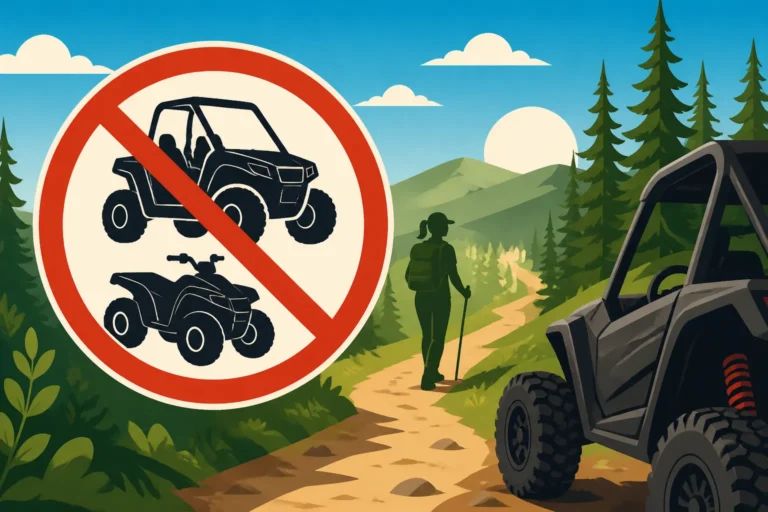
The key distinction is between riding on a route designated for machines and riding wherever a quad or side-by-side can physically travel. A visible track, open patch or tempting path does not automatically mean it is an approved ATV trail. In a provincial park, boundaries and posted directions matter, and riders should stay on routes that are identified for machine use.
That can feel restrictive if you are used to riding private acreage, farm trails or informal bush tracks. It is still the safer assumption: follow park information and signs, and do not use a hiking trail, campground road or other route unless park rules clearly allow it. Conditions and access arrangements can differ among parks, so advice from another Saskatchewan riding area should not be treated as a substitute for Great Blue Heron’s own instructions. The broader context is covered in [Saskatchewan Parks With Designated Trails Only].
The short trail network makes staying oriented especially important. On a long ride, it may be obvious that you have taken a wrong turn only after a considerable distance. On a compact network, it can be tempting to improvise because the next trail seems close. Resist that temptation. If a junction is unclear, stop somewhere safe, consult your map or park information, and retrace your route if needed rather than creating a new one.
Keep expectations realistic about terrain and facilities
Do not plan the outing around assumptions about trail width, elevation, mud, shade, cell reception, wash facilities or nearby services unless you have confirmed those details for your visit. Trail conditions change with weather and use, and a short route can still include sections that feel challenging to a new rider. A modest distance does not guarantee easy riding.
A useful plan is to arrive with enough time to read posted information, prepare your machine and gear, and begin without rushing. If you are meeting friends at the park, agree on where to regroup before the ride. A rider who stops to fix a loose strap or check a map should not have to guess where the rest of the group went.
If you are travelling in from Prince Albert, Christopher Lake or farther away, build in a little flexibility. The trail may be the main reason for the trip, but your day should not depend on squeezing every minute out of a fixed schedule. A relaxed start gives you room to respond if the trailhead instructions, weather or group’s energy differ from what you expected.
Permits, park rules and route checks
Sort out the park’s permit process before unloading
Before riding, check what Great Blue Heron requires for access to its designated ATV trails. Park riding can involve an information session, an acknowledgement form or a trail permit process. The exact steps and where to complete them are practical details to confirm with the park rather than guess at when you arrive with a trailer and machines ready to go.
Give yourself time for that process. If a form or briefing is required, it is easier to handle it before everyone is geared up and eager to ride. For a family group, one person can confirm the requirements while another checks helmets, eye protection and the machines. Keep any permit or proof of completion where it can be produced if requested, and follow instructions about displaying it. See [How to Get a Saskatchewan Park Trail Permit] and [Signing the ATV Use Acknowledgement Form First] for related steps.
A permit is not permission to ride every road or track in the park. It applies within the scope of the park’s rules, so keep reading signs after completing the paperwork. If a route is closed or a sign directs riders away from an area, follow that direction even if an online map or older trip report appears to show a route there.
Check access information close to your trip
A trail plan made weeks ahead can be useful, but it should not be your only source of information. Access can be affected by maintenance, weather, safety concerns or park operations. Check the latest park notices and contact the relevant park office when a requirement is unclear. That small bit of preparation can save a long drive with no ride at the end of it.
Look for information about designated trail access, current closures, permit steps, machine eligibility and any restrictions that apply to your group. If you cannot tell whether a particular machine or route is allowed, ask before unloading. That is especially important for side-by-sides, youth riders and visitors who may be used to different rules at home.
Use maps as navigation aids, not as proof that a route is open or authorized. Apps such as onX Offroad can help you understand your position and plan around a general route, but a digital track does not replace park signs, official information or permission to ride. Downloading or saving useful map information before leaving home can also help if mobile service is poor, but make sure your group knows which information governs access.
Respect closures and posted boundaries
A closed trail is frustrating when you have driven a long way, but riding around a barrier can create bigger problems than a changed itinerary. Closures may be in place to protect riders, wildlife, sensitive ground or park infrastructure. If you encounter a blocked route or a sign that contradicts your planned direction, stop and follow the park’s instructions rather than searching for an informal bypass.
Before the trip, talk with everyone in your group about that expectation. It is easy for one rider to drift ahead and turn a “quick look” at a side path into an unauthorized detour. Agree that riders will stay together at junctions and that no one will leave the designated route without clear permission.
If the closure leaves too little riding for your group, treat that as a cue to revise the day, not to make your own route. You can shorten the outing, spend more time on the open section or choose another approved riding area on a different trip. Related reading on park access includes [Saskatchewan Park Trail Permits Are Free] and [Saskatchewan Permit Rules at Great Blue Heron].
Preparing your machine and group
Do a practical pre-ride check
A short ride is not a reason to skip a machine check. Before leaving home, inspect the tires, brakes, throttle, steering, lights and visible fluid levels. Check that any cargo is secure and that nothing is loose enough to catch on brush or interfere with controls. If the machine has been sitting through winter or has not been used recently, allow extra time to find small issues before they become trail problems.
Carry the basic items that match your machine and the conditions, such as a tool kit, tire repair supplies, a first-aid kit, water and a way to contact the group if riders become separated. What you need will vary with your machine and the length of your outing, but the principle is simple: do not assume a short route means you can ride unprepared. A small repair or a minor injury can take time even when you are not far from the trailhead.
Check that each rider has a properly fitted helmet and appropriate eye protection, and that passengers are riding only on machines designed to carry them. Saskatchewan’s broader legal requirements are explained in [Saskatchewan Helmet and Eye Protection Rules] and [Saskatchewan Passengers Only on Machines Built for Them]. Park-specific rules may add requirements, so review those as well.
Make the ride work for the least experienced person
A group ride is only enjoyable if its pace works for more than the strongest rider. Before starting, ask who has ridden trails before, who is unfamiliar with the machine and whether anyone has concerns about mud, narrow sections or riding near other machines. People often hesitate to speak up once the group has started, so the trailhead is the best place to make the plan comfortable for everyone.
Choose a lead rider who knows the route information and a sweep rider who stays behind the group. Agree on a simple regrouping routine: stop at junctions, wait if someone falls behind, and do not let a faster rider disappear around a bend. If your party includes children or riders who need supervision, check the park’s applicable age and supervision requirements before the trip. [Riders 12 to 16 Need Supervision in a Park] covers an important consideration for youth groups.
Set expectations about speed and spacing before the engines start. Keep enough room to respond to dust, loose ground or a sudden stop, and avoid pressuring a hesitant rider to keep up. If somebody needs a break, make it a group break. That is usually faster and less stressful than letting the group stretch out and then trying to locate one another later.
Pack for a short trip that can still run long
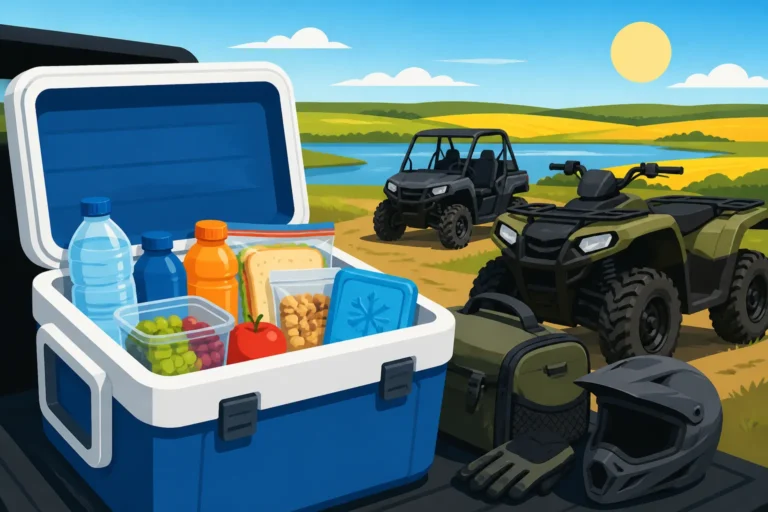
The planned riding distance does not account for time spent checking in, waiting at a junction, addressing a minor problem or adjusting to conditions. Bring water and weather-appropriate layers even if the forecast looks comfortable at departure. A cloudy morning can feel very different after a slow ride, and a rider who gets cold or overheated may struggle to concentrate.
Carry any paperwork or proof the park expects you to have, along with a phone or other communication option. If you are relying on a phone for navigation, make sure the map is available offline where possible and conserve battery. onX Offroad may be useful for viewing saved route information, but keep a separate backup plan in mind: know your intended route, identify the trailhead and agree on what to do if devices stop working.
For the group, keep essentials accessible rather than buried beneath gear. A first-aid kit that cannot be reached without unloading the machine is not much help when someone needs a bandage. Before departure, tell someone who is not riding where you plan to go and when you expect to be back, especially if your route to the park involves a long drive or your group has limited phone coverage.
Navigation and trail etiquette
Use digital maps without letting them overrule the ground
Offline maps can make navigation easier, particularly if your phone loses service. Before leaving, save the area you need, check that the map opens without a connection and bring a charging option. If multiple riders use navigation apps, make sure they are looking at the same general plan rather than following different tracks and assuming they will meet up later.
onX Offroad can help riders visualize their location and keep an eye on a planned route, but it should be treated as a supporting tool. A mapped line can be outdated, approximate or outside the route currently open to machines. At Great Blue Heron, official park directions and posted trail signs take priority. If the app suggests a shortcut that is not clearly part of the authorized trail network, do not follow it simply because it appears on screen.
Try to keep your device use simple while riding. Choose the route before moving, stop safely to check a junction, and avoid looking down at a screen while the machine is in motion. A map is most useful when it reduces uncertainty without distracting the rider from the trail, other machines or people nearby.
Be considerate at encounters and junctions
On a shared trail, other users may appear around a bend or at a narrow point. Reduce speed when visibility is limited, be prepared to stop and give other trail users room. Avoid kicking up unnecessary dust or pushing past a group that is still figuring out its next turn. A friendly pause is usually quicker than a tense encounter.
At junctions, stop in a place that does not block the route. Count riders before moving on, especially if the group has children or inexperienced riders. If a machine has a problem, pull over only where it is safe to do so and keep the trail clear for others. These habits matter even on a compact network because traffic can bunch up when several groups reach the same decision point.
Keep noise and behaviour in mind around the park setting. Do not rev unnecessarily, leave litter or ride outside the designated area to avoid another group. If you see a problem such as a blocked route or damaged sign, report it to the appropriate park contact rather than trying to repair or reroute it yourself.
Leave the trail in good condition
Ground that feels firm on arrival can become vulnerable after rain or repeated traffic. Avoid creating new ruts by riding around a muddy section, and do not widen the trail to get around an obstacle. If a section looks unsafe or badly damaged, stop and seek current guidance instead of making a new line through vegetation.
Clean your machine before and after the trip when conditions warrant it, especially if mud, seeds or plant material are caught around the tires or undercarriage. Cleaning reduces the chance of carrying unwanted material between riding areas. It is also a good moment to check for damage, tangled debris or a loose component before hauling home.
Pack out everything you bring in. That includes food wrappers, drink containers, broken straps and any small parts that come loose. The easiest cleanup is the one you plan for: keep a small bag secured to the machine or trailer, and check the staging area before leaving.
Making the most of a short ride
Build a day around the trail, not just the mileage
Ten kilometres may not fill an entire day, so decide what the outing is meant to be. For a beginner, the goal might be a calm first experience on designated trails. For a family, it may be a manageable ride followed by time to rest and regroup. For experienced riders, Great Blue Heron might be one part of a broader visit to the area rather than the only activity.
That distinction helps with expectations. If you arrive expecting a long-distance route, the park may feel small. If you approach it as a focused, supervised ride with a clear start and finish, the distance can feel just right. A steady pace, conversation at breaks and a well-organized group can make a short outing more enjoyable than a longer ride where everyone is rushing.
Avoid planning a tight sequence of activities that leaves no room for delays. The permit process, machine checks and a slower group can all add time. A flexible schedule is especially valuable when travelling with children or meeting riders who are unfamiliar with the park.
Compare the park’s offer with your group’s needs
Before choosing Great Blue Heron, consider what matters most to your group: a short designated route, a longer ride, varied terrain, nearby services or a particular kind of challenge. The ten-kilometre network may suit riders who value a contained outing and are prepared to follow park-specific procedures. It may not match the expectations of someone looking for unrestricted exploration or a full day of continuous riding.
Use a simple planning checklist:
| Planning question | Why it matters | What to do |
|---|---|---|
| Is the designated trail access open? | A closure can change the whole outing | Check park information before travelling |
| Does your group need a permit or briefing? | Arriving unprepared can delay the ride | Confirm the process and allow time |
| Is the route suitable for every rider? | Skill and comfort levels affect the pace | Match the plan to the least experienced rider |
| Can you navigate without mobile service? | A phone signal may not be dependable | Save maps and agree on a backup plan |
| Are machines and gear ready? | Small faults can become trail problems | Complete a pre-ride inspection |
| What will you do if access changes? | Conditions and closures can affect plans | Keep a flexible alternative in mind |
If the park’s scale or access does not suit your group, compare it with other designated riding opportunities rather than assuming the nearest visible track is legal to use. [Saskatchewan Trails Within Two Hours of Saskatoon] may help with broader trip planning, while [Saskatchewan Trail Conditions Before You Haul] is a useful reminder to verify conditions before committing to a drive.
Treat the ride as a park visit
A successful ride is not measured only by how many kilometres you cover. Getting the permit steps right, keeping the group together, respecting signs and returning without a machine problem are all part of a good outing. That approach also helps protect access for other riders: park riding depends on people following the routes and conditions that have been provided.
Before you leave, check the trailhead area for personal items, confirm that all riders are accounted for and look over the machines. If you noticed a confusing junction, a changed condition or a problem that the park should know about, share that information through the appropriate channel. For additional context on the park’s designated trail network, see [Great Blue Heron's 10 Kilometres in Saskatchewan] and [Saskatchewan Park Use Acknowledgement Forms].
Keep your expectations grounded, your route choices within the rules and your group plan simple. With those basics in place, Great Blue Heron’s compact trail network can offer a satisfying Saskatchewan outing without pretending that ten kilometres needs to be an all-day expedition.
Disclaimer
This article is for general informational purposes only and does not constitute professional advice. Laws, prices and regulations vary by location and change over time. Consult a qualified professional for guidance on your specific situation.