Liability Insurance Produced on Demand in a Park
A park officer asking for proof of liability insurance can catch riders off guard, especially when the policy is on a phone and the trailhead has no reliable signal. This guide explains what to carry, how to prepare before riding in a Saskatchewan park, and what to check so you can show your coverage without turning a routine stop into a stressful search.
What “Produce Proof on Demand” Means in a Saskatchewan Park
Be ready to show evidence of coverage
“Produced on demand” means you should be able to provide proof of insurance when an authorized officer asks for it. Having an active policy is not always enough in practice: you may still need to show that the policy applies to the machine you are riding and includes liability coverage.
In Saskatchewan, ATV riders should understand the insurance rules that apply to their situation, including the minimum liability requirement. For a fuller look at the province-wide rules, see [Saskatchewan Insurance Requirements for Riders] and [Saskatchewan Insurance Proof on the Trail]. Park requirements may add conditions, so do not assume that meeting a general road or riding requirement automatically satisfies every park’s rules.
A request for proof does not necessarily mean you are accused of doing anything wrong. It can be a routine check, much like confirming that a machine is permitted on a trail. The practical goal is to make the information easy to find and legible, rather than expecting an officer to accept a verbal assurance that you are insured.
Know which document shows the important details
The best proof is an insurer-issued document that clearly identifies the insured person or policyholder, the covered ATV or UTV, and the relevant liability coverage. Depending on how your insurer provides documents, this may be a policy document, insurance certificate, or another official proof-of-coverage record. Check with your insurer if you are unsure which document is intended to serve as evidence.
Before leaving home, compare the machine information on the document with the ATV or UTV you are taking. A mismatch in a serial number, vehicle description, or named insured can make a simple check more awkward. This matters especially if your household has several machines and you have saved more than one policy document on your phone.
If you borrowed a quad, confirm who owns and insures it, and ask the owner to provide the correct proof. Do not assume that your own policy automatically covers someone else’s machine or that the owner’s policy covers every rider and use. Coverage depends on the policy terms, so ask the insurer or broker about the specific arrangement before the trip.
How to Prepare Your Insurance Proof Before a Ride
Save a digital copy and carry a backup
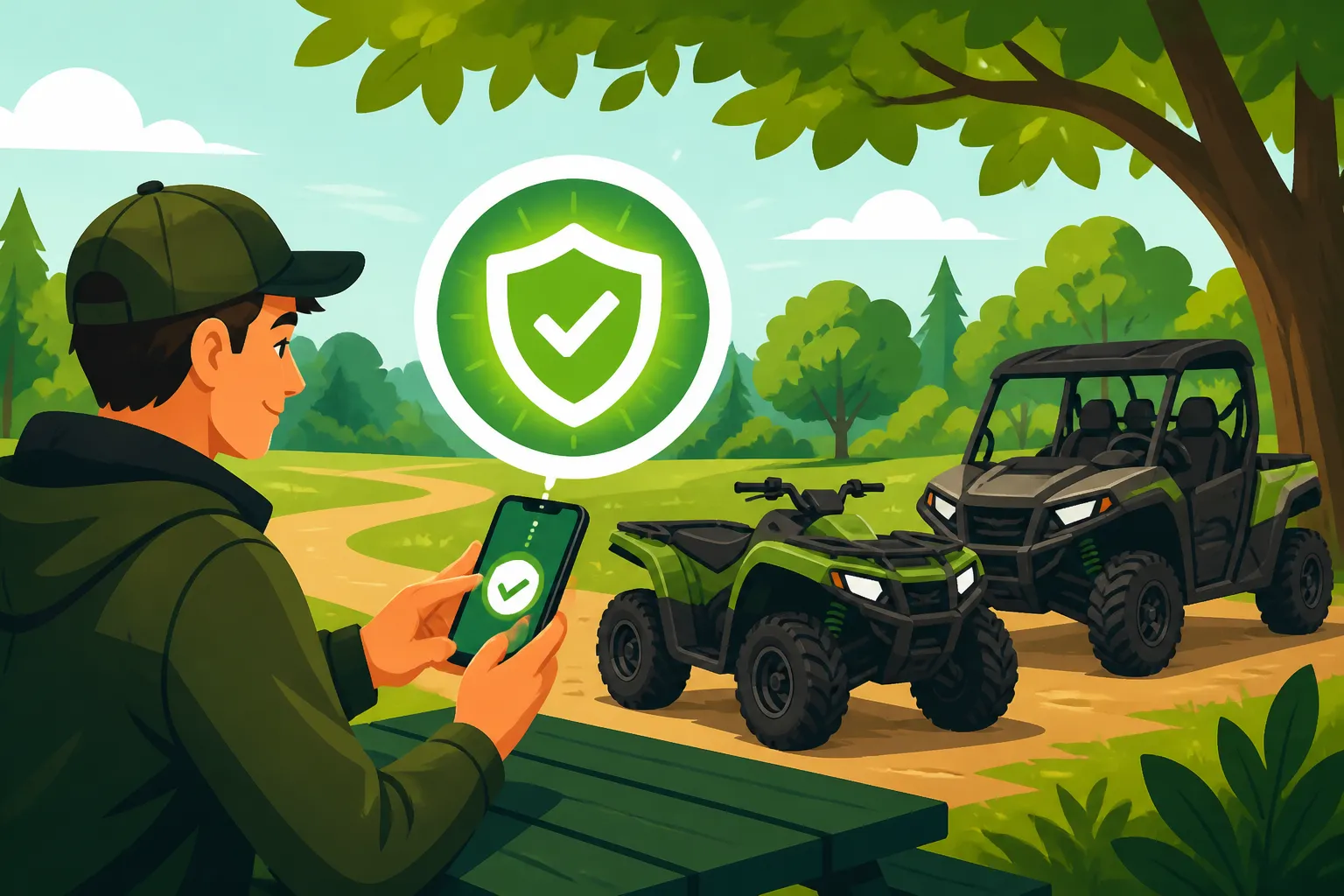
A digital document is convenient, but a phone can run out of battery, lose signal, or become difficult to use in rain, dust, or gloves. Save the proof where you can open it without relying on an email connection. A paper copy stored in a waterproof sleeve is a sensible backup, particularly for a full-day ride or a remote trailhead.
Before setting off, open the file once while you still have reliable service. Check that it is the complete document, not just a screenshot of a payment confirmation or a message from your broker. Make sure the text is readable and that you can find it quickly. If another family member is riding, confirm they know where the proof is stored too.
Keep the backup protected from water and mud, and avoid leaving sensitive policy details openly visible when the machine is unattended. You want the document accessible when asked, not exposed to weather or casual viewing all day.
Check the machine, rider, and trip details
A quick pre-ride check can prevent a frustrating conversation at the trailhead. Confirm that the policy is in force for the date of the ride, that the machine information matches, and that the covered use fits your plans. If you are unsure whether a particular activity or additional rider is covered, call the insurer or broker before travelling.
| Before you leave | What to check | Why it helps |
|---|---|---|
| Policy document | Coverage dates and liability details | Confirms the document relates to the planned ride |
| Machine information | Description and serial or VIN details where shown | Helps match the proof to the ATV or UTV |
| Rider arrangements | Whether the person using the machine is covered | Avoids relying on assumptions about borrowed machines |
| Digital access | File opens without an internet connection | Reduces delays in areas with weak service |
| Backup copy | Paper proof is readable and protected | Gives you another option if the phone fails |
| Park rules | Current trail, permit, and insurance requirements | Requirements can differ by park and riding area |
This check is especially useful when a group has several machines, riders are swapping vehicles, or the trip includes a borrowed UTV. A document for the wrong machine may be genuine, but it may not answer the officer’s question about the vehicle in front of them.
Park Rules, Permits, and Trailhead Checks
Confirm the rules for the specific park
Saskatchewan park requirements are not something to guess from a friend’s experience at a different trail system. Check the rules for the park and the trails you plan to use, including whether a permit, acknowledgement form, or proof of insurance is required and how it must be displayed or presented. [Saskatchewan Park Use Acknowledgement Forms] explains why park paperwork can be a separate part of trip preparation.
If you are heading to Moose Mountain or Great Blue Heron, look up the relevant park information before loading the trailer. Start with [Saskatchewan Free Permits at Moose Mountain] or [Saskatchewan Free Permits at Great Blue Heron], then verify the current instructions directly with the park. A permit process and an insurance check are separate things: completing one does not automatically mean you have completed the other.
At the trailhead, read posted signs rather than relying only on an old printout or a map saved months ago. Rules can vary by location, designated trail, season, and temporary closure. Keep any required permit where park staff can see it, and have your insurance proof ready to show if asked. For permit steps and preparation, see [How to Get a Saskatchewan Park Trail Permit] and [Displaying a Permit Where an Officer Can See It].
Plan for weak signal before you unload
A trailhead that feels close to town can still have poor cell service once you reach the parking or unloading area. If your insurance proof is stored only in an online account, sign in and download the document before you leave home. Do the same for maps and other ride information you expect to need.
Navigation apps can help you plan, but they are not a substitute for park signs or official access information. If you use onX Offroad, download the relevant map before you lose reception and check that you have selected the correct area. Keep the official park instructions available separately, since an app map may not reflect a temporary closure or a posted restriction.
The same preparation applies if you use onX Offroad to review a route with your group. Agree on the trailhead and planned route before unloading, and do not treat a line on a screen as permission to ride through an area. At the entrance, compare your plan with posted directions and any park-specific restrictions.
What to Do If an Officer Asks for Proof
Stay calm and show the relevant document
If an officer asks for insurance proof, stop in a safe place, follow instructions, and open the saved document or hand over the paper copy. You do not need to make the interaction harder by searching through every email or trying to explain coverage from memory. A clearly named file, such as “UTV insurance,” can save time when you are wearing gloves or standing beside a dusty trail.
If the officer needs more detail, answer plainly and show the document that identifies the machine and coverage. Do not edit or alter a policy document to make it appear to say something different. If you believe the information is unclear or a document is missing, ask what evidence is needed and contact your insurer or broker to clarify.
For a youth rider, a borrowed machine, or a group ride, make sure the person responsible for the machine knows where the proof is. Park rules may also include supervision requirements for younger riders, so check those independently; insurance proof does not replace the rules described in [Riders 12 to 16 Need Supervision in a Park].
Handle a missing or unclear document before riding again
If you discover that the file will not open, the machine details do not match, or you cannot confirm who is covered, pause and resolve the issue before continuing. Contact the policyholder, insurer, or broker. If you are at a trailhead and cannot get a clear answer, do not assume that a screenshot of a payment or an old document will be accepted as proof of current coverage.
It is also worth checking your paperwork after any change: buying or selling a machine, changing the insured person, adding a rider, or moving a policy to a different vehicle. A quick review before the next trip is easier than sorting out a mismatch beside a busy trail entrance.
When organizing a ride, include insurance proof in the same pre-trip check as permits, trail access, and vehicle preparation. If you use onX Offroad for route planning, download the map before leaving coverage and keep insurance documents in a separate, accessible place. That way, navigation and proof of coverage are both ready when you need them, even if the phone has no signal.
Disclaimer
This article is for general informational purposes only and does not constitute professional advice. Laws, prices and regulations vary by location and change over time. Consult a qualified professional for guidance on your specific situation.