Saskatchewan Dealer Paperwork at Delivery
Navigating the paperwork for a new ATV or UTV purchase in Saskatchewan can feel a bit like wading through the North Saskatchewan River after a spring thaw – murky and full of unknowns. Many folks expect a provincial registration or title like they'd get for a car, only to find that such a thing doesn't exist for quads here. This guide will walk you through the essential documents you'll receive from a Saskatchewan dealer, what each piece of paper means for you, and why holding onto it is crucial for proving ownership and ensuring smooth sailing for years to come.
The Paperwork You Will Get From a Saskatchewan ATV Dealer
When you walk out of a dealership in Saskatchewan with a shiny new (or new-to-you) ATV or UTV, the stack of papers you receive might look different than what you anticipated. There's no provincial registration card or license plate to tuck into your wallet, and that can be a real head-scratcher for new owners or those coming from other provinces. However, the documents you do get are incredibly important and serve as your official proof of ownership and the record of your purchase. Understanding each one is key.
The All-Important Bill of Sale
This is arguably the most critical document you'll receive from a dealer in Saskatchewan. For ATVs and UTVs, which aren't registered with the province, the bill of sale acts as your primary proof of ownership. Think of it as your machine's birth certificate and deed rolled into one. It details everything about the transaction: who bought it, who sold it, the date, the price, and, most importantly, the specific details of the machine itself. Without a proper provincial registry for quads, your [Saskatchewan Bills of Sale Do the Work] of establishing legal ownership.
A good bill of sale from a reputable dealer will be comprehensive. It should include the full legal names and addresses of both the buyer and the seller (the dealership), the date of the sale, and a clear breakdown of the purchase price, including any taxes and additional fees. Crucially, it must accurately list your ATV or UTV's make, model, year, and its unique Vehicle Identification Number (VIN) or serial number. Double-checking that VIN against your machine's physical VIN plate before you leave the dealership is a smart move, as any discrepancy could cause headaches down the line. Keep this document in a safe place, ideally a fireproof safe, and consider making digital copies.
Manufacturer's Statement of Origin (MSO) or Manufacturer's Certificate of Origin (MCO)
For brand new ATVs and UTVs, your dealer will also provide you with a Manufacturer's Statement of Origin (MSO) or Manufacturer's Certificate of Origin (MCO). This document is essentially the machine's "original title" from the factory. It confirms that the vehicle is new and has not been previously sold to a retail customer. The MSO/MCO is issued by the manufacturer and is transferred to the dealer, and then to you, the first retail owner.
While Saskatchewan doesn't use this document for provincial registration of ATVs, it's vital for a few reasons. Firstly, it proves that your machine is indeed new and hasn't been re-sold. Secondly, if you ever move to a province or state that does require ATV registration or titling, the MSO/MCO is what you'll need to present to register it there. Think of it as the ultimate provenance for your machine, verifying its journey from the assembly line to your garage. Ensure the VIN on the MSO/MCO matches your bill of sale and the machine itself.
Warranty and Owner's Manuals
Beyond the core legal documents, dealers will hand over practical materials like your ATV or UTV's warranty information and the owner's manual. The warranty details the coverage provided by the manufacturer for various components and specifies the terms and conditions for making a claim. Understanding your warranty is essential in case you encounter any mechanical issues during the initial ownership period. Keep these documents handy with your service records.
The owner's manual is your go-to guide for everything from basic operation and maintenance schedules to safety warnings and troubleshooting tips. While it might seem like a thick, overwhelming book, taking the time to review it, especially sections on pre-ride checks and recommended service intervals, can save you time and money in the long run. Many manuals also contain important information about recommended fuel types, oil specifications, and tire pressures, all crucial for the longevity and safe operation of your machine.
Understanding Your Dealer's Role in Sales Tax and Fees
Buying from a licensed dealer in Saskatchewan comes with certain obligations and advantages when it comes to taxes and other costs. Unlike a private sale where you, the buyer, are responsible for self-assessing and remitting the provincial sales tax, a dealer handles all of this for you. This simplifies the purchase process significantly, but it also means you need to be aware of what charges to expect on your final invoice.
Saskatchewan PST and GST Collection
When you purchase an ATV or UTV from a dealer in Saskatchewan, they are legally required to collect both the Provincial Sales Tax (PST) and the Goods and Services Tax (GST) on your behalf. The [Saskatchewan PST at Purchase] is applied at the provincial rate, and the [Saskatchewan GST at Purchase] is the federal tax. These taxes are calculated on the agreed-upon selling price of the machine, as well as any taxable accessories, freight, or preparation fees. The dealer then remits these taxes directly to the respective government agencies.
This process offers peace of mind, as you know the taxes have been correctly handled and you won't receive an unexpected bill from the province later. It's important to understand that if you were buying privately, the situation would be different, requiring you to proactively pay the PST yourself. The dealer's invoice will clearly show these taxes as separate line items, providing transparency on the total cost of your purchase.
Freight, PDI, and Documentation Fees
Beyond the purchase price and sales taxes, new ATVs and UTVs often come with additional fees that are standard practice at dealerships. These typically include freight, pre-delivery inspection (PDI), and documentation charges. Freight covers the cost of transporting the machine from the manufacturer to the dealership. PDI is the fee for the dealership to uncrate, assemble, and inspect the machine, ensuring it's ready and safe for you to ride. This can involve fluid checks, battery installation, tire pressure adjustments, and a general once-over.
Documentation fees cover the administrative costs associated with preparing all the necessary paperwork, submitting warranty registrations, and processing the sale. While these fees can sometimes feel like an extra pinch, they are generally legitimate charges for services rendered by the dealer. It's always a good idea to discuss all potential fees with your sales representative upfront so there are no surprises when you're looking at the final invoice. Understanding [Saskatchewan Dealer Fees to Expect] can help you budget accurately.
What to Expect at Delivery Day
The day you pick up your new ATV or UTV is exciting, but don't let the adrenaline rush cause you to overlook important steps. Delivery day is your last chance to confirm everything is in order before you take your machine home. A thorough check-over and a careful review of the final paperwork can save you a lot of hassle down the road.
The Pre-Delivery Inspection Checklist
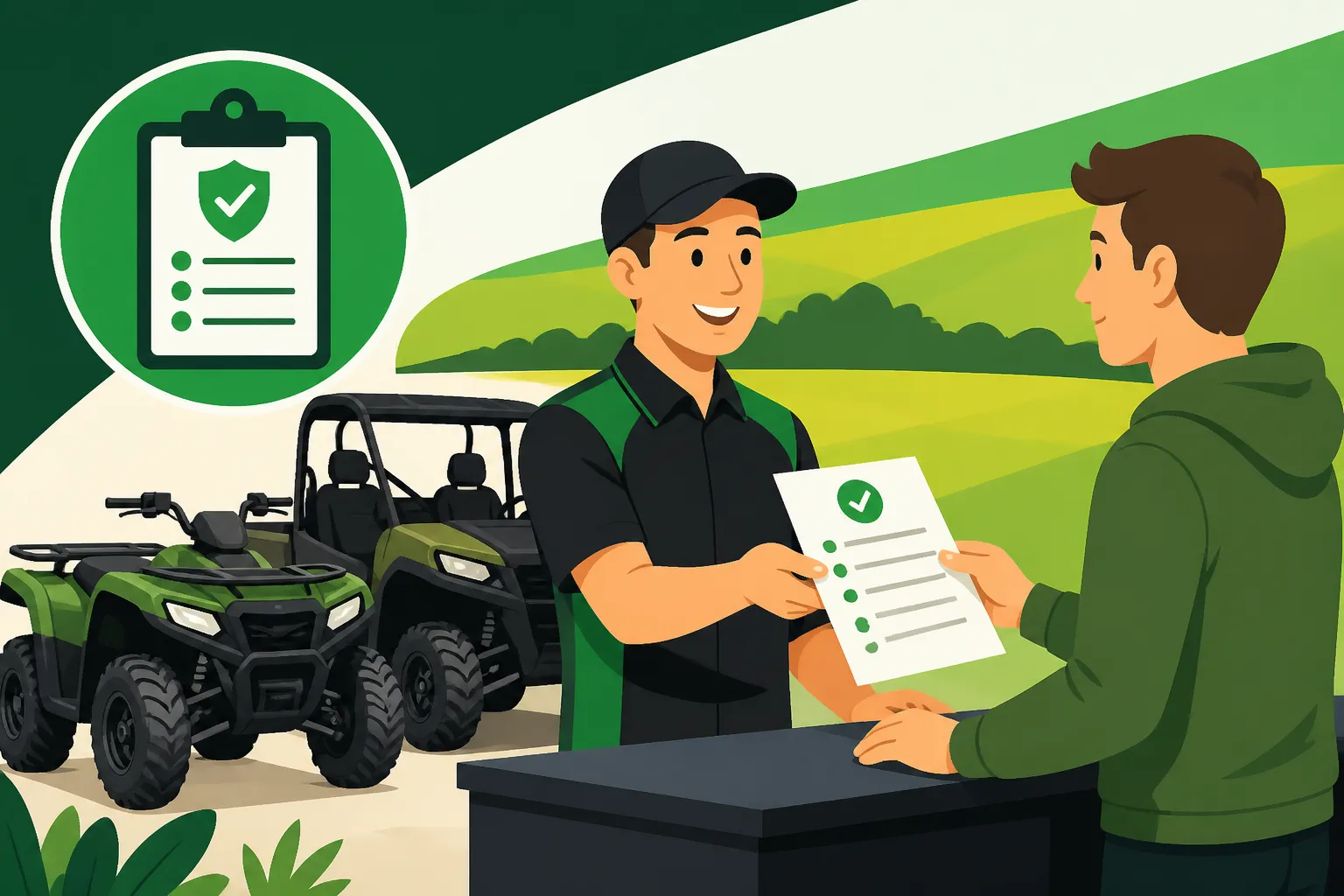
A reputable Saskatchewan dealer will perform a comprehensive pre-delivery inspection (PDI) before your machine leaves the lot. This isn't just a formality; it's a critical step to ensure your ATV or UTV is safe, fully operational, and meets manufacturer specifications. The PDI checklist often includes things like: checking all fluid levels (oil, coolant, brake fluid), inspecting tires for proper pressure and damage, ensuring all lights and controls work, testing the brakes, and confirming that any ordered accessories are correctly installed.
You should ask your dealer about their PDI process and what's included. Some dealers even provide a copy of the completed PDI checklist for your records, which is an excellent practice. Don't hesitate to point out anything that doesn't look quite right during your final walk-around of the machine. It's much easier to address any issues while you're still at the dealership than to discover them after you've trailered your machine all the way home to the farm or cabin.
Final Paperwork Review and Sign-Off
Before you sign on the dotted line for the last time, take a few minutes to carefully review all the final paperwork. This includes your bill of sale, the MSO/MCO, warranty documents, and the final invoice. Cross-reference the VIN on all documents with the actual VIN on your machine one last time. Confirm that all personal details, purchase amounts, and taxes are correct. Look for any discrepancies or terms you don't understand and ask for clarification.
This is also the time to ensure you have proof of your [Saskatchewan Insurance Requirements for Riders]. While the province doesn't mandate registration, it absolutely requires all ATV/UTV operators to carry at least $200,000 in third-party liability insurance. Some dealers might offer to help you arrange insurance, or you'll need to show proof from your own provider. Having your insurance in place before you drive off the lot is crucial, not just for legal compliance, but for your own financial protection.
Getting Your Machine Home
Once all the paperwork is signed and you've completed your final inspection, it's time to get your new machine home. If you're trailering it, ensure your trailer is properly hitched, the lights are working, and the machine is securely tied down. Always use appropriate ramps and loading techniques to prevent accidents. If you're driving it home directly from the dealer (only if permitted by local bylaws and done safely), remember that [Saskatchewan ATV Road Rules Explained] are strict, and you'll need to follow them to the letter.
Consider the route you'll be taking and any local bylaws that might apply. For instance, some municipalities have specific rules about where and when ATVs can be operated on local roads or ditches. Having a plan for safe transport is just as important as the purchase itself.
Why This Paperwork Matters for Future Ownership and Insurance
Without a central provincial registry, the paperwork you receive from your dealer becomes the backbone of your ATV or UTV's history and legal standing. It’s not just about the purchase; it impacts future sales, insurance claims, and even how you prove ownership if your machine is ever stolen.
Proving Ownership
In Saskatchewan, because there's no official provincial registration or title for ATVs, your bill of sale is the primary document used to prove ownership. This becomes incredibly important in several scenarios. If your machine is ever stolen, law enforcement will rely on your detailed bill of sale and the VIN to identify your property. Without it, recovering a stolen machine can be significantly more challenging. It also comes into play if you ever need to demonstrate ownership for insurance purposes or in a dispute.
It's not uncommon for people to purchase ATVs privately and neglect to get a proper bill of sale, which can lead to huge problems. The comprehensive bill of sale from a dealer sets you up with solid documentation from day one. This makes it easier to navigate situations where you need to show [How to Prove You Own an ATV in Saskatchewan] to authorities or other parties.
Future Sales and Transfers
When the time comes to sell your ATV or UTV, the paperwork you received from the dealer will be essential for the next owner. A potential buyer will want to see a clear chain of ownership, and your original bill of sale (and potentially the MSO/MCO if it's still the first sale) provides that. Without it, buyers might be wary, as there's no provincial database to cross-reference ownership. You might find yourself in a situation where you need to provide extra assurances to a new buyer.
If you sell your machine privately, you'll then issue your own bill of sale to the new owner, creating the next link in the ownership chain. Services like LawDepot can provide templates for [Saskatchewan Bills of Sale for a Quad] to ensure you include all the necessary legal details for a smooth private transaction, mirroring the thoroughness of a dealer's document. This ensures the buyer has the proper proof of ownership, just as you received when you bought it.
Insurance and Financing
Having proper documentation from your dealer is also crucial when dealing with insurance companies and financial institutions. When you apply for insurance, your provider will ask for the machine's VIN and details, often requiring a copy of your bill of sale as proof of purchase and ownership. This paperwork helps the insurer properly identify and value your ATV or UTV, ensuring you get the right coverage. Dealing with [Saskatchewan Insurance Claims Without a Plate] is much smoother when you have all your original purchase documents readily available.
Similarly, if you're [Financing an Unregistered Machine in Saskatchewan], the lender will require substantial documentation. Your bill of sale and MSO/MCO serve as crucial evidence of the asset you are financing. They verify the machine's existence, its new status, and your legal claim to it. Lenders rely on these documents in the absence of a provincial registration or title to secure their interest in the loan. Always keep these documents secure for the duration of your loan and insurance policy.
| Document Type | Issued By | Purpose | Why It's Important |
|---|---|---|---|
| Bill of Sale | Dealer | Proof of purchase & ownership, sales tax record | Primary legal document for ownership in SK (no registration) |
| Manufacturer's Statement/Certificate of Origin (MSO/MCO) | Manufacturer (via dealer) | Verifies machine is new from factory, first sale to retail | Essential if moving to a province/state requiring registration; proves new status |
| Warranty Information | Manufacturer (via dealer) | Details coverage for defects, terms & conditions of repair | Protects your investment; outlines what manufacturer will fix |
| Owner's Manual | Manufacturer | Operating instructions, maintenance schedule, safety guidelines | Essential for safe operation, proper maintenance, and troubleshooting |
| Final Invoice | Dealer | Breakdown of purchase price, taxes, fees, and payments | Financial record; proof of taxes paid; clear cost transparency |
| Insurance Policy/Card | Insurance Provider | Proof of liability coverage (minimum $200k required in SK) | Legal requirement for operation; financial protection in case of accident |
Disclaimer
This article is for general informational purposes only and does not constitute professional advice. Laws, prices and regulations vary by location and change over time. Consult a qualified professional for guidance on your specific situation.