Saskatchewan Riding Near Lumsden
Lumsden’s Qu’Appelle Valley setting can make an ATV ride look easy to plan: find a road, a track or a patch of open land and head out. The difficult part is knowing what you’re allowed to ride. This guide explains how to assess access near Lumsden, check local rules, plan a responsible route and avoid treating a map line as permission.
What to Know About ATV Riding Near Lumsden
The landscape is appealing, but access is not automatic
Lumsden sits in the Qu’Appelle Valley northwest of Regina, where the landscape can shift quickly between valley terrain, farmland, roads and developed areas. That variety makes the region attractive to riders looking for a change from flat, open riding. It also makes route planning more complicated: land that appears open from a road or on a digital map may be privately owned, leased, restricted or unsuitable for motorized use.
A visible track is not proof that ATVs are allowed on it. It may be a farm access lane, a maintenance route, a private trail or a path used for a purpose that does not include recreational riding. Likewise, finding a route online—or seeing another vehicle use it—does not establish that you have permission to follow it. Start by identifying the land and the person or authority responsible for access.
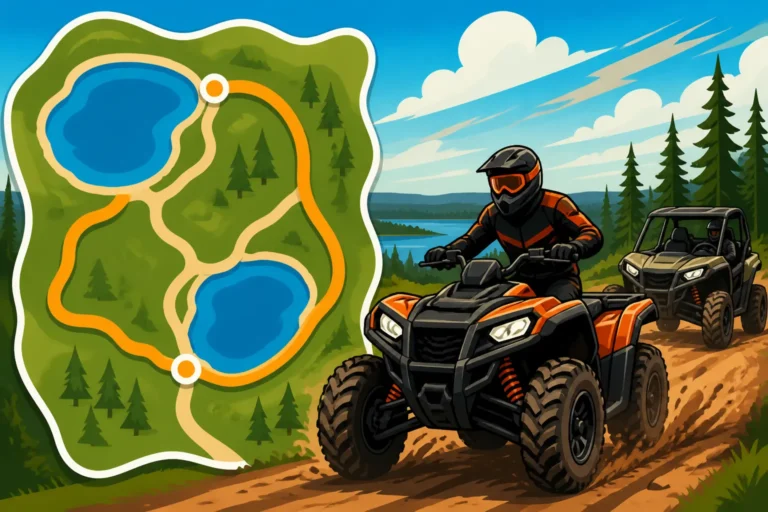
If you’re exploring unfamiliar roads or trails, treat mapping tools as planning aids rather than permission records. For example, onX Offroad may help you organize candidate routes and review mapped information, but you still need to verify access with the relevant landowner, municipality or land manager. Confirm the status of each section before unloading your machine.
Find out what is actually open to riding
There may not be a clearly marked, continuous public ATV trail network right beside Lumsden. That means you should avoid assuming that a route can be pieced together from road allowances, field edges and tracks. Ask the Town of Lumsden or the relevant rural municipality about local rules, permitted roads and any posted restrictions in the area you plan to visit. If your route crosses land outside the town, the town’s answer may not cover that section.
A few helpful starting points are [Saskatchewan Trails Within an Hour of Regina] and [Saskatchewan Riding Areas Reachable in a Day]. These broader guides can help you compare the Lumsden area with established riding destinations, but a nearby location is not automatically a legal riding area. Verify the current access rules for the exact destination before setting out.
For a reality check, sketch your proposed route in segments. Mark where it begins, what roads or trails it follows, and where it crosses or approaches private land, a lease or a protected area. If you cannot establish who manages a segment or whether recreational riding is allowed there, leave that segment out until you can confirm it.
How to Check Access and Local Rules
Confirm who controls each part of your route
A practical route check begins with land status, not with the machine. Near Lumsden, a route may involve town streets, rural municipal roads, private agricultural land, Crown land or a managed recreation area. Each can have different rules. Permission from one landowner does not give you permission to cross the next property, and a municipal bylaw does not grant access across private land.
For private land, contact the owner or occupier before riding. Ask specifically whether ATVs or UTVs are permitted, where you may travel, whether passengers or guests are covered, and whether there are conditions such as speed limits, gates or seasonal restrictions. Get the permission in a form you can keep, such as a text or email. A vague “people ride around here” is not a substitute for permission from the person with authority over the land.
For Crown land, check whether the area is open to the kind of use you’re planning and whether an order or restriction applies. Do not assume that public ownership means unrestricted motorized access. If you’re considering Crown land as part of a longer outing, [Saskatchewan Crown Land Riding Explained] and [Saskatchewan Crown Land Access Rules] are useful starting points for understanding why the specific location and access conditions matter.
Check roads, ditches and municipal bylaws separately
Riding beside a road is not the same as riding on the road. Saskatchewan’s ATV rules include restrictions on where a machine can travel in relation to a highway’s travelled portion, and local bylaws can further affect where riding is permitted. A route that looks like a broad ditch on a map may narrow, disappear or become unsafe in the field. Don’t assume that a road allowance is a general-purpose ATV trail.
Before using any road or ditch near Lumsden, check the municipality responsible for that specific stretch. A road may pass through more than one jurisdiction, and rules can change as you approach a town or village. [Saskatchewan Ditch Riding Between Towns] and [Saskatchewan Municipalities With ATV Bylaws] can help you frame the questions to ask. Confirm the exact road, not just the general area.
| Route section | What to verify before riding | A safer planning choice |
|---|---|---|
| Town street | Whether the local bylaw permits ATV or UTV use on that street | Avoid town streets unless the municipality confirms they are permitted |
| Rural municipal road or ditch | The municipality’s rules, road conditions and applicable riding restrictions | Ask about the named road or road segment |
| Private farm track | Permission from the landowner or occupier, plus any conditions | Keep written permission and follow the agreed route |
| Crown land | Whether motorized riding is allowed and whether restrictions or closures apply | Confirm with the responsible land manager before travelling |
| Park or designated trail | Whether machines are permitted on that particular trail and whether any permit or form is required | Use signed, designated routes and follow posted instructions |
A useful question for a municipal office is: “Can I ride an ATV on this specific road or ditch, and are there sections where the rule changes?” That is more likely to get a practical answer than asking whether “ATV riding is allowed around Lumsden.” For more detailed local questions, [Questions Worth Asking a Rural Municipality] can help you prepare before calling.
Choosing and Planning a Ride
Compare the kinds of riding available
If you are starting near Lumsden, you may be comparing a local ride on land where you have permission with a trip to a managed trail system. Those are different kinds of outings. A private-land ride can offer flexibility, but it depends on the landowner’s permission and boundaries. A designated trail area may have clearer routes and posted instructions, but you still need to check machine access, seasonal status and any requirements for that location.
| Riding option | Best suited to | Main thing to confirm |
|---|---|---|
| Permission-based private land | A short ride with a known landowner or host | Boundaries, route, guests and any conditions |
| Municipal road or ditch where permitted | A road-connected trip where local rules allow riding | Exact bylaw, route limits and road conditions |
| Designated trail area farther away | Riders who want a marked route and defined trail system | Current access, closures, permits and machine restrictions |
| Unverified track found on a map | No one until access is confirmed | Who controls the land and whether riding is allowed |
A marked destination farther from Lumsden may be a better choice than trying to assemble an uncertain local route. Resources such as [Saskatchewan ATV Trails: Crown Land and Ditches] and [Best Saskatchewan ATV Trails for Beginners] can help you look beyond the immediate area. Treat these as planning leads: check with the trail operator or land manager for the exact trail, operating conditions and any requirements before loading your machine.
When reviewing a route in onX Offroad or another mapping tool, note where the proposed line meets property boundaries, water, roads or developed areas. Then verify each crossing through the relevant authority or landowner. A line shown on a screen is only a clue to investigate. It does not confirm that the route is open, maintained or legal for an ATV or UTV.
Build a realistic route before you leave
Keep a first ride conservative. Choose a route with known starting and ending points, avoid adding unverified shortcuts, and make sure the vehicle used to haul your ATV or UTV can reach the unloading area without relying on an unconfirmed access road. If you’re travelling with a group, share the planned route and meeting point with everyone before departure.
Think through the conditions you may encounter. Valley terrain and rural roads can create changes in visibility, surface and drainage. A route that looks straightforward in dry weather may become difficult after rain, and a narrow or soft section can be a problem for a heavier side-by-side. Do not cross private fields, fences or gates simply to get around a muddy spot. Turn back or use a route you have confirmed is permitted.
Download or save route information for use when reception is poor, and carry a backup way to navigate. A mapping app can help you follow your plan, but local signs, closures and conditions on the ground still matter. If a posted notice conflicts with what you expected from a map, stop and resolve the uncertainty before continuing.
Ride Safely and Respect the Area
Prepare the machine and the people riding it
Before leaving home, check the machine’s basic condition: tires, brakes, throttle, steering, lights, fuel and any equipment you rely on for recovery. Bring water, weather-appropriate layers, a first-aid kit, basic tools and a way to communicate. A small ride close to home can still become a long delay if a machine breaks down or a route is blocked.
Make sure every rider understands the plan and the rules that apply to the outing. Saskatchewan has requirements for such matters as licensing, insurance, helmets and rider age, and requirements can differ depending on a rider’s circumstances. Review [Saskatchewan ATV Road Rules Explained] and [Saskatchewan Insurance Requirements for Riders] before you go. If children or newer riders are joining, check the rules that apply to their ages and level of supervision rather than relying on a casual assumption.
A UTV does not make route choice or safety planning less important. Confirm that the machine is allowed on the route, that passengers are seated in positions designed for them, and that everyone uses the safety equipment appropriate to the machine. Stay within the conditions you and your group can handle. If visibility, weather or ground conditions change, shorten the ride rather than pushing on to complete a planned loop.
Leave room for residents, farm work and wildlife
The Lumsden area is a working landscape as well as a place to visit. Farm vehicles, livestock, gates and private driveways may be part of the route environment. Keep noise and speed under control, give people and animals space, and never assume a closed gate is an invitation to pass through. If you were given permission to cross land, follow the landowner’s instructions exactly and leave gates as agreed.
Stay on the route you were authorized to use. Cutting across crops, wet ground or a field edge can damage property and create conflict for future riders. Avoid spinning tires or making a new track to bypass an obstacle. If a route becomes impassable, turn around and contact the person who granted permission if needed.
Wildlife and changing weather deserve the same attention as property boundaries. Slow down where sightlines are limited, avoid harassing animals and do not ride through areas subject to a closure. Check for local notices before departing, especially when conditions are dry or access is affected by fire risk. For a broader look at seasonal closures, [Saskatchewan Wildfire Season Rules for Riders] offers a useful planning reference.
A Simple Pre-Ride Checklist for Lumsden
Confirm the route, permission and requirements
Before loading up, write down the route you intend to ride and identify who manages each part. Confirm permission for private land, check the relevant municipality’s rules for any road or ditch section, and verify access with the responsible land manager for Crown land or a designated trail. If one section remains uncertain, change the route rather than hoping the answer will be obvious when you arrive.
Check whether the ride has requirements beyond access. A designated trail or park may have its own rules, permit process or use form. A municipal plate scheme, where available, is not a replacement for permission to ride on land, and a plate does not necessarily authorize riding across multiple jurisdictions. Keep paperwork and any permission details accessible during the outing.
Before leaving, check the weather, local notices and the condition of your machine. Tell someone where you expect to ride and when you plan to return. Build in time to turn around if a road is closed, the ground is too soft or you encounter a boundary you cannot verify.
Use this checklist at the trailhead
- Confirm the exact route and the authority responsible for each section.
- Carry written permission for private land where applicable.
- Check municipal bylaws for any road or ditch riding.
- Verify that Crown land or designated trails are open to your machine.
- Review applicable rules for licensing, insurance, helmets and age.
- Carry identification, proof of insurance and relevant documents.
- Inspect the machine and bring basic recovery and emergency supplies.
- Share your route and expected return time with someone.
- Follow posted signs and turn back when access is unclear.
A little planning may mean choosing a ride outside Lumsden instead of forcing an uncertain local route. That is not wasted effort. It helps protect landowner relationships, reduces the chance of a ticket or conflict, and makes the day more enjoyable because you are not constantly wondering whether the next turn is allowed. When in doubt, ask the person or office responsible for the land before you ride.
Disclaimer
This article is for general informational purposes only and does not constitute professional advice. Laws, prices and regulations vary by location and change over time. Consult a qualified professional for guidance on your specific situation.