Saskatchewan Wildfire Act Duties for Riders
Saskatchewan’s wildfire rules matter to ATV and UTV riders even when a machine is being used for recreation. A hot exhaust, packed grass or a ride through a closed area can turn a routine outing into a fire hazard—or a costly legal problem. Understand the duties that apply, prepare your machine, and check for local restrictions before unloading.
What the Wildfire Act means for ATV and UTV riders
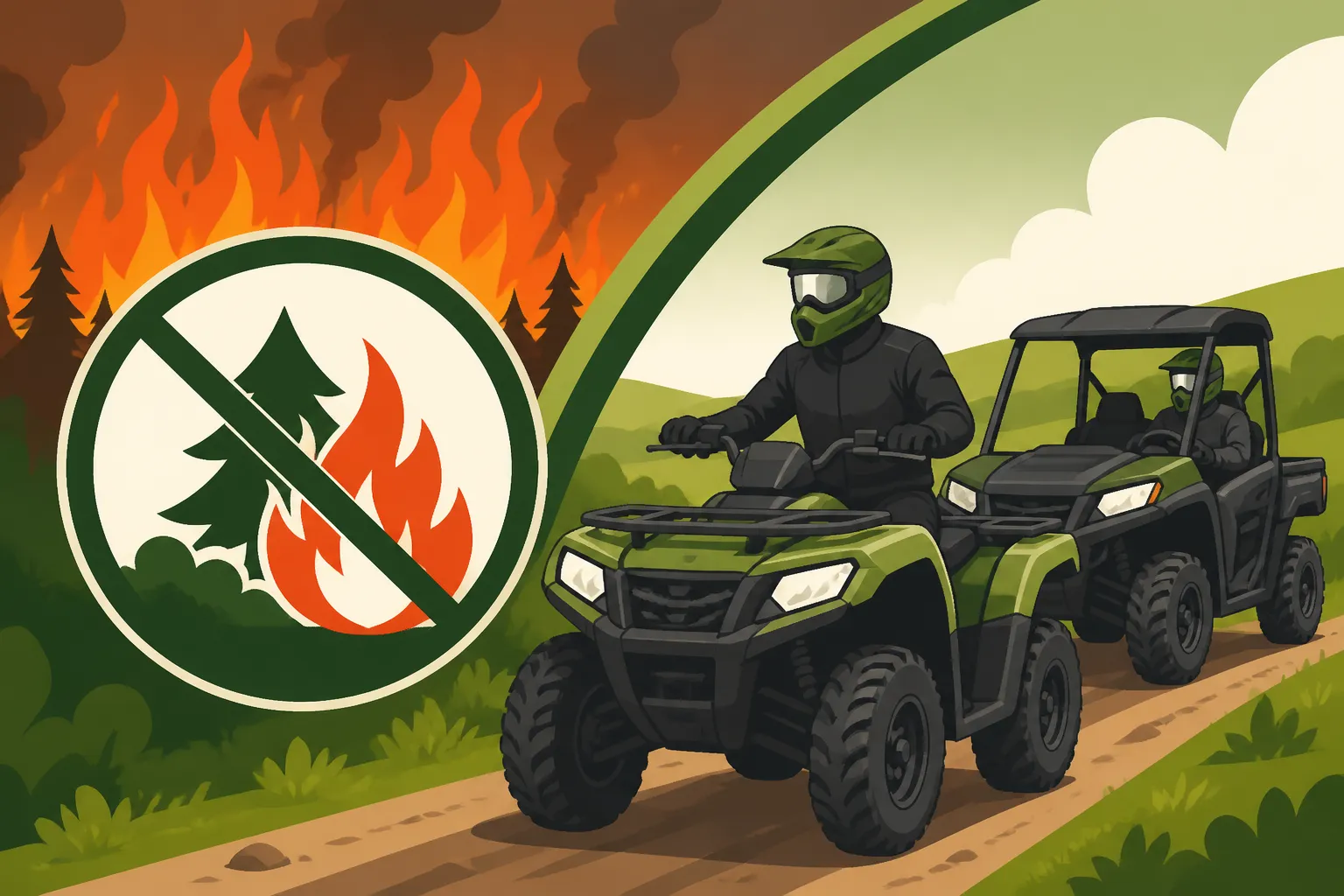
The Wildfire Act and related restrictions are meant to prevent fires and limit their spread. For riders, the practical message is straightforward: take reasonable steps to keep your machine from starting a fire, follow current restrictions, and do not assume that an open trail or a past trip means riding is allowed today.
Wildfire duties are separate from the ordinary rules for ATV operation. Being insured, having permission to access land, or having a trail permit does not override a fire closure. Likewise, being allowed to ride in an area does not remove your responsibility to manage ignition risks.
Fire-season timing is a useful starting point, not a complete decision rule. Saskatchewan’s listed fire season runs from April 1 to October 31, but the risk and restrictions can change within that period. Check Saskatchewan Wildfire Season Dates and Saskatchewan Wildfire Season Rules for Riders before a trip, and pay particular attention to current fire bans, closures and local orders. Conditions can also make an area risky outside the dates riders commonly associate with fire season.
The main responsibilities
For an ATV or UTV rider, the duties and sensible precautions fit into four connected tasks:
- Prevent ignition. Keep the machine in safe condition and clear of material that could contact hot or moving parts.
- Carry appropriate fire-suppression equipment. Know what equipment the applicable rule or order requires, and make sure it is accessible and usable.
- Inspect as you ride. Grass, leaves and other debris can collect on a machine during a day out, so a clean machine at the trailhead may not stay clean.
- Obey closures and restrictions. A fire ban or land-management order can close an area even if the route is normally open.
These are not interchangeable. Carrying a shovel does not make it legal to ride through a closed area, and staying on a designated trail does not excuse an unsafe machine.
When the rules are stricter than ordinary precautions
A general fire-season duty can apply alongside a specific restriction for a particular place or time. An order may restrict access, close a route, limit activities or require particular precautions. The details can vary, so read the actual notice rather than relying on a short social-media post or a sign seen on an earlier visit.
Riders sometimes treat “fire ban” as a single, uniform rule. In practice, restrictions can come from different authorities and cover different lands or activities. A municipal restriction, a park closure and a provincial land order may not have identical boundaries. Confirm which restriction applies to the land you plan to cross.
A permit, club membership or landowner’s permission does not cancel a wildfire restriction issued by an authority with jurisdiction over the area. If a route crosses several types of land, check the rules for each part of the route. More on closures and land access is covered in Saskatchewan Wildfire Closures and Riding and Saskatchewan Crown Land Access Rules.
Prepare the machine before leaving
A pre-ride check is one of the easiest ways to reduce risk. The goal is not to turn every recreational outing into a complicated inspection. It is to catch obvious hazards before they meet dry grass, brush or debris.
Start with the places where vegetation can collect or touch heat. Check around the exhaust, engine, skid plates, guards, suspension and other areas where leaves, grass or mud may lodge. Look for damaged heat shields, loose parts, leaking fluids, exposed wiring and anything rubbing against a hot component. If you find a problem that could create heat, sparks or contact with dry material, fix it before riding.
Clear combustible debris
Dry grass and other plant material can build up beneath a machine, especially after travelling through long grass, brush or a trail with overhanging vegetation. Material trapped close to hot components can ignite. That is why a clean-looking exterior is not enough: inspect underneath and around covered areas too.
Use Your Legal Duty to Check for Combustible Debris as a reminder to make the check part of your routine, not a one-time chore at home. Before setting out:
- Park on a safe surface and shut the machine off.
- Allow hot components to cool before reaching into tight spaces.
- Look for grass, leaves, twigs and other material caught under guards or near the exhaust.
- Remove debris carefully without damaging wiring, hoses or protective components.
- Check for leaks or damage that could create an ignition risk.
- Secure any loose cargo or equipment that could contact hot parts.
Do not reach into a hot engine area or use a method that could start a fire while cleaning. If debris is packed into a place you cannot safely access, let the machine cool and use an appropriate tool or get help. A hurried attempt to clear vegetation beside a hot exhaust can create the hazard you are trying to prevent.
A machine can collect debris again after a few minutes of riding. A thorough check at home helps, but it does not replace checks during the outing.
Carry suppression equipment you can use
Carry the fire-suppression equipment required by the rules that apply to your ride, and make sure the equipment suits the machine and is ready to use. Requirements can depend on the current regulation, order, land and activity. Check the applicable direction rather than assuming that a particular item or setup is enough everywhere.
A shovel and an extinguisher may be useful parts of a practical setup; see Fire Suppression Gear on a Machine and Carrying a Shovel and an Extinguisher on Board. Whatever you carry, it should be secured so it cannot fall off, interfere with control of the machine or become a hazard in a rollover. Keep it reachable without unloading the entire vehicle.
A compact extinguisher has limited capacity. It may help with a small, early-stage fire, but it is not a substitute for calling emergency services or leaving an unsafe area. Know how your equipment works before an emergency, check its condition, and do not put yourself at risk trying to control a fire that is growing or spreading.
Do not rely on an accessory listing or a product label alone to decide what the law requires. If you are buying fire equipment, confirm the required type and specifications with the relevant authority or land manager. An online retailer such as Amazon may offer equipment, but the retailer’s product description is not a legal determination.
Make the pre-trip check a whole-machine check
It is easy to focus only on the exhaust, but a broader inspection is more useful. Check that the machine is in good working order, protective parts are in place, and nothing is dragging or rubbing. Look at the route too: dry vegetation, wind, recent weather and the possibility of getting stuck can all affect the consequences of a small ignition.
A passenger should know where the equipment is and what to do if the operator notices smoke or a fire. If you ride in a group, agree on a simple plan before leaving: who calls for help, how riders regroup, and which direction to leave if the route is blocked.
Inspect throughout the ride
Fire prevention is not finished when the machine passes its driveway check. Grass and debris can collect during a ride, while heat, damage or a change in conditions can create a new hazard. A quick inspection at sensible stops can catch problems before they become serious. See Inspecting Your Machine Throughout a Day of Riding.
Stop and check after travelling through long grass, brush or an unusually dry section. Also check after the machine has been stuck, dragged through debris, taken a hard impact or developed an unfamiliar smell or sound. If you smell burning, see smoke, or notice debris near a hot component, stop in a safe place and investigate. Do not keep riding in the hope that the smell will disappear.
Match your riding to the conditions
A marked trail does not remove the need to ride carefully. Stay on permitted routes and avoid unnecessary detours into dry vegetation. A tire, exhaust or damaged part contacting dry material can create risk, and driving off-trail can damage land or expose the machine to hazards that are difficult to see.
The fire risk can rise when vegetation is dry and weather is hot, windy or unusually dry. Pay attention to the conditions at the trailhead and along the route. If conditions worsen or a restriction is announced, be ready to shorten or cancel the ride. A plan that was reasonable in the morning may no longer be safe later in the day.
During a break, park where the machine is not resting in dry grass or against combustible material. Avoid leaving a running machine unattended. If you need to stop beside a route, choose a safe, clear location without blocking access for other riders or emergency vehicles.
Keep the group from spreading the problem
Group rides can make an incident harder to manage if riders are separated or move in different directions. Before riding, agree that anyone who sees smoke or fire will alert the group and stop in a safe place. Keep communication brief and clear. Do not have every rider ride toward a fire to investigate.
If someone needs to leave the route, tell the group where they are going and avoid creating a second emergency. Keep the trail clear for responding crews where possible. Never assume a fire is small simply because flames are not visible; smoke, wind and dry ground can make it grow quickly.
Check closures, bans and permission before you ride
A fire restriction can affect access even where riding is normally permitted. Before hauling a machine, check the current notices for the specific riding area and the land it crosses. Do not rely only on a general trail map, an old trip report or an online route that still appears to be available.
Check for:
- Fire bans or restrictions on activities that could cause ignition.
- Closures of Crown land, parks, trails or roads.
- Orders affecting a particular district or land-management area.
- Local rules from a municipality, club or land manager.
- Any conditions attached to access permission or a permit.
For current notices, use Saskatchewan Fire Ban Lookups and the official information channels responsible for the area. If it is unclear whether a closure covers your intended route, ask the land manager or the appropriate office before riding. A map boundary can be easy to misread, especially when a trip crosses different jurisdictions.
Do not treat a permit as a fire clearance
A trail permit or landowner’s consent answers a different question from a wildfire closure. Permission may let you use a route under normal conditions, but it does not guarantee the route is open during a fire restriction. Check both access permission and current fire status.
This matters especially on routes that connect public land, private land, park trails or municipal roads. A trip may be open for one section and closed for another. Plan an alternate route, but do not use an alternate that crosses land where you lack permission or that is also subject to a closure.
The distinction between ordinary trail access and fire restrictions is important in Saskatchewan’s parks and on Crown land. Read Saskatchewan Park Regulations for Machines alongside the current fire notice, and check The 2025 Ban That Closed Crown Land to Quads for an example of how a temporary restriction can change access. A past closure is not proof that a current closure exists, just as a route’s usual status is not proof that it is open today.
Be ready to cancel
If the route is closed, do not ride around a barrier or look for an unofficial way in. If there is no reliable information about whether the area is open, postpone the trip until you can confirm it. The cost of a wasted drive is minor compared with the risk of entering a restricted area or creating an emergency.
If you discover a closure after unloading, secure the machine and leave by a permitted route. Do not assume you can continue to a nearby trailhead or campsite if the order closes the area. Follow posted instructions and avoid blocking gates or access points used by emergency crews.
What to do if you see smoke or a fire
Treat smoke, a burning smell or flames as a reason to stop and assess, not as an invitation to ride closer. Your first priorities are people’s safety and getting a clear report to emergency responders.
- Stop in a safe location away from dry vegetation and the suspected fire.
- Alert other riders and move the group away from immediate danger.
- Call emergency services when there is an active fire or an immediate threat. Give the clearest location you can, including a trail name, road, landmark or map coordinates if available.
- Follow instructions from emergency responders and land managers.
- Use a fire extinguisher or other equipment only if the fire is small, you have a safe escape route, and attempting to control it will not put anyone at risk.
- Leave the area if the fire is spreading, wind changes direction, smoke reduces visibility or you are unsure of the safest route.
Do not block a road or trail that responders may need. Do not ride through smoke or toward a fire to get a better view. Keep the group together only if doing so is safe; people should not delay leaving a dangerous area while trying to account for every machine.
If your machine appears to have started a fire, stop it only if you can do so safely, get everyone clear and call for help. Do not keep riding to escape the location if doing so could spread flames or ignite more vegetation. Follow emergency instructions rather than trying to solve the situation alone.
Report what you can, not what you guess
A useful report is specific and concise. Describe what you observed, where it is, whether people or structures may be at risk, and how responders can reach the location. If you do not know the exact location, say what landmarks, trail intersections or road access points you can identify. Avoid presenting a guess as a confirmed fact.
Do not post an unverified fire location as a substitute for contacting emergency services. Public posts may help other riders avoid an area, but they do not ensure responders have received the information. Do not enter a closed area to take photographs or confirm whether the fire has been contained.
A practical rider checklist
A short routine makes the duties easier to remember. Use this before loading, again at the trailhead, and during longer rides when conditions or the route make debris buildup more likely.
| When | What to check | Why it matters |
|---|---|---|
| Before the trip | Fire bans, area closures and land access | A normally open route may be restricted |
| Before loading | Machine condition, leaks, loose parts and protective components | Damage can increase heat or ignition risk |
| At the trailhead | Grass or debris near hot parts; required equipment secured and accessible | The machine may have collected material during transport or staging |
| During the ride | New debris, burning smells, smoke, damage or changing conditions | Risk can develop after the initial inspection |
| Before leaving a stop | Machine parked clear of dry vegetation; group accounted for | Reduces ignition risk and helps prevent separation |
| If smoke or fire appears | Stop safely, move away and notify emergency services when needed | Early, accurate reporting helps responders act |
The checklist is a practical aid, not a replacement for the rules that apply to a specific area. Review Your Legal Duty to Check for Combustible Debris, Fire Suppression Gear on a Machine and current local notices when planning a ride. If you are uncertain about a requirement, ask the responsible authority before entering the area.
Penalties are only part of the risk
Breaking a wildfire restriction can have consequences beyond a ticket. A fire can threaten lives, property, wildlife and access to recreation areas. It can also lead to closures that affect an entire riding community. Saskatchewan’s wildfire penalties can be severe; review [Saskatchewan Wildfire Penalties for Riders] for the consequences that may apply, and confirm current rules with the official source.
The safest approach is to treat fire prevention as part of ordinary ride preparation: check the machine, carry required equipment, inspect during the day, and confirm that the route is open. When risk or uncertainty is high, choosing another day or another permitted area is the responsible decision.
Frequently Asked Questions
When is Saskatchewan fire season for ATV riders?
The listed season runs from April 1 to October 31, but restrictions and fire risk can change. Check current official notices before each ride and do not rely on the calendar alone.
Do I need to carry a shovel or fire extinguisher?
The equipment requirement can depend on the applicable rule, order, land and activity. Check the current direction for your riding area and carry equipment that meets it. A shovel or extinguisher does not make a closed area open.
Can I ride a trail if I already have a permit?
Not necessarily. A permit does not override a wildfire closure or restriction. Confirm both that you have access permission and that the route is currently open.
What should I do if I see smoke while riding?
Stop in a safe place, alert your group, move away from danger and call emergency services if there is an active fire or immediate threat. Give responders the clearest location details you can and follow their instructions.
Disclaimer
This article is for general informational purposes only and does not constitute professional advice. Laws, prices and regulations vary by location and change over time. Consult a qualified professional for guidance on your specific situation.