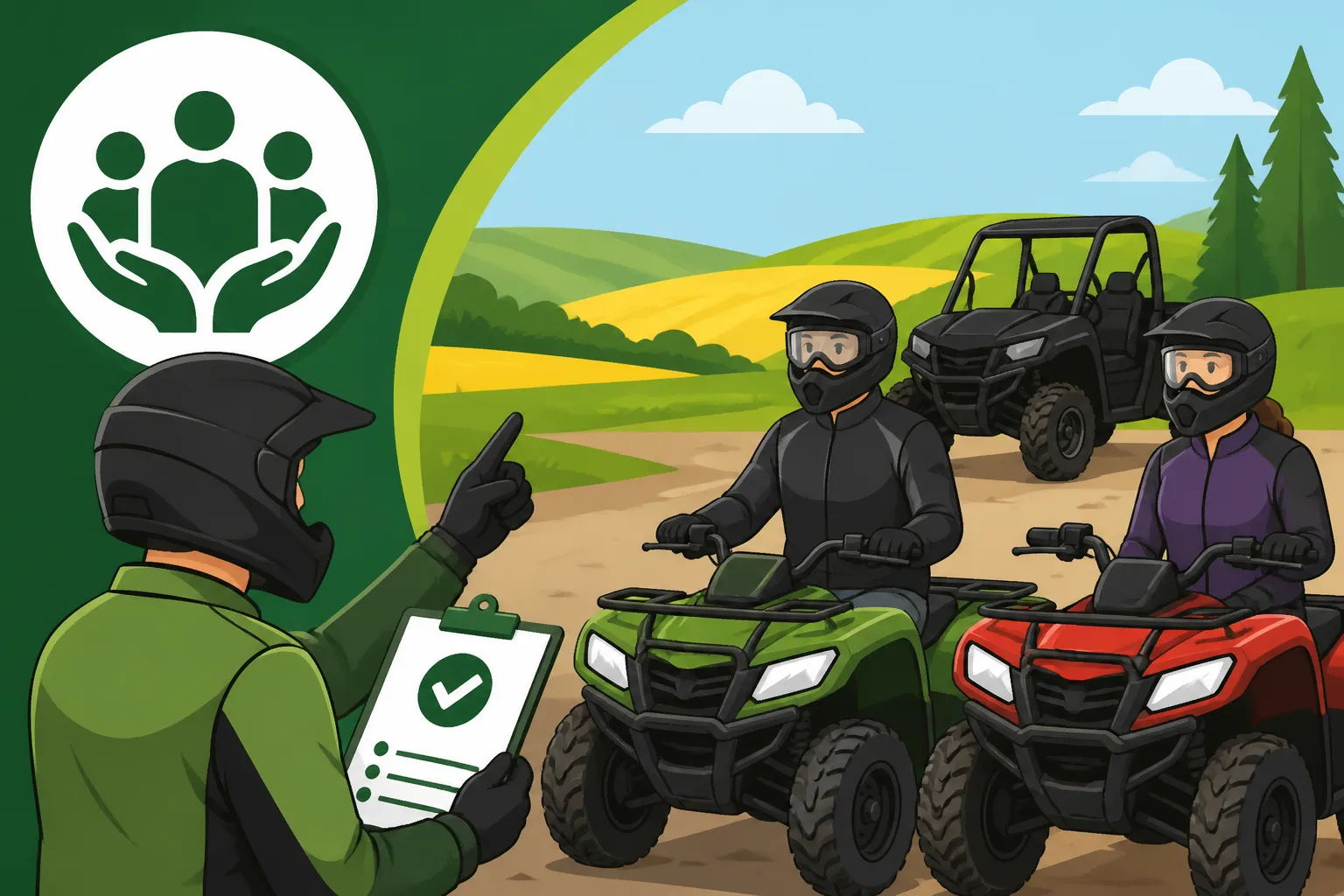
Taking an ATV Course From a Safety Council
Taking an ATV course through a safety council can build practical skills, but it may also matter for a young rider’s legal eligibility in Saskatchewan. The key is choosing a course that meets the province’s requirements, not simply one that promises general ATV training. Here’s how to check whether a course fits your rider, what to ask before enrolling, and what a certificate does—and does not—replace.
What an ATV safety course can do in Saskatchewan
A course can serve two different purposes: teaching safer riding and, in some cases, meeting a legal training requirement for a young rider. Those purposes overlap, but they are not interchangeable. A course that improves confidence is not automatically one that qualifies under Saskatchewan’s rules.
Saskatchewan does not require every adult ATV rider to take a safety course. For a rider who is old enough to operate without the youth restrictions, a course is generally a training choice rather than a general licence requirement. The situation is different for riders ages 12 to 15, who may need to meet a specific condition to ride legally. One possible route is qualifying training; another is riding with an eligible supervisor. The details matter, so check Saskatchewan ATV Age Requirements and Saskatchewan Youth Training Requirements before booking.
An approved course may allow a qualifying young rider to ride without the supervisor who would otherwise be required. That does not mean any certificate from any provider automatically counts. The course must meet the applicable requirements, and the rider must still follow the other laws that apply to ATV use. See How a Safety Course Replaces a Supervisor and Which Certificate Satisfies the Act for a Youth for the specific question to resolve before enrolling.
A course does not usually turn an ATV into a road-legal vehicle, create a provincial registration, or provide permission to ride on land where access is restricted. It also does not replace insurance, a helmet, or other operating requirements. Think of certification as one possible answer to a rider-qualification question, not as an all-purpose riding permit.
| What you need to know | What a course may help with | What it does not automatically provide |
|---|---|---|
| Rider eligibility | It may satisfy a training condition for a qualifying youth if the course is approved | Permission for a child below the eligible age to ride |
| Riding skills | It can teach controls, safe operation and hazard awareness | Proof that a rider can safely handle every machine or terrain |
| Supervision | It may replace a supervisor for a qualifying young rider | An exemption from every youth rule |
| Land access | It can prepare riders to make safer decisions | Permission to cross private land, a grazing lease or restricted Crown land |
| Riding administration | It can help clarify what training records to keep | Provincial ATV registration or a trail permit |
For adults, the case for training is practical rather than regulatory. A rider who is new to ATVs, returning after a long break, or moving from a small quad to a heavier side-by-side can benefit from instruction even when a course is not mandatory. A passenger who will take the controls on a trip may also need more than a quick explanation in a parking area.
Training is especially useful when the machine will be used for work. Farm and ranch riding can involve uneven ground, loads, towing, gates, livestock and changing weather. Those tasks create risks that differ from riding a maintained trail. A certificate does not make every work practice safe, but structured instruction can help a rider understand braking, balance, speed and terrain before a situation becomes urgent.
Choosing a course that qualifies
The most important question to ask before paying or arranging travel is whether the specific course satisfies the requirement that applies to the rider. Do not rely only on the words “ATV safety course” in an advertisement. Different programs may offer recreational instruction, youth training, employer training or a general orientation, and those programs may not have the same legal status.
Start with the current list of approved courses or providers from the relevant Saskatchewan authority. The provider can tell you what it offers, but confirm acceptance with the administrator responsible for the rule if the certificate is being used to meet a youth requirement. The list Which ATV Training Courses the Administrator Has Approved is a useful place to focus your questions, while [Saskatchewan Safety Course Providers] addresses how to look for an eligible option.
Before enrolling, ask the provider:
- Is this exact course accepted for the Saskatchewan youth training requirement?
- Does approval apply to this course, this instructor, or both?
- What minimum age or other conditions apply?
- Does the course include practical riding, or is it classroom-only?
- What document will the rider receive after successful completion?
- What information will appear on the certificate, and how long should it be kept?
- Does the student need to bring or use a particular type of machine?
- What happens if weather or another issue affects the practical portion?
Get a clear answer about the course itself, not a vague assurance that the provider “offers certification.” If the provider cannot explain what rule the certificate meets, pause and verify with the authority before booking. This is particularly important if a course is promoted for riders in another province or is part of a general outdoor program.
A safety council course may be one way to find structured instruction. For example, the Saskatchewan Safety Council is identified among the training options discussed in Courses Run by the Safety Council in Regina. Training availability can depend on location and scheduling, so check directly for the current course format, location, age eligibility and certificate details. If the nearest option is elsewhere, Finding an Instructor in Unity or Saskatoon may help you consider other locations.
If the safety council course is not available when you need it, ask whether another approved course meets the same requirement. Do not assume that a course from a dealer, private instructor, online provider or out-of-province organization qualifies simply because it covers similar topics. Similar content is not the same as formal acceptance.
Course duration is another practical consideration, but it should not be the main test of quality or eligibility. A program may include classroom instruction, machine familiarization and supervised practice, and the amount of time needed can vary. The title Why an ATV Safety Course Runs 6 to 8 Hours points to a common planning question; confirm the actual schedule with the provider rather than assuming every course uses the same format.
When comparing options, use this checklist:
- Confirm the rider’s age and the reason a course is being considered.
- Identify the exact rule the certificate is meant to satisfy.
- Verify that the specific course is accepted for that purpose.
- Confirm the location, schedule, format, age limits and equipment expectations.
- Ask what proof of completion is provided and how to obtain a replacement.
- Keep the certificate and any course records where they can be found later.
That process can prevent a frustrating mistake: completing a legitimate training course that is useful for riding but does not meet the particular legal requirement the family had in mind.
What to expect from a safety council course
Course content and delivery can vary, so ask the provider for a current outline. In general, quality ATV training should be more than a quick talk about controls. It should help riders think through how a machine behaves, how riding choices affect stability, and how to respond when the terrain or situation changes.
A course may include topics such as:
- Basic controls, starting and stopping
- Mounting and dismounting safely
- Braking, turning and managing speed
- Balance and body position
- Reading terrain and identifying hazards
- Carrying passengers only when the machine is designed for them
- Working around other riders and vehicles
- Protective equipment and pre-ride checks
- What to do after a breakdown or incident
Practical instruction matters because the machine’s weight, dimensions and handling are easier to understand through supervised practice than through a description alone. A rider may know where the brake lever is but still need coaching on how speed, a slope or a sudden turn changes control. If the course includes riding, ask what kinds of skills students practise and whether instruction is adjusted to their experience.
Not every participant will arrive with the same machine or experience. A child used to a small youth quad may need different practice from an adult who has operated farm equipment but is new to ATVs. Tell the provider about the rider’s age and experience in advance. Ask whether the course uses provider machines, participant machines, or a mix, and whether the instruction applies to a side-by-side as well as a quad. Do not assume that experience on one type automatically prepares someone for another.
A course is also a chance to learn habits that are easy to overlook when a rider learns informally from family or friends. That can include checking controls and tires before riding, matching speed to visibility and surface conditions, wearing suitable protective equipment, and leaving enough space between machines. It can also encourage riders to stop and reassess rather than trying to push through unfamiliar terrain.
Training cannot remove every risk. A certificate does not guarantee that a rider can manage a powerful machine, ride in poor conditions, or make sound decisions under pressure. The student still needs practice appropriate to their ability, and a parent or experienced adult should be realistic about what a young rider can handle. A smaller machine, a familiar practice area and direct supervision can be sensible even when the rider has completed a course.
Preparing the rider
Before course day, confirm the practical details instead of guessing. Ask what clothing and footwear are required, whether the rider needs a properly fitting helmet, and whether eye protection or other gear is supplied. If the rider will practise on a personal machine, make sure it is in safe working order and meets the provider’s requirements. Do not bring a machine that the instructor has not agreed to accept.
For a youth participant, check whether a parent or guardian must attend or sign forms. Ask whether the provider expects the student to be comfortable with basic instructions, able to follow directions and ready for practical exercises. If the rider is nervous, has limited experience, or is not comfortable with the machine, tell the instructor before the session begins. That information can help the provider determine whether the student is ready for the practical portion.
A sensible pre-course checklist includes:
- Confirmed registration and the correct course location
- Any required consent or registration forms
- Suitable clothing and footwear
- A properly fitting helmet and required eye protection, if the provider asks students to bring them
- A machine that meets the provider’s requirements, if students supply their own
- Water and any other items specified by the course provider
The goal is not to make the rider look experienced. It is to arrive ready to learn and to give the instructor an accurate picture of the rider’s ability.
After the course: certificates, supervision and other rules
At the end of the course, make sure you understand what the rider has completed and what the certificate means. If the course is intended to qualify a youth to ride without a supervisor, the family should keep the completion record and be able to show it if required. Ask the provider how to correct an error on the certificate or request a replacement if it is lost.
Do not assume that course completion changes the rider’s age category or removes unrelated restrictions. A young rider remains subject to applicable rules about where and how an ATV may be operated. The certificate is not a general exemption from road rules, municipal bylaws, insurance requirements or land-access conditions.
The alternative to a qualifying course may be riding with a supervisor who meets the legal conditions. That route is not just a matter of having an adult nearby. The supervisor must meet the relevant requirements, and the supervision arrangement must comply with the rule. See What the 365-Day Supervisor Rule Actually Requires and Riding With an Escort Instead of a Certificate before deciding which option fits your family.
It is useful to separate the questions that often get bundled together:
- Can this rider legally operate the machine? Check age, supervision and any accepted training route.
- Is the machine insured as required? A course certificate is not insurance.
- Is the rider allowed on this road or trail? Check the applicable law, local bylaws and land-use rules.
- Does the site require a separate permit or plate? Verify the rules for the municipality, park or riding area.
- Can the rider handle this particular machine? Consider experience, size, power and conditions.
That last question remains a judgment call even when the legal requirements are met. A young rider may have the required certificate but still be unready for a large machine, a busy trail or a long ride. Build up gradually. Practise on a suitable machine in a controlled area, and keep the rider within sight and reach until their skills are consistent.
Training is not a trail permit
Course completion and riding access are separate. An ATV course does not itself authorize riding in a provincial park, on a municipal road or on someone else’s land. Some riding areas may require their own permit, acknowledgement form, local plate or other permission. Rules can differ between locations, and permission in one area does not necessarily carry over to another.
That distinction matters for visitors, too. A rider may have completed training elsewhere, but still needs to meet Saskatchewan’s operating requirements and the access rules at the destination. Before hauling to a park or trail system, check whether it requires a permit and what proof riders must carry. Saskatchewan Park Trail Permits Are Free and Saskatchewan Visitors and Municipal Plates cover separate questions that should not be confused with course approval.
The course also does not replace the rider’s responsibility to check insurance. Confirm coverage with the insurer and carry proof as required. If a peace officer, park official or land manager asks for documents, a safety certificate may not answer a question about insurance, ownership or access. Keep each document for its own purpose.
When a course is being taken only to meet a youth requirement, it can be tempting to treat the certificate as the finish line. A better approach is to use it as a starting point: discuss the rules with the rider, practise the skills learned, and make a clear plan for where the rider may operate and who will be present.
Frequently Asked Questions
Do all ATV riders in Saskatchewan have to take a safety course?
No. Saskatchewan does not impose a general safety-course requirement on every adult rider. Training may be relevant to a young rider’s eligibility, and it can be useful voluntarily for riders of any age.
Will any ATV safety certificate let a young rider ride without a supervisor?
No. Confirm that the specific course is accepted for the Saskatchewan requirement and that the rider meets the applicable age and other conditions. A generic course certificate may not qualify.
Is a course certificate the same as an ATV permit?
No. Training and permission to ride are separate. A certificate does not automatically provide insurance, a municipal plate, access to private land or a permit for a park or trail.
What should I do if a course provider is unsure whether its certificate qualifies?
Do not rely on an assumption. Ask the provider for the course details and verify acceptance with the relevant administrator before enrolling, especially if the certificate is intended to replace supervision for a young rider.
Disclaimer
This article is for general informational purposes only and does not constitute professional advice. Laws, prices and regulations vary by location and change over time. Consult a qualified professional for guidance on your specific situation.