Saskatchewan Wildlife on the Trail
A quiet Saskatchewan trail can change quickly when a moose steps out of the bush or a bear appears near a bend. Riders often have little room to react, especially in thick forest or at dusk. This guide explains how to prepare for wildlife encounters, respond without escalating them, and plan an ATV or UTV ride that gives animals and people more space.
Why wildlife encounters happen on Saskatchewan trails
Animals may be near the trail before you see them
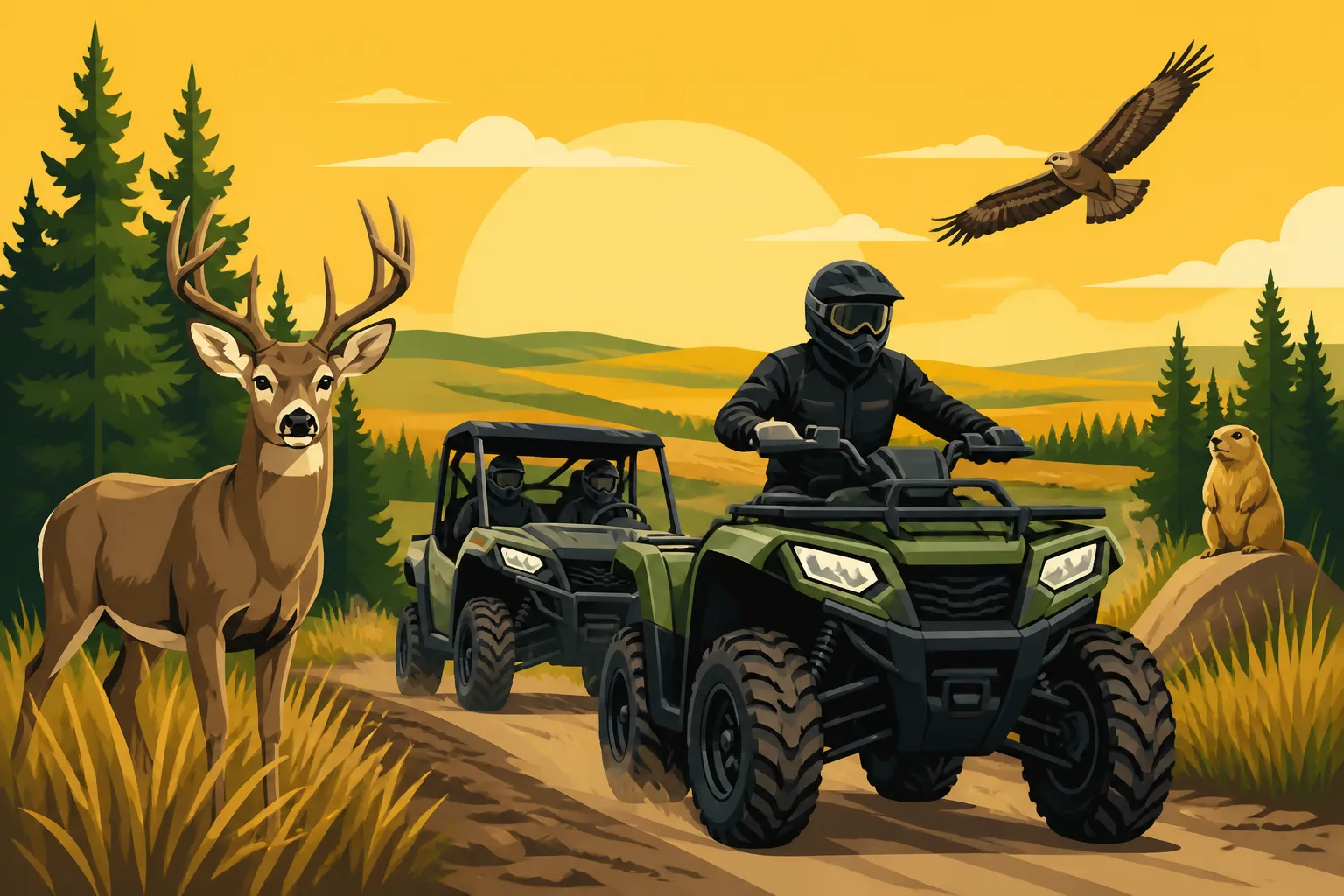
Saskatchewan riding routes pass through a mix of boreal forest, grassland, wetlands, and agricultural country. Areas around Narrow Hills Provincial Park, the Prince Albert region, and the forested north can bring riders close to wildlife habitat. Deer, moose, black bears, and other animals may use the same corridors as people, particularly where trails pass through cover, near water, or along the edge of a clearing.
The challenge is that a machine can cover ground quickly while visibility is limited. A bend, a rise, tall grass, or dense spruce can hide an animal until you are close. Wildlife may also be difficult to notice when wind, engine noise, or vegetation masks the sounds and movement that would otherwise catch your attention.
Treat every blind corner and narrow stretch as a place where an animal could be present. Ease off the throttle when sightlines shorten, keep enough distance behind the rider ahead to leave room to brake, and avoid assuming that a trail is empty just because you have not seen tracks or fresh sign. [Saskatchewan Trail Etiquette Locals Expect] is useful context for sharing a route responsibly with other trail users and the environment.
Season and time of day change the ride
Wildlife activity varies with season, weather, food availability, and local conditions. Animals may be more visible when moving between cover and feeding areas, and low light can make it harder for riders to see them in time. Dusk and dawn deserve extra caution, but a midday ride is not a guarantee that the trail will be clear.
Weather can change visibility and stopping distance, too. Rain may make a trail slick; dust can reduce what you can see behind another machine; and wind may carry engine noise toward or away from animals. If the trail is busy, slow down and leave room for a sudden stop rather than trying to keep a fixed pace.
Before hauling to an unfamiliar area, check access information and local trail conditions. A mapping tool such as onX Offroad can help you review your planned route and keep track of where you are, but a map is not a live wildlife alert or permission to travel across every parcel of land. Confirm access separately and review [Saskatchewan Trail Conditions Before You Haul] before committing to a long drive or remote ride.
How to respond when you encounter wildlife
Moose and deer need room to move
A moose can appear suddenly and may be difficult to judge from a machine. If you spot one ahead, slow down early and stop at a safe distance. Do not ride closer to get a better look, block the animal’s route, or try to pass between an adult and a calf. Give the animal time and space to leave on its own, and be prepared to wait or turn back if the trail does not offer a safe way through.
Deer may bolt across a trail with little warning, sometimes followed by other animals. Avoid swerving sharply into brush or toward another rider to avoid one. A controlled stop is usually safer than a fast, unpredictable maneuver. Keep the group together without crowding one another, and make sure riders behind you know you have stopped.
A practical rule is to treat an animal’s hesitation as a reason to increase distance, not an invitation to move closer. If it looks unsettled, changes direction repeatedly, or remains near the route, give it more time and space. For more encounter-specific guidance, see [Saskatchewan Moose Encounters While Riding].
Bears require calm, unhurried decisions
If a bear appears, do not approach it, follow it, or try to drive it away for a photo. Stop at a safe distance and give it a clear route to move off. Avoid sudden acceleration toward the animal, which can make a tense situation worse and leaves little room to react if it moves unexpectedly.
Keep your group together and speak clearly so riders know what is happening. Do not crowd the bear with multiple machines, surround it, or leave food and garbage where wildlife can reach them. If the bear stays close to the route, back away carefully when you can do so without moving toward it, then choose another route or wait in a safe place. The right response can depend on the circumstances, so review [Saskatchewan Bear Encounters While Riding] before heading into bear country.
Do not assume that a bear has left simply because it disappeared into vegetation. Give the area time, keep watching from a safe distance, and avoid riding into thick cover where you cannot see what is ahead. If an encounter presents an immediate danger or an animal appears injured or unusually aggressive, contact the appropriate local authority when it is safe to do so.
| Situation | Safer response | Avoid |
|---|---|---|
| Animal appears around a blind corner | Brake smoothly and stop with room to maneuver | Accelerating past before you know where it went |
| Moose or deer is on the trail | Wait at a distance and let it choose its route | Crowding it or separating an adult from a young animal |
| Bear is near the route | Stay together, give it space, and retreat if needed | Approaching, surrounding, feeding, or pursuing it |
| Wildlife remains in the trail corridor | Turn back or choose another route | Squeezing between the animal and cover |
| A rider has stopped unexpectedly | Slow down and alert the rest of the group | Passing closely or stopping in a way that blocks the trail |
Prepare your ATV or UTV ride for wildlife
Set a pace that leaves time to react
A speed that feels comfortable on an open stretch may be too fast for a tight, wooded trail. Reduce speed before bends, crests, narrow passages, and areas where brush blocks your view. Leave a generous following gap: the rider ahead may brake for an animal without warning, and dust or muddy spray can make it harder for you to see.
Agree on simple group signals before setting out. Everyone should know how the lead rider will communicate a stop, hazard, or change of route. Keep the group’s pace appropriate for its least experienced rider, and avoid leaving a large gap that could separate someone from the others if a wildlife encounter occurs.
Plan a route with realistic alternatives. A phone-based map such as onX Offroad can help you orient yourself and understand nearby route options, particularly when you have downloaded the information you need before entering an area with weak reception. Still, confirm closures and land access through the relevant local or park authority. [Saskatchewan Crown Land Access Rules] can help clarify why being able to see a route on a map does not, by itself, establish that riding there is permitted.
Reduce the things that attract or disturb animals
Pack food securely and take every wrapper, can, and other piece of garbage back out with you. Never feed wildlife. Feeding can draw animals toward people and machines, and food scraps left at a trailhead or campsite can create problems for the next visitor as well as the animal.
Keep dogs under control and do not let them chase wildlife. A dog that runs ahead can provoke an animal and then return toward its owner, bringing the encounter closer to the group. If a dog cannot be kept safely managed for the whole outing, leaving it at home is the more responsible choice.
Avoid unnecessary noise and off-trail detours. Do not use a machine to chase animals, flush them from cover, or get close enough for a photograph. Staying on designated routes protects habitat and reduces the chance of surprising wildlife at close range. For broader planning advice, [Saskatchewan Riding in the North] covers the considerations that come with remote and forested riding areas.
When to change or end the ride
Turn around when the route is not safe or open
Some encounters leave no good way to pass. A moose may remain on a narrow trail, a bear may stay close to the corridor, or a group of animals may occupy a crossing. In those situations, turning around is not a failure to complete the ride; it is a sensible decision that protects the riders and gives wildlife room.
Be prepared to shorten the day if weather, visibility, fire restrictions, or trail damage changes the conditions. Check for notices before leaving and again when practical during a trip. If a route has been closed, follow the closure rather than trying to find an informal way around it. [Saskatchewan Wildfire Season Rules for Riders] offers related planning information, while [Saskatchewan Trail Closures After a Storm] is relevant when recent weather may have affected access or trail safety.
A mapping app can be helpful for keeping your bearings when you turn back or choose an alternate route. Riders using onX Offroad should still compare the route with current posted notices and local access rules; an app’s line on the screen cannot replace a closure sign, landowner permission, or park direction. If you are uncertain whether a route is open, choose a confirmed alternative.
Make a simple group plan before unloading
Before the first machine leaves the trailer, agree on who is leading, who is riding at the back, and what everyone should do if the group stops unexpectedly. Share the intended route and a return time with someone who is not riding. In remote areas, do not rely on a mobile connection being available throughout the day.
Carry what your group needs to handle a delay: water, suitable clothing, a charged phone, and basic first-aid supplies. Riders should know how to stop safely and how to regroup without spreading out into brush. If one person is uncomfortable with a wildlife situation, stop and discuss the next move rather than pressuring them to continue.
The best ride is not always the one that follows the original plan exactly. A cautious pace, a respectful distance, and the willingness to turn back make wildlife encounters less likely to become dangerous. When animals are using the trail, let them have the right of way.
Disclaimer
This article is for general informational purposes only and does not constitute professional advice. Laws, prices and regulations vary by location and change over time. Consult a qualified professional for guidance on your specific situation.