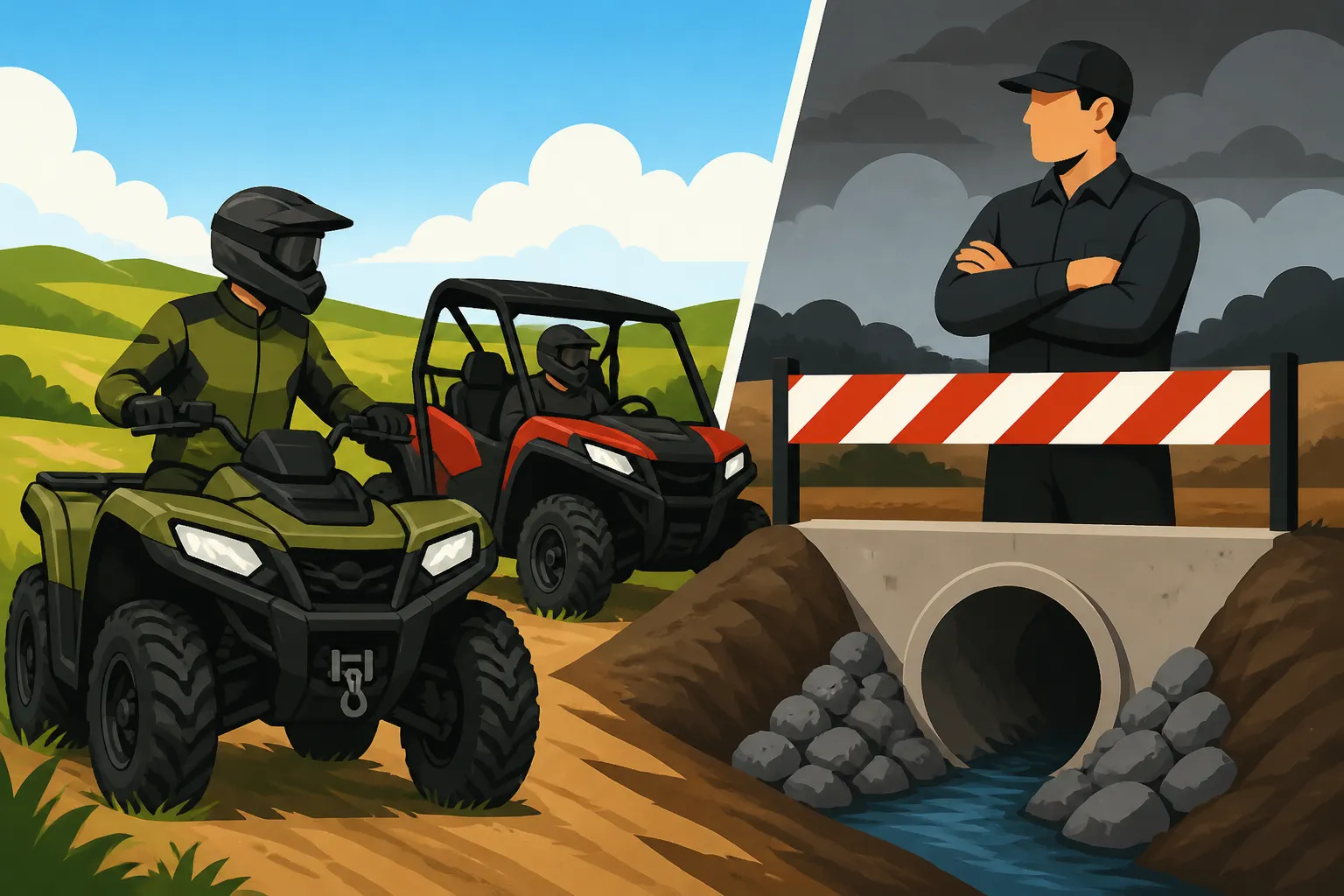
When a Council Shuts the Ditch to Riders
There's nothing quite as frustrating as heading out for a relaxing ATV ride, looking forward to hitting those familiar ditch lines, only to be met with an unexpected sign proclaiming "No ATV Riding." It’s a common scenario across our beautiful province, where what you thought was a perfectly legitimate riding spot has suddenly been shut down by local authorities. This guide is here to shed some light on why and how a local council can put the brakes on your ditch riding, helping you understand the rules and avoid those unwelcome surprises.
The Frustration of Unexpected Riding Bans
We've all been there – cruising along a familiar route, feeling the freedom of the open prairie or the shelter of the bush, when suddenly you see a sign. Maybe it's a new "No Trespassing" notice, or perhaps an official-looking municipal sign prohibiting ATVs. It stops you in your tracks, and often, the immediate reaction is confusion, then frustration. Why now? Why here? It feels like the rules are constantly changing, and keeping up can be a real headache, especially when it concerns areas you've ridden for years.
Why Ditch Riding Is So Popular in Saskatchewan
For many riders in Saskatchewan, ditches aren't just ditches; they're essential corridors. Our vast landscape, with its patchwork of private land, fields, and grid roads, often means that the road allowance and its accompanying ditch are the most practical, if not the only, routes connecting properties, accessing fishing spots, or simply getting from one point to another without trespassing. It’s a matter of convenience and tradition for many rural families and recreational users alike.
The appeal lies in the accessibility and the feeling of freedom. You're off the main thoroughfare, away from highway traffic, and often navigating varied terrain that offers just enough challenge without being overly technical. For some, it’s about accessing hunting grounds; for others, it’s the quickest way to get to a friend’s farm. When these routes, which feel like an extension of the public domain, are suddenly closed, it can feel like a direct hit to a long-standing way of life. It’s not just about losing a place to ride; it’s about losing a perceived right to access and enjoy the land around us.
The Disconnect Between Provincial and Local Rules
One of the biggest sources of confusion stems from the layers of legislation governing ATV use. You might be familiar with [Saskatchewan's All Terrain Vehicles Act], which provides a broad provincial framework for things like age limits, helmet use, and insurance requirements. This Act does permit riding in a ditch under certain conditions, primarily staying [Saskatchewan Ditch Riding and the 2-Metre Rule] from the travelled portion of a highway. However, what many riders don't realize is that while the province sets the baseline, local municipal councils have the power to add their own, more restrictive rules.
This means that what's perfectly legal under provincial law might be explicitly prohibited by a local bylaw in a specific rural municipality, village, or town. This disconnect creates a real headache for riders. You might travel from one RM where ditch riding is largely unrestricted to another where it's completely banned within certain boundaries. It's a prime example of how local governance can trump broader provincial guidelines, leaving riders feeling caught in a legal grey area and often leading to accidental infractions. It's not always intuitive to know where one set of rules ends and another begins, and the lack of consistent signage can make it even harder.
Understanding Municipal Bylaws and Their Power
It's a common misconception that if a provincial law allows something, it's fair game everywhere. However, when it comes to ATVs and roads, municipalities wield significant power. They have the authority to tailor rules to their specific community needs, and sometimes, those needs conflict with what riders want to do.
Who Can Actually Shut Down a Ditch?
In Saskatchewan, various local government bodies have the power to regulate land use within their borders. This includes [Saskatchewan Rural Municipality Rules], as well as the councils of villages, towns, and cities. These entities are responsible for managing local infrastructure, maintaining public safety, and responding to the concerns of their residents. A ditch, particularly one alongside a municipal road or within a road allowance, falls squarely under their jurisdiction.
This means that your local council, whether it's the council of a small village or a larger rural municipality, can pass bylaws that specifically prohibit or restrict ATV use in ditches, on certain grid roads, or within designated areas. They don't need provincial permission to do this; their authority is derived from provincial legislation that grants them powers of local governance. So, even if the province doesn't have a province-wide ban on ditch riding, a local council absolutely can, and often does, impose one for their specific area. It's important to remember that these bylaws are legally binding within that municipality's boundaries.
The Process of Creating a Bylaw to Restrict ATV Use
Bylaws don't just magically appear. They are created through a formal process by the municipal council. Typically, this process involves several steps:
- Identification of an Issue: Concerns might be raised by residents, local law enforcement, or council members themselves regarding noise, safety, environmental damage, or property access.
- Research and Draft: Municipal staff or a committee will research the issue, look at what other municipalities have done, and draft a proposed bylaw.
- Public Consultation: Often, but not always, the proposed bylaw will be presented to the public. This might happen at a council meeting [Speaking at a Council Meeting About Quads], through public notices, or by inviting submissions from residents. This is a critical point where riders can make their voices heard.
- First, Second, and Third Readings: The proposed bylaw goes through several readings and votes by the council. Amendments can be made at various stages.
- Adoption: Once passed by council, the bylaw is formally adopted and becomes law within that municipality.
Once adopted, the bylaw will specify the areas affected, the prohibitions, and the penalties for non-compliance. Councils often provide notice of new bylaws, but it’s still the rider's responsibility to know and follow the rules. This is why it’s so crucial for riders to stay engaged with their local municipal offices, especially when new bylaws are being discussed, as many [Saskatchewan Municipalities With ATV Bylaws] are constantly reviewing their policies.
Common Reasons for Ditch Riding Prohibitions
So, why would a council go to the trouble of shutting down ditch riding? It's rarely done out of spite. More often than not, it stems from genuine concerns within the community that reach the council's ears. Understanding these reasons can help riders navigate the restrictions and even advocate for more balanced solutions.
Noise, Nuisance, and Resident Complaints
This is probably the single biggest driver behind many ATV restrictions. Picture a quiet acreage community or a small town where residents are trying to enjoy their yards. The constant drone or sudden roar of ATVs in the adjacent ditch, especially early in the morning or late at night, can be incredibly disruptive. While we, as riders, love the sound of our machines, not everyone shares that sentiment.
Homeowners can feel like their peace and quiet is invaded, leading to numerous complaints to their local council. These complaints can range from general noise disturbance to specific concerns about loud aftermarket exhausts. When a council receives a steady stream of such grievances, they are obligated to act. A bylaw prohibiting riding in ditches within residential zones, or setting specific hours of operation, is a common response to address these quality-of-life issues for residents. It's a tough pill to swallow, but councils often prioritize the collective peace of the majority when faced with persistent complaints.
Safety Concerns and Environmental Impact
Beyond noise, councils also have a mandate to ensure public safety and protect local environments. Ditches, while seemingly benign, can pose various risks, especially in areas with pedestrian traffic or near roads. There's always the concern of an ATV losing control and veering into traffic or hitting someone walking or cycling. In some cases, ATVs crossing roads at undesignated spots can contribute to accidents.
From an environmental perspective, repeated ATV use in ditches, particularly during wet conditions, can lead to erosion, damage to fragile plant life, and degradation of water quality in nearby streams or wetlands. Littering is another issue that can draw the ire of environmental advocates. When councils see evidence of habitat destruction, soil erosion, or perceive a clear safety hazard, they are likely to implement restrictions. This is especially true near sensitive ecological areas, community parks, or within town limits where children might be playing near a ditch. Accessories from companies like SuperATV, while great for performance, don't exempt you from these environmental and safety considerations.
Specific Examples of Municipal Restrictions
While I can't name specific, current bylaws due to my data cutoff, I can tell you about the types of restrictions [Saskatchewan Municipal Bylaws on Roads] put in place. Some municipalities might completely ban ATVs from ditches and road allowances within town or village limits, directing riders to trailer their machines to designated trails outside of town. Other bylaws might allow ditch riding but impose strict curfews, prohibiting use after a certain hour in the evening and before a certain hour in the morning.
You might also encounter prohibitions on specific grid roads that have become problematic due to heavy ATV traffic or safety concerns. Councils often use signage to communicate these bans. Look for official signs, often [White With Black Lettering] on a dark background, stating "No ATV's" or "Off-Road Vehicles Prohibited." These signs typically need to meet certain standards, such as being [Prohibition Signs Must Be 60 Centimetres Square], to be legally enforceable. It’s vital to pay attention to these visual cues, as ignoring them can lead to significant penalties.
What to Do When a Ditch Is Closed to Riders
Discovering that a beloved riding spot has been shut down can be disheartening. But instead of letting frustration win, there are concrete steps you can take, both to stay legal and potentially to advocate for future access.
How to Spot a Bylaw Prohibition
The first step is always vigilance. When riding, be on the lookout for official signage. Municipalities are generally required to post clear and visible signs where prohibitions are in effect. These signs are typically designed to be easily read and understood, often with specific dimensions and colour schemes, as mentioned earlier. Don't assume that because a ditch looks rideable, it is.
If you’re planning a trip to a new area, or if you simply want to verify the rules for your regular routes, the best approach is to be proactive. Check the website of the specific rural municipality, village, or town you plan to ride in. Many local governments post their bylaws online. If you can’t find the information, don't hesitate to call the municipal office directly. A quick phone call can save you a potential ticket and a lot of headaches. It's far better to ask than to assume and be wrong.
Respecting the Rules and Finding Alternatives
Once you've identified a prohibited area, respecting the rules is paramount. Ignoring a bylaw not only carries the risk of significant fines—which can be substantial, as [Saskatchewan Fines Capped at $1,000]—but it also paints all ATV riders in a negative light. Continued defiance can lead to even stricter regulations and further erosion of riding opportunities for everyone.
Instead, seek out legal alternatives. Look for designated [Saskatchewan ATV Trails: Crown Land and Ditches] or riding areas on Crown land where permits might be required but access is granted. Always ensure you have [Saskatchewan Crown Land Access Rules] or [Saskatchewan Private Land Permission] if riding on private property. Explore areas known for their ATV-friendly policies. Sometimes, investing in accessories from companies like SuperATV that enhance your machine's versatility for different terrains can open up more riding options if your usual ditch routes are now off-limits. Finding legal places to ride responsibly demonstrates that ATV enthusiasts are part of the community, not a nuisance.
Engaging with Your Local Council
If you're passionate about preserving or expanding ATV access in your area, getting involved with your local council is the most effective way to make a difference. Councils respond to community input, and a well-organized, respectful approach from the ATV community can yield positive results. Consider these actions:
- Join or Start an ATV Club: [Saskatchewan ATV Clubs Worth Joining] often have a louder, more organized voice than individual riders. They can present a united front, lobby councils, and even work towards developing new, legal riding areas.
- Attend Council Meetings: Show up when ATV-related bylaws are on the agenda. Present your concerns and suggestions respectfully.
- Educate and Advocate: Prepare a presentation for your council. Explain the economic benefits of ATV tourism, propose solutions to noise issues (e.g., advocating for quieter mufflers), suggest designated routes, or offer to help maintain trails.
- Offer Solutions: Instead of just complaining about restrictions, propose workable solutions. Maybe there's an underutilized area that could be designated for riding, or perhaps a volunteer group could help monitor noise or enforce rules.
Constructive dialogue and a willingness to compromise are far more effective than simply ignoring restrictions. By actively participating in the decision-making process, riders can help shape policies that are fair and sustainable for both the community and the ATV enthusiast.
| Reason for Bylaw | Description | Impact on Riders | Potential Solutions |
|---|---|---|---|
| Noise Complaints | Residents disturbed by ATV engine noise, especially in residential or sensitive areas. | Restricted hours of operation, bans in specific zones. | Promote quieter exhausts, designated sound-buffered routes, adhere to curfews. |
| Safety Concerns | Risk of collisions with pedestrians, other vehicles, or property damage; rider safety. | Bans near schools/parks, on busy grid roads, or in high-traffic ditches. | Advocate for dedicated trails, promote safety courses, responsible riding speeds. |
| Environmental Impact | Erosion, habitat damage, littering, disturbance of wildlife in ditches. | Closures in ecologically sensitive areas, during wet conditions. | Stay on established tracks, participate in cleanup efforts, wash machines to prevent invasive species. |
| Nuisance/Property Access | Riders accessing private land without permission, general disruption to rural living. | Complete bans in certain municipal boundaries. | Obtain [Saskatchewan Private Land Permission], respect property lines, engage with landowners. |
Disclaimer
This article is for general informational purposes only and does not constitute professional advice. Laws, prices and regulations vary by location and change over time. Consult a qualified professional for guidance on your specific situation.