Carrying a Shovel and an Extinguisher on Board
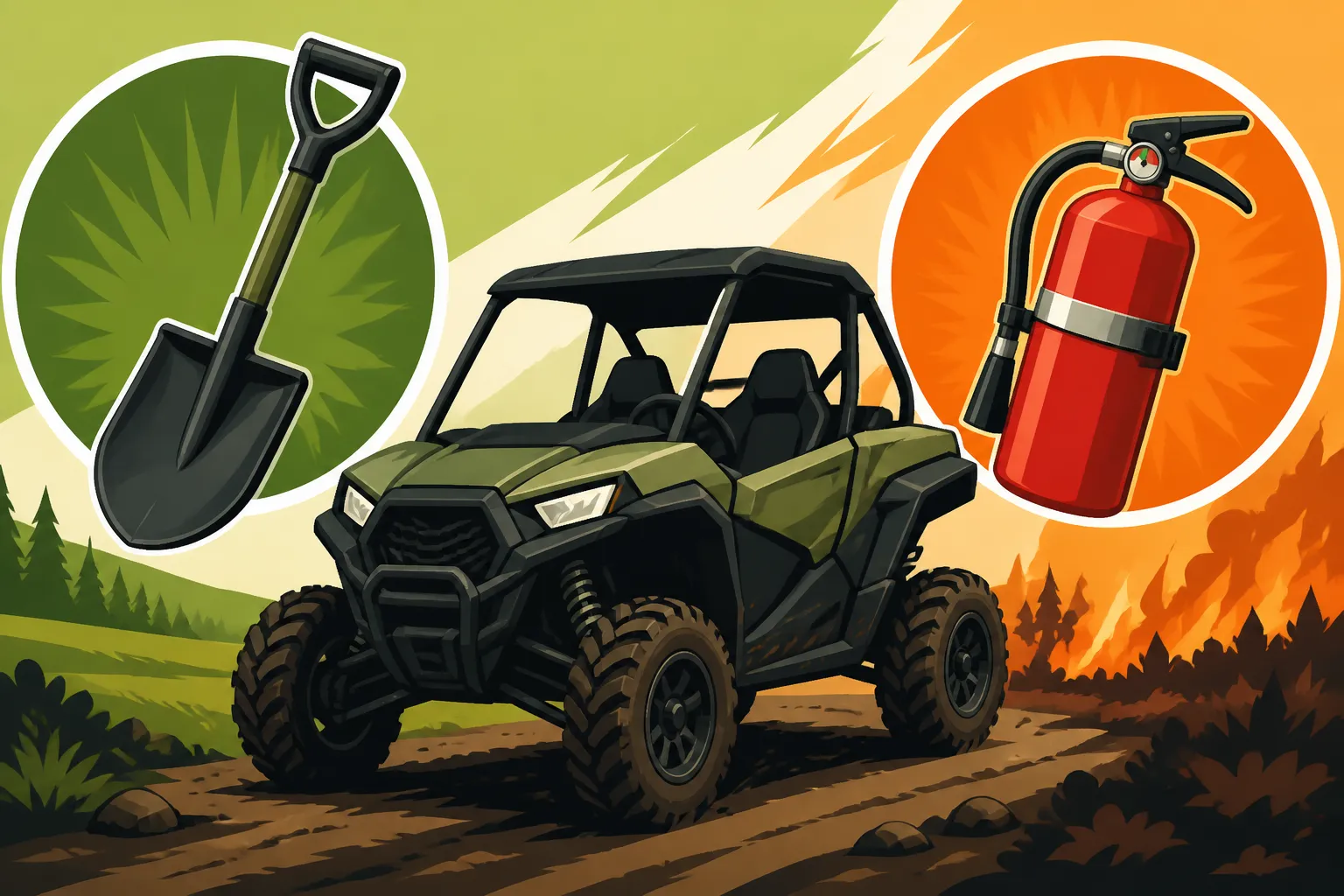
A shovel and extinguisher can make a small fire easier to address, but only if they are on the machine, secured, and usable when needed. Saskatchewan riders also need to know when fire restrictions apply and what duties go beyond carrying equipment. Here’s how to choose and carry practical gear, check the rules, and respond without putting yourself at greater risk.
Why carry a shovel and extinguisher
An ATV or UTV can travel through dry grass, brush and forest where a small ignition may spread quickly. Hot machine parts, combustible debris and dry conditions make fire prevention part of trip planning, not just an emergency concern. A shovel and extinguisher give you tools for an early response, but they do not make riding during a ban safe or permitted.
Treat this equipment as a practical minimum for fire readiness, not as a substitute for checking what applies to your route. Provincial wildfire rules, temporary restrictions, park rules and local orders can differ. Confirm current requirements before you leave, especially if you are riding Crown land or in a provincial park. Start with Saskatchewan Wildfire Season Rules for Riders and Saskatchewan Fire Ban Lookups.
A well-chosen shovel can help move soil onto a small, contained ground fire or clear a limited patch of dry material around a stopped machine. An extinguisher may help with a small fire while it is still at an early stage. Neither tool is a safe answer to a fire that is spreading, producing heavy smoke, or threatening people, fuel or escape routes. Your first priority is getting everyone away safely and calling for help.
| Item | What to look for | How it helps | Main limitation |
|---|---|---|---|
| Shovel | A sturdy blade and handle that lock securely; a size you can use effectively | Moves soil and can help with small ground fires or debris | A compact tool may be too small for a fast-growing fire |
| Fire extinguisher | A model suitable for the hazards you may encounter, with its instructions and service information intact | May suppress a small, accessible fire at an early stage | Limited contents; unsafe or ineffective if the fire has grown |
| Mount or case | A secure attachment designed for the machine and the tool | Keeps gear available without letting it bounce loose | A poor mount can fail on rough trails or interfere with riding |
| Communication device | A charged phone or other device appropriate to the area | Helps you call for assistance and report your location | Coverage may be unreliable in remote areas |
The exact tools and requirements can depend on where you ride and the conditions in effect. Read Fire Suppression Gear on a Machine for more on preparing the machine, and check official information for any current equipment rules. Don’t assume that carrying a shovel and extinguisher by itself satisfies every restriction.
Choose equipment you can reach and use
A tool that is buried under cargo or difficult to release may not be much help in an emergency. Before a trip, check that a rider can access the shovel and extinguisher without unloading the machine or reaching near a hot or smoking area.
Picking a useful shovel
Choose a shovel that is sturdy enough to move soil, not just a novelty tool that folds into a tiny package. A folding shovel can be useful when storage space is limited, provided the handle and locking parts are robust and work reliably. Check that the blade is intact and that the tool can be opened quickly with the gloves you expect to wear.
Consider how you will use it as well as where it will fit. A shovel that is too short or awkward to grip may be hard to use while standing on uneven ground. Keep it somewhere it cannot interfere with the controls, passengers, suspension, tires or access to other emergency equipment. A loose shovel can become a hazard if it shifts or falls off on a trail.
Choosing and mounting an extinguisher
Use an extinguisher that is appropriate for the kinds of fire hazards associated with your machine and follow its manufacturer’s directions. Check its condition before a ride, including the gauge or other status indicator if the model has one, the safety pin and the label. Replace or service it according to its instructions, and after any use, even if only a small amount was discharged.
Mount it firmly where it can be reached quickly. The mount should hold the extinguisher through vibration and rough ground while still allowing you to release it as intended. Avoid putting it where it can be struck by cargo, damaged by a rollover, or covered in mud. If you use a case, make sure you can open it without a tool and without removing other gear first.
If you are comparing compact gear through a local dealer or Amazon, check the extinguisher’s intended use, dimensions, mounting method and maintenance instructions rather than choosing by size alone. A smaller unit is easier to carry, but its limited capacity may matter. The right setup is one you can secure, inspect and operate safely.
Secure everything for the ride
Before setting off, tug on the shovel and extinguisher to make sure their mounts hold. Check that straps and latches are not frayed, loose or blocked by baggage. After riding rough terrain, take a moment to confirm the equipment is still in place.
A UTV may have more storage options than a quad, but storage space does not guarantee access. Passengers and cargo should not block emergency gear. On an ATV, avoid carrying a long-handled tool in a way that could catch brush or affect your balance. If the only available location creates a riding hazard, change the setup rather than accepting a loose or awkward attachment.
Check fire rules before and during the ride
Fire conditions can change, and a route that was open when you planned the trip may be restricted later. Check the applicable provincial information, land-manager notices and posted signs before unloading. If you ride in a park, confirm its machine rules separately; park access and designated trails are not the same as general Crown land access. Saskatchewan Crown Land Access Rules and Saskatchewan Park Regulations for Machines are useful starting points.
A fire ban or closure can restrict access even if you have the right gear. Do not treat an extinguisher or shovel as permission to ride in a closed area. Check for current notices on the day of your ride and watch for updates while travelling. Checking a Fire Ban From Your Phone at the Trailhead can help you make that check part of your arrival routine.
Saskatchewan’s wildfire season is identified in guidance as running from April 1 to October 31, but seasonal dates do not tell you whether a particular area is open today. Restrictions and conditions can change, and specific orders may apply outside a period you expect to be high risk. Confirm current dates, maps and notices with the responsible official source before relying on them.
Inspect the machine for combustible material
Dry grass, leaves and other debris can collect around hot parts of a machine. Before leaving and during the day, inspect areas where material may gather, including around the engine, exhaust and guards. Remove buildup only when it is safe to do so and the machine has cooled enough to handle. Don’t reach into hot components or use a method that could create another ignition source.
The obligation to prevent fire is broader than carrying response equipment. Follow Your Legal Duty to Check for Combustible Debris and Inspecting Your Machine Throughout a Day of Riding for practical checks. Also confirm any spark-arrestor or other equipment requirements for the land and route you plan to use. A shovel and extinguisher cannot compensate for a machine carrying dry debris into risky conditions.
A simple pre-ride check can help:
- Check current fire restrictions, closures and route notices.
- Inspect the machine for grass, leaves or other combustible buildup.
- Confirm the shovel and extinguisher are secure and accessible.
- Check the extinguisher’s condition and that its instructions are readable.
- Make sure your communication device is charged and that someone knows your plan if you are riding remotely.
Repeat the debris check after riding through dry vegetation, and keep an eye on changing weather and local notices. If conditions make the trip unsafe or prohibited, postpone it or choose a permitted route.
What to do if you find a fire
If you see smoke or fire, stop in a safe place, alert the other riders and move away from immediate danger. Avoid driving through smoke or toward a fire to get a better look. If the fire is growing, spreading through vegetation, or putting people at risk, leave the area and contact emergency services as soon as you can. Share your location as clearly as possible, including a trail name, nearby road, landmark or map coordinates if available.
Use an extinguisher only if the fire is small, you have a clear escape route, and you can act without moving close to danger. Follow the extinguisher’s instructions. If it does not work promptly, the fire grows, or smoke makes it hard to see or breathe, stop trying and get away. A portable extinguisher has limited capacity; it is not a reason to stay beside a machine that is burning.
A shovel may be useful for a small ground fire when it is safe to approach, but don’t put yourself between the fire and your route out. Avoid disturbing burning material if doing so could spread embers or expose you to heat. When in doubt, leave the area and report the fire rather than attempting to control it.
After a fire or suspected ignition, don’t assume it is out because flames are no longer visible. If you can do so safely, give responders the location and details of what you observed. Follow their directions, and do not return to a closed area until it is officially safe and open.
For trip planning, the key is to combine equipment with prevention: check current rules, keep the machine clear of debris, mount tools securely and know when to leave instead of fighting a fire. A shovel and extinguisher can support an early response, but they are only one part of responsible riding.
Disclaimer
This article is for general informational purposes only and does not constitute professional advice. Laws, prices and regulations vary by location and change over time. Consult a qualified professional for guidance on your specific situation.