Signing the Use Form at a District Office
A district-office visit can be confusing if you are expecting a simple permit pickup and are handed a use form instead. In Saskatchewan, the form may be one step in a park’s trail-permit process, but it does not replace other riding requirements. Here’s how to prepare, what to clarify before signing, and what to keep with you afterward.
What the use form is for
A use form is an acknowledgement connected to a particular riding area or permit process. It may record that you have received information about the area’s rules, agree to follow its conditions, or understand your responsibilities while riding. The precise form and process can depend on the location, so do not assume that a form used at one park applies elsewhere.
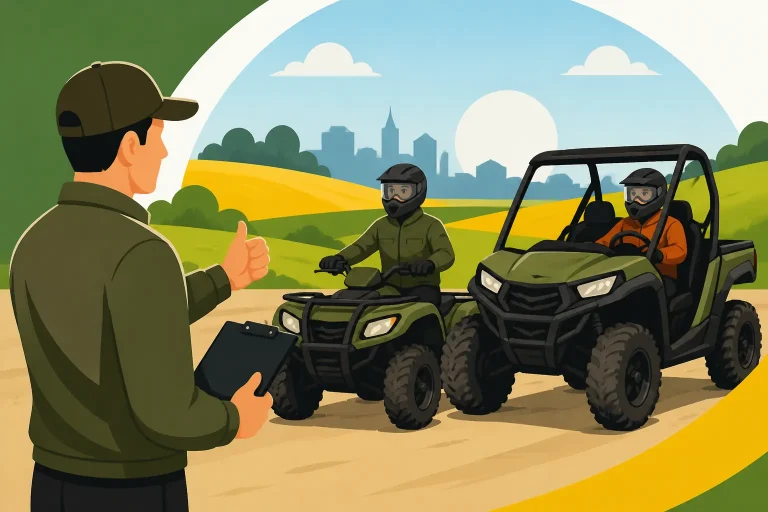
In some park permit processes, an information session comes before the permit is issued. Staff may explain where machines can travel, which trails are open, and what conditions apply. The session and signed form are not necessarily a separate trail pass; they may be steps required before staff can issue or activate the permit. Confirm what happens at the specific office you plan to visit. The process is described further in The Info Session That Comes Before Your Permit
A signed acknowledgement is also not a general licence to ride wherever you want. It does not automatically authorize travel on a road, Crown land outside the permitted area, a private trail, or a grazing lease. Access depends on the land and the rules that apply there. For park-specific limits, see Saskatchewan Parks With Designated Trails Only
It helps to keep these documents and permissions separate in your mind:
| Item | What it may do | What it does not automatically do |
|---|---|---|
| Use or acknowledgement form | Records that you have reviewed or accepted conditions for a particular process | Give permission to ride outside the area or trails covered by those conditions |
| Park trail permit | Allows use under the applicable park permit rules | Replace insurance, equipment, age, or operating requirements |
| Municipal plate | Meets a local municipality’s requirements where that scheme applies | Serve as a provincial ATV registration or a park permit |
| Insurance proof | Shows coverage when an officer or park staff asks for it | Establish land access or make a closed trail available |
| Landowner permission | Allows access where permission is needed and granted | Override a park closure, bylaw, or other restriction |
A signed form does not replace a park permit when one is required. Saskatchewan has no provincial trail pass, but particular areas can have their own permit requirements. Check the location before travelling; Saskatchewan Has No Provincial Trail Pass explains the province-wide distinction.
Before you go to the district office
The most useful preparation is to confirm the office’s process before making the trip. A district office may handle permits for a particular area, but opening hours, staff availability, and permit pickup arrangements can vary. Ask whether you need to attend an information session, whether you can complete the form at the office, and whether you need to bring every rider who will use the permit.
Also ask which trails the permit covers and whether the trails are currently open. A permit does not guarantee access during a closure, fire restriction, or other temporary restriction. If you are travelling a long distance, check conditions shortly before departure as well as when arranging the permit. Saskatchewan Trail Conditions Before You Haul covers the value of checking before you load the machine.
Before you leave, make sure you know:
- The correct office and its current hours.
- Whether an appointment or information session is required.
- Whether the form is completed by each rider, the permit holder, or another person.
- Whether the permit is issued at the office or collected elsewhere.
- What identification or machine information, if any, staff need.
- Which trails and dates the permit applies to.
- Whether minors need a parent or guardian present.
- What documents you must carry while riding.
Do not guess about the last few points. A form may be tied to the permit holder or to a particular site, and an answer that was correct for another park may not apply at this office. If staff direct you to sign at a campground or another location instead, confirm that arrangement before driving there. Picking Up a Trail Permit at the Campground Office is relevant when permit collection is handled away from the district office.
Bring the information you are likely to be asked for, even if the office does not require every item. Useful items may include your identification, the machine’s details, your planned riding dates, and proof of insurance. Treat that as a preparation list rather than a universal document requirement: ask the office which items it actually needs. Insurance rules can apply independently of the form; Saskatchewan Insurance Proof at a Park Office explains why it is sensible to have proof available.
If several people are travelling together, sort out who will speak for the group and who must sign. Do not assume that one person’s signature covers every rider or every machine. Ask staff how the permit and form handle groups, passengers, and youth riders. Park rules may impose additional conditions, and Saskatchewan’s general rider requirements still matter. For example, supervision requirements for youth do not disappear because a form has been signed.
Signing the form at the office
Read the form before you sign it, and ask staff to explain any condition you do not understand. The office visit is the right time to clarify boundaries, seasonal restrictions, permit display instructions, and where to find current trail information. Do not rely on a verbal summary if the form or permit gives written conditions; make sure you understand both.
A practical visit can follow these steps:
- Confirm that you are at the right office. State the riding area you plan to use and ask whether this office handles its permit process.
- Ask what the form covers. Find out whether it is an acknowledgement, a permit application, or another required part of the process.
- Review the conditions. Ask about trail boundaries, closures, vehicle limits, permit display, and any rules that are easy to misunderstand.
- Complete the form accurately. Check names and other requested details before signing. If you are unsure how to describe a machine or group, ask rather than filling in a guess.
- Confirm whether everyone must sign. This is especially important when there are multiple riders or a youth rider in the group.
- Ask what you receive after signing. Confirm whether staff issue a permit, give you a copy of the form, or direct you to another step.
- Check what must be carried or displayed. Follow the office’s instructions about keeping paperwork available or placing a permit where it can be seen.
The form’s wording matters. If it says you acknowledge certain conditions, signing generally records that acknowledgement; it should not be treated as permission to ignore a restriction you later find inconvenient. If a condition seems inconsistent with what staff have told you, pause and ask them to reconcile it before signing. Get clear instructions on what the written terms mean for your route.
Before leaving, keep a copy or take note of any instructions the office says you need while riding. If you receive a separate permit, check that its details are legible and that you know where it must be displayed. Displaying a Permit Where an Officer Can See It covers the practical importance of following display directions.
If you are signing on behalf of a family member or group, do not assume you can legally agree for everyone. Ask staff who needs to sign and whether a parent or guardian must be present for a minor. If someone who needs to sign is not there, find out whether the office accepts another arrangement rather than signing on their behalf without permission.
After signing: check what still applies
Once the office visit is complete, treat the signed form as one part of your riding paperwork, not as proof that every other requirement is satisfied. Read the permit and any accompanying instructions before unloading. Confirm that your planned route stays within the approved riding area and uses trails currently open to machines.
The permit also does not settle questions about local plates. Saskatchewan does not issue a province-wide ATV registration plate, while some municipalities operate their own schemes. A municipal plate may be relevant for riding under that municipality’s rules, but it is not automatically a substitute for a park permit. See Saskatchewan Municipal ATV Plates Explained if you are unsure which system you are dealing with.
Keep the different checks separate:
- Permit: Is one required for this specific park or trail area, and do you have the correct one?
- Form: Did the required person or people complete the acknowledgement or other paperwork?
- Insurance: Can you show proof if requested?
- Access: Are you allowed to ride on the land and trail you intend to use?
- Operating rules: Do your age, supervision, equipment, and riding practices meet the applicable requirements?
- Closures: Is the route open today, including any temporary fire or trail restrictions?
If a park employee, officer, or permit instruction gives you a more specific direction, follow it for that location and clarify anything that remains uncertain. Conditions can differ between riding areas, and a permit for one place should not be treated as permission for another. Rules That Differ Between Two Parks is a useful reminder to check the area you are actually visiting.
If you arrive and discover that the office is closed or the form process has changed, do not assume that you can ride first and sign later. Contact the office or follow the current official instructions before entering a permit-controlled area. The same caution applies if you have a form but no permit, or a permit but cannot confirm that your intended trail is open. Sorting out the paperwork at the start is easier than dealing with a misunderstanding at the trailhead.
Disclaimer
This article is for general informational purposes only and does not constitute professional advice. Laws, prices and regulations vary by location and change over time. Consult a qualified professional for guidance on your specific situation.