How the Act Measures a Mini-Bike
Navigating the world of off-road vehicles in Saskatchewan can feel like deciphering a secret code, especially when it comes to smaller machines like mini-bikes. Many riders, or parents considering a first machine for their kids, find themselves scratching their heads, wondering if that small, two-wheeled ride is treated the same as a quad under the law. This guide aims to clear up that confusion, diving deep into how Saskatchewan's All Terrain Vehicles Act specifically defines and treats mini-bikes, and what that means for riders across the province.
Understanding the All Terrain Vehicles Act in Saskatchewan
The All Terrain Vehicles Act (often just called "the Act") is the cornerstone of off-road vehicle regulation here in Saskatchewan. It's the provincial legislation that outlines what an all-terrain vehicle (ATV) is, where and how it can be operated, and what responsibilities come with ownership. However, it's crucial to understand that not every machine that can go off-road falls neatly under its primary definitions. This is where the nuanced world of exclusions comes into play, and mini-bikes are a prime example of a machine that sits in a rather unique legal space.
Why the Act Matters for Mini-Bikes
At first glance, you might think a mini-bike, being an off-road vehicle, would automatically be subject to all the same rules as a larger quad or side-by-side. But the Act is quite specific about what it does and doesn't cover. For mini-bikes, this distinction is absolutely critical. If a machine isn't defined as an "all terrain vehicle" under the Act, then many of the operational rules – things like age restrictions, helmet requirements, and where you can ride – simply don't apply in the same way. This can lead to a lot of confusion, and frankly, a lot of incorrect assumptions about what's permissible. Understanding the specific legal definition is the first step in ensuring you're operating within the bounds of the law, whether you're on your own land or considering a quick ride in a rural area. It’s not just about avoiding a ticket; it's about knowing your rights and responsibilities.
The General Scope of the Act
Broadly speaking, the Act primarily focuses on machines designed for off-road use, typically with four or more wheels, built to carry one or two people, and intended for recreational or utility purposes on varied terrain. Think of your standard quad or a larger UTV; these are the poster children for what the Act intends to regulate. It covers aspects like mandatory insurance, driver's licence requirements for certain ages, and specific rules about riding on ditches, grid roads, and other public access points. This comprehensive approach aims to ensure safety and responsible operation for the more powerful and prevalent off-road vehicles. However, the legislation isn't a one-size-fits-all garment. It carves out specific exemptions and exclusions for certain types of vehicles, recognizing that not all off-road machines pose the same risks or require the same level of provincial oversight. [Saskatchewan's All Terrain Vehicles Act] is quite detailed in its reach, but it’s just as important to understand where its reach ends.
Defining an All Terrain Vehicle ATV in Saskatchewan Law
To understand how a mini-bike fits (or doesn't fit) into the legal landscape, we first need a solid grasp of what the All Terrain Vehicles Act considers an "all terrain vehicle" in the first place. The Act provides a clear, albeit sometimes technical, definition that sets the stage for all subsequent regulations regarding operation, safety, and ownership.
Key Characteristics of an ATV
Under the Act, an "all terrain vehicle" is generally described as a motorized vehicle designed for off-road use, primarily for recreation or utility purposes. While the Act doesn't state specific horsepower limits, it emphasizes features like low-pressure tires, a seat designed to be straddled by the operator, and handlebar steering. It's typically a single-rider machine or one designed to carry a single passenger in addition to the operator. This definition largely captures the typical quad or three-wheeler that many people associate with ATVs. The intent behind these characteristics is to identify vehicles that present certain operational characteristics and safety considerations, leading to the regulatory framework we have in place. These are the machines that require specific insurance, adherence to age limits, and often, permits if you're riding in designated areas.
The Exclusion Clause
Here's where it gets interesting, especially for mini-bikes. The Act explicitly lists several types of vehicles that, despite their off-road capabilities, are not considered "all terrain vehicles" for the purpose of the legislation. This is not to say they are unregulated; rather, they are simply outside the scope of this particular Act. These exclusions include:
- Snowmobiles (which have their own separate Act)
- Vehicles registered under The Traffic Safety Act (like cars, trucks, and motorcycles)
- Agricultural implements
- Golf carts
- Wheelchairs
- Bicycles
- Any motor vehicle that has a seating capacity of more than two persons
- And, most importantly for our discussion, a mini-bike.
The presence of this exclusion means that while a mini-bike might look and feel like a smaller ATV to a casual observer, the law treats it differently. This legislative nuance is vital because it directly impacts everything from [Saskatchewan ATV Age Requirements] to insurance needs and where these machines can legally go. It also means that a lot of the common questions about ATV registration simply don't apply to these excluded machines, which can be a relief for owners, but also a source of confusion. [Saskatchewan Machines the Act Excludes] is a good resource for understanding these distinctions further.
Unpacking the Mini-Bike Exclusion
So, what exactly is a mini-bike in the eyes of Saskatchewan law, and why is it explicitly excluded from the All Terrain Vehicles Act? This distinction is not arbitrary; it's based on specific design and operational characteristics that set mini-bikes apart from their larger, more robust ATV cousins.
What Constitutes a Mini-Bike Under the Act
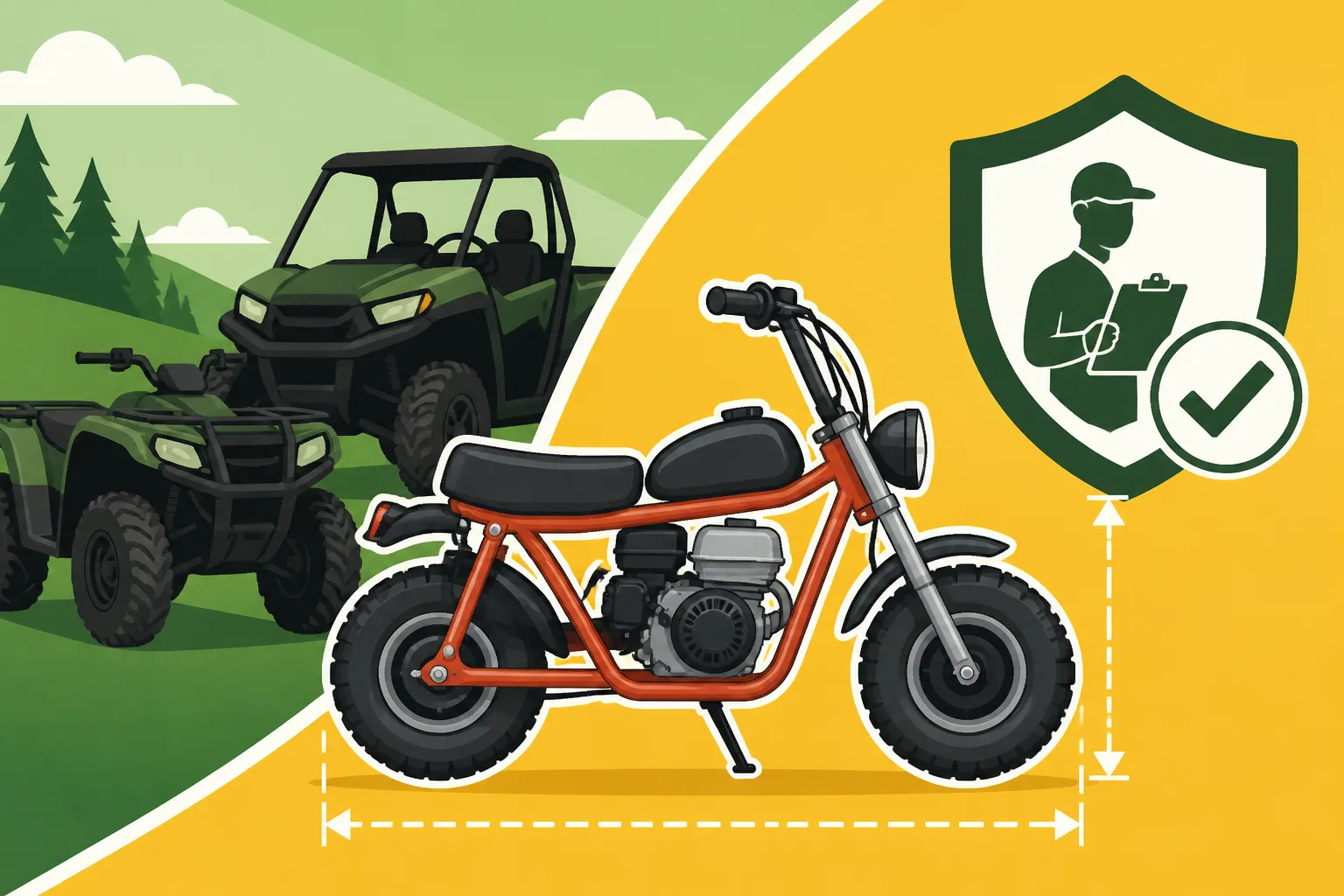
The Act offers a precise definition for a "mini-bike," which is critical for understanding its legal status. According to the legislation, a "mini-bike" is defined as:
- a motorized vehicle;
- equipped with not more than two wheels;
- that has a wheel rim diameter of 25.4 centimetres or less; and
- has an engine displacement of 60 cubic centimetres or less.
This is a very specific set of criteria. It’s not just any small two-wheeled off-road machine. The wheel rim diameter and engine displacement are the key differentiators. If your small, two-wheeled off-road vehicle has larger wheels or a more powerful engine than these specifications, it would likely not qualify as a "mini-bike" under the Act. Instead, it might fall into the category of a restricted use motorcycle or simply a regular motorcycle, subject to different rules entirely. This definition helps clarify what kind of smaller, lower-powered two-wheelers are being given this specific exclusion from the main ATV regulations. How the Act Measures a Mini-Bike confirms these precise measurements are paramount.
Common Misconceptions About Mini-Bikes
One of the biggest misconceptions is that any small off-road dirt bike or pit bike automatically qualifies as a mini-bike under the Act. This is simply not true. Many popular children's dirt bikes or smaller pit bikes actually exceed the 25.4 cm wheel rim diameter or the 60 cc engine displacement limit. If a machine exceeds these specifications, it is not a mini-bike in the legal sense, and therefore, it is not excluded from the All Terrain Vehicles Act in the same way. This means that a seemingly innocent dirt bike could still be subject to ATV regulations, which might come as a surprise to many parents or new owners.
Another common misunderstanding is that because mini-bikes are excluded from the ATV Act, they are entirely unregulated. This is also false. While the All Terrain Vehicles Act might not apply, general principles of safe operation, private property laws, and local municipal bylaws still come into play. You can't just ride a mini-bike anywhere without consequences. For example, if you ride it on public roads or private property without permission, you could still be ticketed or charged under other legislation or bylaws. The exclusion simply means you don't have to worry about the specific provincial ATV rules for that particular machine. It's a subtle but important distinction that riders need to grasp to avoid legal trouble.
Practical Implications of Mini-Bike Classification
The fact that mini-bikes, as strictly defined by the Act, are excluded from the main body of ATV legislation has significant practical implications for owners and riders. It changes the landscape regarding operational rules, safety requirements, and even where these machines can be legally used.
How Mini-Bikes Differ from ATVs in Terms of Rules
The most profound difference stems from the lack of provincial regulation under the All Terrain Vehicles Act. This means that many of the rules that apply to ATVs simply do not apply to mini-bikes that meet the specific criteria. Let's look at some key areas:
- Registration and Licensing: For ATVs, while Saskatchewan doesn't have a provincial registration system, certain municipalities might require a plate. For mini-bikes, because they are excluded, there is no provincial registration, nor are they typically subject to municipal plate schemes. [Saskatchewan Does Not Register ATVs] is a crucial piece of information for all ATV owners, but especially for mini-bikes, it means one less layer of bureaucracy.
- Age Requirements: The All Terrain Vehicles Act has strict age limits for ATV operators, generally requiring operators to be 16 years or older, with specific exceptions for supervised youth. For mini-bikes that fit the exclusion criteria, these provincial age restrictions technically do not apply. This is a significant point for parents considering buying a small machine for younger children. However, this doesn't mean a two-year-old can ride unsupervised; general negligence laws and parental responsibility still exist.
- Insurance: ATVs in Saskatchewan are required to carry a minimum amount of liability insurance. For mini-bikes, because they are excluded from the Act, this provincial insurance requirement does not apply. This might seem like a cost-saving measure, but it also means that if an accident occurs, the owner could be personally liable for damages without specific mini-bike insurance. Many homeowners' policies might offer some coverage, but it's essential to check with an insurance broker to understand the risks. [Saskatchewan Insurance Requirements for Riders] details what is needed for ATVs, highlighting the difference for mini-bikes.
- Helmet and Eye Protection: The ATV Act mandates helmets and eye protection for ATV riders. Again, for mini-bikes fitting the exclusion, these provincial mandates do not apply. While not legally required by the Act, wearing appropriate safety gear, including a helmet, remains a critical safety recommendation, especially for younger riders. Ignoring safety for a machine that is still motorized is never a good idea.
The Role of Private Land and Exclusions for Mini-Bikes
The exclusion of mini-bikes from the All Terrain Vehicles Act primarily affects their operation on public lands, ditches, and roadways. However, where most mini-bikes are ridden – on private property – the rules are largely determined by the landowner.
- Riding on Your Own Land: On your own private land, you generally have broad discretion to ride your mini-bike as long as you're not creating a public nuisance or violating local bylaws (e.g., noise restrictions). Since the Act doesn't apply, you're not bound by its age, licence, or insurance requirements while on your own property. This is where many families enjoy their mini-bikes without legal complications. [Riding on Family Land Falls Outside the Act] covers this concept broadly for all off-road machines, but it's particularly relevant for mini-bikes.
- Riding on Other Private Land: If you're riding a mini-bike on private land that isn't your own, you must have the express permission of the landowner. Without it, you are trespassing, regardless of whether the machine is an ATV or a mini-bike. Trespass laws apply universally, and violating them can lead to fines, impoundment of the machine, or other legal consequences. Always secure written permission if you're riding on someone else's property, even for a small mini-bike.
- Public Access Restrictions: While the ATV Act's specific rules don't apply, this does not grant mini-bikes free rein on public roads, ditches, or provincial parks. Many municipalities have bylaws that prohibit or restrict the operation of any off-road vehicle, including mini-bikes, on public streets, sidewalks, and parks. Furthermore, general traffic laws for motor vehicles typically apply to any motorized conveyance operated on a public road, and mini-bikes are almost universally not street-legal. Attempting to ride a mini-bike on a public road can lead to charges under The Traffic Safety Act for operating an unregistered or uninsured motor vehicle, or operating a vehicle not designed for road use. Even if you're not ticketed under the ATV Act, you could still face significant legal issues.
| Feature | All Terrain Vehicle (ATV) | Mini-Bike (as defined by Act) |
|---|---|---|
| Provincial Act | Covered by ATV Act | Excluded from ATV Act |
| Wheels | 3+ (typically 4+) | Not more than 2 |
| Wheel Rim Diameter | Not specified | 25.4 cm (10 inches) or less |
| Engine Displacement | Not specified | 60 cc or less |
| Provincial Registration | No | No |
| Municipal Plates | Some municipalities require | Generally no |
| Age Requirement (Act) | 16+ (with exceptions) | None under ATV Act |
| Provincial Insurance | Required | Not required under ATV Act |
| Helmet/Eye Protection | Required | Not required under ATV Act |
| Ditch Riding (Prov.) | Regulated | Not regulated under ATV Act |
| Road Riding (Prov.) | Restricted | Restricted (other laws apply) |
| Private Land Use | Landowner permission | Landowner permission |
Navigating Ownership and Documentation for Mini-Bikes
Even though mini-bikes have a unique legal status in Saskatchewan, ownership still comes with responsibilities, particularly concerning proof of ownership. Since there's no provincial registry for ATVs, and mini-bikes are excluded from even that non-existent system, understanding how to legally document your ownership is crucial.
The Absence of Provincial Registration
This is perhaps one of the most consistent points of confusion for anyone owning an off-road vehicle in Saskatchewan: there is no province-wide registration or titling system for ATVs, and by extension, for mini-bikes either. Unlike cars, trucks, or even snowmobiles (which do require provincial registration and a plate), your quad or mini-bike won't have a piece of paper from the provincial government proclaiming you as its owner, nor will you receive an annual renewal notice. This means you don't pay an annual registration fee to the province, and there's no provincial database tracking who owns which machine. While this simplifies some aspects of ownership, it places a greater emphasis on other forms of documentation. This is often surprising for new residents or those used to other provinces' systems. [Saskatchewan Has No ATV Plate or Decal] is a frequent topic of discussion among riders.
Proving Ownership: The Importance of a Bill of Sale
Since there's no provincial registry, your bill of sale becomes the single most important piece of documentation for proving ownership of a mini-bike in Saskatchewan. When you purchase a mini-bike, whether new from a dealer or used from a private seller, you absolutely must get a clear, detailed bill of sale. This document acts as your official record of purchase and evidence of legal title.
What should a good bill of sale include?
- Seller's Information: Full legal name, address, and contact information.
- Buyer's Information: Your full legal name, address, and contact information.
- Vehicle Description: Make, model, year, and crucially, the Vehicle Identification Number (VIN) or serial number. This unique identifier is paramount for distinguishing your machine from any other.
- Purchase Price: The amount you paid for the mini-bike.
- Date of Sale: The exact date the transaction occurred.
- Signatures: Signatures of both the buyer and the seller. It's often a good idea to have a witness sign as well, though not legally required, it can add an extra layer of verification.
Why is this so important?
- Proof of Legal Ownership: In the event of a dispute, theft, or if you need to prove the machine is yours, the bill of sale is your primary evidence. Without it, it can be incredibly difficult to assert ownership.
- Future Sales: When you eventually sell the mini-bike, the buyer will expect a bill of sale from you, tracing the ownership chain. A missing bill of sale can significantly devalue a machine or make it impossible to sell to an informed buyer. [Saskatchewan Bills of Sale Do the Work] to transfer ownership in the absence of a registry.
- Insurance Claims: If you choose to insure your mini-bike, your insurance provider will almost certainly require proof of ownership, and a bill of sale is typically what they'll ask for.
- Theft Recovery: If your mini-bike is stolen, law enforcement will need the VIN/serial number and proof of ownership to help track and recover it. Without a clear bill of sale, this process becomes much more complicated.
You can find templates for bills of sale online through services like LawDepot, or simply draft one yourself, ensuring all the critical details are included. Even for a small machine like a mini-bike, taking the time to properly document the sale can save you a world of headaches down the line. Remember, just because it's not registered doesn't mean paperwork isn't important. [Saskatchewan Proof of Ownership Without a Registry] is a concept all off-road vehicle owners in the province should master.
Disclaimer
This article is for general informational purposes only and does not constitute professional advice. Laws, prices and regulations vary by location and change over time. Consult a qualified professional for guidance on your specific situation.