Saskatchewan Machines Used at a Cabin
It's a common scenario in Saskatchewan: you've got a cabin tucked away near a lake or in the bush, and you're thinking about getting an ATV or UTV to make life easier – hauling wood, getting to the dock, or just enjoying the trails. Many folks wonder about the specific rules for these machines, especially if they're mainly used on private property or for recreational purposes around the cabin. This guide will clear up the confusion surrounding permits, registration, and legal necessities for your cabin machine, ensuring you're informed and compliant while enjoying the beautiful Saskatchewan outdoors.
The Common Misconception About Cabin Quads
One of the biggest sources of confusion for ATV and UTV owners in Saskatchewan, especially those with machines primarily used at their cabins, revolves around registration. Many assume that because it’s a motorized vehicle, it must be registered with the province, just like a car or even a snowmobile. However, this isn't the case, and understanding this key difference can save you a lot of unnecessary worry and searching for a registry that simply doesn't exist.
Why No Provincial Registration is Needed
Unlike many other provinces or even other types of recreational vehicles within Saskatchewan, ATVs and UTVs do not have a provincial registration system. This means there's no provincial plate to get, no annual sticker to renew, and no central database where your quad is officially listed with the government. This can feel a bit strange for those accustomed to a more bureaucratic approach to vehicle ownership, and it often leads to frantic searches for information that simply isn't there. The fact is, [Saskatchewan Does Not Register ATVs]. You won't find a form to fill out or a government office to visit to get your cabin quad registered because the system for it doesn't exist. Consequently, you also won't find yourself needing a specific [Saskatchewan Has No ATV Plate or Decal] from the province. This fundamental difference is crucial to grasp.
For many years, various groups have lobbied for a provincial ATV registry, citing reasons like easier theft recovery or better trail funding. However, the government has not yet implemented such a system. So, for now, your cabin quad, whether it's a nimble sport quad or a robust utility side-by-side, remains outside the provincial registration framework. This doesn't mean there are no rules, of course, but it significantly simplifies one aspect of ownership compared to what many expect.
The Difference Between ATVs and Snowmobiles
To add to the confusion, Saskatchewan does have a provincial registration system for snowmobiles. This often leads ATV owners to believe their machines should be treated similarly. But while both are off-road recreational vehicles, the province has chosen to regulate them quite differently. [Saskatchewan Registers Snowmobiles, Not ATVs]. If you own a snowmobile for winter use at your cabin, you absolutely need to register it, pay an annual fee, and display the valid registration decal.
This distinction is rooted in different historical legislative paths and various provincial priorities. Snowmobiles fall under the Snowmobile Act, which mandates registration and includes a basic liability insurance component. ATVs, on the other hand, are governed by [Saskatchewan's All Terrain Vehicles Act], which focuses more on rules of operation, age limits, and safety equipment rather than ownership registration. So, if you're pulling a sled with your ATV in the summer and then hopping on a snowmobile in the winter, remember that you’re dealing with two entirely separate sets of administrative requirements, even if both machines call your cabin home for part of the year. It's a key distinction that frequently catches new cabin owners off guard.
Understanding Saskatchewan's ATV Laws for Private Use
Even without provincial registration, owning an ATV or UTV at your Saskatchewan cabin still comes with responsibilities and rules, primarily outlined in [Saskatchewan's All Terrain Vehicles Act]. This legislation dictates how you can operate your machine, who can ride it, and what safety gear is required. For machines primarily used on private land around a cabin, many of the stricter road-use rules don't apply, but it's vital to understand the nuances.
What the All Terrain Vehicles Act Says (and Doesn't Say)
The Act doesn't specifically carve out "cabin machines" as a special category, but it does lay down general rules that apply to all ATVs and UTVs. The core focus is on safe operation, operator age, and necessary equipment. For instance, the Act specifies helmet requirements and eye protection for all riders, regardless of where they are operating the machine. It also defines what an ATV is, clarifying that it includes vehicles like quads, three-wheelers, and side-by-sides. What it doesn't do is mandate how you should register or title your machine, because, as we've established, that system doesn't exist.
The Act is primarily concerned with public safety and minimizing risks associated with ATV use. This means even if you're just puttering around your private cabin property, you're still expected to adhere to safety standards. Think of it as a framework for responsible riding rather than a system for tracking ownership. It might feel less robust than other vehicle laws, but its intent is to ensure everyone operating an ATV does so safely, whether it's for work on a farm, exploring back trails, or running errands at the cabin.
Exemptions for Private Land and Specific Uses
One of the most significant aspects of the Act for cabin owners is the set of exemptions related to private land. Generally, the more restrictive rules regarding licensing, age, and ditch riding often do not apply when you are operating an ATV on land that you own or lease. For example, the requirement for a driver's licence or the prohibition on riders under 16 often have exceptions when the machine is operated entirely on private property. This is a huge relief for many families who use their quads for chores or recreation within their own cabin lot or associated land. [Saskatchewan Private Land Exemptions] mean that a 12-year-old, under direct supervision, might be able to help haul wood on your cabin property, whereas they couldn't legally do the same on a public road or ditch.
However, these exemptions aren't blanket permissions for anarchy. Even on private land, you're expected to operate the machine safely and responsibly. The moment you cross your property boundary and enter a public road, ditch, or Crown land, the full force of the Act kicks in. This includes rules about age, supervision, and permissible areas of travel. It’s crucial to know exactly where your property lines are and what public access points might be nearby, especially if your cabin is in a developed resort village or near managed Crown land.
Municipal Bylaws and Their Impact on Cabin Riding
While the province doesn't register ATVs, local authorities – specifically rural municipalities (RMs) and villages – do have the power to create their own bylaws regarding ATV use within their boundaries. This is especially relevant if your cabin is located within a village or organized hamlet, or even in an RM that has chosen to regulate ATV access more strictly. Some municipalities might require a local permit or "plate" to ride on certain municipal roads or ditches, especially if they are trying to manage noise, traffic, or safety.
For instance, some resort villages around popular lakes might have bylaws restricting ATV use to specific hours, designated trails, or even requiring a municipal permit or decal. These local permits are entirely separate from any provincial registration (which doesn't exist) and are designed to help fund local trail maintenance or manage local concerns. It's imperative that you check with the specific RM or village office where your cabin is located to understand their local bylaws. What might be perfectly acceptable in one RM could lead to a fine in another. These local rules can significantly impact where and how you use your cabin quad, so don't overlook them.
Essential Paperwork for Your Cabin Machine
Since Saskatchewan doesn't have a provincial registration system for ATVs and UTVs, you might wonder what kind of "paperwork" you actually need. While there's no official title or registration card from the province, there are still crucial documents you should possess to prove ownership, ensure legal operation, and protect yourself in case of theft or sale. Think of these documents as your ATV's unofficial "identity kit."
Your Bill of Sale as Proof of Ownership
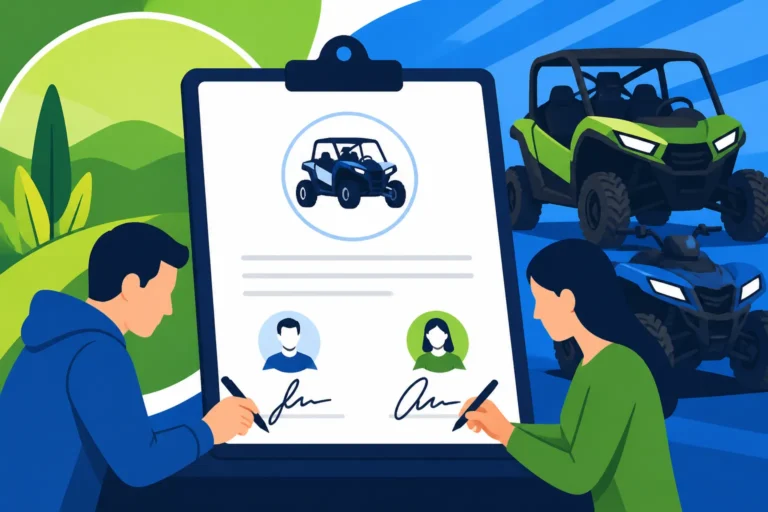
In the absence of a provincial registration or title, your bill of sale becomes the most important document for proving ownership of your ATV or UTV. When you buy a machine, whether from a dealer or a private seller, you absolutely need a clear, detailed bill of sale. This document should include:
- The date of sale.
- The full names and addresses of both the buyer and the seller.
- A clear description of the ATV/UTV, including its make, model, year, and most importantly, the Vehicle Identification Number (VIN) or serial number.
- The purchase price.
- Signatures of both parties.
Having a robust bill of sale is critical. It acts as your proof that you legally acquired the machine. If your quad is ever stolen, this is the first document the police will ask for. If you later decide to sell your machine, the next owner will also need a proper bill of sale. Without one, proving ownership can become a nightmare, potentially affecting insurance claims or resale value. You can often find templates online, or use a service like LawDepot to generate a legally sound [Saskatchewan Bills of Sale Do the Work] to protect both parties. Make sure to keep this document in a safe place, ideally a physical copy and a digital scan.
Why Insurance is Non-Negotiable
Even though your ATV isn't provincially registered, carrying appropriate insurance is not just a good idea – it's often a legal requirement and always a financial necessity. The [Saskatchewan All Terrain Vehicles Act] mandates that any ATV operated off private property must have at least liability insurance. This minimum requirement is often set at two hundred thousand dollars in coverage. This isn't bundled into an annual registration fee like it is with snowmobiles; you need to purchase it separately.
Think about it: an accident can happen in a flash, whether you're on a trail, crossing a ditch, or even just maneuvering around your cabin property. If you're involved in an incident that causes injury to another person or damage to someone else's property, your liability insurance will step in to cover those costs. Without it, you could be facing substantial out-of-pocket expenses. Beyond the mandatory liability, many cabin owners choose to carry additional coverage for collision, comprehensive (for theft or vandalism), and even coverage for medical payments or accessories. A good insurance broker specializing in recreational vehicles can help you navigate the options and ensure you have adequate [Saskatchewan Insurance Requirements for Riders]. Don't assume your home or auto policy will cover your ATV; typically, it won't.
Handling Sales and Transfers
When the time comes to sell your cabin quad, the lack of a provincial registry means the transfer process is primarily a private transaction. There's no government office to visit to "transfer" the title because there isn't one. Instead, the transaction hinges entirely on the bill of sale. As the seller, you'll provide the buyer with a new, signed bill of sale, effectively transferring ownership. This document should clearly state the machine's details, the sale price, and the full information of both buyer and seller. Again, utilizing a reliable template, perhaps from LawDepot, can ensure all necessary details are included and help prevent future disputes.
It's also essential to notify your insurance provider when you sell your machine so you can cancel your policy or transfer it to a new vehicle. For the buyer, receiving a clear bill of sale is paramount. They should also perform a serial number check to ensure the machine isn't reported stolen, as there's no provincial system to verify clean title. This is where the importance of a well-documented sale becomes even more apparent for [Selling a Quad Privately in Saskatchewan]. Always remember to keep a copy of the bill of sale for your own records, even after the sale is complete.
Here's a quick comparison of essential vs. non-essential "paperwork" for your cabin ATV in Saskatchewan:
| Document/Requirement | Status for Cabin ATV (Saskatchewan) | Importance | Notes |
|---|---|---|---|
| Provincial Registration | NOT required | N/A | Saskatchewan does not register ATVs. Don't look for it! |
| Provincial Plate/Decal | NOT required | N/A | No provincial plate or decal issued for ATVs. |
| Bill of Sale | REQUIRED | Extremely High – Proof of ownership, vital for sales, insurance, and theft recovery. | Must be detailed with VIN/serial, buyer/seller info, date, price, signatures. Use a template like LawDepot. |
| Liability Insurance | REQUIRED (for use off private land) | High – Legal mandate for public use, protects against financial ruin from accidents. | Purchase separately through a broker. Recommended even on private land for comprehensive protection. |
| Municipal Permit/Plate | May be required (check local bylaws) | Medium – Varies by location. Essential if riding in specific villages/RMs. | Local permits may be required for specific municipal roads/trails. Check with your local RM/village office. |
| Operator's Licence | REQUIRED (for use off private land, with exceptions) | High – Legal requirement for public road/ditch use. | Adults generally need a valid driver's licence. Age exceptions for private land or supervised youth with training. |
| Proof of Safety Training | Recommended (for youth), REQUIRED (for youth without supervision) | High – Ensures safe operation. Required for youth (12-15) operating without 365-day supervisor. | Various safety courses are available and beneficial for all riders. |
Riding Your Cabin Machine Beyond the Property Lines
While your ATV might spend most of its life on your cabin property, there will inevitably be times when you want or need to take it off your land. Whether it's to access a nearby lake, ride to a friend's cabin, or explore designated trails, understanding the rules for operating your machine on public roads, ditches, and Crown land is critical. This is where the exemptions for private land end, and the full weight of the [Saskatchewan All Terrain Vehicles Act] and various other regulations come into play.
Navigating Ditches, Grid Roads, and Public Land
Once you leave your private cabin property, the rules for ATV operation become much more stringent. You can't just ride anywhere. In Saskatchewan, ATVs are generally prohibited from highways, unless specifically permitted by a bylaw, or for the purpose of crossing. However, ditch riding is a common practice, but it comes with strict limitations. The Act allows riding in ditches adjacent to highways, but you must remain [Saskatchewan Ditch Riding and the 2-Metre Rule] from the travelled portion of the highway, and travel in the same direction as traffic. This rule is often overlooked, but peace officers do enforce it.
For grid roads and other municipal roads, the rules vary depending on local bylaws. Some rural municipalities may allow ATVs on certain grid roads, while others strictly prohibit it. Always check with the specific RM. When it comes to Crown land, access can be complex. Some Crown lands are open to ATVs, especially for recreational purposes, while others may be restricted or have specific seasonal closures, often due to wildfire risk or environmental protection. Always look for signage and check with the Ministry of Environment for specific access rules for [Saskatchewan Rules for Riding Crown Land] in your chosen area. Ignoring these rules can lead to significant fines or even impoundment of your machine.
Age and Supervision Requirements
The moment your cabin quad leaves your private property, the rules regarding operator age and supervision tighten significantly. [Saskatchewan ATV Age Requirements] dictate that a person must be 16 years of age or older to operate an ATV on public land, including ditches, Crown land, or municipal roads where permitted. There are critical exceptions, however:
- 12-15 Year Olds: A person aged 12 to 15 can operate an ATV off private property if they are under the direct supervision of a person 18 years of age or older who has held a valid driver's licence for at least 365 days. Alternatively, they can operate unsupervised if they hold a valid ATV safety course certificate recognized by the province. This certificate effectively replaces the need for direct supervision for that age group.
- Under 12: Children under the age of 12 are generally not permitted to operate an ATV off private property under any circumstances.
It’s crucial for cabin owners with younger family members to understand these rules. Letting a child operate a machine unsupervised on a public access trail, even a short distance from the cabin, can result in serious legal repercussions for the supervisor or owner. The Act is quite clear on the responsibility of the adult in these scenarios.
Helmet and Safety Gear Rules
Regardless of where you're riding your cabin ATV in Saskatchewan – be it on your own private land, down a ditch, or on an approved trail – wearing a helmet is a non-negotiable legal requirement. The [Saskatchewan Helmet and Eye Protection Rules] are clear: every operator and passenger on an ATV must wear a helmet that meets accepted safety standards (e.g., DOT, Snell, ECE). This isn't just a suggestion; it's a law designed to protect riders from serious head injuries, which are tragically common in ATV accidents.
Beyond the helmet, appropriate eye protection is also mandated, which can be integrated into a full-face helmet or come in the form of goggles or a shatterproof face shield. Riding without these essential safety items not only puts you and your passengers at extreme risk but also makes you liable for fines if caught by a peace officer. Additionally, it's highly recommended to wear sturdy boots, long pants, and long sleeves to protect against scrapes, impacts, and debris, even when just doing chores around the cabin. Safety is paramount, and the small effort of gearing up properly can prevent life-altering injuries.
Disclaimer
This article is for general informational purposes only and does not constitute professional advice. Laws, prices and regulations vary by location and change over time. Consult a qualified professional for guidance on your specific situation.