Why Police Say They Cannot Identify a Helmeted Rider
It’s a frustrating reality for both law enforcement and the public: when an incident occurs involving an ATV or UTV in Saskatchewan, identifying the rider can be incredibly difficult, especially when they're wearing a helmet. This challenge impacts everything from accident investigations to theft recovery, leaving many wondering why this critical hurdle persists. This guide will explore the specific reasons behind this identification dilemma, what tools police do have at their disposal, and the broader implications for riders and the community across the province.
The Obscuring Nature of Helmets in Rider Identification
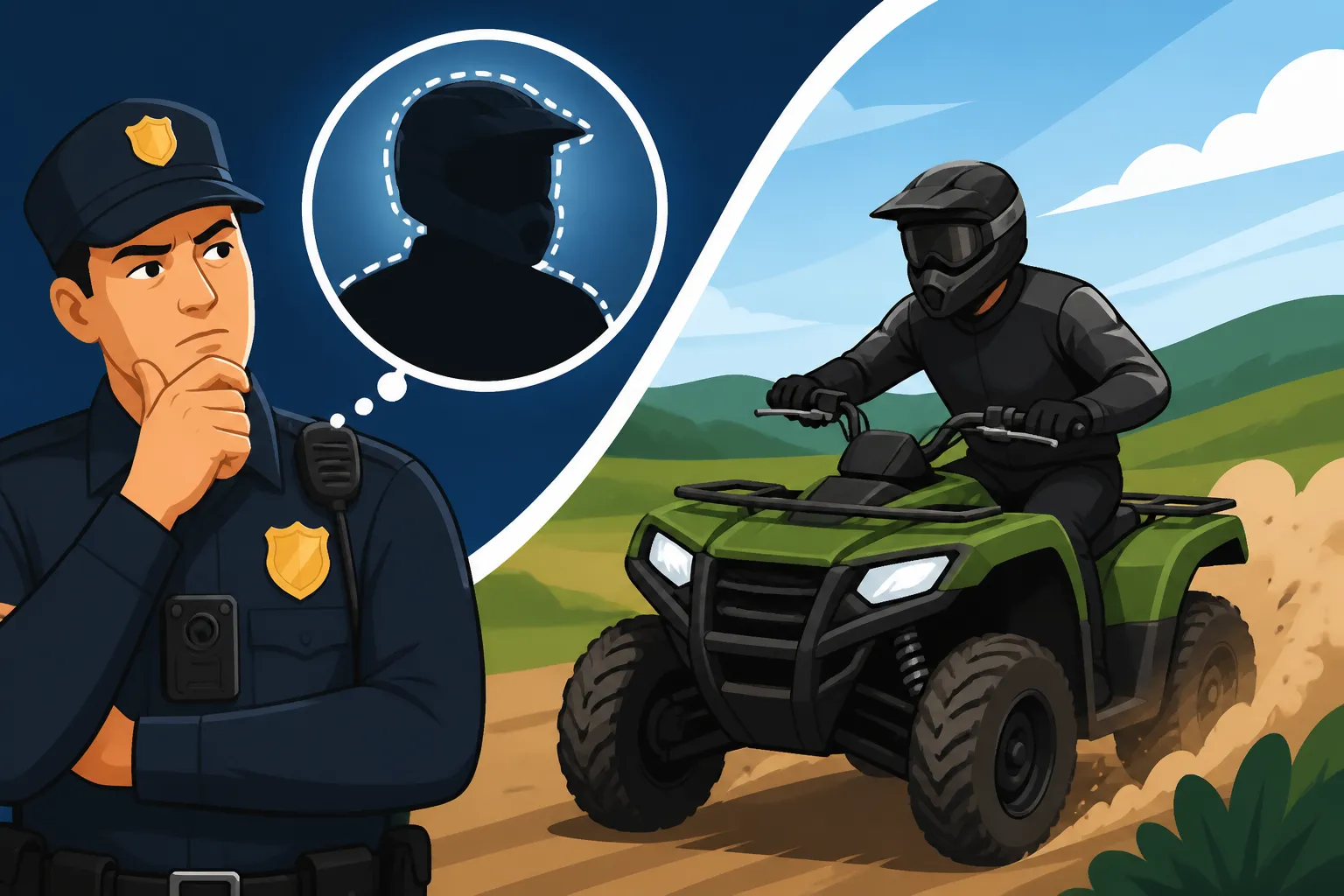
One of the most immediate and obvious reasons police often struggle to identify ATV and UTV riders is the very safety gear that protects them: the helmet. While absolutely essential for rider safety and mandated by law, helmets inherently obscure facial features, making positive identification a significant challenge in many situations.
Physical Barriers to Visual Identification
Think about it from a law enforcement perspective or even as a witness to an incident. A full-face helmet, or even an open-face helmet combined with goggles and a neck gaiter, can cover almost every distinguishing feature of a person's face. All you might see is a glimpse of their eyes. This isn't just a minor inconvenience; it can be a critical roadblock in investigations. If a rider is involved in a hit-and-run, a dangerous operation, or simply a violation of local bylaws, a witness report might only describe the colour of the machine and the helmet, not the individual beneath it. This lack of clear visual identification means police cannot easily track down individuals based on eyewitness accounts alone, which are often crucial in other types of incidents.
Moreover, many helmets look quite similar, especially from a distance or in low light. Generic black, white, or red helmets offer little in the way of unique identifiers. Unless a helmet has very distinctive markings, colours, or stickers that a witness can accurately recall, it provides minimal help in singling out an individual from the riding community. This makes it difficult for officers to piece together who was operating a machine at a specific time and place, adding a layer of complexity to even routine enforcement stops, let alone more serious investigations.
The Mandate for Helmet Use
It's crucial to remember that helmet use isn't optional in Saskatchewan; it's a legal requirement designed to save lives and prevent serious injuries. The province’s All Terrain Vehicles Act clearly outlines the need for appropriate head protection. Riders must wear a helmet that meets accepted safety standards, such as those set by DOT (U.S. Department of Transportation), Snell, or ECE (Economic Commission for Europe). This is a non-negotiable safety rule, and rightly so. You'll find specific details about these requirements in [Saskatchewan Helmet and Eye Protection Rules].
While essential for safety, this legal mandate inadvertently creates the very identification challenge police face. There’s a constant tension between ensuring rider safety through required gear and the practical difficulties this gear presents for law enforcement. No one is suggesting riders forgo helmets, but it highlights the systemic issue. Without other means of identification, the helmet, a shield against injury, also becomes a shield against identification, complicating police efforts to uphold the law and investigate incidents involving ATVs and UTVs.
The Impact of No Provincial ATV Registration
Beyond the physical obstruction of a helmet, the primary systemic reason police struggle to identify ATV riders in Saskatchewan stems from the province's unique approach to ATV regulation: there is no provincial registration system for these machines. This might come as a surprise to some, especially those from other jurisdictions, but it's a cornerstone of Saskatchewan's ATV legislation.
The Absence of a Central Database
Unlike cars, trucks, or even snowmobiles, ATVs and UTVs in Saskatchewan are not required to be registered with the province. This means there's no central database holding ownership information linked to a specific machine. When a police officer stops a vehicle on the road, they can run the licence plate and quickly pull up details about the registered owner. With an ATV, that simply isn't an option. You can read more about this in [Saskatchewan Does Not Register ATVs] and [Saskatchewan Has No ATV Plate or Decal].
This lack of a provincial registry creates a significant void in law enforcement's ability to quickly and accurately identify an owner or operator. If an ATV is involved in an incident and the rider flees, or if the machine is found abandoned, there’s no easy way to trace it back to an individual. Officers can't just "run the plates" because there are no provincial plates or decals to run. This makes theft recovery incredibly challenging and complicates investigations into improper use, trespass, or environmental damage. The burden of proof shifts dramatically, often requiring more intensive, time-consuming investigative methods.
Contrast with Snowmobile Registration
To truly understand the gap, it's helpful to look at how snowmobiles are treated in Saskatchewan. Snowmobiles do require provincial registration, and they are issued a licence plate. This difference is stark and highlights what an ATV registration system could offer. With a registered snowmobile, police have a direct link to an owner through a central database. This facilitates everything from accident reporting to theft recovery and enforcing regulations. [Saskatchewan Registers Snowmobiles, Not ATVs] delves into this distinction.
The historical reasons for this divergence are complex, but the practical outcome for law enforcement is clear. When a snowmobile is reported stolen or found abandoned, police have a starting point. For an ATV, however, the process is much more like trying to find a needle in a haystack, especially if the machine doesn't have any distinctive aftermarket modifications or a clearly visible Vehicle Identification Number (VIN). This lack of parity between similar recreational vehicles often leaves police with fewer tools when dealing with ATV-related incidents, directly contributing to the challenge of identifying riders.
What Police Can Use for Identification and Investigation
Even without provincial registration or easy visual identification of a helmeted rider, law enforcement in Saskatchewan is not entirely without recourse. They employ various methods and rely on other pieces of information to investigate incidents involving ATVs and UTVs. It just often requires more effort and different strategies than with other types of vehicles.
Machine Identification: VINs and Unique Features
Every ATV and UTV has a unique Vehicle Identification Number (VIN), typically stamped on the frame. This VIN is the machine's fingerprint and can be a crucial tool for identification. If police can get the VIN, they can use national databases for stolen vehicles or contact manufacturers to potentially trace the machine's sales history. However, obtaining the VIN isn't always straightforward, especially if a rider flees or the machine is damaged. Also, merely knowing the VIN doesn't instantly identify the rider at the time of an incident, only the registered owner from the point of sale.
Beyond the VIN, police look for any unique identifiers on the machine itself. This could include specific aftermarket accessories, custom paint jobs, distinctive stickers, or even damage patterns. A highly customized machine, for example, might be easier to identify through witness descriptions or surveillance footage than a stock model. For those involved in private sales, ensuring a detailed bill of sale, perhaps using a template from resources like LawDepot, that includes the VIN and any unique features can be helpful for future proof of ownership, which can aid in investigations. [Saskatchewan Theft Recovery Without a Registry] explores how police approach recovery without a central registry.
Witness Statements and Surveillance
While a helmet might obscure a rider's face, witnesses can still provide valuable information. Descriptions of the machine's colour, make, model, type of helmet, riding gear (jacket, pants), approximate height or build of the rider, and direction of travel are all crucial. In rural areas, local knowledge can also play a significant role. If a specific type of ATV is seen regularly in a small community, combined with witness descriptions, it can narrow down the search.
The increasing prevalence of surveillance cameras, both public and private, also provides another layer of investigative potential. Dashcams, doorbell cameras, and business security systems can capture footage of ATVs and UTVs, sometimes showing enough detail of the machine or even the rider's general appearance to aid in identification. Piecing together footage from multiple sources can help establish a timeline and path of travel, providing leads even when the rider's face remains hidden.
Local Bylaws and Municipal Plates
While there's no provincial ATV registration, some rural municipalities and resort villages in Saskatchewan have taken it upon themselves to implement local bylaws requiring residents to register their ATVs and obtain a municipal plate or permit. These plates are specific to the municipality and are often accompanied by local rules for operating ATVs on public lands or roads within their jurisdiction. [Saskatchewan Municipal Plate Schemes] provides an overview of this patchwork system.
For police operating within these specific municipalities, these local plates do offer a direct link to an owner, much like a provincial snowmobile plate would. If an incident occurs in a place like the District of Lakeland or the Village of Candle Lake, and the ATV has a municipal plate, officers can access local records to identify the permit holder. This is a powerful tool for local enforcement, but it's important to remember that these plates are not universally recognized across the province. A plate issued by Candle Lake won't help police in another municipality that doesn't have its own scheme. Knowing [Which Municipalities Run Their Own Plate Scheme] can be invaluable for riders and law enforcement alike.
Rider Responsibilities and Potential Consequences
The challenges police face in identifying helmeted ATV riders in Saskatchewan don't absolve riders of their legal responsibilities. In fact, understanding these challenges can underscore the importance of responsible riding and the potential consequences if you're involved in an incident. The lack of a simple identification method doesn't mean you can't be held accountable; it simply means the investigative process might be different.
Legal Duties After an Incident
Saskatchewan's All Terrain Vehicles Act outlines clear duties for operators involved in an accident. If you're involved in a collision that results in injury, death, or significant property damage, you are legally obligated to stop, provide assistance, and exchange information. Failing to do so can lead to serious charges, including hit-and-run offences, which carry much heavier penalties than a simple traffic violation. Even if you're helmeted, fleeing the scene will only escalate the legal ramifications.
Furthermore, if an officer asks for your identification and proof of insurance while you are operating an ATV, you are generally required to provide it. [Saskatchewan Insurance Requirements for Riders] is a critical read for all operators. While you don't have a provincial registration document for your ATV, you do need to be able to prove you're properly insured and, if applicable, that you have a valid driver's licence. The Act treats the operator as the one responsible, and police will pursue all avenues to determine who was operating the machine at the time of an incident.
Implications for Enforcement
The difficulty in identification can have varied implications for enforcement. On one hand, it can make it harder for police to issue citations for minor infractions if a rider refuses to stop or quickly leaves the scene. This can sometimes lead to frustration among communities dealing with nuisance ATV riding, noise complaints, or trespass issues. The lack of an immediate, identifiable link to an owner means officers have to invest more time in follow-up investigations.
On the other hand, for more serious incidents, police will use every resource at their disposal. This can include forensic analysis of accident scenes, canvassing for witnesses, reviewing security footage, and even working with informants or community members who might recognize specific machines or riding styles. If an individual is eventually identified and charged, the penalties can be severe, especially if actions like fleeing or dangerous operation are proven. [Saskatchewan Owner Liability Rules] also details how owners can be held responsible for the actions of those they permit to ride their machines, even if they weren't the operator themselves. This places an added burden on owners to ensure their machines are operated responsibly.
The Role of a Bill of Sale and Proof of Ownership
Since there's no provincial registration for ATVs, your bill of sale becomes your primary proof of ownership. This document is incredibly important, not just for a private purchase, but also for police investigations. If an ATV is stolen and later recovered, the bill of sale is what helps authorities verify you are the rightful owner. Without it, proving ownership can be a prolonged and difficult process. For a comprehensive overview, look at [Saskatchewan Bills of Sale Do the Work].
When buying or selling an ATV privately, it's highly advisable to use a robust bill of sale. Templates from resources like LawDepot can ensure all necessary details are captured, including the VIN, sale price, names and contact information of both parties, and the date of sale. A properly executed bill of sale acts as your legal record and can be critical in situations where police need to confirm ownership, for example, if they recover a stolen machine. [Your Bill of Sale Stands In for a Registration] explains just how vital this simple piece of paper is in Saskatchewan. Keeping a copy of your bill of sale, and proof of insurance, readily accessible (perhaps digitally on your phone, or a laminated copy in a waterproof bag on your machine) is a smart practice for all riders.
Summary of Identification Challenges and Solutions
Here's a quick look at the core reasons behind the identification challenges and the tools police have:
| Challenge | Explanation | Police Tools/Solutions |
|---|---|---|
| Helmets Obscure Identity | Full-face helmets, goggles, and gear hide facial features, making visual identification difficult. | Witness descriptions of machine/gear, surveillance footage, physical characteristics (build, height). |
| No Provincial ATV Registration | No central database links ATVs to owners, unlike cars or snowmobiles. | VIN checks, national stolen vehicle databases, manufacturer tracing (complex), unique machine features. |
| Lack of Provincial Plates/Decals | No registration plates to "run" for immediate owner information. | Local municipal plates (where applicable), witness statements, community intelligence. |
| Rider Non-Compliance | Riders fleeing a scene or refusing to identify themselves. | Pursuit (if safe), extensive investigation (forensics, witness canvass, surveillance), owner liability. |
Ultimately, while the lack of provincial registration and the necessity of helmets present unique obstacles, police in Saskatchewan are equipped with various investigative techniques to piece together incidents involving ATVs and UTVs. It often requires more legwork and a reliance on diverse information sources, emphasizing the importance of responsible riding and documentation for all operators in the province.
Disclaimer
This article is for general informational purposes only and does not constitute professional advice. Laws, prices and regulations vary by location and change over time. Consult a qualified professional for guidance on your specific situation.