Saskatchewan Parks With No Permit at All
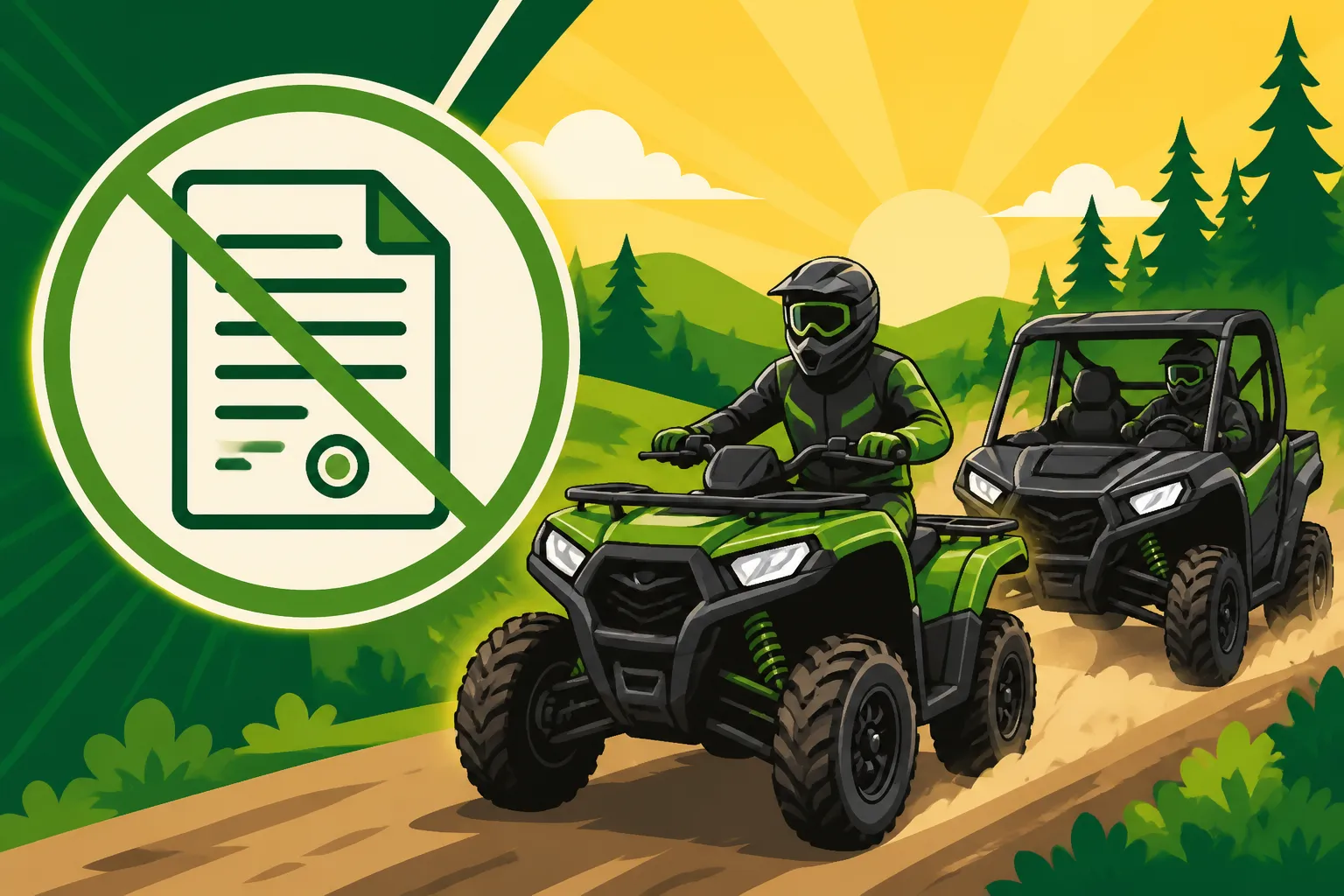
Saskatchewan riders can easily mistake a park that does not issue ATV permits for a park where ATVs are allowed. Those are different things. The practical rule is simple: no permit may be needed where ATV riding is not authorized, but that does not make the park open to machines. Check both access and permit rules before unloading.
No permit does not mean permission to ride
There is no single Saskatchewan provincial trail pass that grants ATV or UTV access across every provincial park. A park may require a permit for riding on its designated machine trails, while another may have no ATV permit because it has no authorized ATV trails. In the second case, “no permit” is not a shortcut to riding wherever you choose.
That distinction matters because a park permit and permission to ride solve different problems:
- A permit is an administrative requirement for using a particular trail or riding area.
- Access rules determine whether ATVs or UTVs may be used there at all, and where they may go.
- Other park rules can govern such matters as allowed routes, rider supervision, insurance, machine washing, and where permits must be displayed.
A visitor may be able to drive a road-legal vehicle into a park, park a truck and trailer, camp, or walk its trails without needing an ATV trail permit. None of that proves an ATV can be unloaded and ridden there. The machine-use rules apply separately.
The safest interpretation of “no permit required” is therefore narrow: the park does not require that specific ATV permit for the activity and location being considered. It does not automatically mean riding is allowed, unrestricted, or exempt from other rules.
This is also why it helps to distinguish a provincial park from a municipal trail system or Crown land. Requirements in one area do not necessarily carry over to another. A local plate scheme, for example, is not the same as a provincial park trail permit. For the broader picture, see Saskatchewan Park Trail Permits Are Free and Saskatchewan Municipal ATV Plates Explained.
What a park permit does and does not tell you
A permit is only one part of the rules. Before you plan around a park’s permit policy, check whether ATV use is allowed and whether the route you intend to ride is designated for machines.
| What you are checking | What it answers | What it does not prove |
|---|---|---|
| ATV trail permit | Whether you need the park’s permit for the activity | That riding is allowed anywhere in the park |
| Designated ATV trails | Which routes, if any, are open to machines | That roads, hiking trails, beaches, or other routes are open |
| Park machine rules | Conditions that apply to ATVs and UTVs | That a municipal plate or other permit replaces a park requirement |
| Park access information | Whether the park has an authorized riding area | That the area is open on the day you arrive |
| Municipal plate rules | Whether a local plate scheme applies in that municipality | That the plate authorizes riding in a provincial park |
Some parks with designated machine trails may require a permit even when the permit itself is free. A free permit is still a permit: riders may need to complete an information session or form, collect the permit at a specified location, and display it as directed. For example, requirements at designated riding areas such as Moose Mountain and Great Blue Heron should be checked with the park before a trip. See [Saskatchewan Permit Rules at Moose Mountain] and [Saskatchewan Permit Rules at Great Blue Heron] for park-specific details.
Other parks may not offer designated ATV routes. If machines are not authorized there, the absence of a permit requirement means there is no ATV permit to obtain for that park; it does not create permission to ride. Saskatchewan Parks With Designated Trails Only explains why being inside a park does not make every road or trail available to machines.
A permit requirement can also be different from an entry charge, camping reservation, or other park service. When someone asks whether a park needs “a permit,” it is worth clarifying whether they mean an ATV trail permit, general park access, a camping booking, or permission for an organized event. Those requirements are not interchangeable.
How to understand “parks with no permit at all”
In everyday conversation, “a park with no permit” can describe several different situations. Sorting out which one applies prevents a frustrating trip and, more importantly, helps keep riders off routes where machines are not allowed.
The park has no ATV riding area
This is the most important case. If a park does not authorize ATV or UTV riding, it may have no trail permit program for machines. The absence of a permit process is not an invitation to ride its ordinary park roads, hiking trails, beaches, campground roads, or open ground.
Cypress Hills is a clear example of why this distinction matters: Saskatchewan’s Cypress Hills blocks are closed to quads. There is no ATV permit that turns that closure into permission. Check Why Cypress Hills Says No to Quads and Saskatchewan Trails Closed Inside Parks before considering any route there.
The park allows a specific kind of machine use without a separate permit
A park may allow some limited machine access under its rules without requiring the same trail permit used at a designated ATV riding area. That does not mean every ATV or UTV activity is allowed. The route, purpose, season, vehicle type, or other conditions may matter.
Do not infer that a general vehicle-access rule applies to recreational trail riding. If the park information does not plainly say that recreational ATV use is allowed without a permit, ask the park office which routes are open and what conditions apply.
The park has no separate ATV permit, but other rules still apply
Even where an ATV trail permit is not required, a rider may still need to follow rules under provincial law, park regulations, municipal bylaws, or land-access conditions. Those rules can address safe operation, insurance, supervision of young riders, helmet use, and access to private or occupied land.
A permit exemption does not cancel the usual obligations that apply to the machine and its operator. For a broader overview of in-park requirements, see Saskatchewan Park Regulations for Machines.
A free permit is being mistaken for no permit
If a permit costs nothing, riders sometimes describe the area as “no permit required.” But if the park requires riders to apply, attend an information session, sign a use form, or display a permit, it is still a permit system. The cost and the requirement are separate questions.
This distinction is especially useful when planning a trip with friends. One rider may remember that no payment was required, while another may assume that means no paperwork or preparation. Confirm whether the permit is required, whether there is a fee, and how to obtain it.
Check before you haul the machine
Park information can be easy to misread when you are comparing a map, a trail page, and a general visitor page. Use a short verification process before loading the ATV or UTV.
- Identify the exact riding area. A park name alone may not be enough. Confirm the block, trail system, staging area, or route you intend to use.
- Look for explicit ATV or UTV authorization. Find a park page or posted notice that specifically addresses machine riding. General statements about park access are not a substitute.
- Check whether the route is designated. If riding is limited to marked machine trails, do not assume that nearby roads, hiking trails, or unmarked tracks are open.
- Confirm the permit requirement. Ask whether a permit is required, whether it is free or paid, and whether an information session, acknowledgement form, or display requirement applies.
- Check current closures and operating conditions. Fire restrictions, trail work, weather damage, or other temporary notices can affect access even when riding is usually allowed.
- Ask where the rule applies. A municipal plate or a permit for one park may not be valid in another area. Confirm which authority administers the route.
- Keep proof of what you need. If the park requires a permit, insurance evidence, or another document, make sure you know how to present it.
Use an official park contact or current park information when a detail is unclear. A map showing a trail is useful, but it may not tell you whether the route is currently open to ATVs or whether a permit is required. If you get an answer by phone, note the name of the park or trail area and the specific route discussed; “ATVs are allowed in the park” is less useful than confirmation of the exact trail and conditions.
If you are carrying a permit or insurance document, keep it protected and easy to reach. A waterproof document sleeve from an outdoor retailer or Amazon can help keep paper legible in wet or muddy conditions, but it does not replace any digital or physical display requirement set by the park.
A practical pre-ride checklist
Use this checklist whether the park requires a permit or says none is needed:
- Confirm that recreational ATV or UTV use is allowed in the specific area.
- Verify which trails or roads are open to machines.
- Find out whether the permit is required, free, paid, or unavailable because riding is not authorized.
- Check whether a form, information session, or permit display is required.
- Review current closures, fire restrictions, and seasonal notices.
- Confirm rules for insurance, youth supervision, passengers, and equipment.
- Make sure you have permission for any adjoining private or occupied land.
- Keep required documents accessible and follow the park’s instructions.
If the park says it has no ATV permit, ask one more question: Does that mean riding is allowed without a permit, or does the park not authorize ATV riding at all? That small clarification resolves the main source of confusion.
Do not rely on a permit from a different park, a municipal plate, or another rider’s understanding of the rules. Permission is location-specific. A visitor who rides legally on one designated trail may still be prohibited from riding on a different park road or nearby land.
For general rules about designated routes, closures, and riding inside parks, see Saskatchewan Provincial Park Machine Rules. For trail-specific planning, [Saskatchewan Park Trail Permit Cost] and How to Get a Saskatchewan Park Trail Permit can help clarify the difference between obtaining a permit and being authorized to ride.
Frequently Asked Questions
Do Saskatchewan parks with no ATV permit allow quads?
Not necessarily. A park may have no ATV permit because it does not authorize recreational ATV riding. Confirm that the park and the specific route are open to machines before unloading.
Is a free park permit the same as no permit?
No. If riders must obtain, complete, or display a permit, the permit is required even if there is no charge. Check the park’s instructions for the current process.
Can a municipal ATV plate replace a park permit?
Do not assume so. A municipal plate scheme and a provincial park trail permit serve different purposes. Confirm the requirements for the exact location you plan to ride.
Can I ride a park road if no trail permit is required?
Not automatically. A road may be closed to ATVs even when no permit applies. Use only routes that the park identifies as open to machines.
Disclaimer
This article is for general informational purposes only and does not constitute professional advice. Laws, prices and regulations vary by location and change over time. Consult a qualified professional for guidance on your specific situation.