Saskatchewan Municipal ATV Plates Explained
A Saskatchewan municipal ATV plate can look like a licence plate, but it does not mean your quad or side-by-side is registered across the province. Municipalities set their own plate or permit rules, and the details can change from one place to the next. This guide explains what a local plate does, where it may apply, and what to check before you buy one or ride.
What a Saskatchewan municipal ATV plate means
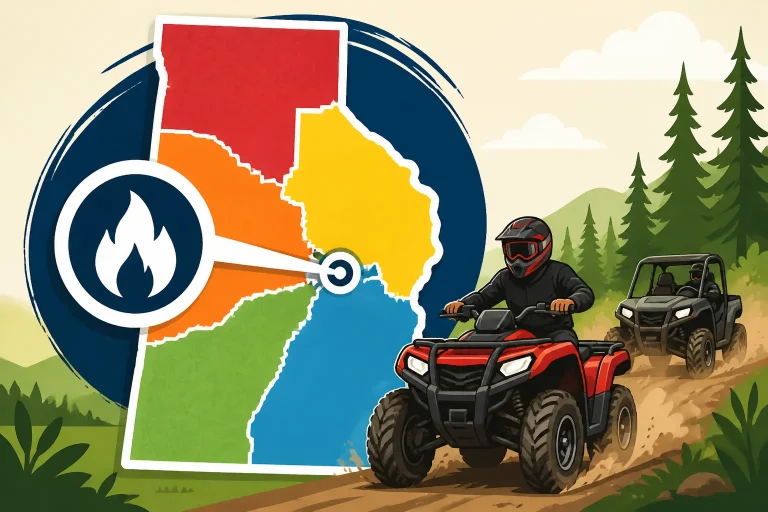
Saskatchewan does not issue a province-wide registration plate for ATVs in the way it registers some other vehicles. A plate sold or issued by a town, village, resort community, or other municipality is a local program. It may be called a plate, permit, decal, or pass, but its meaning comes from the local bylaw and program conditions—not from the fact that it looks like a vehicle plate.
A municipal plate generally serves as evidence that the machine has met a local requirement for riding in the area covered by that program. Depending on the municipality, it may also help officials identify a machine, support local trail or road management, or show that a rider has paid a local permit charge. The exact purpose and conditions are not identical everywhere.
That distinction matters when you travel. A plate issued by one municipality does not automatically grant permission to ride in a neighbouring municipality, on provincial land, or on a road that is otherwise closed to ATVs. It is not a province-wide registration, and it does not replace the rules that apply to the rider and machine.
| What you may have | What it usually represents | What it does not automatically provide |
|---|---|---|
| A municipal ATV plate or permit | Local authorization or evidence of compliance with that program | Province-wide registration or permission to ride anywhere |
| ATV insurance | Financial protection subject to the policy terms | Permission to ride on a closed road or private land |
| A bill of sale or other ownership records | Evidence of a purchase or ownership history | A municipal permit or riding authorization |
| A driver’s licence or required youth supervision | Compliance with rider rules | Permission to use a particular road, trail, or property |
| A park or trail permit | Permission under that park or trail program | A municipal plate or permission to use unrelated routes |
The province-wide registration question is separate from local plate programs. For the broader picture, see Saskatchewan Does Not Register ATVs and Saskatchewan Has No ATV Plate or Decal. If you are trying to understand what local programs add, Saskatchewan Municipal Plate Schemes explains why a municipality may create its own system.
The short version is simple: treat a municipal plate as a local rule, not as a universal pass. Before riding, identify the municipality or land manager responsible for the route and confirm whether its program applies to your machine and trip.
Why municipalities issue plates when the province does not
A municipality may use a plate scheme to manage ATV use within its boundaries or on specified local roads and trails. Local authorities are closer to the places where riding happens, so their concerns may be practical and specific: traffic on a busy street, noise near homes, access to a lakeshore, wear on a trail, parking near a staging area, or the cost of maintaining routes.
A local program can give officials a way to distinguish participating machines from those that have not followed the local process. It can also help a municipality communicate local rules and fund local services. But the plate itself does not create permission beyond what the applicable bylaw or permit conditions allow.
This local approach creates a patchwork. One municipality may offer a plate for particular roads or areas, while another may have no ATV plate program at all. A third may allow riding only on named streets, at specified times, or under conditions that differ from its neighbour’s. The absence of a plate program does not necessarily mean ATVs are allowed; it may mean riding is prohibited, restricted, or governed by other rules.
That is why it is risky to assume that “the area has plates” or “I have a Saskatchewan plate” is enough. Ask what the program covers, and check the current local rules for the route you plan to use. A municipality’s website or office is usually the best place to start, but the relevant bylaw or written permit terms are more useful than a general description.
A plate is not the same as provincial registration
Provincial registration normally ties a vehicle to a province-wide system with defined registration and transfer processes. A municipal plate scheme is local in scope and should not be treated as that kind of registry. It may not establish legal ownership, provide a transferable registration record, or serve as proof that the machine meets every rule elsewhere.
Keep your purchase and ownership documents separately. A signed bill of sale, payment record, and a clear record of the machine’s identification number can be useful if you sell it, make an insurance claim, or need to establish how you acquired it. For more on that role, see Saskatchewan Proof of Ownership Without a Registry and Saskatchewan Bills of Sale Do the Work.
A plate is not the same as a trail permit
A municipality’s plate and a park or trail permit may be separate requirements. A machine with a local plate might still need a park-specific permit, while a park permit may not satisfy a town’s local plate bylaw. The land manager matters.
The same caution applies to Crown land, private property, grazing leases, and provincial parks. A municipal plate does not give you a right to cross land or use a trail. Confirm the land-access rules as well as the vehicle rules. Saskatchewan Municipalities With ATV Bylaws and Saskatchewan Crown Land Access Rules are useful starting points for separating those questions.
Where a municipal plate applies
The first question to ask is not “Is this a Saskatchewan plate?” It is “Which municipality issued it, and where does its authority apply?” A local permit may be limited to municipal roads, designated routes, or a specific community area. It may not apply outside that boundary, even if the neighbouring road looks similar.
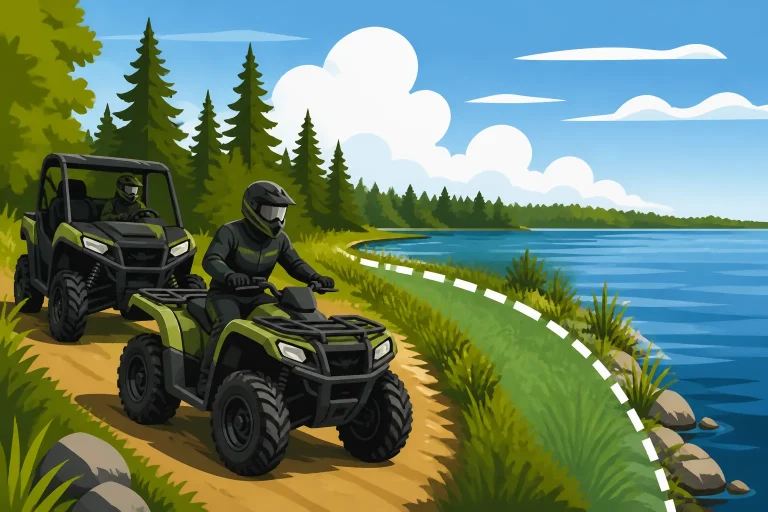
Municipal boundaries can be easy to miss when you are riding. A road may appear to continue naturally from one community into another, while the applicable bylaw changes at the boundary. The same is true near lakes, rural subdivisions, resort communities, and unincorporated areas. A route that is open in one place may be prohibited or subject to a different permit in the next.
Before a longer ride, identify each jurisdiction on your planned route. If you will pass through more than one municipality, ask each one whether its rules apply to visitors and what documentation or plate it requires. For a route involving Crown land, a provincial park, or private property, check those access conditions separately.
Confirm the route, not just the destination
A rider may be allowed to use an ATV in a destination community but still have no legal route to reach it. Permission to ride on local streets does not necessarily mean permission to travel along the highway, shoulder, ditch, or roads between communities.
Check each part of the trip:
- Identify the municipality or land manager for every road, trail, and staging area.
- Confirm whether ATVs are allowed on the route, not just in the destination.
- Ask whether the municipal plate or permit is required for residents, visitors, or both.
- Check whether there are restricted streets, speed limits, hours, seasonal closures, or other local conditions.
- Confirm that you can legally connect the route to the place where your machine is stored or unloaded.
Do not use a plate as a shortcut around a route restriction. A municipality may require a plate for allowed use while still prohibiting riding on particular roads or areas. The rule allowing or prohibiting the ride and the plate requirement are related, but they are not the same rule.
For province-wide operation rules, including rider requirements and general road restrictions, see Saskatchewan ATV Road Rules Explained. Local bylaws can add restrictions or authorize specific local use, so check both the general rules and the rules for the exact area.
Municipal plates and neighbouring programs
Municipalities may design programs differently. A plate from one community might not be recognized elsewhere, and a municipality may not have any reciprocal arrangement with another one. Do not infer reciprocity from the fact that two plates look alike or that both communities are in Saskatchewan.
If you are visiting from another province, the same principle applies. Your home-province registration or plate does not necessarily satisfy a Saskatchewan municipality’s local requirement. Nor should you assume that a Saskatchewan municipal plate makes your machine compliant with the rules in another province. Check the visitor rules at both ends of the trip. Saskatchewan Plate Rules for Visitors covers the local question for visiting riders.
When a local office says another community’s plate is accepted, ask where that acceptance applies and whether there are conditions. If the answer is important to your trip, request the details in writing or consult the bylaw. A vague understanding can be hard to rely on when you cross a boundary or encounter an officer.
How to find out whether your machine needs a local plate
Start with the office responsible for the area where you plan to ride. Depending on the location, that may be a town or village office, a rural municipality, a resort community, or another local authority. Ask about the current bylaw and plate program rather than relying on an old post, a seller’s statement, or a plate seen on another rider’s machine.
Use questions that make the answer specific:
- Does the municipality currently require or offer an ATV plate or permit?
- Which machines does the requirement cover: ATVs, side-by-sides, youth machines, or other off-road vehicles?
- Does it apply to residents, visitors, or both?
- Where may a plated machine ride?
- Does the plate authorize any road use, or only use on particular routes?
- Are there separate permits for parks, trails, or events?
- Where must the plate be displayed, and must it be visible while riding?
- How long is the permit valid, and when does it expire?
- Does the plate stay with the owner, or can it be transferred with the machine?
- What should a visitor do if the office is closed when they arrive?
The answers may depend on the machine, the location, and the purpose of the ride. A utility quad used at a rural property may be treated differently from a machine used on public roads or local trails. If the office gives a broad answer, explain your actual plan: where you will unload, which roads you hope to use, whether you are visiting, and whether you will cross a municipal boundary.
Verify the rules before you travel
Local rules and office procedures can change. Confirm them before making a long drive, especially if your plan depends on a specific route or plate. A web page may be helpful, but if its wording is unclear, contact the municipality and ask which bylaw or program terms control.
Keep a note of the answer and the date you received it. If the response involves an exception or cross-municipality acceptance, save the written confirmation. This is not a substitute for following the bylaw, but it can help you avoid relying on a casual assumption.
If you need to visit an office, confirm its hours and what it needs from you before driving there. Do not assume that every municipality sells plates at the same location or handles applications in the same way. Planning a Village Office Visit Before You Drive and What to Bring to Get Your First Quad Plate cover the practical questions to settle before you go.
Buying and displaying a municipal plate
Once you confirm that a local plate is required or useful for your planned riding, ask the municipality how to obtain it. The application process may be different from one local program to another. An office may ask for information about the machine or applicant, but do not assume that every municipality uses the same documents or checks the same details.
A plate purchase is not a substitute for checking the machine’s identity and ownership records. If you are buying a used ATV, get a bill of sale that clearly identifies the buyer, seller, machine, price, and sale date. Record the serial number or vehicle identification number accurately and keep a copy of the paperwork. These records remain useful even if the municipality gives you a local plate.
Make the serial number part of the process
Before paying for a plate or completing a private sale, compare the machine’s identification number with the number written on the bill of sale and any other documents you receive. Dirt, corrosion, worn stamping, and handwritten errors can make a number difficult to read. Check it carefully, and take a clear photograph for your records.
If you are uncertain whether the machine falls within a program’s definition, describe its type and configuration to the municipal office. Do not rely only on what the seller calls it. A machine that looks like a quad may be treated differently under a particular rule, and the local program may use its own definitions.
Display and care
Follow the municipality’s instructions for where and how to display the plate or permit. If it must remain visible, mount it securely and keep it readable. Mud, a cargo box, a rack, or added accessories can obscure it. Check it after hauling or maintenance, particularly if you remove body panels or change equipment.
If the plate is lost, damaged, or stolen, contact the issuing municipality before continuing to ride where the local program applies. The replacement process and whether you can ride while waiting are local questions. Do not assume that a photograph of the plate, an old receipt, or a temporary handwritten sign will be accepted.
For storage and transport, keep your paperwork with the machine’s other records rather than relying on a loose slip in a tool box. A waterproof document pouch can help protect a copy of the permit and insurance information from rain or mud; you can find generic pouches through outdoor retailers or Amazon. Keep original ownership documents somewhere secure at home, and carry copies only if they are suitable for the purpose.
Renewal, replacement, and selling the machine
A municipal plate may have a defined validity period or renewal process. The dates and requirements are set locally, so read the permit terms and confirm the next renewal date with the issuing office. Do not assume that a plate remains valid indefinitely or that all municipalities use the same expiry date.
Ask how renewal works before the current permit expires. Some programs may require a new application or an in-person visit; others may have a different process. If the municipality uses a calendar date, keep it in your records and set a reminder. A plate that is expired or no longer valid may not satisfy the local requirement, even if it remains attached to the machine.
If a plate goes missing, contact the issuer promptly. Ask what information it needs, whether a replacement is available, and whether you should report a theft. Keep any replacement receipt or confirmation with the permit documents. A local plate’s replacement procedure is not necessarily the same as replacing a provincial vehicle plate.
Do not assume the plate follows the machine
When you sell an ATV, ask the municipality whether the plate or permit can be transferred. Some local programs may issue authorization to a person or household; others may tie it to a particular machine, or use a different arrangement. The answer depends on the specific program.
Put the agreement in writing. If the buyer expects to use the machine under a local plate, clarify whether the buyer must apply for a new one. Do not include a plate in the sale as if it were automatically transferable unless the municipality confirms that it is. A plate from a local program does not prove that the seller owns the ATV, and it should not replace a bill of sale.
For a clean transaction, record the machine’s identification number, the sale date, and the names and signatures of both parties. Give the buyer the documents you agreed to provide, and retain a copy. The guide Surrendering a Municipal Plate When You Sell discusses why a seller should check the local program’s process instead of assuming the plate transfers with the quad.
If you are buying, ask the seller whether the plate is current, who it was issued to, and whether it can legally be transferred. Then verify the answers with the municipality. This small check can prevent an avoidable trip to the office—or a ride that turns out not to meet local requirements.
Costs, insurance, and the rules a plate cannot replace
Municipalities set their own charges and may change them. Check the current amount and payment methods directly with the issuing office. A local plate charge is separate from the cost of insuring the ATV, maintaining it, or obtaining any other permit required for the ride.
Do not budget for one municipality based on another’s program. Fees, renewal timing, replacement procedures, and what the charge supports can differ. Some programs may direct revenue toward local services or trails, but ask the municipality what its fee covers rather than assuming every plate funds the same things.
Insurance is a separate requirement
A municipal plate does not automatically insure the machine. Confirm that the ATV or side-by-side has the coverage required for the type of riding and location. Read the policy carefully, including who may operate the machine, where it may be used, exclusions, and any conditions relevant to off-road riding.
Carry proof in the way required by the applicable rules, and make sure it is current. A local plate and insurance document answer different questions: the plate may address a municipal program, while the insurance policy addresses financial protection under its terms. For more, see Saskatchewan ATV Insurance Requirements and Saskatchewan Insurance Proof on the Trail.
Rider and equipment rules still apply
A plate does not make an otherwise unlawful ride legal. Rider age, licensing, supervision, helmets, eye protection, passengers, lighting, speed, and road-use rules still matter. So do local bylaws that restrict particular streets, trails, beaches, or hours.
Before heading out, check that:
- The route is open to the kind of machine you are using.
- You have permission to use the land or trail.
- Any local plate or permit requirement is satisfied.
- The operator meets the applicable age, licence, or supervision rules.
- The machine has required safety equipment and the rider has appropriate protective gear.
- Insurance is in place and proof is available.
- You understand any local limits on speed, passengers, parking, or riding hours.
If you are planning park riding, check park rules separately. A municipal plate may not satisfy a park’s permit or use requirements. Likewise, a park permit does not necessarily satisfy a municipality’s rules on the roads leading to the park.
Common mistakes to avoid
Treating a local plate as a provincial plate
A municipal plate is local. It does not create province-wide registration or prove ownership. Keep your bill of sale and other ownership records, and check local rules at every boundary.
Assuming one municipality recognizes another’s plate
Reciprocity should be confirmed, not guessed. Ask whether the specific program is accepted in the specific place where you intend to ride. If the answer is unclear, check the bylaw or get written confirmation.
Thinking the plate opens every road
A plate requirement and permission to ride a route are separate matters. A municipality may require a plate while allowing ATVs only on certain roads. A plate does not authorize travel on a highway, a closed street, private land, or a trail managed by someone else.
Relying on old information
A neighbour’s experience or a plate bought several seasons ago may not reflect the current program. Confirm current rules, dates, office procedures, and costs with the issuing municipality.
Confusing the plate with insurance or ownership papers
Keep all three categories distinct. The plate relates to a local program, insurance relates to coverage, and ownership paperwork records the sale or ownership history. One does not replace the others.
Waiting until you arrive to ask
A closed office, missing document, or uncertain boundary can disrupt a trip. Confirm the rules before hauling the machine. If you are riding with a group, make sure each operator understands which permits apply and where the route changes jurisdiction.
A practical checklist before you ride
Use this checklist when planning a ride in a municipality with an ATV plate program:
- Identify the local authority. Determine who controls the roads, trail, or community area you plan to use.
- Check the current bylaw. Find out whether a plate or permit is required, who must obtain one, and which machines are covered.
- Confirm the route. Ask where ATVs may ride and whether the route connects legally to your starting point.
- Ask about visiting riders. Confirm whether residents and visitors follow the same process and whether another municipality’s plate is recognized.
- Check permit details. Verify validity, renewal, display, replacement, and transfer rules.
- Bring the right records. Keep insurance proof and relevant ownership or sale documents available.
- Review rider and machine requirements. Check age, licence, supervision, helmet, passenger, lighting, and equipment rules.
- Check other land rules. A municipal plate does not replace park, Crown land, private-property, or event permissions.
- Save confirmation. Keep a note of who answered your questions and retain any written directions that clarify local requirements.
- Recheck before a later trip. A plate that worked for one route or season may not answer every question on another ride.
The safest way to think about a Saskatchewan municipal ATV plate is as one piece of a local compliance puzzle. It may be required or helpful in a particular community, but it is not a universal pass, registration document, insurance policy, or ownership record. Confirm what the issuing municipality allows, then check the rider, route, land-access, and insurance rules separately.
Disclaimer
This article is for general informational purposes only and does not constitute professional advice. Laws, prices and regulations vary by location and change over time. Consult a qualified professional for guidance on your specific situation.