Permit Questions a Park Office Answers in a Minute
You have the ATV or UTV loaded, but you are not sure whether the park needs a permit, which trails are open, or what paperwork to bring. A quick call can prevent a wasted drive and an awkward conversation at the trailhead. Here are the practical questions to ask a Saskatchewan park office before you unload, plus what to have ready when you call.
Start with the permit and the route
The word “permit” can mean different things depending on where you plan to ride. A Saskatchewan provincial park may have its own trail-permit process, while another park or riding area may have different requirements. Some parks have no permit requirement, and some allow machines only on designated trails. Do not assume that permission to enter a park means permission to ride every road, trail, or open area in it.
Start by naming the park and your intended access point. If you know the trail or route, mention it. A staff member can usually give a clearer answer when you ask about a specific plan rather than “Can I ride an ATV there?”
| Ask the park office | Why it matters |
|---|---|
| Does this park require a trail permit for my machine? | Permit requirements can vary by park and activity. |
| Does the requirement apply to both ATVs and UTVs? | Confirm that your machine type is covered. |
| Which trailhead or access point should I use? | The nearest entrance may not lead to an open machine route. |
| Which trails are designated for machines? | Park access does not necessarily permit off-trail riding. |
| Are my planned trails open on the day I visit? | Closures and conditions can change. |
| What paperwork should I bring or display? | Staff can explain the local permit and proof requirements. |
Find out what kind of permit is required
Ask whether the permit is for the park, the trail, or a particular riding area. Also ask whether you need to complete a form or attend an information session before receiving it. At some locations, getting a permit may involve steps beyond picking up a document at an office.
For example, riders planning to use a designated park trail can ask about the process described in How to Get a Saskatchewan Park Trail Permit. If the office says a permit is free, still ask whether you need to register, attend an information session, sign a use form, or display the permit. “Free” does not necessarily mean “no steps required.” For related detail, see Saskatchewan Park Trail Permits Are Free.
The office can also tell you where to complete the process. It might be handled at a park office, campground office, or another designated location. Ask about opening hours and whether you need to visit in person. If you will arrive outside normal office hours, check whether there is another way to complete the required steps before riding. A permit process that depends on an office visit can affect your arrival plan.
Confirm which trails are actually for machines
Ask the staff member to identify the designated trails or roads that allow your type of machine. Parks may have areas that are open to other visitors but closed to ATVs and UTVs. Hiking trails, campground roads, beaches, and boat-launch areas are not automatically machine routes.
If you have a park map, refer to its trail names or markings while you call. If you do not, ask where to find the current map and how machine routes are marked on it. You can also ask whether the route is suitable for a side-by-side if that is what you are bringing. Machine size, access barriers, or route conditions may affect whether a trail is a sensible choice.
The general principle is worth keeping in mind: ride only where the park allows machines. Saskatchewan Parks With Designated Trails Only explains why a route that looks open on the ground may still not be a permitted ATV route. When staff direct you to a specific trail, make sure you know how to reach it without riding through a restricted area.
Ask about paperwork, insurance, and riders
A permit is only one part of the preparation. Before hanging up, ask what you need to carry and whether the requirements apply to every rider or every machine. That can save time at a checkpoint or trailhead, especially if your group includes visitors, young riders, or more than one vehicle.
Ask what to bring and where to display it
Ask whether the permit is a paper document, a display item, or a record the park checks another way. If it needs to be visible on the machine, ask where and how to display it. Keep the permit instructions with your trip paperwork until you are sure you have followed them.
The same goes for a use acknowledgement form. Ask whether each operator needs to sign one, whether a parent or guardian must sign for a young rider, and whether the form must be completed before arrival. The details can depend on the park’s process, so avoid relying on what a friend did at a different location. See Saskatchewan Park Use Acknowledgement Forms for more on this step.
You can also ask whether an officer or park employee may ask to see proof of insurance. Parks may have their own visitor checks alongside the broader rules that apply to riding. If you are unsure what proof to carry, ask directly and bring the requested documentation. Saskatchewan Insurance Proof at a Park Office covers that question in more detail.
Check age and supervision requirements
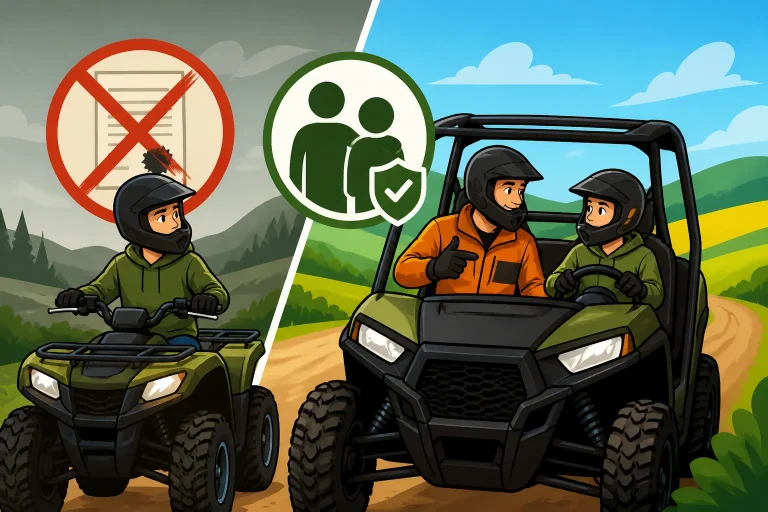
If anyone in your group is under 16, tell the office before the ride. Ask whether the park has any additional rider or supervision procedures, and confirm the provincial requirements that apply to the young operator. Do not assume that a park permit changes the general rules for age, licensing, or supervision.
Give the office the age of the rider and describe who will be accompanying them. That is more useful than asking only whether “kids can ride.” The answer may depend on the rider’s age and whether the required adult supervision or training applies. If your group includes a youth rider, review Saskatchewan ATV Age Requirements and Saskatchewan Youth Training Requirements before heading out.
Also explain whether a young rider will operate their own machine or ride as a passenger. Passenger rules can depend on whether a machine is designed to carry one. A park permit does not make an otherwise unsafe or prohibited passenger arrangement acceptable.
Tell the office what machine you are bringing
Use ordinary, precise terms when you describe your vehicle: ATV, quad, side-by-side, or UTV. If the machine is modified, unusually wide, or equipped with a trailer, mention that too. Staff can tell you whether it can use the route and whether there are access limits you should know about.
If you are bringing a trailer to the park, ask where you can unload and park it. The trailhead you have in mind may not have suitable space, and a large group can make parking more complicated. Ask about the best arrival time or staging area if you are travelling with several machines.
Check closures and conditions before you leave
A permit answers whether you have completed the park’s process; it does not guarantee that a particular trail will be open when you arrive. Closures, poor conditions, maintenance work, fire restrictions, or other temporary measures can change the plan. Ask about current status close to your trip, especially if you are hauling a long distance.
Ask about temporary closures and fire restrictions
Use a direct question: “Are any machine trails or access roads closed today?” Then ask whether there are restrictions specific to the route you intend to use. If a park office cannot confirm a condition, ask which official source or office can.
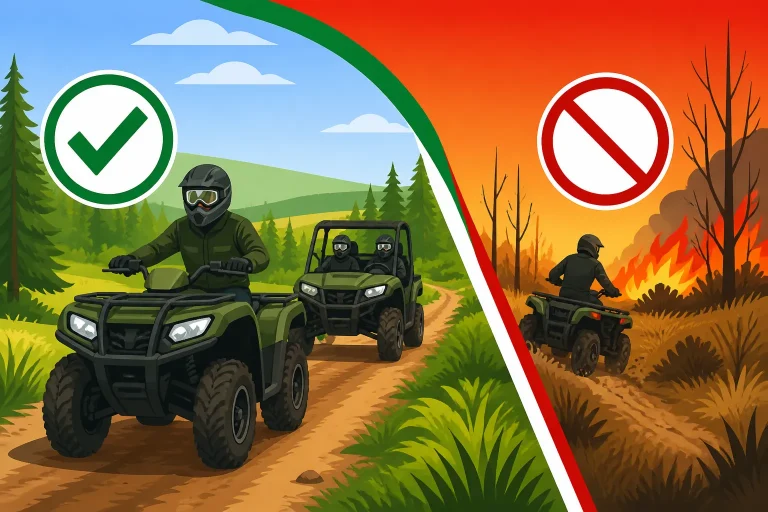
Fire-related restrictions deserve a separate question during periods of wildfire risk. Ask whether a fire ban or closure affects the park, whether machine travel is restricted, and whether any equipment or operating precautions are required. Do not assume that a trail shown as open on a map remains available during a closure. For more background, see Saskatchewan Wildfire Closures and Riding.
If staff mention a closure, ask what boundary applies and whether there is a permitted alternative route. A short detour may cross land with different rules, so do not create a new route based on guesswork. Confirm that any alternative is open to your machine and that you can reach it legally.
Ask what the trail is like today
A trail can be technically open but unsuitable for your group or equipment. Ask whether recent rain, standing water, soft ground, fallen trees, or maintenance has affected the route. If the answer is uncertain, ask whether there is a trail-status page or a local contact who can provide an update closer to departure.
This is particularly useful if you are carrying a low-clearance trailer, travelling with inexperienced riders, or planning a long loop. Ask about the condition of the whole route, not just the first kilometre from the trailhead. A trouble spot farther out can change your plans more than a rough entrance.
For planning, compare the office’s update with Saskatchewan Trail Conditions Before You Haul. If a park trail connects to a club trail or another land area, ask where park rules end and what permission or access rules apply beyond that point. A route continuing past a park boundary does not automatically remain under the same permit.
Make the call useful and keep a record
A park office can usually answer a focused question quickly, but it helps to have the basic details ready. You do not need to read out your entire trip plan. Give the staff member enough information to identify the rule that applies.
Before calling, note:
- The park and the date you expect to visit.
- Your machine type, including whether it is an ATV or UTV.
- The trailhead or route you intend to use.
- The number of machines and riders.
- Whether anyone is under 16.
- Whether you are towing a trailer or travelling with a large group.
Then ask the questions that affect your decision to go: Is a permit needed? How do you get it? Which route is open? What must you carry or display? Are there current closures or conditions that change the plan?
A simple call flow keeps the conversation short:
- Identify the park, date, and machine type.
- Ask whether a permit or form is required and how to complete it.
- Confirm the designated machine route and access point.
- Ask what proof, insurance, or permit display is expected.
- Check current closures, fire restrictions, and trail conditions.
- Confirm where to park, unload, or pick up any permit.
Write down the date of the call and the staff member’s instructions, especially if you were given a particular route or advised about a temporary closure. If the information changes later, check again before travelling. A phone conversation is helpful planning, but it is not a substitute for posted signs, current closure notices, or rules that apply on the ground.
If you are comparing requirements between parks, do not assume one office’s answer applies elsewhere. A permit accepted at one park may not work at another, and a municipality’s local plate scheme is separate from a provincial park trail permit. Ask the office that manages the exact area where you will ride. The general overview in Saskatchewan Permit Questions Riders Ask can help you identify which questions belong to the park, the municipality, or another authority.
A minute spent confirming the details can prevent several common problems: arriving without a required form, riding toward the wrong trail, discovering a closure after unloading, or carrying the wrong proof. Keep the questions practical, give the office your actual route and machine type, and check again if conditions could have changed.
Disclaimer
This article is for general informational purposes only and does not constitute professional advice. Laws, prices and regulations vary by location and change over time. Consult a qualified professional for guidance on your specific situation.