Checking a Bylaw Before a Long Drive North
A long drive north with an ATV or UTV can end in a frustrating surprise: the trail is open, but local rules restrict where you can unload, ride, or display a municipal plate. Checking the bylaw before you leave helps you confirm what applies at your destination, along any riding route, and to your particular machine.
Why a local bylaw belongs in your trip plan
Saskatchewan’s provincial rules and a municipality’s rules are not the same thing. Provincial requirements may govern matters such as insurance, rider qualifications, helmets, and where machines can travel. A local bylaw may add rules for riding on municipal roads, designate permitted streets, restrict certain areas, or require a local plate or permit.
That distinction matters when you travel to another community. A route that is legal under provincial rules may still be closed by a local bylaw. Likewise, a plate or permit issued under one municipality’s scheme should not be assumed to work in another. Check the specific destination’s rules rather than treating a municipal plate as province-wide permission. Saskatchewan Municipal Plate Schemes and Does a Lakeland Plate Work at Candle Lake? explain why local schemes need to be checked individually.
The practical question is not simply, “Can I ride an ATV in Saskatchewan?” It is, “Can I ride this machine, on these roads or trails, in this municipality, under the rules in force there?” The answer may depend on the machine, the road, the location, and the purpose of the trip.
This is especially important if you plan to ride from your campsite or cabin, use a road to reach a trail, or travel between two communities. A bylaw might allow riding on named streets but prohibit it elsewhere. It could also close a beach, lakeshore, park, or other area even if riding is allowed in another part of the municipality. Saskatchewan Bylaws That Permit Road Riding and Saskatchewan Bylaws That Prohibit Riding cover the kinds of differences to look for.
If you are hauling the machine on a trailer and will not ride it until you reach your destination, local ATV road rules may not govern the drive north itself. But they still matter as soon as you unload. Confirm your unloading location, the route from there, and any rules that apply where you intend to park or ride.
A quick phone call can prevent a long detour. It can also help you avoid relying on an old online summary, a sign you saw on a previous visit, or a rule from a neighbouring municipality.
Find the right bylaw and ask specific questions
Start with the municipality where you will actually unload and ride. Depending on the destination, that might be a rural municipality, town, village, or resort community. Do not assume that a nearby community’s rules apply across the boundary. If your route crosses several municipalities while riding, check each one.
Search the municipality’s official website for terms such as “ATV,” “all-terrain vehicle,” “off-road vehicle,” “quad,” “side-by-side,” “UTV,” “permit,” and “traffic bylaw.” Some local rules may be included in a broader traffic or public-safety bylaw rather than a document with “ATV” in its title. If the website does not make the current rule clear, contact the municipal office and ask where the bylaw can be read.
For a general approach to finding local rules, see Saskatchewan Bylaw Lookups Before You Ride. If you are unsure which local government covers your destination, confirm the boundary before relying on a bylaw you found for a nearby place.
When you locate the bylaw, check that you have the current version and look for amendments. A posted web page might summarize a rule without showing all its conditions. Read the bylaw itself when possible, including definitions, schedules, maps, and any section that names specific roads or areas. If the municipality directs you to a map or separate schedule, check that too.
Rather than asking only whether “ATVs are allowed,” ask questions that match your plan:
- Is this exact ATV or UTV covered by the bylaw’s definition?
- Is riding permitted on the road or trail I plan to use?
- Are machines allowed only on named roads or in designated areas?
- Are there streets, parks, beaches, or lakeshore areas where riding is prohibited?
- Does the municipality require a local plate, permit, or other proof?
- Does the local requirement apply to visitors as well as residents?
- Are there local speed, time-of-day, parking, or access restrictions?
- Does the bylaw treat a side-by-side differently from a quad?
- Where can I legally unload and park?
- Who should I contact if I need to confirm a route or boundary?
Keep the answers tied to your itinerary. “You can ride in the municipality” may not mean you can ride on every street or across every public area. Ask about the particular road, trailhead, campsite, cabin access, or destination you have in mind.
If you need a municipal plate or permit, ask what it covers and where it is valid. Find out how to obtain it, whether you need to visit an office in person, what documents are required, and whether the office is open when you expect to arrive. These details can be especially important for a remote trip where there may be no convenient alternative if you discover a requirement after reaching the area. Which Municipalities Actually Sell You a Quad Plate provides further context on local plate schemes.
Check your machine, route, and paperwork together
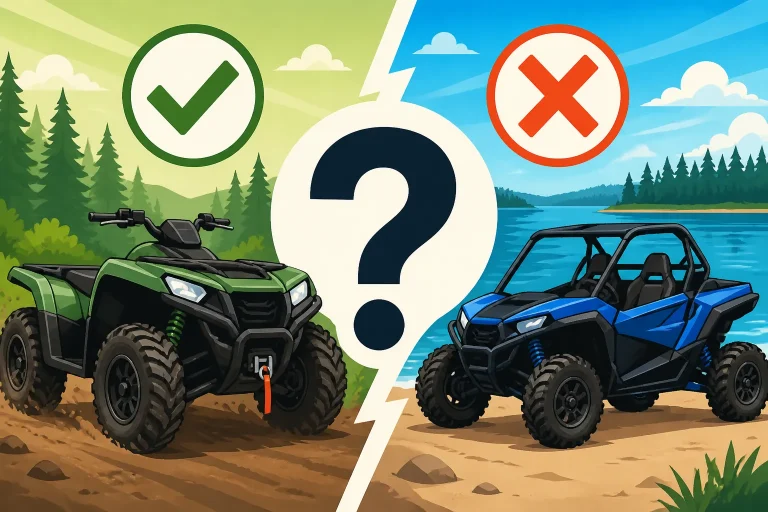
A bylaw’s wording can matter. It may cover one category of machine but exclude or define another differently. Do not assume that rules written for an “ATV” automatically apply in exactly the same way to every UTV, side-by-side, mini-bike, or other off-road machine. Compare your machine with the definitions in the bylaw, and ask the municipality if the wording is unclear.
Next, map the places where you intend to ride. Mark your unloading point, permitted roads, trail access, and any public areas you plan to visit. If your route passes through more than one municipality, check the rules for each jurisdiction on the riding portion of the trip. A road may cross a boundary without an obvious sign, and permission in one municipality does not establish permission in the next.
Separate the drive from the ride:
| Part of the trip | What to confirm |
|---|---|
| Highway travel with the machine on a trailer | Safe, lawful transport and a suitable unloading location |
| Riding from the unloading point | Whether the road or access route is permitted locally |
| Riding within the destination | Designated areas, prohibited places, and local conditions |
| Crossing a municipal boundary while riding | Rules in both municipalities and any intervening jurisdiction |
| Using a local plate or permit | Where it is valid, who needs it, and what it covers |
| Riding on Crown land or in a park | Separate land-access, permit, closure, and trail rules |
A municipal bylaw is only one part of the picture. Provincial rules and land-access rules may apply as well. For example, permission to use a municipal road does not automatically give permission to cross private land, a grazing lease, or a closed area. Check access separately before crossing onto land that is not clearly open to you. Saskatchewan Crown Land Access Rules and Saskatchewan Grazing Lease Access Rules are useful starting points for those questions.
Also confirm the machine’s paperwork and insurance before leaving home. A municipal plate is not the same thing as provincial ATV registration, and carrying a plate does not replace insurance or proof of ownership. If you are stopped or asked to provide proof, having relevant documents accessible can make the conversation simpler. See Saskatchewan Proof of Ownership on the Trail and Proof of Insurance Is What Saskatchewan Officers Ask For for more on what to have available.
If you are travelling with a visitor from another province, check the rules for that rider and machine separately. Do not assume that a registration, permit, or insurance arrangement from home automatically satisfies every Saskatchewan or local requirement. Saskatchewan Visitors and Municipal Plates and Saskatchewan Insurance Rules for Visitors can help you identify what to verify.
A practical check before you leave
Do the research early enough to change your plan. A municipality may need time to answer a question, and a local office may not be open when you arrive. Save the bylaw or official information on your phone, and keep a note of any instructions you receive. If you get an answer by phone, write down the office or person you spoke with and the date, along with the specific route or activity you asked about.
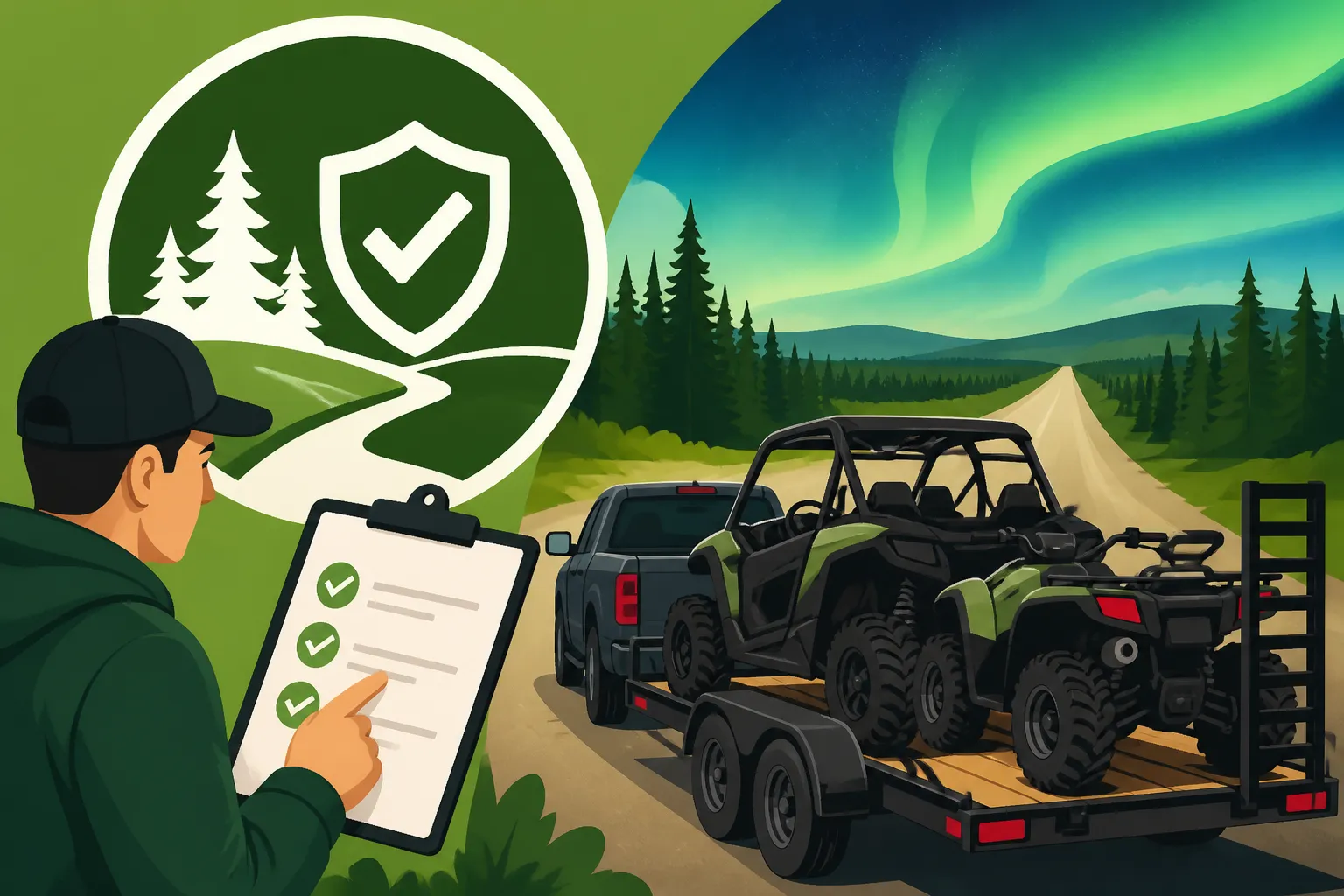
Use this checklist before loading the trailer:
- Identify the destination jurisdiction. Confirm the municipality for your unloading point and each place where you intend to ride.
- Find the current bylaw. Check the official municipal source, including amendments, maps, and schedules.
- Match the wording to your machine. Verify whether the bylaw covers your ATV, UTV, or side-by-side.
- Confirm the exact route. Ask about named roads, trail connections, prohibited areas, and boundaries.
- Check local permits or plates. Find out whether visitors need one and where it is valid.
- Review separate access requirements. Confirm permission for private land, Crown land, parks, or other controlled areas.
- Prepare documents and equipment. Carry applicable proof of insurance and ownership, and make sure the machine meets provincial requirements.
- Recheck close to departure. Look for temporary closures, fire-related restrictions, or other notices that could affect the trip.
Rules and conditions can change, so a successful ride last season is not a guarantee that the same route is open now. Recheck official municipal information before departure, especially if you are travelling during a period when closures or local restrictions may affect access.
If the municipality cannot give you a clear answer, ask which official document or office controls the decision. Avoid relying on an informal statement from a third party when the bylaw, map, or road designation is unclear. If necessary, choose a route you can confirm rather than gambling on an uncertain connection after a long haul.
The goal is not to collect paperwork for its own sake. It is to arrive knowing where you can unload, what local rules apply, and whether your planned ride is permitted. A few targeted questions at home are usually easier to manage than learning about a restriction at the trailhead.
Disclaimer
This article is for general informational purposes only and does not constitute professional advice. Laws, prices and regulations vary by location and change over time. Consult a qualified professional for guidance on your specific situation.