Saskatchewan Training Course Providers
Saskatchewan riders often hear that an ATV safety course is required, but the answer depends on who is riding and what the course is meant to satisfy. The right provider matters most when a young rider needs training to meet a legal exception. Here’s how to compare course options, check approval and avoid relying on a certificate that does not fit the situation.
What Saskatchewan’s ATV training rules mean
A safety course can be useful for any rider, but it is not a blanket licensing requirement for every adult in Saskatchewan. The key legal question is whether a rider is relying on a course to qualify for an exception to the age and supervision rules.
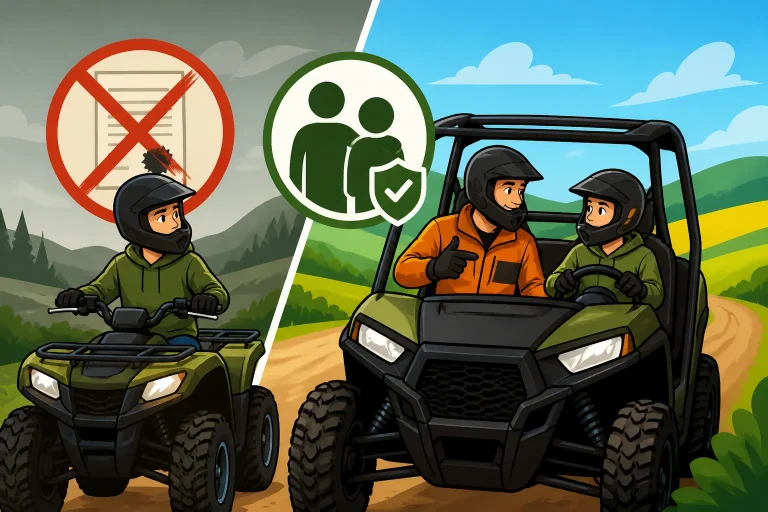
Saskatchewan generally sets 16 as the minimum age to operate an ATV. A rider aged 12 to under 16 may be able to operate under the statutory exception by riding with a qualifying adult supervisor or by successfully completing a training course approved for that purpose. The precise conditions matter: a general course that teaches safe riding is not necessarily the same as a course that satisfies the legal exception.
For the age rules and their limits, see Saskatchewan ATV Age Requirements and Saskatchewan’s Exception for Riders 12 and Over. The course route is explained in more detail in How a Safety Course Replaces a Supervisor. If a young rider plans to rely on a certificate, confirm that the specific course is approved for that legal purpose before booking.
The distinction is easy to miss because providers may offer several kinds of training. One course might be designed as a general introduction for new riders; another may be intended to satisfy the approved-course exception. Both can teach valuable skills, but only the qualifying course should be relied on to replace supervision where the law allows it.
Adults should not assume they need a course simply to ride. They still need to meet the other applicable requirements, including rules around licensing, insurance, protective equipment and where riding is permitted. For more on those separate obligations, see Do You Need a Licence for an ATV in Saskatchewan? and Saskatchewan Insurance Requirements for Riders.
A course also does not grant permission to ride on land, roads or trails where access is restricted. Training is one part of responsible riding; it does not replace permission, bylaws, park requirements or other rules.
Course providers to check in Saskatchewan
Provider schedules and course offerings can change, so treat any provider name as a starting point for an inquiry rather than a guarantee that a particular course is currently available or approved for a specific legal exception.
Saskatchewan Safety Council
The Saskatchewan Safety Council is one organization to contact about ATV training. It has offered ATV courses, including courses in Regina, but riders should ask about current locations, dates, the type of machine covered and whether the course meets the approved-course requirement for a young rider.
Do not assume that every course offered by the organization has the same content or legal status. Ask for the exact course name and confirmation that it is approved for the relevant exception under Saskatchewan’s rules. If the rider will use a side-by-side rather than a quad, ask whether that machine type is part of the instruction.
Saskatchewan All Terrain Vehicle Association
The Saskatchewan All Terrain Vehicle Association, often referred to as SATVA, is another place to ask about rider training. The association has been associated with rider courses for members. Ask whether a course is currently being offered, whether membership is needed, what machines it covers and whether the course qualifies for the youth exception.
A club or association course can be a good fit for riders who also want practical advice about local trail etiquette and riding conditions. Still, practical value and legal approval are separate questions. Confirm both rather than assuming that a course is accepted because it is organized by a riding group.
Local instructors and other courses
You may also hear about instructors or courses in communities such as Saskatoon or Unity. A local course can be convenient, but location and course title alone do not establish that it satisfies Saskatchewan’s legal requirement.
Before registering, ask who delivers the training, what credential or approval the course carries, and whether the provider can confirm acceptance for the specific youth exception. If the instructor cannot answer, seek confirmation from the authority responsible for administering the rules before paying or relying on the certificate.
| Provider route | What to ask | Best next step |
|---|---|---|
| Saskatchewan Safety Council | Which current ATV courses are available, and which one is approved for the youth exception? | Request the exact course name and written confirmation |
| Saskatchewan All Terrain Vehicle Association | Is a rider course currently offered, and does it qualify for the legal exception? | Confirm eligibility, machine type and certificate details |
| Local instructor or training organization | Who approves the course, and what proof is issued on completion? | Verify approval independently before booking |
| General online or retailer course | Is it accepted for Saskatchewan’s legal exception, or is it general education only? | Do not rely on it without explicit confirmation |
For a more focused look at course recognition, Which ATV Training Courses the Administrator Has Approved is a useful companion. The practical rule is straightforward: identify the legal requirement first, then choose a provider that can document that its course meets it.
How to choose a course that fits the rider
The best course is not necessarily the closest one or the one with the most polished description. Start with the rider’s age, machine and intended use. Then check that the course has the right approval and provides clear proof of completion.
Confirm the course’s legal purpose
Ask the provider this specific question: “Is this course approved to satisfy Saskatchewan’s ATV training exception for a rider under 16?” That is more useful than asking whether the course is “recognized,” “certified” or “official.” Those words can mean different things to different providers.
If the answer is yes, ask who approves it and how the provider documents that approval. Request the exact course title and confirmation in writing, such as in an email or course information sheet. Keep that information with the certificate after the rider completes the training.
If the provider says the course teaches safe operation but cannot confirm whether it satisfies the exception, treat it as educational training only until you verify otherwise. It may still be worthwhile, but do not plan around it as a substitute for supervision.
Match the instruction to the machine
An ATV course may focus on a particular style or size of machine. A quad and a side-by-side have different controls, seating arrangements and passenger considerations. Ask whether the rider will receive instruction on the machine they expect to operate, and whether the course is suitable for that machine class.
For side-by-side-specific rules, see Saskatchewan Rules for a Side-by-Side Driver. A certificate should not be assumed to settle every rule that applies to a different machine. If the household has both a quad and a UTV, ask the provider whether the course covers both or whether separate training is advisable.
Check the practical component
Safe operation involves more than knowing what the controls do. Ask how much of the course is hands-on and what practical skills are covered. Depending on the course, instruction may include pre-ride checks, starting and stopping, braking, turning, managing slopes, riding over uneven ground, passenger safety and responding to changing trail conditions.
A course that combines classroom learning with supervised practice may be more useful for a new rider than a short overview with little time on a machine. That does not automatically make one course legally acceptable and another unacceptable; it helps you compare the quality and fit of the training.
For a rider who has never operated an ATV, be candid with the provider about experience level. A young rider who is small for the machine or nervous about basic controls may need a different pace or machine setup than a confident older teen. Ask whether the instructor can accommodate that safely.
Ask about age, supervision and eligibility
Course minimum ages and participation rules can differ by provider. Before booking for a young rider, confirm the provider’s minimum age, whether a parent or guardian must attend, what equipment the rider must bring and whether the rider needs access to a machine.
Do not assume that completion of training changes every age-related restriction. The legal exception has conditions, and the rider must stay within them. If the rider cannot meet the exception, they may still need a qualifying adult supervisor. Details are covered in Saskatchewan Youth Training Requirements.
Understand course length and format
ATV courses are often described as lasting around 6 to 8 hours, but duration depends on the provider and course. Ask whether the stated time includes breaks, classroom work and practical riding. Also check whether the course is delivered in one day or split across sessions.
The format affects what you should bring and how to plan travel. A course with outdoor practice may be affected by weather, site conditions or machine availability. Confirm the location, arrival time, cancellation policy and any required gear directly with the provider.
Questions to ask before you book
A short call or email can prevent a costly misunderstanding. Get answers before paying, especially when a young rider needs the course for a legal exception.
Use this checklist:
- Does this exact course qualify for the Saskatchewan under-16 training exception? Ask about the specific course, not just the organization.
- Who approves the course for that purpose? If the provider cannot say, verify with the responsible authority before booking.
- What proof will the rider receive? Confirm whether it is a certificate, completion card or another document, and what details it shows.
- Does the certificate identify the rider? Check that it includes the rider’s full name and the course completed.
- What machine types are covered? Ask whether instruction is for an ATV, a side-by-side or both.
- Is riding practice included? Find out whether the course includes supervised operation or is classroom-based.
- What equipment must the rider bring? Ask about a helmet, eye protection, boots, gloves and any other required gear.
- Is a machine provided? If not, confirm what machine the rider may bring and whether it must meet any conditions.
- What are the age and participation requirements? Ask about parent or guardian attendance and any prerequisites.
- What happens if the course is cancelled or the rider cannot attend? Get the provider’s current terms directly from them.
The most important answer is the first one. A course can be worthwhile without qualifying for the legal exception, but the family should know that before booking. If the provider’s wording is vague, ask for a direct written response. You can then keep it with the rider’s certificate and refer to it if questions come up later.
Also ask whether the course covers the riding situations the student will encounter. A rider who expects to use a machine on a farm may need practice with different terrain and tasks than a rider who will be on established recreation trails. Training cannot make every situation safe, but a suitable course can help a new operator understand limits and make better decisions.
Parents should avoid treating course completion as a sign that a young rider is ready for every machine or condition. A certificate can meet a legal requirement while the rider still needs more practice, close oversight or a smaller and more manageable machine. Skill develops over time, and a course is a starting point rather than a guarantee of competence.
After the course: keep proof and check the rest of the rules
When the rider completes the course, keep the original certificate in a safe place and make a legible copy. Record the provider’s name, the course title and the completion date. If the provider supplied written confirmation that the course is approved for the exception, store that with the certificate.
The rider should know where the proof is and how to produce it if asked. Requirements about what must be carried or shown can depend on the situation, so check the applicable rules rather than assuming a photo on a phone will always be enough. See Proof Shown to a Peace Officer for related information.
Course completion does not replace insurance requirements, equipment rules or restrictions on where the machine can be used. Before a ride, check that the rider’s supervision status is lawful, the machine is insured as required and the route or property is open to ATV use. Park and municipal rules may add conditions of their own.
If a rider changes from a quad to a UTV, moves to a different riding setting or starts operating without an escort, reassess what training and supervision are appropriate. The course may have met the legal condition, but that does not automatically make every ride a good match for the rider’s experience.
For families who are still comparing options, a sensible sequence is:
- Confirm the rider’s age and which legal pathway applies.
- Find a provider that can identify the exact approved course.
- Ask about machine type, practice, eligibility and proof.
- Keep the certificate and approval information together.
- Continue to supervise and build skills according to the rider’s ability.
- Check insurance, equipment, land access and local rules before each ride.
That approach keeps the course in its proper role: useful training and, where the requirements are met, a way for an eligible young rider to meet the applicable exception. It avoids the two common mistakes—assuming every safety course counts, or assuming a certificate removes all other riding obligations.
Frequently Asked Questions
Do adults have to take an ATV safety course in Saskatchewan?
A general adult course is not a blanket requirement simply to ride. Adults still need to follow the other applicable rules, including licensing, insurance, equipment and access requirements.
Can any ATV course qualify a young rider to ride without an escort?
No. The course must meet the approval requirement for the legal exception. Confirm that the exact course qualifies before booking; a course that teaches safe riding may not satisfy that condition.
Which organizations should I contact about training?
The Saskatchewan Safety Council and the Saskatchewan All Terrain Vehicle Association are two places to ask. Check current availability and confirm whether the specific course is approved for the rider’s intended purpose.
Is a course certificate enough to carry while riding?
Keep the certificate and any written confirmation of course approval. Check the applicable proof requirements, including what a rider must produce if asked; do not assume a phone photo is sufficient in every situation.
Disclaimer
This article is for general informational purposes only and does not constitute professional advice. Laws, prices and regulations vary by location and change over time. Consult a qualified professional for guidance on your specific situation.