Riding With an Escort Instead of a Certificate
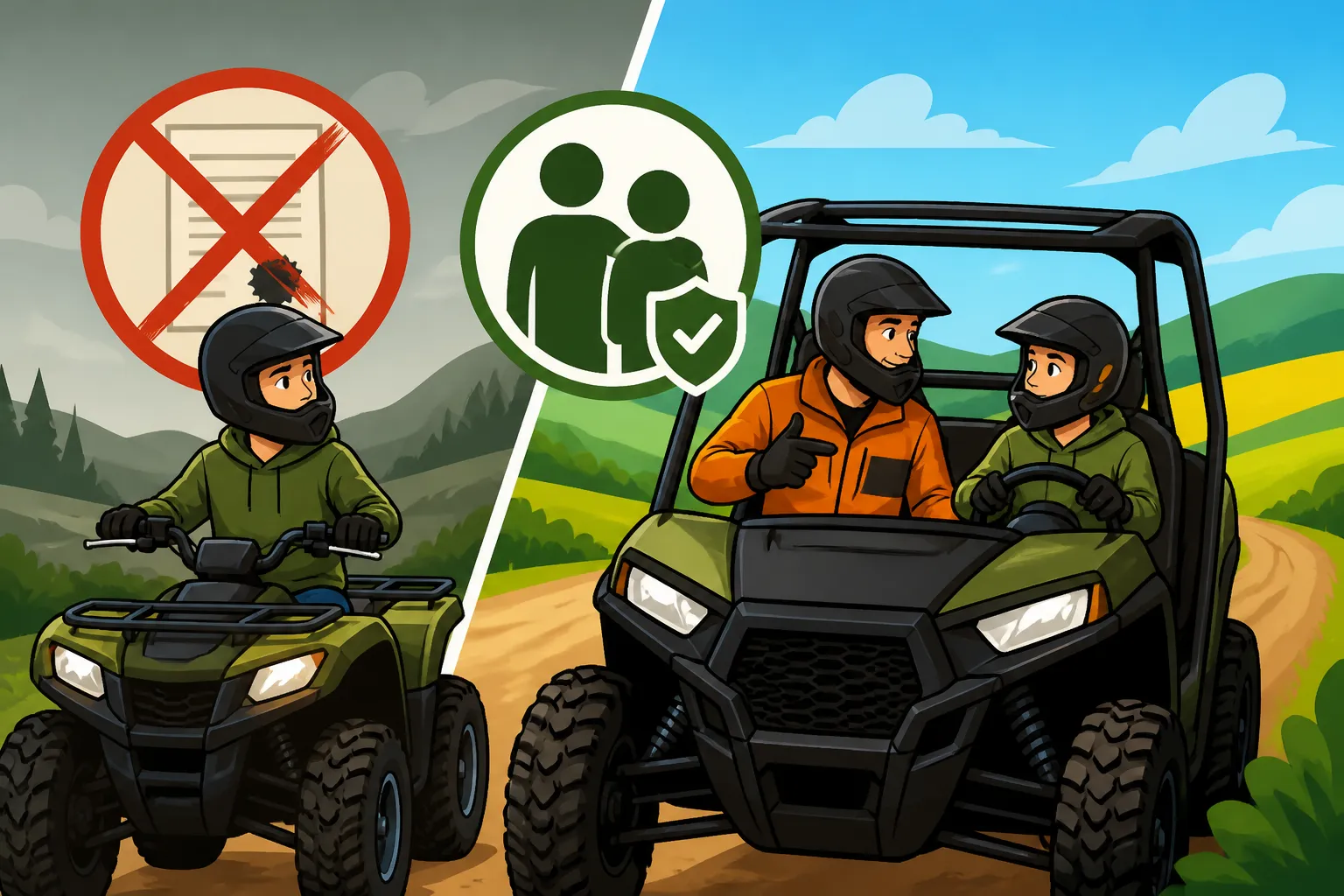
A young rider may be allowed to operate an ATV in Saskatchewan with an eligible adult escort instead of an approved safety-course certificate. The choice is not simply “bring an adult”: the rider’s age, the escort’s licence history, and the kind of riding all matter. Here is how to think through the escort option and what to check before heading out.
Who can ride with an escort instead of a certificate
For a rider who is at least 12 but under 16, Saskatchewan’s rules provide an escorted option alongside the approved training option. In general, the young rider can operate an ATV if accompanied and supervised by an adult who is at least 18 and has held a valid driver’s licence for at least 365 days. The alternative is to complete an approved ATV safety course and hold the required proof of completion.
The escort route is useful when a young person is ready to ride but has not yet taken an approved course. It does not remove the age floor: a child under 12 cannot use an adult escort as a workaround. The rules for a rider’s age and the specific conditions for riding are worth checking together; see Saskatchewan ATV Age Requirements and Saskatchewan Rules for a 12-Year-Old Rider.
| Rider’s situation | General pathway to check | What it means in practice |
|---|---|---|
| Under 12 | The escort option does not make the rider eligible | Do not assume parental permission or an adult riding nearby is enough |
| At least 12 but under 16 | Eligible adult escort, or qualifying approved-course completion | Confirm the adult meets the licence-history requirement, or verify the course and certificate |
| 16 or older | The youth escort-or-certificate rule generally no longer applies | Other operating requirements still apply, including rules about licences, insurance, equipment and where riding is allowed |
The table is a starting point, not a substitute for checking the current rule and the conditions of the place where you plan to ride. An ATV used on private property, a municipal road, Crown land or a park may be subject to different access rules. Local bylaws and land-use restrictions can apply even if the youth has a lawful escort.
The escort must meet the legal qualifications, not just be an older relative or experienced rider. A parent who is under 18 does not meet the adult age condition. An adult who has never held a driver’s licence, or has held one for less than the required period, may not qualify either. A learner’s permit or a licence that is suspended or otherwise invalid should not be treated as satisfying the requirement. If there is any doubt about a person’s eligibility, confirm it before the ride rather than trying to resolve it at the trailhead.
It also helps to separate two questions: whether the youth is allowed to operate at all, and whether the escort qualifies to supervise. For the escort pathway, both need to be satisfied. Having the right adult along does not make a rider under the minimum age eligible; being old enough does not make an unqualified adult a valid escort. The Supervisor Needs a Licence Held 365 Days explains why the escort’s licence history matters.
What supervision means on a real ride
An escort is not just someone who signs permission, drops the rider off, or stays at home with a phone. The adult needs to accompany and supervise the young operator. Plan the ride so the adult can actually observe what the youth is doing and respond if the machine stalls, tips, enters difficult terrain or encounters other trail users.
The practical details matter. A large group spread across a long trail can make supervision ineffective, even if the adult is technically part of the group. Likewise, an adult riding far ahead, taking a different route or being unable to see the youth for long stretches may not provide meaningful supervision. Keep the youth and escort within a manageable distance, agree on signals and stopping points, and choose a route where the adult can stay attentive.
The law’s supervisor qualification is not the same as a guarantee that the adult is competent to teach. A driver’s licence held for the required period establishes a legal condition; it does not necessarily mean the adult knows the controls, limits and safety features of the specific ATV or UTV. Before the ride, the adult should be familiar with the machine and comfortable helping the young rider operate it safely.
A safety certificate and an escort are different ways to meet the youth-specific requirement. The course pathway does not mean the youth can ignore the rest of the operating rules, and the escort pathway does not mean a course is pointless. A course can provide structured instruction on controls, hazards and safe riding practices. The escort option may be convenient, but it places more responsibility on the adult to make sure the youth understands the machine and can handle the planned terrain. For the training pathway, see How a Safety Course Replaces a Supervisor and Which ATV Training Courses the Administrator Has Approved.
Do not assume that any online video, dealer demonstration or informal lesson counts as an approved certificate. If you choose the course route, check that the provider and course meet Saskatchewan’s requirements, and keep the completion record accessible. If you choose the escort route, be ready to show that the adult meets the applicable conditions if asked. For more on what may need to be shown, see Proof Shown to a Peace Officer.
The escort pathway does not authorize a youth to carry passengers unless the machine is designed for passengers and the other passenger rules are met. A second person on a single-rider ATV can create a handling risk even when both riders are family members. Check the machine’s design and instructions, and review Saskatchewan Passengers Only on Designed Machines before planning to ride two-up.
The escort does not replace other riding rules
Meeting the youth escort condition is only one part of legal operation. It does not automatically permit riding on a road, ditch, trail, park route or someone else’s land. The location still needs to be open to ATV use, and the rider must follow the rules that apply there.
Road use is a common source of confusion. A young rider with an eligible escort does not gain permission to use every public road. Road access depends on the provincial rules and, in some cases, a municipality’s bylaws. Check Can You Ride an ATV on the Road in Saskatchewan? and the relevant local rules before using a road or ditch to reach a trail.
Land access is separate too. An escort cannot grant permission on behalf of a landowner, leaseholder or land manager unless they have authority to do so. On private land, get permission from the person who controls access. On Crown land or a grazing lease, check the applicable access rules and any closures. A route that looks passable is not necessarily open to riders. The relevant background is in Saskatchewan Crown Land Access Rules and Saskatchewan Grazing Lease Permission.
Insurance and protective equipment also remain important. Do not treat the escort relationship as a substitute for the required insurance or as a reason to relax helmet and eye-protection rules. Make sure the policy covers the machine and the intended use, and confirm what proof the rider should carry. Review Saskatchewan ATV Insurance Requirements and Saskatchewan ATV Helmet Law before setting out.
A park or municipality may add its own conditions, such as a permit, a designated route, a minimum age for a particular activity or rules about who must accompany a youth. Those conditions can be stricter or more specific than the general escort pathway. Check with the park office or municipality for the exact riding area, rather than relying on what was allowed at another location.
A practical check before the ride
Use this sequence before taking a youth out under the escort option:
-
Confirm the rider is old enough. The escort pathway is not a way around the minimum age. If the youth is under 12, stop and check the rules for that age rather than assuming an adult can supervise them into eligibility.
-
Check the adult’s qualifications. Confirm the escort is at least 18 and has held a valid driver’s licence for the required period. If the licence is expired, suspended, or its history is unclear, do not assume the adult qualifies.
-
Choose the pathway and gather proof. Decide whether the youth will ride with a qualified escort or rely on completion of an approved safety course. If using the certificate pathway, confirm that the course is approved and keep proof of completion available. If using an escort, make sure the adult is present and able to supervise throughout the ride.
-
Match the machine to the rider. Check that the youth can reach and operate the controls, understand the braking and throttle response, and handle the machine’s weight and power. A machine that is too large or unfamiliar can be a poor choice even if the legal conditions are met.
-
Plan a route the adult can supervise. Choose terrain suited to the youth’s ability, keep the group together and agree on when to stop. Avoid routes where dust, brush, distance or speed will prevent the escort from keeping the rider in view.
-
Check access and local rules. Confirm that the planned road, trail, park or private property is open to ATVs and that any local permit or bylaw conditions are met. Recheck for closures before travel.
-
Prepare the machine and the rider. Review protective equipment, insurance, passenger limits and basic operating rules. Make sure the youth knows how to stop, what to do if separated and how to get help.
If the planned outing involves a town street, a provincial park or a trail network, make the location-specific check part of the plan. A youth who can legally ride with an escort may still be prohibited from a particular route or area. For a broader look at operating rules, see Saskatchewan ATV Road Rules Explained.
The escort option works best when the adult treats supervision as an active responsibility, not a formality. Confirm the youth’s age, verify the adult’s licence eligibility, choose a suitable route and check local access rules. If any of those pieces is uncertain, postpone the ride until you have a clear answer or the youth has completed a qualifying course.
Disclaimer
This article is for general informational purposes only and does not constitute professional advice. Laws, prices and regulations vary by location and change over time. Consult a qualified professional for guidance on your specific situation.