Saskatchewan Wildfire Penalties
Saskatchewan Wildfire Penalties
A wildfire started during an ATV or UTV ride can bring consequences far beyond a routine trail ticket. The outcome depends on what happened, which rules applied and whether the machine or rider caused or worsened the fire. Understanding the main sources of liability—and what to do before and after a ride—can help you reduce risk and respond sensibly if an incident occurs.
What penalties can follow a wildfire-related offence?
There is no single “wildfire fine” that applies to every riding incident. Saskatchewan’s wildfire laws, ATV rules, land-access restrictions and local bylaws may all come into play, depending on the conduct and location. A rider may face more than one consequence if the same event breaks multiple rules.
A fire starting near a machine does not, by itself, prove that its operator committed an offence. Investigators may need to establish what happened, whether a legal duty was breached and whether that breach contributed to the fire or damage. The details matter: an overheated machine parked in dry grass is different from a fire deliberately lit where burning is prohibited, or a rider entering an area after a closure notice.
Possible outcomes can include:
- A warning, ticket or other enforcement action for a specific rule violation.
- A prosecution under the law that applies to the conduct.
- A penalty set by a court if the person is found guilty.
- A demand to pay certain firefighting or damage-related costs, where the law permits recovery and the facts support it.
- Separate consequences under park rules, municipal bylaws, land-use restrictions, insurance terms or other applicable laws.
These are possibilities, not automatic results. A rider is not necessarily responsible for every cost associated with a wildfire just because the fire started nearby. Responsibility, legal authority to recover costs and the amount claimed are matters that depend on evidence and the applicable rules.
Wildfire-related penalties should not be confused with penalties under Saskatchewan’s ATV legislation. A ticket under one set of rules does not establish the limit for an offence under another. A fire investigation can involve questions that have nothing to do with whether the machine had municipal paperwork or whether the rider was following a road-use rule. Saskatchewan Wildfire Act Duties for Riders explains the fire-prevention responsibilities that can apply during a ride.
The consequences can also be practical before a court case is resolved. A machine may be inspected, a rider may be asked for information, and a person may need to deal with an insurer, land manager or enforcement agency. If a fire causes damage, questions about responsibility can continue after the initial response. Avoid assuming the incident is finished simply because the fire is out.
The safest way to think about penalties is as a range of possible outcomes, not a fixed price attached to every fire. The conduct, the fire danger, the location, the extent of harm and the evidence can all affect what happens next. If an authority contacts you about a serious incident, get legal advice before making decisions about a formal response.
Which riding conduct can create wildfire exposure?
Some risks are tied to the machine itself; others come from ignoring a closure or operating carelessly in dry conditions. A rider can also create risk without intending to start a fire. The practical question is whether the machine, its operation or the rider’s choices could ignite dry vegetation or prevent responders from reaching a fire.
Operating a machine with combustible debris
Dry grass, weeds and other debris can collect around hot or moving parts. Material caught near an exhaust, engine or other heat source may ignite, particularly when vegetation is dry. A rider who sees debris and continues without checking the machine is taking a preventable risk.
Before riding, inspect areas where dry material can lodge. Recheck during the day, especially after pushing through tall grass, brush or dusty trails. The appropriate inspection points vary by machine, so use the manufacturer’s instructions rather than relying on a generic checklist. Saskatchewan Combustible Material Checks covers the debris issue in more detail.
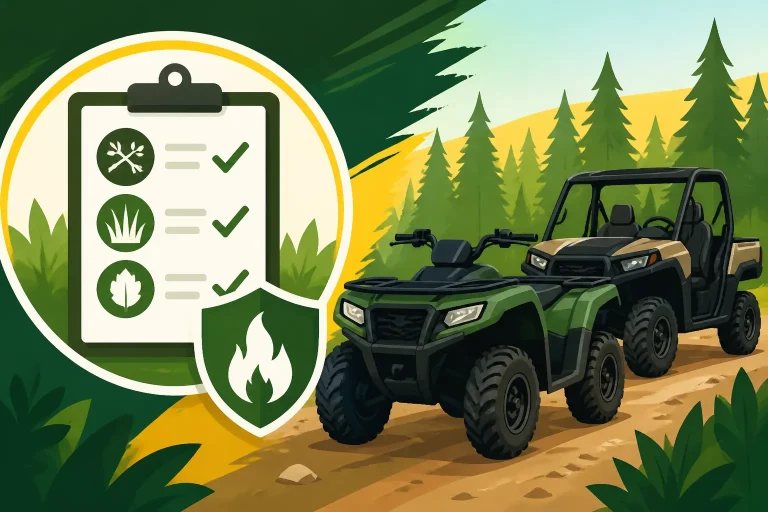
A basic routine should include:
- Check the machine before unloading, including around hot components and places where grass can collect.
- Stop in a safe place if you smell burning, see smoke or notice unusual heat.
- Shut the machine down and check for a cause before continuing.
- Keep hot parts away from dry grass when stopping to rest or repair the machine.
- Recheck after riding through vegetation that could wrap, lodge or accumulate around the machine.
The point is not that every small patch of debris will start a wildfire. It is that a quick inspection can catch an obvious hazard before a machine continues across a dry area.
Riding during a fire ban or closure
Fire restrictions and area closures are not interchangeable. A fire ban may prohibit specified activities or ignition sources, while a land closure may prohibit entry or use of an area altogether. A rider should read the actual notice, identify the affected location and check whether it applies to the planned route and type of use.
A notice posted at one location may not be the only restriction that matters. Conditions and orders can change, and a road or trail can cross into a different land-management area. Check the current restrictions before driving to the trailhead, and check again if conditions are changing. Saskatchewan Fire Ban Lookups and Saskatchewan Wildfire Closures and Riding are useful starting points for understanding the separate checks involved.
Riding into a closed area can create an enforcement issue even if the machine does not start a fire. A closure is a rule in its own right, intended to manage danger and access. If a rider enters despite a posted or communicated restriction, the fact that no fire occurred may not erase the underlying violation.
The reverse is also true: being outside a formal closure does not make every activity safe or permissible. A rider still needs to follow applicable fire-prevention duties and use sound judgment when vegetation and conditions are dry. Saskatchewan Wildfire Season Riding Restrictions provides more context on restrictions that can affect riding.
Ignition sources and careless stopping
A machine can create a spark or hot surface, but wildfire risk is not limited to mechanical failure. Smoking materials, open flames, camp equipment and careless disposal of burning material can all create ignition hazards. Riders should not assume that an activity is allowed simply because it is common at a trailhead or camping area.
Parking and repairs deserve attention too. Avoid leaving a hot machine in dry grass, and do not carry out work that produces sparks in a place where dry vegetation can catch. If a repair requires tools or heat, consider whether the location and conditions make the work unsafe. A short delay to move to a suitable surface is generally preferable to creating an avoidable ignition source.
Equipment choices can help, but they do not guarantee safety or replace legal duties. Check the machine’s exhaust and maintenance condition, follow the manufacturer’s instructions and keep any required fire-suppression equipment in working order. [Saskatchewan Spark Arrestor Requirements] discusses equipment questions, while Carrying a Shovel and an Extinguisher on Board covers practical preparation.
Entering land without checking access conditions
Permission to ride on a piece of land does not necessarily override a wildfire closure or other restriction. A private landowner, grazing-lease holder or trail organizer may grant access, but riders still need to follow relevant government orders and posted rules.
Likewise, a familiar trail can become unavailable when fire danger rises. Do not treat a route as open just because it was open on the previous visit, because another rider used it or because a map still shows it. Check current conditions with the responsible land manager or trail organization when necessary. This is especially important when a route crosses public land, leased land and private property.
How authorities assess an incident
A wildfire investigation may look at more than the point where flames first appeared. Investigators may consider the fire’s origin, weather and vegetation, the machine’s condition, the rider’s actions, the applicable restrictions and the steps taken after smoke or flames were noticed.
The exact process depends on the incident and the agencies involved. A serious fire may draw several kinds of attention: wildfire responders, land managers, law enforcement, insurers or people whose property was affected. Each may be looking at a different question. For instance, an agency may be determining whether a rule was breached, while an insurer examines coverage and a property owner considers a damage claim.
Evidence can include physical traces, photographs, witness accounts, machine inspection findings, posted notices and records of calls or messages. A rider’s account may be relevant, but so may the account of other people present. That is one reason to avoid guessing about a cause or making a confident claim before the facts are clear.
An investigation does not mean a rider has already been found responsible. It is reasonable to ask who is contacting you, what the inquiry concerns and whether you are being asked to provide a voluntary statement or comply with a legal requirement. Be courteous and do not obstruct an investigation, but avoid speculating about what caused the fire.
What can make an outcome more serious?
The consequences may be more serious when the evidence suggests that a person knowingly ignored a clear restriction, failed to take reasonable care, continued after noticing a hazard or delayed reporting a fire. The scale of the fire and the damage may also matter. These factors do not automatically decide the outcome; they are the kinds of circumstances that can influence how an incident is treated.
A prior warning, a posted closure or direct instructions from an official may be relevant to whether a rider knew about the restriction. So can the practical steps taken to prevent a fire, such as checking the machine and stopping when a warning sign appears. Keep in mind that complying with one precaution does not provide blanket immunity if another rule is broken.
Some ATV offences have their own penalty framework. That framework should not be treated as a universal ceiling for fire-related conduct. A person could face a separate process under a different law, and a land manager may also have rules that apply to access or use. Wildfire Fines Dwarf Anything in the ATV Act explains why comparing the two categories as if they were one penalty system can mislead riders.
Cost recovery is not the same as a fine
A fine is a penalty imposed through a legal process. A claim for firefighting expenses or property damage is a different kind of issue. Whether costs can be recovered, from whom and in what amount depends on the law, the evidence and the circumstances. A claim is not automatically valid merely because it is large, and it is not automatically invalid because a rider did not intend to start a fire.
If you receive a demand for payment, do not ignore it. Ask for the written basis of the claim, the incident details it relies on and any deadline for responding. Preserve the letter and related records, and seek advice if the amount or allegations are significant. An insurer may also need prompt notice under the policy, so check your policy wording and contact the insurer or broker.
A wildfire can also lead to a third-party claim if someone alleges that the fire damaged land, equipment or other property. That question is separate from whether a ticket is issued. Do not assume that paying a ticket resolves every potential claim, or that a claim automatically proves an offence.
What to do if smoke or fire appears during a ride
The first priority is safety and prompt reporting, not deciding who is legally responsible. If you see a fire, move away from immediate danger and contact emergency services or the appropriate reporting channel as soon as it is safe to do so. Give the location as clearly as possible, including a nearby road, trail, landmark or access point. Do not put yourself or others at risk trying to control a fire that is beyond safe, trained response.
If a small fire is clearly safe to address and you have suitable equipment, follow local instructions and your training. Do not assume that a shovel or extinguisher makes it safe to approach an advancing fire. Wind, dry fuel and limited escape routes can change conditions quickly. If the fire is growing or your escape could be cut off, leave and report it.
After reporting:
- Follow directions from emergency responders and keep access routes clear.
- Do not ride back through a closed area or move equipment in a way that puts people at risk.
- Record the time, general location, weather conditions and what you observed, while details are fresh.
- Preserve relevant photos or messages; do not alter, delete or post material that may be part of an investigation.
- Identify other witnesses and keep their contact details if they are willing to share them.
- Notify your insurer if the incident may involve damage, a claim or a policy reporting requirement.
- Seek legal advice before providing a detailed formal statement if you may be accused of an offence or face a substantial claim.
Be factual when communicating. Separate what you personally saw from what someone else told you, and say when you do not know. Do not guess about the ignition source, the direction the fire travelled or the extent of damage. A clear, accurate record is more useful than a hurried explanation that later turns out to be wrong.
The same caution applies on social media. Posts can be misunderstood, taken out of context or circulated beyond the intended audience. Avoid assigning blame or making claims about the cause while the incident is being investigated. Keep your records and communicate through the appropriate channels.
If an officer or investigator asks questions, stay calm and ask for clarification if you do not understand a request. You may ask whether a statement is voluntary and whether you can speak with a lawyer before responding. Do not lie, destroy evidence or interfere with other witnesses. If you receive a ticket, formal notice or payment demand, note any response deadline and get advice promptly rather than waiting until it is close.
A practical prevention and response checklist
Good planning reduces the chance of an incident and makes it easier to show what steps were taken. Before heading out, confirm that the route is open, check applicable fire restrictions and prepare the machine for dry conditions. Do not rely on a single map, an old screenshot or a previous visit as proof that access remains permitted.
| Before or during the ride | What to check | Why it matters |
|---|---|---|
| Before leaving home | Current fire bans, closures and route access | Restrictions may change and may apply to only part of a route |
| Before unloading | Dry debris around hot or moving machine parts | Grass and other material can collect and create an ignition hazard |
| At the trailhead | Signs, posted notices and local instructions | A restriction may apply even if the route appeared open elsewhere |
| During the ride | Smoke, burning smells, unusual heat and changing conditions | Early action can help prevent a small hazard from becoming a larger one |
| When stopping | Dry vegetation beneath or around the machine | Hot parts should not be left against combustible material |
| After spotting a fire | Safe location, clear directions and prompt reporting | Responders need accurate location information and unobstructed access |
| After an incident | Records, insurer notice and any official deadline | Documentation and timely responses can protect your ability to deal with the matter |
Before departure, make the checks specific to the route rather than relying on a general assumption that “the area is fine.” If the trail crosses different land types or jurisdictions, identify who manages each part and where to find current closure information. Checking a Fire Ban From Your Phone at the Trailhead and Which Fire Centre Map Covers Your Riding Area can help with the information-gathering step.
Make sure everyone in the group understands what to do if smoke is spotted. Agree on how to stop safely, who will report the fire and how to give a useful location. A group should not split up to investigate a fire unless responders direct it to do so. A rider with a map, location-sharing capability or a reliable description of nearby landmarks can help emergency services find the site.
Carry equipment that suits the machine, route and conditions, and know how to use it. An extinguisher that is inaccessible, damaged or unfamiliar may not help in an emergency. The same goes for a shovel or other required tool: carrying equipment is useful, but it does not make unsafe conduct legal or turn a rider into a fire responder.
Finally, treat official instructions as time-sensitive. A closure can be imposed after a group has planned a trip, and a fire ban can change the activities allowed. Check before departing and again at the access point when possible. If a restriction is unclear, contact the responsible office or land manager and wait for a clear answer rather than taking a chance.
Frequently Asked Questions
Does an ATV or UTV rider automatically pay for a wildfire that starts nearby?
No. The fact that a fire began near a machine does not automatically establish legal responsibility or make the rider liable for all response costs. Authorities may investigate the cause, conduct, applicable rules and evidence. Any claim for costs or damage needs a legal basis and must be assessed on its facts.
Can a rider be penalized for entering a closed area if no fire starts?
Potentially. A closure can be enforceable as an access restriction on its own. Whether a penalty applies depends on the notice, the land and the applicable rules. Check the current closure and follow instructions rather than treating the absence of a fire as proof that entry was allowed.
Is a fire ban the same as a wildfire closure?
No. A fire ban may restrict certain activities or ignition sources, while a closure may prohibit access or use of an area. The terms and restrictions depend on the specific order or notice. Read the complete instructions and confirm whether they apply to your route and activity.
What should I do if I receive a wildfire-related ticket or cost demand?
Keep the notice, note any deadline and ask for the written basis of the allegation or claim. Contact your insurer if the incident may be covered or the policy requires notice. If the matter involves a serious allegation or substantial costs, speak with a lawyer before making a formal response.
Disclaimer
This article is for general informational purposes only and does not constitute professional advice. Laws, prices and regulations vary by location and change over time. Consult a qualified professional for guidance on your specific situation.