Saskatchewan Group Size on a Club Trail
A large group can be harder to manage on a narrow club trail than it looks on a map. In Saskatchewan, there may not be one province-wide group-size limit for every club trail, but that does not mean every group can ride any trail in any size. Check the trail’s current rules, land access conditions and event requirements before you haul.
Is there a maximum group size on a Saskatchewan club trail?
Do not assume there is one fixed maximum that applies to every Saskatchewan club trail. A group may be subject to rules set for a particular trail, land area, club ride or organized event. Those conditions can differ, and trail access arrangements may change.
A club trail is not automatically a public trail with unrestricted access. Some trails are maintained through agreements or permissions involving clubs and land managers. That arrangement may come with limits on where and when riders can go, how the trail is used, or how an organized activity must be handled. For context, see The Trail Agreement Behind Crown Land Riding and Saskatchewan Club Trails on Crown Land.
It helps to separate three questions:
| Question | What to check |
|---|---|
| Is there a general legal group-size cap? | Check the rules that apply to the land and the activity; do not infer a limit from another trail or municipality. |
| Does the club or trail operator have a local limit? | Ask the club or organizer and follow posted instructions. |
| Is this an organized event rather than a casual ride? | Confirm whether additional permission, coordination or a permit is required for the location and activity. |
The practical answer is to ask the group’s organizer or the club responsible for the trail before setting out. A limit might apply to a specific event even if the same riders could use the trail in smaller, separate groups on an ordinary day. Conversely, a club’s general trail information may not cover a temporary closure or land-access condition.
If you cannot confirm the rule, do not treat silence as permission to bring an unlimited convoy. Ask whether the group should be divided, whether a particular trail section is suitable, and whether the club needs advance notice.
How to check the rules before riding
Do the check while you can still change the plan, not at the trailhead with trailers parked and machines unloaded. Trail maps and old posts can be useful starting points, but current club instructions, signs and land-manager notices matter more if they differ.
- Identify the exact trail and access point. Similar names can refer to different routes or trail sections. Confirm which trail you intend to use and where the group will enter.
- Find the club or organization responsible for the route. Ask about any current group-size limit, booking requirement, closure, or preferred way to split a large group.
- Check whether the route crosses land with separate rules. A club-maintained trail does not necessarily override requirements for Crown land, a park, private land or another managed area. Review Saskatchewan Crown Land Access Rules and contact the relevant land manager when the status is unclear.
- Confirm whether the outing counts as an organized ride. A casual group ride and a publicly promoted, club-run or commercial event may not be treated the same way. Check Saskatchewan Event Permits for a Ride if you are organizing an event.
- Read signs at the trailhead and along the route. A posted restriction or closure can affect the ride even if an online map shows the trail.
- Recheck close to departure. Fire conditions, trail damage, maintenance or land-access changes can affect whether the route is open. Saskatchewan Trail Conditions Before You Haul is a useful reminder to verify conditions rather than rely on an old trip report.
When contacting a club, give useful details: the planned date, approximate number of machines, whether the riders are members, the route or trailhead, and whether the ride is private or open to others. Ask for the answer in writing if the outing is organized or involves a substantial group. That gives the leader something clear to share with riders and reduces misunderstandings at the trailhead.
A map can help with planning, but it is not proof that a route is currently open or that a group is permitted to use it. If directions, signs and online information conflict, pause and contact the club or land manager rather than improvising a route.
Why a group may need to split up
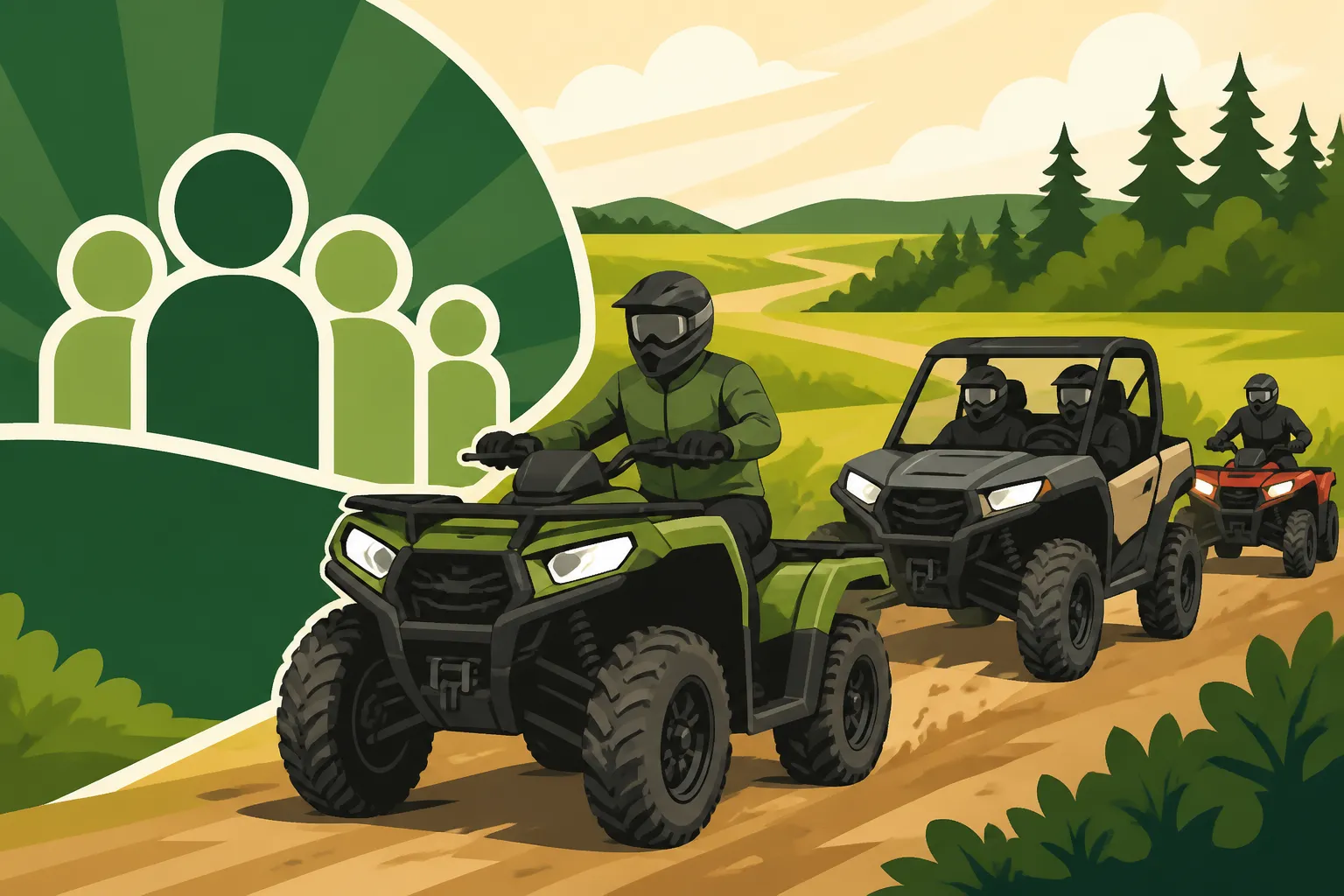
Even when a group is allowed, one long line of machines can be difficult to manage. It can stretch out of sight, make turns easy to miss and leave riders at the back unsure whether the group has stopped or changed direction. Dust, trees, slopes and trail bends can make communication harder.
A useful option is to divide a large ride into smaller riding groups, each with a designated leader and a person at the back who knows the route. The point is not to create a legal limit where none has been confirmed; it is to make sure every group can stay together and respond if someone has trouble.
Before departure, agree on:
- The route, planned stops and turnaround points.
- Who leads each group and who rides at the back.
- How groups will regroup after a turn, crossing or stop.
- What to do if a machine breaks down or someone is separated.
- How riders will communicate if cell service is poor.
- Whether a slower group or less experienced riders need a different pace or route.
Do not split the group in a way that leaves a rider alone without a clear plan. If a machine develops a problem, the group should stop somewhere safe and decide who stays, who gets help and how the rest will proceed. The plan should account for the possibility that phones will not work throughout the route.
For a sizeable group, radios can help leaders communicate between the front and back, but they are not a substitute for agreeing on the route and regrouping points. Riders may use handheld radios or compatible helmet communication equipment; check that the chosen devices suit the group and riding conditions. Amazon is one possible place to compare equipment, but suitability and reliability matter more than where it is bought. Test devices before the ride and do not assume every rider has the same model or range.
The trail itself should shape the plan. Narrow, winding or difficult sections may not work well for a tightly packed convoy. Consult Saskatchewan Trail Difficulty Ratings and Saskatchewan Trail Etiquette Locals Expect when deciding whether the route fits the riders and how the group should move.
Planning a club-trail ride that works for everyone
A responsible group leader does more than count machines. They check that riders understand the route and trail rules, then set a pace the group can manage. This matters especially when riders have different experience levels or the route has difficult sections.
Before the ride, share the trail information and ask riders to arrive ready to go. Confirm that machines are suitable for the planned route and that everyone understands the basic riding and safety expectations. Review Saskatchewan Group Ride Planning for help organizing responsibilities and keeping the group coordinated.
At the trailhead, keep unloading and staging orderly. Avoid blocking access for other users, and do not expand the ride onto nearby routes just because the group is already there. If the group is larger than the club recommends, follow the club’s direction to split it, reschedule or choose a different route.
During the ride, leave enough space to see and react to the machine ahead. Keep track of the rider behind you, but do not pressure them to maintain a pace that feels unsafe. At junctions, use the agreed regrouping procedure rather than assuming everyone saw the turn. If the group becomes difficult to control, stop somewhere safe and reorganize before continuing.
If the outing is a public event, has commercial elements, or uses land with special access conditions, check requirements before advertising it or collecting participants. An event permit or land-manager approval may be relevant depending on the location and activity. A club’s permission to ride a trail does not automatically settle every requirement for a separately organized event.
After the ride, report trail problems or confusing signs to the club responsible for the route. Leave gates and facilities as instructed, take rubbish with you, and avoid widening or bypassing damaged sections. Good trail use helps preserve access for future rides and makes it easier for clubs to work with land managers.
The safest planning rule is straightforward: confirm the current group conditions with the club or land manager, then size and organize the ride to fit the trail. If there is no clear answer, divide the group or choose a route with confirmed capacity rather than risking a conflict or an unsafe convoy.
Disclaimer
This article is for general informational purposes only and does not constitute professional advice. Laws, prices and regulations vary by location and change over time. Consult a qualified professional for guidance on your specific situation.