Prohibition Signs Must Be 60 Centimetres Square
Navigating where you can and cannot ride your ATV in Saskatchewan can feel like deciphering a secret code written across the vast prairie landscape. Riders often encounter conflicting information, vague signs, or sometimes, no signs at all, leading to genuine confusion and the fear of inadvertently breaking the law. This guide aims to clear up the mystery, specifically focusing on the critical role of official prohibition signs and how their precise specifications impact your riding freedom.
Understanding ATV Prohibitions on Saskatchewan Roads
It's a common misconception that all roads in Saskatchewan are simply off-limits to ATVs. While the province sets some general guidelines, the reality is far more nuanced, creating a patchwork of rules that can leave even experienced riders scratching their heads. Understanding this complexity is the first step toward staying on the right side of the law and enjoying your machine safely.
The Confusion Around Road Access
Many ATV enthusiasts assume that if a road has pavement or even just a gravel surface, it’s automatically a no-go zone for their off-road vehicles. This perception often stems from the clear rules governing highway use for conventional vehicles, which don't directly translate to ATVs. People hear stories or get vague warnings, leading to an overly cautious approach that might unnecessarily restrict their riding. The truth is, while major highways are certainly out, the rules for grid roads, rural municipal roads, and even certain town streets are often determined at the local level, leading to significant variations from one area to another. This lack of uniformity is a major source of frustration for riders who just want to know where they can legally go.
The confusion is compounded by the fact that what might be acceptable in one rural municipality could be strictly prohibited just a few kilometres down the road in another. Without clear, consistent provincial guidance that covers all roads, riders are left to interpret local bylaws, which aren't always easy to find or understand. It’s not uncommon to see a local resident riding their quad down a quiet village street to get to a trail, only for an out-of-towner to wonder if they’re breaking the law by doing the same. This inconsistency is precisely why specific, official signage becomes so important for communicating the local rules effectively.
Provincial Law vs. Local Bylaws
At the provincial level, the [Saskatchewan's All Terrain Vehicles Act] sets the fundamental framework for ATV operation, including broad stipulations about where these machines can and cannot be operated. For instance, the Act generally restricts ATVs from "highways" in the conventional sense – multi-lane roads with high speed limits. However, it also provides for exceptions, particularly concerning ditches and crossings, under specific conditions. For a more detailed breakdown, you might want to read [Saskatchewan ATV Road Rules Explained].
Where things get really interesting, and often complex, is at the municipal level. The province empowers cities, towns, villages, and rural municipalities to enact their own bylaws governing ATV use within their boundaries. This means that a village council can decide to permit ATVs on certain streets, restrict them entirely, or set specific times for their operation. These local rules often dictate whether you can ride down a street to access a trail, drive to the local store, or simply traverse a grid road. Some municipalities, like Candle Lake or the District of Lakeland, have even gone so far as to implement their own local ATV plate schemes and specific regulations for riding within their areas, demonstrating the varied approaches across the province. You can learn more about these local rules in [Saskatchewan Municipal Bylaws on Roads]. It's crucial for riders to understand that while provincial law sets the baseline, local bylaws can, and often do, add significant layers of restriction or permission that directly impact your ability to ride on roads.
The Importance of Official Prohibition Signs
When it comes to restricting ATV access on specific roads or areas, a mere suggestion or an unapproved sign won't cut it. For a prohibition to be legally enforceable, especially on public roads or Crown land, it needs to meet certain criteria, and the size and appearance of the sign are surprisingly critical elements. This often comes as a surprise to riders who might assume any "No ATVs" sign is legally binding, regardless of its form.
What Makes a Sign Enforceable?
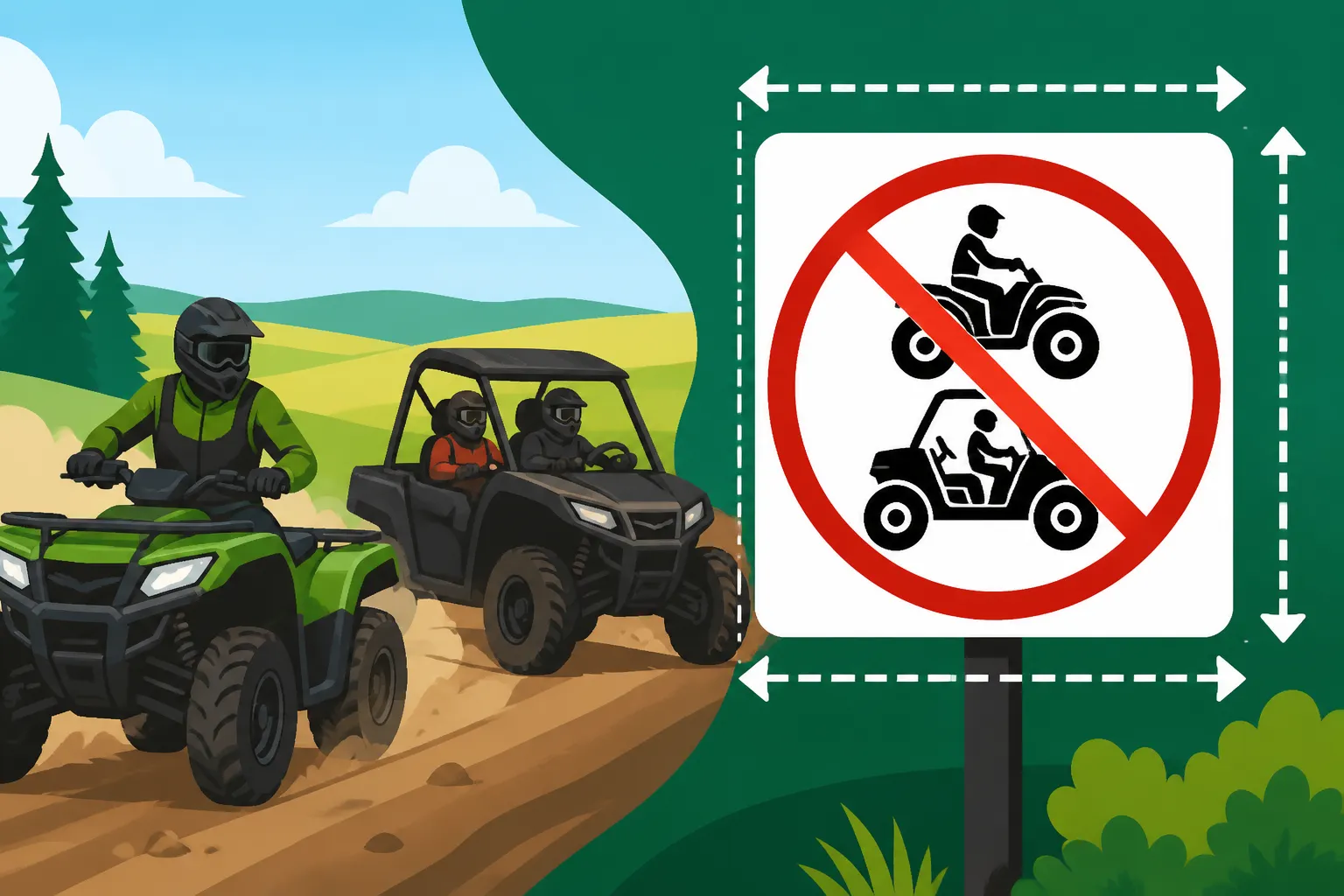
This is where the topic really hones in on the specific details that can make or break the legality of a riding restriction. Under Saskatchewan regulations, particularly when municipalities or other authorities wish to prohibit ATV operation on certain highways or areas, the signage used is not just a suggestion – it's a legal requirement. A key specification is that "prohibition signs must be 60 centimetres square." This isn't an arbitrary number; it's a standard designed to ensure visibility, consistency, and legal enforceability. Imagine riding down a dusty grid road, and you see a small, faded sign tucked behind a bush. Would you notice it? Would you even know if it's official? The 60 cm square size ensures that such signs are prominent enough to catch a rider's eye, even at speed, and signals that it's an official directive, not just a property owner's personal preference.
Furthermore, the standard dictates that these signs should be [White With Black Lettering]. This colour combination provides maximum contrast and legibility, making the prohibition clear and unambiguous. A sign that doesn't meet these specifications might be confusing or even deemed unenforceable if challenged in court, as the onus is on the authority to clearly communicate the prohibition. So, if you're riding and see a smaller, perhaps homemade, or differently coloured sign, it might indicate that it's not an officially recognized and enforceable prohibition under the Act. However, don't just ignore it; always seek clarification if unsure, as it could still be conveying private property rules or a local sentiment.
Common Locations for Prohibition Signs
You'll typically encounter these official prohibition signs in several key locations across Saskatchewan. One of the most common places is at the entry points to residential areas within towns and villages, or on specific streets where ATVs are not permitted due to noise concerns, traffic volume, or safety reasons. For example, a village might allow ATVs on quieter side streets for access but ban them from the main street or near schools. These signs act as clear markers, guiding riders on where they can and cannot travel within a municipal boundary.
Another frequent location for prohibition signs is at the boundaries of public parks, ecological reserves, or specific recreational areas. While some provincial parks have designated ATV trails that may require a permit, many others, like Cypress Hills, explicitly prohibit ATVs entirely. These parks will often have prominently displayed 60 cm square signs at entry points, making it clear that off-road vehicle use is not allowed. [Cypress Hills Bans ATVs in Saskatchewan] is a good example of this. Additionally, certain sensitive Crown lands or areas undergoing environmental rehabilitation might also be marked with these specific signs to protect natural habitats or ongoing work. Riders should always be vigilant for these signs, as riding in prohibited areas can lead to significant fines and penalties.
Navigating Municipalities with ATV Restrictions
The varied landscape of municipal bylaws in Saskatchewan means that every ride can present a unique challenge when it comes to understanding where you're permitted to go. It's not enough to simply know the provincial rules; you also need to be a local law detective, especially when planning a trip that takes you through different towns or rural areas.
Researching Local Bylaws Before You Ride
Before you load up your quad and head out, especially if you're exploring new territory, taking a few minutes to research local bylaws can save you a lot of grief. Many municipalities, particularly those with popular riding areas or specific concerns about ATV use, will have their bylaws available online. A quick search on the municipal website for "ATV bylaws" or "off-highway vehicle regulations" can often provide the clarity you need. If you can't find information online, don't hesitate to call the municipal office directly. This proactive approach is much better than facing a fine or, worse, causing a disturbance because you were unaware of local rules.
Think of it as part of your pre-ride checklist, just like checking your tire pressure or fuel level. Knowing that a specific street is off-limits or that you can only ride during certain hours can drastically change your route planning. For instance, some rural municipalities have specific regulations for grid roads, allowing ditch riding but prohibiting travel on the paved portion, or vice-versa. Others might have specific "no go" zones near residential developments or protected natural areas. This due diligence ensures you're riding responsibly and respectfully within the community you're visiting. For more specific guidance, consider looking into [Saskatchewan Bylaw Lookups Before You Ride] or even [Asking Your Rural Municipality About a Grid Road].
The Impact of Prohibitions on Riding Plans
Enforceable prohibition signs and local bylaws directly influence where you can ride your ATV and how you plan your routes. If a town strictly prohibits ATVs on its streets, it means you can't just drive through it to get to another trail system. Instead, you'll need to trailer your machine around the restricted area or find an alternative route that bypasses the prohibition. This often means adding extra time to your trip or requiring more logistical planning, which can be a real hassle, but it's essential for compliance.
These restrictions also highlight the importance of knowing your exact location and having reliable navigation. Modern GPS devices or smartphone apps are invaluable tools for identifying your position relative to municipal boundaries or known prohibited zones. You certainly don't want to find yourself deep in a residential area, having missed a sign, trying to figure out how to get back to an approved route. Moreover, some towns that embrace ATV tourism might have designated routes that allow passage, often marked with specific signage. This is why always looking for official signs, and understanding what they mean, is key to an enjoyable and lawful ride.
Here's a quick comparison of how riding rules can vary in different types of areas in Saskatchewan:
| Area Type | Typical Riding Status | Common Restrictions / Considerations | Key Enforcing Authority |
|---|---|---|---|
| Major Highways | Generally prohibited (travelled portion) | High traffic, speed, safety concerns; fines for non-compliance | Provincial (RCMP, Highway Patrol) |
| Rural Municipal Grid Roads | Often permitted, especially in ditches; varies by bylaw | Speed limits, ditch riding rules, visibility at night, specific municipal bylaws | Rural Municipality (bylaw officers), RCMP |
| Town/Village Streets | Generally prohibited, but exceptions exist via local bylaws | Noise, residential safety, specific streets may be designated for access or strictly banned | Town/Village (bylaw officers), RCMP |
| Provincial Parks | Generally prohibited, unless on designated trails with a permit | Protect wildlife, ecosystem, human safety; specific park rules override general rules | Parks, Culture and Sport (Park Officers) |
| Crown Land | Often permitted, but subject to specific Administrator Orders | Environmental sensitivity, fire bans, seasonal closures, specific prohibited zones (e.g., ecological reserves) | Ministry of Environment (Conservation Officers) |
| Private Land | Permitted only with landowner permission | Trespassing laws; respect property rights; secure written permission for best practice | Landowner (police for trespassing) |
Beyond Prohibition Signs: Other Riding Restrictions
While the 60-centimetre square prohibition sign is a very important indicator of where you can't ride on a road, it's not the only type of restriction you'll encounter in Saskatchewan. There are other layers of rules and regulations that govern ATV use, particularly on public lands, that riders need to be aware of, even if they don't involve a physical sign.
Crown Land Administrator Orders
Saskatchewan has vast tracts of Crown land, much of which is accessible to the public for recreational activities, including ATV riding. However, this access is not always unrestricted, and you won't necessarily find a physical prohibition sign at every entry point to an area where ATVs are temporarily or permanently banned. Instead, the Ministry of Environment, through what are known as "Administrator Orders," can close specific areas of Crown land to certain activities, including ATV use. These orders are typically issued for reasons such as wildlife protection, habitat rehabilitation, or during periods of high fire risk. For instance, during a severe wildfire season, large areas of Crown land might be closed to all off-road vehicle traffic to prevent new ignitions. You can find more information on this by looking at [Saskatchewan Crown Land Prohibition Regulations].
These orders are usually communicated through official government channels, such as ministry websites, public notices, and sometimes through local media. It's the rider's responsibility to check these sources before heading out, especially for longer trips into remote areas. While sometimes a sign might be posted, relying solely on physical signs for Crown land restrictions is risky. Ignoring an Administrator Order, even if you didn't see a sign, can still lead to significant penalties, as the legal precedent for communication has been met. This is where products like SuperATV GPS mounts and communication devices can be invaluable, helping you stay connected and informed about potential closures even when you're far from cell service.
Private Land and Trespassing
Beyond public roads and Crown land, a significant portion of Saskatchewan is privately owned, encompassing farms, ranches, and residential properties. On private land, the rules are very clear: you cannot ride your ATV without the explicit permission of the landowner. Unlike public roads where specific signs or bylaws dictate access, on private land, the default rule is "no entry" unless you have permission. A simple "No Trespassing" sign acts as a clear prohibition, but even without such a sign, entering private property without consent is illegal.
The implications of trespassing can be severe, ranging from confrontations with landowners to legal charges under [Saskatchewan Trespass Law for Riders]. Many experienced riders make it a practice to seek written permission when planning to cross or ride on private land, especially if it's for hunting, trapping, or accessing another area. This not only protects you legally but also fosters good relationships with landowners, which is crucial for maintaining access in rural areas. Remember, private land rules apply equally whether you're on a two-track trail, a farmer's field, or a rancher's grazing lease. Respecting these boundaries is not just about avoiding legal trouble; it's about being a responsible and considerate member of the outdoor community.
Equipping Your ATV for Compliance and Safety
Riding an ATV in Saskatchewan's diverse landscape means being prepared for anything – from unexpected terrain changes to sudden shifts in regulations. Being equipped not only for safety but also for compliance can make your riding experience much smoother and more enjoyable, helping you navigate the complex rules, including those indicated by prohibition signs.
Essential Gear for Navigating Restricted Areas
Having the right gear on your ATV goes beyond just personal protection; it extends to helping you stay compliant with local rules and navigate areas where prohibitions might pop up unexpectedly. A reliable GPS unit or a smartphone with offline maps and pre-loaded municipal boundary data can be a lifesaver. Imagine you're on a long loop, and you come across a 60 cm square prohibition sign you weren't expecting. With good navigation, you can quickly identify an alternative route, rather than having to blindly backtrack. This kind of preparedness is essential, especially when you're riding far from familiar territory.
Consider robust protection for your machine as well. Skid plates, A-arm guards, and CV boot protectors from brands like SuperATV aren't just for aggressive trail riding; they provide peace of mind when you might have to take an unplanned detour onto rougher terrain to avoid a prohibited road. Similarly, good lighting, even during the day, can enhance visibility if you find yourself on a permissible road section, aiding in compliance with general traffic safety. Even something as simple as a clear, scratch-resistant windshield can improve visibility, allowing you to spot those critical prohibition signs sooner and react accordingly.
Documenting Your Ride and Being Prepared
Beyond physical gear, having your documentation in order is paramount for compliance, especially when interacting with law enforcement or park officers. While Saskatchewan does not have a provincial ATV registration, you absolutely need to carry proof of ownership, such as your bill of sale, and proof of liability insurance. For more on what to carry, check out [Saskatchewan Insurance Proof on the Trail] and [Carrying Papers on a Grid Road]. If you're riding with a youth, any required safety course certificates or proof of supervision also needs to be readily available.
Think about how you'll carry these important papers. A waterproof storage box or a secure compartment on your ATV is ideal. Products like SuperATV's cargo boxes or under-seat storage solutions can provide a safe and dry place for your documents, ensuring they remain legible even after a muddy or wet ride. An officer might ask for these papers at any time, whether you're riding on a public road, a grid road, or even within a provincial park that has designated trails. Being able to produce them quickly and easily demonstrates responsibility and can prevent unnecessary delays or fines. Having all your ducks in a row – from your physical gear to your paperwork – means you're not only ready for the adventure but also ready to meet all legal requirements.
Disclaimer
This article is for general informational purposes only and does not constitute professional advice. Laws, prices and regulations vary by location and change over time. Consult a qualified professional for guidance on your specific situation.