Which Tires Handle Muskeg North of Prince Albert
Muskeg north of Prince Albert can look firm from the trail and turn into a deep, wet trap a few metres later. The right ATV or UTV tires can improve flotation and help you steer through soft ground, but no tread makes every bog safe. This guide explains what to look for, how to set up carefully, and when to turn around.
What makes muskeg difficult for ATV and UTV tires
Soft ground can hide a deeper bog
Muskeg is not just mud. It can include saturated soil, peat, standing water, roots, and a deceptively thin surface layer over softer ground. A machine may cross one section easily, then sink when the ground changes without warning. The challenge is that you often cannot judge the depth or firmness from the trail edge.
That is why tire choice is only part of the decision. A tire that grips well can still dig down if the machine is heavy, the ground is waterlogged, or the rider keeps applying throttle after losing momentum. Spinning tires can deepen ruts, damage fragile ground, and leave the machine harder to recover.
Around northern Saskatchewan, conditions vary with recent rain, thaw, drainage, and the trail itself. Do not assume that a route that was passable on a previous trip will be passable today. Check access and closures before travelling, and stick to trails where riding is permitted. For broader route planning, see Saskatchewan Crown Land Riding Explained and Saskatchewan Trail Conditions Before You Haul.
Flotation matters more than an aggressive tread alone
In soft ground, a tire needs to spread the machine’s weight across a larger contact area. That is the basic idea behind flotation: instead of concentrating the load in a narrow patch, the tire helps the machine ride higher on the surface. A wide tire may help, but width alone does not guarantee better performance. Tire construction, tread shape, pressure, machine weight, and the condition of the ground all affect how the tire behaves.
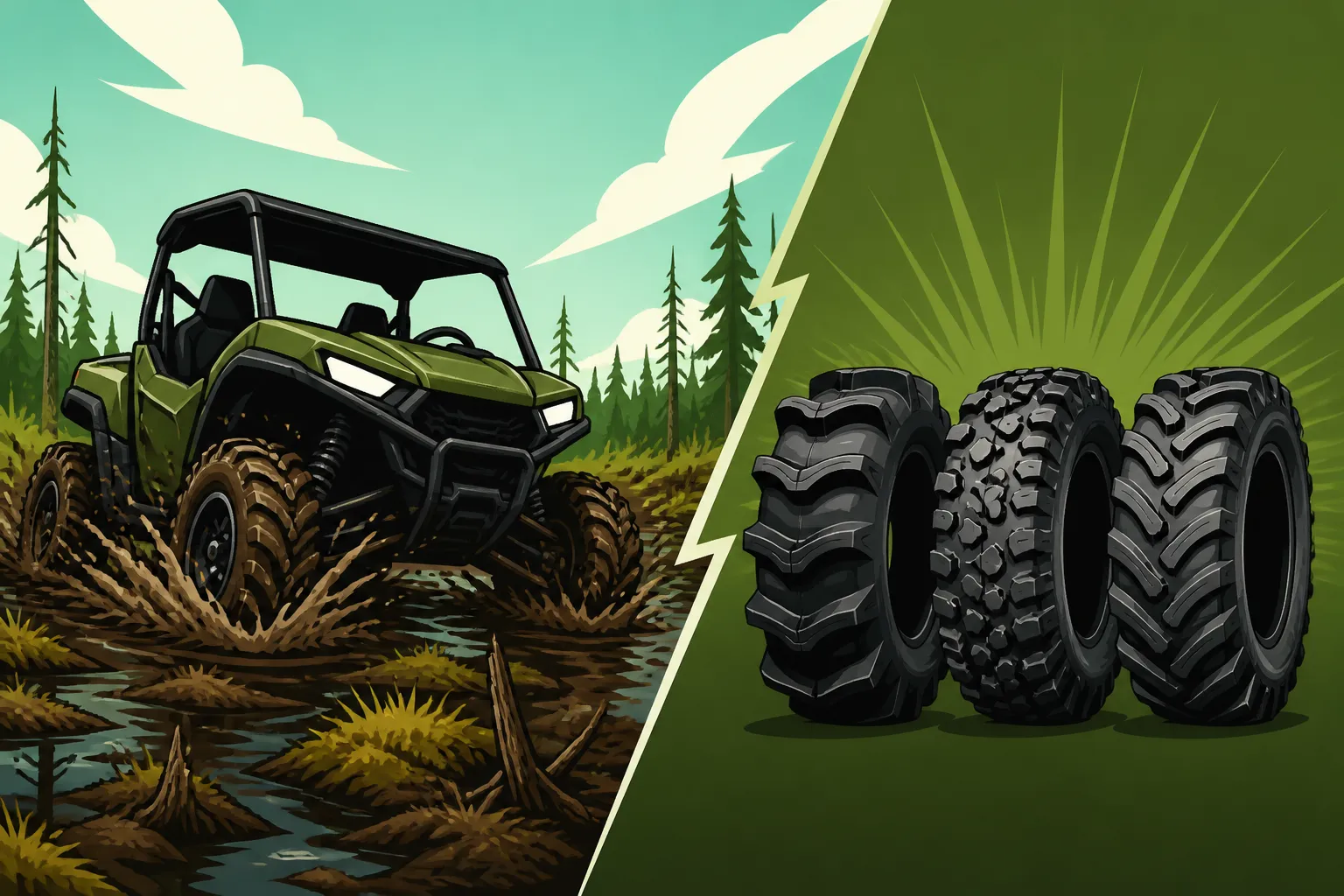
Deep, widely spaced lugs can provide traction in mud, but they can also claw into soft material when the tire spins. That may help the machine move briefly while making the rut worse. In sensitive or very wet ground, a less aggressive tread and a lighter touch on the throttle may be a better combination than the biggest mud tire available.
Think about your usual riding, not just the worst patch you hope to cross. If most of your route is packed trail, gravel, and occasional wet sections, an extremely aggressive tire may be noisy, rough, and harder on the trail without adding much everyday value. For routes with frequent deep mud, choose a tire designed for that use, but treat its extra traction as a tool—not permission to enter an unsafe or closed area.
Choosing tires for muskeg north of Prince Albert
Compare the main tire characteristics
There is no single tire that is right for every ATV or UTV. A sensible choice balances flotation, grip, durability, ride comfort, and the surfaces you will actually encounter. Use the table as a starting point, then check your owner’s manual and the tire maker’s fitment guidance.
| Tire setup | Potential advantage | Possible drawback | Most suitable use |
|---|---|---|---|
| All-terrain tread with moderate lugs | More balanced handling on mixed surfaces | May not clear sticky mud as effectively as a mud tire | Packed trails, gravel, and occasional wet sections |
| Mud-focused tread with deep, spaced lugs | Stronger bite in some muddy conditions | Can dig in when spun and may feel rough on firm ground | Riders who regularly encounter permitted muddy routes |
| Wider tire within approved fitment | Can increase the contact area and support flotation | May affect steering feel, clearance, or machine handling | Setups where the manufacturer approves the size |
| Oversized tire | Extra ground clearance may help in some situations | Can add strain or change gearing and handling | Only when the machine and fitment are suited to it |
Do not choose a tire solely by looking at the tallest lugs or widest profile in a catalogue. Check the machine’s approved tire sizes and load limits. A tire that physically fits may still rub during a turn or suspension movement, alter steering, or put extra demand on drivetrain components.
If you are comparing setups, consider the whole machine. A loaded side-by-side with passengers and recovery gear places a different load on its tires than a lightly equipped ATV. A tire that works well on a small quad may not be the right choice for a heavier UTV. The machine’s manual, tire specifications, and advice from a qualified dealer or mechanic are more useful than a size recommendation copied from a different vehicle.
Bias, radial, and construction trade-offs
Tire construction affects how a tire flexes, rides, and responds to impacts. The important choice is not simply “bias or radial” in isolation; it is whether the tire’s construction and load rating suit your machine and your use. Compare the specifications for the exact tire rather than assuming all tires in one category behave the same way.
For muskeg trips, durability matters because a soft-ground route can still include roots, sharp debris, and rough approaches. Look for construction and sidewall protection appropriate to your terrain, and inspect tires for cuts, bulges, embedded objects, or damage before and after a ride. No construction is puncture-proof, and a rugged tread cannot compensate for a damaged sidewall.
If your route includes both wet ground and harder sections, consider what the tires will feel like across the full ride. A tire selected only for mud may be less comfortable on firm trails and can encourage a rider to take risks because it feels capable. A balanced setup, careful route selection, and sound recovery planning are often more useful than chasing maximum traction.
Tire pressure, riding technique, and recovery
Set pressure using the right guidance
Lowering tire pressure can increase the tire’s contact patch and may improve flotation, but there is no universal pressure that is safe for every ATV or UTV. The correct range depends on the tire, machine, load, rim, and operating conditions. Follow the vehicle and tire manufacturers’ instructions, and do not go below any stated minimum.
Too little pressure can allow a tire to deform excessively, come off the bead, or become vulnerable to damage. Too much pressure can reduce the contact patch and make the ride harsher. If you adjust pressure for a particular ride, use a reliable gauge, record your normal setting, and check the tires again before returning to faster or firmer terrain.
A practical habit is to check pressure before leaving home and after a major change in conditions. Do not rely on appearance or a quick squeeze by hand. Carry a gauge and a pump or compressor suited to your machine, and make sure you know how to use them before you are stopped in a remote area.
Use smooth inputs and avoid digging a deeper hole
When the ground is soft, sudden throttle can make the tires spin before the machine gains forward movement. Smooth, steady input gives you a better chance of maintaining momentum without aggressively digging into the surface. Keep your line conservative, avoid sharp turns in unstable ground, and do not use another machine as an anchor unless the recovery method and equipment are appropriate.
If the machine starts to sink, stop before the tires churn the ground into a deeper rut. Assess the situation from stable ground if possible. Check whether there is a safer route back, and consider whether the machine can be recovered without putting people at risk or damaging the area. A winch, suitable recovery points, rated equipment, and a plan agreed on with your riding group matter more than simply fitting a tire with deeper lugs.
Do not assume a nearby trail is an acceptable detour around a bog. It may cross private land, a grazing lease, a closed area, or sensitive terrain. Review Saskatchewan Grazing Lease Access Rules and [Saskatchewan Private Land Permission] when your route may involve land access beyond a designated riding area.
Planning a northern Saskatchewan ride responsibly
Check the route and the ground before unloading
Before hauling north, check that the trail or riding area is open and that your machine is allowed there. Conditions can change after rain, seasonal thaw, wildfire restrictions, maintenance work, or a land manager’s closure. A trail map can help you plan, but it does not replace posted signs or current access information from the relevant office or land manager.
Mapping tools such as onX Offroad can be one part of planning a route and identifying where you intend to ride. Use onX Offroad alongside official trail information, posted notices, and local guidance rather than treating an app’s route line as proof that a track is open or legal. Before leaving, save the route information you need and consider carrying a paper map, particularly where cell service may be limited.
For northern route ideas and access context, review Saskatchewan Riding Near Prince Albert, Narrow Hills’ 50 Kilometres in Saskatchewan, and Saskatchewan Little Bear Lake Club Trails. Check the specific rules for the area you plan to visit; a nearby trail or road may have different restrictions from the riding area you intended to use.
Pack for a stuck machine, not just a successful ride
A ride plan should account for the possibility that a machine will not get through. Tell someone where you are going and when you expect to return. Ride with a group when practical, keep enough fuel and supplies for delays, and bring recovery gear suited to your machine and the conditions. A phone is useful, but do not assume it will have service everywhere.
Before entering a questionable section, stop and assess it rather than following another rider blindly. Look for signs of recent water, deep ruts, soft shoulders, or a route that narrows into wet ground. If the surface looks unstable, there is no shame in turning around. A cautious decision protects the machine, your group, and the trail.
Use onX Offroad or another mapping tool to help organize your route, but check for changes before you travel and keep a backup navigation method. After the ride, note which sections were firm, which were wet, and where conditions changed. Those observations can help you make a safer tire and route decision next time—but conditions can still be different on the next trip.
Disclaimer
This article is for general informational purposes only and does not constitute professional advice. Laws, prices and regulations vary by location and change over time. Consult a qualified professional for guidance on your specific situation.