Saskatchewan Muskeg and Machines
A quad can look perfectly capable at the edge of a northern Saskatchewan muskeg, right up until the ground gives way beneath the tires. Soft peat, hidden water and a narrow trail can turn a quick ride into a long recovery. This guide explains how to assess muskeg, prepare your machine, reduce environmental damage and make safer riding decisions.
Why Saskatchewan muskeg can catch riders off guard
What muskeg is and why it is unpredictable
Muskeg is waterlogged ground made up largely of partially decayed plant material. It can be covered by moss, grass, shrubs or a thin layer of firmer-looking vegetation, so the surface doesn’t always reveal what is underneath. One stretch may support a machine while the next sinks around the tires.
That inconsistency is the problem. A trail can look dry from the seat, yet give way when a heavier side-by-side reaches it. Water may be hidden under plants, or the ground may be soft enough that repeated tire passes quickly deepen ruts. A route that was passable on an earlier visit can also change after rain, snowmelt or a change in water levels.
Muskeg isn’t the same as a shallow puddle on a hard trail. If a tire breaks through the surface, the machine may settle into soft material and lose traction. Spinning the tires often makes the hole deeper rather than getting the vehicle moving. That’s why a cautious decision before entering is usually much easier than a recovery after getting stuck.
Reading the trail before you commit
Watch for clues that the ground may be soft: standing water, dark saturated soil, fresh deep ruts, a trail edge that crumbles underfoot, or vegetation that shifts and compresses when you step on it. None of these signs gives a perfect reading of what lies ahead, but several together are a strong reason to stop and reassess.
If you can do so safely, get off the machine and check the surface from firm ground. Don’t walk into deep water or onto vegetation that may conceal a drop or unstable edge. Look for a clearly established route across the soft section, not a new line cut around it. A bypass can widen the damaged area and lead into even softer ground.
A companion’s machine can help you judge the conditions, but it is not a guarantee. A lighter quad might cross where a loaded side-by-side cannot, and a route that holds in the morning may soften after a warm day. If the crossing looks questionable, turn around while you still have solid ground beneath you.
Choose a route, not just a destination
In the forested areas around Candle Lake and north of Prince Albert, the appeal of a ride can be the feeling of getting away from pavement and busy roads. But an intended destination is only one part of the plan. Before loading up, check current access information, trail conditions and any closures that apply to the area. [Saskatchewan Trail Conditions Before You Haul] is a useful starting point for thinking through that pre-trip check.
Use mapped trails and established routes where riding is allowed. A navigation tool such as onX Offroad can help you plan and keep track of your position, but don’t treat any app as permission to ride or as the final word on access. Compare your route with the relevant park, land manager, club or local authority information. For northern riding ideas and logistics, see [Saskatchewan Riding Near Prince Albert] and [Saskatchewan Riding Near Candle Lake].
Preparing a quad or side-by-side for soft ground
Tires, pressure and a realistic setup
Tires designed for loose or wet terrain can help with flotation and traction, but no tire makes deep muskeg safe to cross. Aggressive tread may also dig in if you apply too much throttle. Start with a tire setup suited to your machine and riding conditions, and follow the vehicle and tire manufacturers’ guidance on pressure. Don’t lower pressure by guesswork: too little can increase the risk of tire damage or the tire coming off its bead.
Keep loads sensible. Extra cargo, passengers and accessories add weight, and a heavily loaded machine may sink sooner. Before a long ride, consider where the weight sits and whether gear is secured so it won’t shift if you stop abruptly or encounter uneven ground. The right tires, manageable load and smooth control all help, but judgment about whether to enter a soft section matters more. For a more focused look at equipment choices, see [Which Tires Handle Muskeg North of Prince Albert].
Inspect the machine before and during the ride
A basic inspection is especially worthwhile before a remote ride, where a small problem can become a difficult walk back. Check tires for damage, confirm that the brakes and steering feel normal, and make sure the machine’s cooling openings and other vulnerable areas are clear of debris. Carry the tools and repair items that make sense for your vehicle and your route.
If your machine has a winch, inspect its operation and the condition of the cable or synthetic line before leaving. A winch is not a substitute for route judgment, but knowing how it works before you need it is far better than learning beside a stuck machine. A proper recovery setup also includes a suitable attachment point and recovery gear rated for the task. Never wrap a winch line around a person or stand where a loaded line could strike you if something fails.
On a longer outing, keep checking for mud or plant debris around the radiator area, belts, tires and other components where buildup could cause trouble. If the machine starts behaving differently, stop somewhere firm and investigate rather than pushing deeper into remote terrain.
Carry the right recovery and navigation gear
A recovery plan should account for the possibility that the machine cannot be moved under its own power. Depending on the trip, that may mean carrying a winch, suitable straps, gloves, a shovel and basic tools. Tell your riding group what you have, and agree on a recovery approach before anyone starts pulling. A recovery that feels improvised can put people in the line of tension or damage a machine.
Navigation deserves the same attention. Cell coverage can be limited in northern areas, so download or carry maps you can use offline and make sure someone outside the group knows where you intend to ride and when you expect to return. onX Offroad can be part of your navigation plan, but carry a backup such as a paper map and don’t rely on a phone battery lasting through a full day. [Cell Dead Zones in Northern Saskatchewan] and [Carrying a Paper Map Into Northern Bush] cover two practical parts of that planning.
| Riding condition | What it may mean | Safer response |
|---|---|---|
| Firm, established trail with no standing water | The surface may be more supportive, though conditions can still change | Stay on the trail and ride at a controlled pace |
| Fresh, deep ruts or water-filled tracks | The surface may be soft or deteriorating | Stop before entering and look for current route information |
| Vegetation covering standing water | The ground beneath may be hard to assess | Don’t assume the plants can support a machine |
| A companion sinks or loses traction | The route may not support your vehicle or group | Avoid following into the same line; plan a careful recovery |
| A trail is closed, damaged or marked as restricted | Riding could be unsafe or unauthorized | Turn around and use an approved route |
Riding through muskeg without making a difficult situation worse
Use steady control and avoid unnecessary wheelspin
When you are on a suitable established trail, gentle, consistent throttle is usually more useful than abrupt bursts of power. Sudden acceleration can spin the tires, dig into soft ground and make the machine harder to recover. Keep a speed that lets you respond to ruts, water and other riders without losing control.
If you feel the machine start to bog down, don’t keep trying to power through. Ease off, stop if you can do so safely, and assess the ground. A few seconds of patience may prevent the tires from excavating a deep hole. If the machine is already stuck, avoid repeatedly revving it while people stand near the tires or recovery line.
Keep enough space between machines that one rider can stop without being pushed into a soft section. That spacing also gives the rider ahead room to assess the trail and the rider behind time to react. On narrow routes, agree on how the group will handle passing or turning around before the trail becomes difficult.
Protect the ground and stay on established routes
Muskeg and wetland edges can be vulnerable to damage. Once a machine cuts through a soft surface, repeated passes may widen and deepen the track. Riding around a muddy patch can seem like a small shortcut, but every new line may create more damage and make the area harder for future riders to cross responsibly.
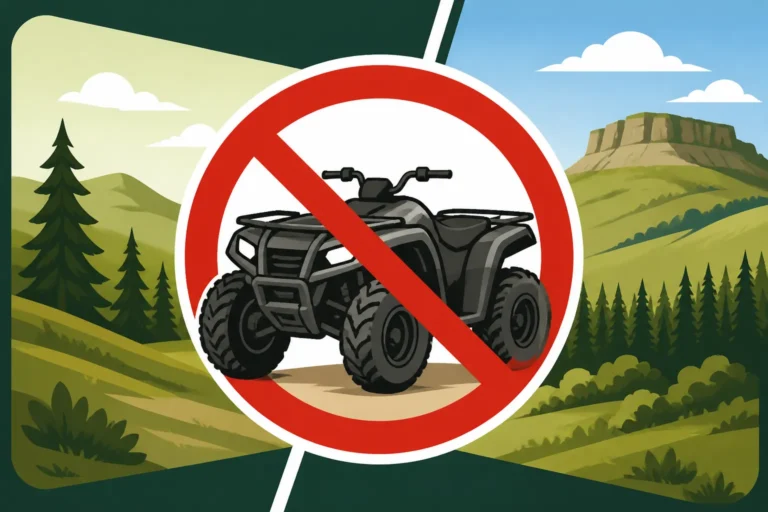
Stay on an established route where riding is permitted. Don’t create a bypass through vegetation or follow tracks simply because they are visible; tracks alone don’t confirm that the route is open or appropriate to use. If a trail is badly damaged, blocked or marked closed, turn around rather than making another route beside it. [Saskatchewan Trail Etiquette Locals Expect] and [Saskatchewan Trail Closures After a Storm] offer helpful context for making those decisions.
Access rules can vary by location and land status. Before riding, confirm that the route is open and that you have any required permission. This is particularly important where a route crosses private land, a grazing lease or occupied Crown land. Start with [Saskatchewan Crown Land Access Rules], and ask the relevant local office or land manager if the status is unclear.
Make group decisions before the trail gets difficult
A group ride works best when everyone agrees that turning around is an acceptable outcome. Decide in advance who will lead, who will ride at the back and what the group will do if the trail becomes unsafe. If one machine is having trouble, the rest of the group should stop on stable ground rather than crowding onto the same soft section.
Don’t let pressure to keep up override what you can see and feel. A rider who is uncomfortable with a crossing can wait while the group assesses it. If the route cannot be evaluated safely, the group can choose another trail. That is not a failed ride; it is a sensible way to avoid turning a day outdoors into a recovery job.
When someone becomes stuck, first check that everyone is safe and that the machines are stable. Keep bystanders clear of tires, straps and winch lines. If the recovery cannot be done calmly with the available equipment, stop and reconsider rather than increasing force. [Winching a Stuck Quad Out of Northern Bush] explains why preparation and careful positioning matter.
Planning a muskeg ride in Saskatchewan
Check conditions, access and closures
Build your plan around the actual route, not just the name of a nearby community or recreation area. Conditions can vary over short distances, and a trail that was open or rideable on a previous trip may be closed or damaged now. Check local trail updates before driving out, and look for posted signs when you reach the area.
Fire-season restrictions can affect access, and wildfire-related closures may change where riding is allowed. Don’t assume that a familiar trail remains open because you’ve ridden it before. Check for current notices and follow restrictions from the relevant authority. [Saskatchewan Wildfire Closures and Riding] is a useful companion when planning a trip during fire season.
Make sure your group knows how to leave the area if conditions deteriorate. Save the route offline, carry a backup map and set a time to check in with someone at home. If you change destinations, update that person rather than assuming your original plan is close enough.
Match the outing to the least experienced rider
A route that feels easy to a regular local rider may be intimidating to someone new to muskeg, unfamiliar with the machine or carrying extra passengers and gear. Choose a destination and distance that fit the group’s experience. Leave room in the day for breaks, a slower pace and a change of plan.
Before unloading, discuss the basics: how far apart to ride, where to stop, what signals to use and what to do if someone loses sight of the group. Make sure each rider understands the route and carries essential supplies. A comfortable group is more likely to make careful decisions than one that feels rushed or pressured.
Finally, treat the turn-around point as part of the plan. If the trail is too wet, a crossing is uncertain or a closure blocks the route, choose a safer option. In muskeg country, the best ride is not necessarily the one that reaches the farthest point. It is the one where everyone gets back with their machines, their group and the trail in good shape.
Disclaimer
This article is for general informational purposes only and does not constitute professional advice. Laws, prices and regulations vary by location and change over time. Consult a qualified professional for guidance on your specific situation.