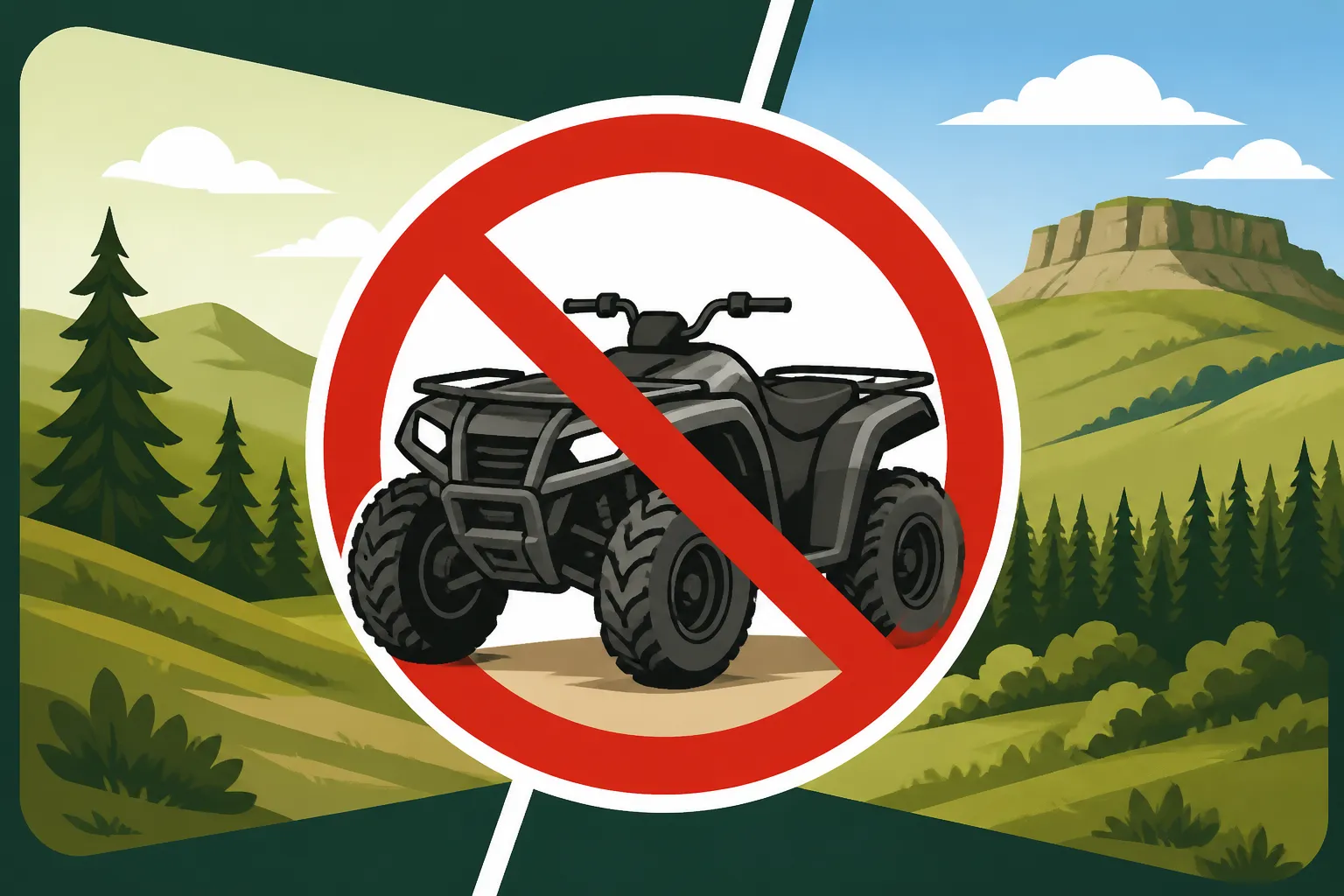
Both Cypress Hills Blocks Are Closed to Quads
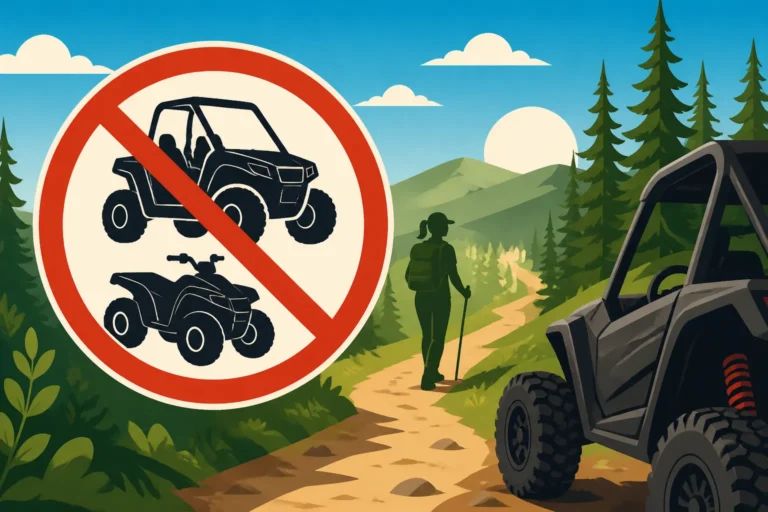
Cypress Hills is a tempting place to unload a quad: the forested hills, winding roads and wide-open prairie nearby make it look like ideal riding country. But ATVs and side-by-sides are not permitted for recreational riding in either the Saskatchewan Centre Block or West Block. This guide explains what that means, where confusion comes from and how to plan a ride without arriving at a closed trailhead.
Why both Cypress Hills blocks are closed to quads
The Centre Block and West Block are both protected park areas
The Saskatchewan side of Cypress Hills Interprovincial Park has two separate blocks. The Centre Block is near Maple Creek, while the West Block is farther west, near Eastend. They offer different scenery and recreation opportunities, but riders should not assume the rules change between them: recreational ATV and UTV riding is not permitted in either block.
That restriction applies whether you are bringing a sport quad, utility ATV or side-by-side. A machine that is compact, quiet or used mainly for property work does not become a permitted recreational vehicle just because it can travel along a narrow track. The important question is whether the route is legally open to that type of machine, not whether it looks passable.
This is easy to misunderstand when a map shows a road or track through the park. A visible line may be a hiking or cycling trail, a route for park operations, or a road with restrictions. A line on a map is not proof that motorized riding is allowed. For a broader look at motorized use in provincial parks, see Saskatchewan Park Regulations for Machines and Saskatchewan Parks With Designated Trails Only.
Roads, trails and riding access are not interchangeable
Cypress Hills has roads that visitors use to reach campgrounds, viewpoints and other park facilities. That does not mean an ATV or UTV can be unloaded and ridden along the road or taken onto nearby trails. Road access for ordinary travel and recreational off-road access are different things, and the rules applying to one do not automatically apply to the other.
A common scenario is a rider towing a side-by-side to the park, seeing a gravel road continue past a recreation area and assuming it is a riding route. The safer approach is to check with park staff before unloading. If staff cannot confirm that a route is open to your exact machine and intended use, treat it as closed.
| What you see at Cypress Hills | What it does not automatically mean |
|---|---|
| A road shown on a map | That an ATV or UTV may travel on it |
| A wide or well-used track | That the route is an authorized motorized trail |
| Other vehicles in the area | That those vehicles are recreational off-road machines |
| A route near a campground | That riding is permitted from the campground |
| An open-looking entrance | That the route has no seasonal or vehicle restrictions |
Common reasons riders misread the rules
A mapped route is not permission to ride
Trail and navigation apps can be useful for understanding terrain, estimating distances and planning a trip. Riders may consult tools such as onX Offroad while comparing possible routes, but a mapped line should never be treated as authorization to ride. App data can show roads, trails or tracks without clearly showing the current legal status for a specific vehicle type.
Before relying on a route, compare what the app displays with current park information and posted signs. If the map identifies a trail but does not confirm that recreational ATVs or UTVs are allowed, it has not answered the key question. onX Offroad can help with route planning, but permission still comes from the applicable land manager and the rules posted for that place.
This distinction matters especially when a route appears to leave the park and continue onto other land. The ride may cross a park boundary, private land, Crown land or a road managed by a municipality. Each section can have different access rules. A route that is legal in one place may become prohibited at the next boundary.
The Alberta side has separate rules
Cypress Hills Interprovincial Park extends across the Saskatchewan-Alberta border, but the park name does not mean that every rule is identical on both sides. The provincial boundary matters. Do not use a report about ATV access on the Alberta side as proof that riding is allowed in the Saskatchewan blocks, or the reverse.
A visitor might search online, find an account of riding near Cypress Hills and assume it refers to the Saskatchewan Centre or West Block. It may describe a different jurisdiction, a nearby area outside the park, or a route with conditions that no longer apply. Confirm the specific block, province, land manager and machine type before following advice from a post, map or friend.
The same care applies to onX Offroad and other navigation tools: a route visible near the border may be on the other side of it. Zoom in, check the boundary and verify the rules with the relevant authority. For more background on legal riding locations beyond the park, see Saskatchewan ATV Trails: Crown Land and Ditches and Saskatchewan Crown Land Access Rules.
How to plan a legal ride near Cypress Hills
Confirm where the ride will actually take place
Start by identifying your intended unloading point and every section of the route. “Near Cypress Hills” is too vague for a reliable access check. The route might be inside the Centre Block, inside the West Block, on private land, on municipal land or on Crown land outside the park. Those distinctions can determine whether a ride is possible.
If you are considering land outside the park, confirm both that motorized riding is allowed and that you have the necessary permission. Crown land is not automatically open to every use, and private land requires the landowner’s consent. Routes may also cross leases or other occupied areas. Check the land status and access rules for the entire trip, rather than assuming that an open gate or existing track signals permission.
A practical planning routine is:
- Mark the trailhead and the full route you hope to ride.
- Identify the land manager for each section, including any boundary crossings.
- Ask whether ATVs and UTVs are permitted on the specific route.
- Check for closures, seasonal limits, fire restrictions and posted signs.
- Choose another area if any part of the route remains uncertain.
Check closures and conditions before towing
A trip can be legal in principle and still be a bad choice on a particular day because of a closure, fire danger, weather or trail damage. Before leaving home, check the applicable park or land-manager notices. Once at the site, read signs at the entrance and trailhead. A closure sign is not overridden by an old map, a previous visit or a route someone shared online.
Navigation apps, including onX Offroad, are most useful as planning aids when paired with official information. Save relevant maps before leaving, especially if you expect weak mobile coverage, and keep a paper map or written notes as a backup. Do not rely on a phone signal to look up access rules at the trailhead.
If your planned area is outside the park, review Saskatchewan Trail Conditions Before You Haul and Saskatchewan Fire Ban Lookups as part of your preparation. Conditions can change after rain, during dry periods or when land managers close an area. If a local club or land manager maintains the route, ask about current access and closures rather than relying only on a general trail map.
What to do if you arrive with a quad or side-by-side
Do not unload inside either park block
If you reach the Centre Block or West Block with an ATV or UTV, do not interpret an available parking area or nearby trail as an invitation to ride. Keep the machine on the trailer unless park staff confirms a specific, legal use for that location. If your plan was to ride within either block, change the plan before unloading.
That can be frustrating, especially after a long tow. It is still better than risking a ticket, a conflict with park staff or damage to sensitive ground. A quick conversation at an office or visitor contact point may clarify where you can go for non-motorized recreation, but it does not create ATV access where recreational riding is prohibited.
If you are already in the area, consider switching to an activity permitted in the park, or towing to a separately verified riding area outside it. Before heading elsewhere, confirm that the alternate route is open to your machine and that you have permission to use it. Do not simply follow a nearby track because it appears to lead away from the park.
Build a backup plan before the trip
A backup destination is one of the simplest ways to avoid turning a closed trail into a stressful day. Choose an alternate area before leaving, identify its land manager, and verify its access conditions. Ask whether the route allows both ATVs and UTVs; some trails may permit one type of machine but not another, or may have local rules that limit where vehicles can travel.
For riders comparing possible areas, Saskatchewan Trails That Allow Side-by-Sides can help frame the search, while Saskatchewan Bylaw Lookups Before You Ride is useful when a proposed route may involve a municipality. Check local rules carefully: a municipal permission or plate scheme does not by itself authorize riding on every road or trail in that municipality.
A useful backup checklist includes:
- A confirmed legal unloading location
- Permission for every private or occupied section
- Current closure and fire information
- A route suitable for your machine and riding group
- A plan for fuel, recovery and limited cell coverage
- A second destination in case the first area is closed
Cypress Hills remains a worthwhile destination for many kinds of recreation, but it is not a place to assume ATV or UTV trail access. Treat both Saskatchewan blocks as closed to recreational quads, verify every proposed route outside the park with the relevant land manager, and make the access check before you tow.
Disclaimer
This article is for general informational purposes only and does not constitute professional advice. Laws, prices and regulations vary by location and change over time. Consult a qualified professional for guidance on your specific situation.