Saskatchewan Riders Who Want a Plate Anyway
It's a common frustration, isn't it? You buy an ATV in Saskatchewan, excited to hit the trails or get some work done on the farm, and then you start thinking about the paperwork. You see folks with plates on their snowmobiles, or perhaps you've moved from another province where ATV registration is standard, and you naturally assume you'll need a plate for your quad too. But then you quickly discover there’s no provincial ATV registry here, leaving many riders feeling a bit lost about how to properly identify their machine or prove ownership. This guide is here to walk you through why Saskatchewan doesn't issue ATV plates, what your options are if you still want a form of identification, and how to effectively prove ownership even without that provincial piece of plastic.
The Provincial Reality: No ATV Registration in Saskatchewan
Let's cut right to the chase: if you're looking for a provincial registration or a government-issued plate for your ATV in Saskatchewan, you won't find one. This often comes as a surprise to new riders or those relocating from other parts of Canada, where a registration system for ATVs is commonplace. It’s a distinct difference in how our province approaches off-road vehicle governance.
Understanding Saskatchewan's Stance on ATV Registration
Unlike many other jurisdictions, and indeed unlike snowmobiles right here in Saskatchewan, the province has a different approach to ATVs and UTVs. The core legislation governing these machines, [Saskatchewan's All Terrain Vehicles Act], does not mandate provincial registration. This means there's no central government database tracking ATV ownership, no provincial decal to affix to your machine, and no official provincial "title" document like you might find for cars or trucks. It's a system that, for better or worse, places more emphasis on safe operation and individual responsibility rather than a centralized tracking mechanism.
Many wonder [Why Saskatchewan Never Built a Quad Registry]. Historically, the province has chosen a less bureaucratic path for ATVs, possibly due to the prevalent use of these machines in rural, agricultural, and recreational settings where formal registration might have been seen as an unnecessary burden. This distinction is crucial, especially when you consider that [Saskatchewan Registers Snowmobiles, Not ATVs]. Snowmobiles fall under a different set of regulations that do require provincial registration, complete with annual fees and a physical plate. This disparity can certainly be confusing for riders who own both types of machines, expecting a similar process for their quad.
The Core Reason Riders Seek a Plate
Even without a provincial mandate, there are very valid and understandable reasons why a rider might still want a plate or some official form of identification for their ATV. It’s not just about wanting to follow rules; it’s about practical concerns that weigh on the minds of responsible owners.
One of the biggest drivers is the desire for clear [Saskatchewan Proof of Ownership Without a Registry]. In a world where theft is a real concern, having a physical, government-issued identifier provides a sense of security and legitimacy that a simple bill of sale, while legally sound, doesn't always convey in day-to-day interactions. Riders want something tangible to show a peace officer or a potential buyer that the machine is legitimately theirs.
Then there's the very real issue of theft deterrence and recovery. Without a provincial plate or registration number tied to an official database, reporting a stolen ATV can feel like shouting into the void. While the VIN (Vehicle Identification Number) is paramount, a plate adds another layer of identification. People imagine that if their quad goes missing, a plate would make it easier for law enforcement to track it down. This concern is often at the heart of discussions around [Saskatchewan Stolen Machine Reports] and how difficult recovery can be without a centralized registry.
Beyond theft, riders also think about identification for liability, especially if they operate their machine in situations where proof of insurance or ownership might be requested. And for those who travel, the rules change drastically outside Saskatchewan. A rider planning a trip to Alberta or Manitoba, where ATV registration is often required, might naturally seek a plate to avoid issues on their journey. It's about preparedness and peace of mind, knowing you have all your ducks in a row.
Municipal Plate Schemes: A Local Solution
Since the province doesn't issue ATV plates, some local governments have stepped up to fill the void. Across Saskatchewan, certain rural municipalities (RMs) and villages have implemented their own localized permit and plate schemes. These aren't provincial registrations, but they do offer a form of identification and often come with local benefits.
How Municipal Plates Work
Many riders are unaware that [Municipal Plates Fill the Gap the Province Left] when it comes to ATV identification. These are local bylaws, not provincial laws, meaning the rules and availability vary greatly depending on where you live or where you primarily ride. For example, some popular recreational areas or towns that see a lot of ATV traffic have decided to implement their own permit systems. These permits often come with a small physical plate or sticker that you display on your machine.
The purpose of these municipal plates is generally twofold:
- Local Identification: It provides a way for local authorities (bylaw officers, RM staff) to identify who is operating a machine within their jurisdiction. This can be particularly useful in enforcing local bylaws regarding noise, speed, or restricted riding areas.
- Revenue for Local Infrastructure: The fees collected from these permits often go directly back into the community, sometimes funding local trail maintenance, signage, or other ATV-related amenities. It's a way for riders to contribute to the local infrastructure they enjoy. [Why Plate Revenue Funds Local Trails] is a key motivator for these municipalities.
It's important to understand the scope of these plates. A municipal plate is typically only valid within the boundaries of the municipality that issued it. It's not a province-wide registration and won't be recognized as such in other RMs or outside Saskatchewan. [Which Municipalities Run Their Own Plate Scheme] is a question worth asking your local RM office or checking their website if you're interested in this option.
Getting a Municipal Plate
The process for obtaining a municipal plate is usually quite straightforward, designed to be accessible for local residents. While specific requirements can differ slightly from one municipality to another, there's a general pattern you can expect.
First, you'll need to gather some basic documentation. This almost always includes proof of ownership, most commonly your bill of sale, and personal identification. If you're buying a used ATV, ensuring you have a solid, detailed bill of sale is paramount. For this, you might consider a reliable template from a service like LawDepot to ensure all necessary details are covered. [What to Bring to Get Your First Quad Plate] will typically involve your driver's license, proof of address, and that all-important bill of sale.
Next, you'll visit the municipal office – often the town or RM office – during their regular hours. This is where you'll fill out an application form, present your documents, and pay the required fee. For example, some communities like Candle Lake might charge a modest fee for their ATV permits. The fees for these permits are generally quite reasonable, especially when compared to provincial registrations in other places. [Saskatchewan Municipal Plate Costs] will vary, so a quick call to the specific municipality you're interested in is always a good idea.
Once you've completed the process, you'll be issued a plate or sticker to display on your ATV. Many municipal plates have a set expiry date, such as [Why Municipal Plates All Expire on April 30], meaning you'll need to renew them annually. Renewing a plate is usually a simpler and sometimes cheaper process than the initial application. [Saskatchewan Municipal Plate Renewals] typically just require you to confirm your details and pay the renewal fee. Remember, this local plate is a fantastic way to show you're a responsible rider within that community.
Limitations and Benefits of Municipal Plates
While municipal plates offer a practical solution for local identification, it's crucial to understand both their advantages and their inherent limitations.
Benefits:
- Local Legitimacy: Having a municipal plate can help you demonstrate compliance with local bylaws and show that you're a responsible operator within that specific community. This can build goodwill with local residents and authorities.
- Support for Local Trails: As mentioned, the fees collected often directly support the maintenance and development of local ATV trails and riding areas. By purchasing a plate, you're investing in your local riding experience.
- Identification: It provides a visible identifier for your machine, which can be helpful if it's misplaced or in an incident within the municipality.
- Community Integration: It helps foster a sense of community among local riders and can sometimes be a prerequisite for participating in local ATV events or poker runs.
Limitations:
- Geographic Restriction: The biggest drawback is that these plates are typically only valid within the specific municipality that issued them. They are not a universal pass. If you ride in multiple RMs or plan to travel out of province, you'll need to be aware that your local plate won't carry weight elsewhere. [Saskatchewan Rural Municipality Rules] often outline these limitations quite clearly.
- Not a Provincial Registry: They do not serve as an official provincial registration, title, or proof of ownership in the eyes of the Saskatchewan government. They won't address the core desire for that "official" provincial recognition many riders seek.
- Varied Rules: The lack of uniformity across municipalities can be confusing. What's required or permitted in one RM might be different in another. This means doing your homework for each area you plan to ride in.
- No Theft Recovery Database: While it helps local identification, there's no province-wide, centralized database linked to municipal plates for theft recovery purposes. The VIN remains the primary identifier for stolen ATVs.
Ultimately, a municipal plate can be a great option if you primarily ride in an area that offers one. It shows local responsibility and can support your local riding community. However, it's not a substitute for a province-wide registration, which simply doesn't exist for ATVs in Saskatchewan.
Alternative Methods for Identification and Proof of Ownership
Given the absence of a provincial ATV registry, Saskatchewan riders must rely on other methods to establish and prove ownership. These methods are just as, if not more, crucial than a physical plate, especially for financial transactions, theft recovery, and legal standing.
The Importance of a Strong Bill of Sale
Without a provincial registration, your bill of sale becomes the most vital document proving you own your ATV. It's not just a receipt; it's a legal contract that transfers ownership from one party to another. Many riders make the mistake of having a flimsy, handwritten note, but a robust bill of sale is your best friend. [Your Bill of Sale Stands In for a Registration] in Saskatchewan, making it an indispensable piece of paperwork.
What should a strong bill of sale include?
- Full Buyer and Seller Information: Names, addresses, and contact details for both parties.
- Detailed Machine Description: Make, model, year, colour, and most importantly, the Vehicle Identification Number (VIN) or serial number. Double-check this against the machine itself.
- Purchase Price: Clearly state the agreed-upon sale price.
- Date of Sale: The exact date the ownership transfer took place.
- Condition of Sale: Any agreed-upon conditions, such as "as is, where is" if it's a private sale.
- Signatures: Both the buyer and seller must sign and date the document. It’s also wise to have a witness signature, if possible.
You can find excellent templates online from resources like LawDepot that help ensure you cover all your bases. Having a professional-looking and comprehensive bill of sale, even for a private sale, can save you a lot of headaches down the road. It's the primary document you'll need for [Saskatchewan ATV Paperwork for a Buyer], for insurance purposes, or if you ever need to prove ownership to law enforcement. A detailed bill of sale is truly the backbone of [Saskatchewan Bills of Sale Do the Work] in lieu of a provincial registration.
Serial Numbers and VIN Etching
The Vehicle Identification Number (VIN) is a unique identifier assigned to every ATV by its manufacturer. This number is permanently stamped onto the frame of the machine and is globally recognized. In Saskatchewan, where there's no registration, the VIN is absolutely critical for tracking your machine, especially in the case of theft.
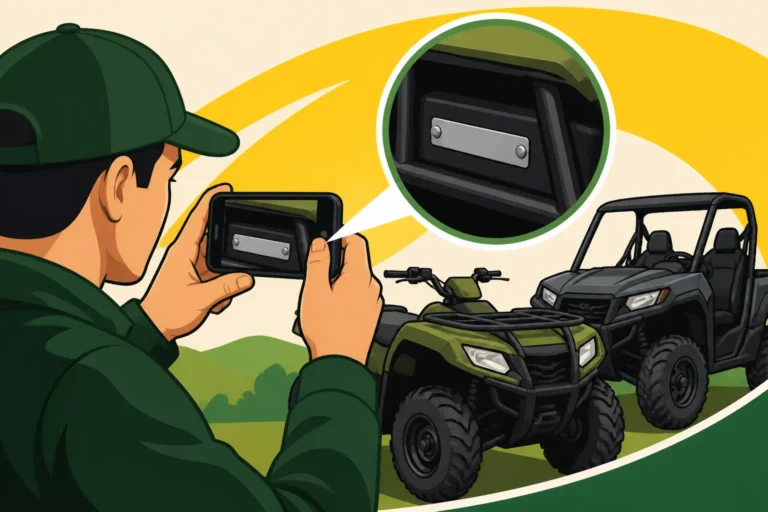
Always ensure you have a clear record of your ATV's VIN. Photograph it, write it down, and store it in a safe place, separate from the machine itself. When buying, always cross-reference the VIN on the bill of sale with the one physically on the machine. This simple step can prevent you from inadvertently buying a stolen ATV. [Checking a Serial Number Twice Before You Pay] is non-negotiable.
For an added layer of theft deterrence, some owners consider VIN etching. This involves permanently engraving the VIN onto various components of the ATV, making it harder for thieves to resell parts or disguise the machine's identity. While it's an extra step and cost, it can significantly increase the chances of recovery if your machine is stolen. [Saskatchewan Stolen Machine Reports] often highlight the challenges of recovery without unique identifiers beyond the primary VIN. It makes the machine less appealing to professional thieves looking to strip parts or flip it quickly.
Insurance as a Form of Identification and Protection
While not a form of "registration" in the traditional sense, obtaining comprehensive insurance for your ATV is another critical step that provides both protection and a verifiable record of ownership. In Saskatchewan, you are legally required to carry a minimum of $200,000 in liability insurance when operating an ATV, unless you meet specific exemptions for private land use. [Saskatchewan's Minimum Insurance Requirement] is a serious aspect of responsible riding.
When you purchase an ATV insurance policy, your machine's VIN and your ownership details are recorded by the insurance company. This creates a valuable third-party record of your machine, separate from your personal documents. In the event of an accident, theft, or damage, your insurance policy provides financial protection and helps establish that you are the rightful owner. [Saskatchewan Insurance Claims Without a Plate] are handled routinely, using the VIN and your policy details.
Many riders opt for coverage beyond the basic liability, including collision, comprehensive, and even specific theft coverage. This investment not only protects your asset but also creates an official, documented trail for your machine that can be presented if questions of ownership arise. Always carry proof of your insurance when riding, as [Saskatchewan Insurance Proof on the Trail] can be requested by a peace officer. You can get a standalone policy from a broker or even explore options through the Saskatchewan All Terrain Vehicle Association (SATVA) for potential member discounts.
Understanding the Act and Legal Context
Navigating ATV regulations in Saskatchewan can feel like a maze, especially with the provincial no-registration rule. However, understanding the broader legal context and specific operational rules is just as important as knowing how to prove ownership.
When a Plate Might Matter
While Saskatchewan doesn't issue a provincial plate, there are situations where some form of official identification, beyond just your bill of sale, can be beneficial or even necessary, particularly for out-of-province travel or specific park access.
If you plan to take your ATV on a trip outside of Saskatchewan, you need to be acutely aware of the regulations in the province or state you're visiting. Many jurisdictions, unlike Saskatchewan, mandate provincial registration and display of a license plate for ATVs. While [Saskatchewan Rules for an Out-of-Province Machine] generally mean you ride with your home province's rules, other provinces may still require you to meet their identification standards. This means a Saskatchewan rider with no plate might face questions or even fines if they don't comply with the local rules where they are visiting. While a municipal plate from your home RM won't solve this, having all your ownership documents, VIN records, and insurance readily available is crucial.
Furthermore, within Saskatchewan, certain provincial parks or designated riding areas might have their own specific permit requirements, even if they don't issue a "plate." For example, some parks require you to obtain a free permit and acknowledge use policies before riding on designated trails, and they may ask to see proof of insurance or ownership. While this isn't a plate, it's a form of official recognition and adherence to local rules. [Saskatchewan Equipment Checks by Officers] can happen anywhere, and being prepared with all your paperwork (bill of sale, insurance, ID) is always the best approach.
Differentiating from Snowmobiles
It bears repeating, as this is a frequent source of confusion for many riders: ATVs and snowmobiles are treated very differently under Saskatchewan law when it comes to registration. This distinction is not just a nuance; it's a fundamental difference in how these recreational vehicles are governed.
[Saskatchewan Registers Snowmobiles, Not ATVs]. If you own a snowmobile in Saskatchewan, you must register it with Saskatchewan Government Insurance (SGI), pay an annual fee, and affix a provincial plate to the machine. This registration includes basic liability insurance coverage. The detailed requirements for snowmobiles can be found in a separate piece of legislation.
This discrepancy often leaves ATV owners scratching their heads. Why one and not the other? The reasons are complex, but generally stem from historical legislative development, differing patterns of use, and the specific types of risks and public safety concerns associated with each type of machine. Snowmobiles often operate on designated trails that cross various land types and require more structured management. ATVs, while also operating on trails, also have widespread utility and agricultural use, which may have led to a less centralized registration approach.
The key takeaway is this: do not assume the rules for your snowmobile apply to your quad, or vice-versa. Always verify the specific requirements for each machine. While there's no provincial plate to buy for your ATV, you will need one for your snowmobile. [A Saskatchewan Snowmobile Registration Runs $150 a Year] and is absolutely mandatory.
Table: ATV vs. Snowmobile Registration in Saskatchewan
| Feature | All-Terrain Vehicle (ATV/UTV) | Snowmobile |
|---|---|---|
| Provincial Registration | No | Yes (Mandatory) |
| Provincial Plate/Decal | No | Yes |
| Primary Proof of Ownership | Bill of Sale, VIN Records | SGI Registration, Bill of Sale, VIN |
| Liability Insurance | Required (Minimum $200,000) | Included with SGI Registration |
| Municipal Plates | Optional, available in some RMs | No (Provincially Registered) |
| Governing Act | The All Terrain Vehicles Act | The Snowmobile Act |
This table clearly highlights why riders often feel a disconnect when comparing the two. So, while you might truly want a plate for your ATV to emulate the system you know or see for other machines, remember that the provincial system simply isn't set up that way for quads. Focus instead on robust documentation and local municipal options where they exist.
Disclaimer
This article is for general informational purposes only and does not constitute professional advice. Laws, prices and regulations vary by location and change over time. Consult a qualified professional for guidance on your specific situation.