Saskatchewan Rules for Towing a Trailer
Riding your ATV or UTV across Saskatchewan’s vast landscapes is a joy, but sometimes you need to bring more than just what fits in your cargo rack. Whether it's hauling firewood to the cabin, moving tools around the farm, or bringing out hunting gear, pulling a trailer can make your off-road machine an incredibly versatile workhorse. However, the rules for doing so aren't always clear, leaving many riders scratching their heads about what's legal and what's safe. This guide is here to untangle the complexities of towing a trailer with your ATV or UTV in Saskatchewan, helping you stay safe, compliant, and ready for whatever the trail throws at you.
The Basics of Towing a Trailer with Your ATV or UTV in Saskatchewan
When you hitch up a trailer to your ATV or UTV in Saskatchewan, you’re not just dealing with the laws governing the machine itself; you're introducing a whole new set of considerations. The primary focus of the All Terrain Vehicles Act is on the safe operation of the ATV or UTV. However, anytime you modify your machine's capabilities by adding a trailer, those underlying principles of safety and control apply even more stringently. It’s crucial to remember that while the Act might not spell out every single detail about trailers, the onus is always on the operator to ensure their entire setup is safe and manageable.
The general expectation is that your ATV or UTV, when combined with a trailer and its load, remains completely under your control at all times. This means no excessive swaying, no struggling to stop, and no difficulty navigating turns or inclines. If a peace officer observes your setup to be unstable or clearly overloaded, you could face consequences under the broad safety provisions of the Act, regardless of specific trailer regulations. It's about maintaining a reasonable standard of operation that protects yourself, your passengers, and anyone else you might encounter on the trails or roads.
Understanding the Act's Broad Strokes for Trailers
The provincial All Terrain Vehicles Act focuses heavily on how you operate the ATV or UTV itself, covering things like age restrictions, helmet use, and where you can ride. It doesn't get into the minute details of trailer dimensions, weights, or specific equipment for trailers being pulled by ATVs or UTVs, as it would for a highway vehicle. This lack of specific detail can be both a blessing and a curse. It offers a degree of flexibility, but it also places a greater responsibility on you, the rider, to exercise good judgment and adhere to general safety principles.
What the Act does imply, through its emphasis on safe operation, is that any attachment to your ATV or UTV must not compromise its stability, braking, or maneuverability. This means if you're towing a trailer that's too heavy, too wide, or poorly balanced, you're inherently operating your ATV or UTV in an unsafe manner, which could lead to fines or other penalties. Think of it this way: the spirit of the law is that your machine should always be controllable, and if a trailer makes it uncontrollable, then you're breaking that fundamental principle.
What Constitutes a "Trailer" Under the Act
For the purposes of being towed by an ATV or UTV, a "trailer" generally refers to any unpowered vehicle designed to be pulled by another. This can range from small, single-axle utility carts commonly used around the yard or farm, to more robust multi-purpose trailers designed for hauling logs, hunting harvests, or camping gear. The key distinction here is that these aren't typically highway-rated trailers that you'd pull behind a truck; they're usually purpose-built for off-road use with features like larger, knobbier tires and lower ground clearance.
It's important to differentiate between these ATV/UTV-specific trailers and standard road trailers. While you could theoretically hitch a small utility trailer designed for a car to your UTV, you need to consider if it's truly suitable for the terrain you'll be covering and if its design compromises your off-road machine's capabilities. A good rule of thumb is to use trailers specifically marketed and designed for ATV/UTV use, as they are engineered with the unique stresses and demands of off-road towing in mind. Using an inappropriate trailer can lead to equipment failure, accidents, and serious injury.
Manufacturer Specifications and Limitations
Your ATV or UTV's manufacturer provides the most critical guidance regarding towing. Every machine has a specified towing capacity, tongue weight limit, and often recommendations for hitch types. Ignoring these can be incredibly dangerous and can void your warranty. The manufacturer knows best what their machine can safely handle, and these limits are set for a reason – to prevent structural damage, brake failure, and loss of control. It's not just about whether the ATV can pull it, but whether it can safely pull and stop it, especially on varied terrain.
Before you even think about hitching up, consult your owner's manual. This often-overlooked document will detail the maximum weight your machine can pull, the maximum weight that can rest on the hitch (tongue weight), and sometimes even suggest appropriate speeds or terrains for towing. For instance, a small 400cc ATV might have a towing capacity of a few hundred pounds, while a large UTV could easily handle over a thousand. Always err on the side of caution. If you're not sure, lighten the load. Pushing your machine beyond its limits doesn't just risk a breakdown; it risks an accident that could have serious consequences under [Saskatchewan Owner Liability Rules].
Safety First: Equipment and Capacity When Towing
Towing a trailer significantly changes the dynamics of your ATV or UTV. Suddenly, you have more weight, a longer footprint, and altered braking characteristics. This means that safety considerations become paramount. Beyond just the legal requirements, there are best practices and essential equipment choices that can make the difference between a smooth trip and a dangerous ordeal. Always remember that even the most robust machine can become unstable if the trailer isn't properly equipped or if the load isn't managed correctly.
Imagine you're heading out to your hunting lease north of Prince Albert, loaded with gear, and you hit a patch of soft ground. If your trailer isn't set up right, that small bump could become a major issue. Or picture yourself navigating a winding bush trail in the Porcupine Hills; an overloaded trailer could easily push your ATV wide on a turn, potentially leading to a rollover. These aren't hypothetical scenarios; they're real risks that responsible riders mitigate with careful planning and proper equipment.
Essential Trailer Equipment
Even though the Saskatchewan ATV Act doesn't list specific equipment for small off-road trailers, common sense and general safety principles dictate what you should have. First and foremost, a secure hitching mechanism is non-negotiable. This means a proper hitch ball and coupler, or a sturdy pin hitch, designed for the weight you intend to pull. Safety chains, while often overlooked for smaller ATV trailers, are a crucial backup in case the primary hitch fails. They can prevent a runaway trailer, which is especially important if you're operating near roads or other people.
Beyond the hitch, consider visibility. If you're operating after dark or in low-light conditions, especially anywhere near a public thoroughfare, your trailer should have reflectors at a minimum. Brake lights and turn signals are generally overkill for small, off-road utility trailers, but if your trailer is exceptionally wide or long, or if you anticipate any road use (even just crossing a highway), additional lighting can only enhance safety and prevent a costly run-in with law enforcement, who can certainly issue tickets for unsafe operation. Remember that [Saskatchewan Equipment Checks by Officers] can happen anytime, anywhere.
Weight Limits and Load Distribution
This is where many towing incidents occur. Every ATV and UTV has a maximum towing capacity, and it's imperative that you never exceed it. This capacity often includes the weight of the trailer itself plus its cargo. Overloading puts undue stress on your machine's engine, transmission, suspension, and most critically, its brakes. It can also cause the ATV or UTV's front wheels to lift, reducing steering control, or conversely, cause the rear end to sag, limiting suspension travel and making the machine unstable.
Equally important is load distribution. The general rule is to place about 60% of the cargo weight towards the front of the trailer (over or slightly ahead of the axle) and 40% towards the rear. Too much weight at the front (excessive tongue weight) can press down on the ATV's rear suspension, causing handling issues and potentially reducing front wheel traction. Too much weight at the back can cause the trailer to sway violently, creating a "tail-wagging-the-dog" effect that can quickly lead to loss of control, especially at speed or over uneven terrain. Always secure your load to prevent shifting, which can instantly change weight distribution and create instability.
Braking Considerations for Towed Loads
Your ATV or UTV's brakes are designed to stop your machine. When you add a heavy trailer, you dramatically increase the kinetic energy that needs to be dissipated, and your machine's brakes alone might not be sufficient. While small, lightly loaded utility trailers generally don't require their own brakes, as the weight falls within the ATV's stopping capability, this changes rapidly with heavier loads. If you're consistently towing substantial weight, especially down inclines, trailer brakes become a critical safety feature.
Many aftermarket and specialty trailers, particularly those designed for heavier loads like logging or larger game retrieval, come equipped with surge brakes or electric brakes. Surge brakes activate automatically as the towing vehicle slows down, while electric brakes require a controller on the ATV/UTV. Even if not legally mandated for your specific off-road trailer, considering trailer brakes is a smart move for anyone who regularly hauls significant weight. The cost of a trailer with brakes, or adding them, is a small price to pay compared to the potential costs of an accident or a [Saskatchewan Fines Capped at $1,000] if found to be operating unsafely.
Navigating Saskatchewan's Landscape: Where Can You Tow a Trailer?
The ability to tow a trailer with your ATV or UTV is largely dictated by where you're riding. Saskatchewan's diverse landscape—from wide-open private farmland to dense Crown land forests and shared grid roads—each comes with its own set of rules and unwritten expectations. What's perfectly fine on a private pasture might be strictly prohibited on a designated provincial park trail or on a municipal street. Understanding these distinctions is crucial to avoid unwanted encounters with law enforcement or landowners.
It's not just about the rules; it's about the practicalities. Towing a trailer through dense bush on Crown land presents different challenges than pulling a small cart across a well-maintained yard. The type of terrain, the presence of other users, and even the weather can all impact whether towing a trailer is a good idea in a particular location. Always think ahead about the route and the destination before you hitch up.
Towing on Private Land and Farms
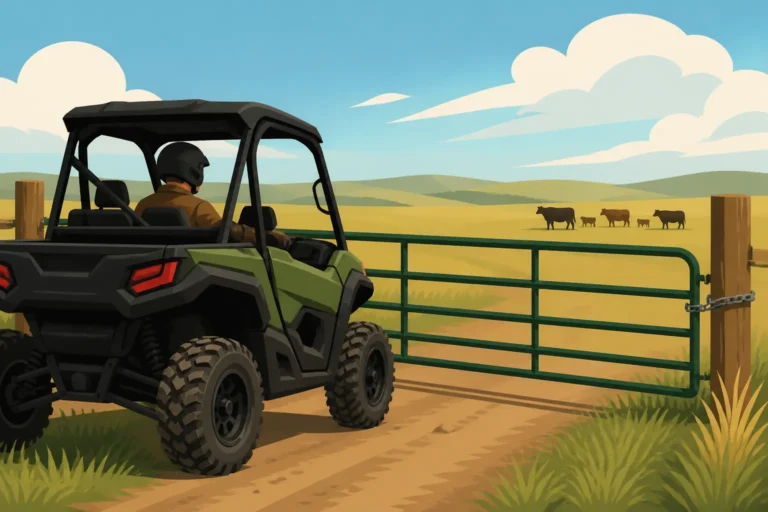
This is generally the most straightforward scenario for towing a trailer. On your own private land, or with explicit permission from a landowner, you have the most leeway. Farmers and ranchers regularly use ATVs and UTVs to pull small utility trailers for tasks like moving feed, tools, or fencing supplies. [Saskatchewan Machines Used on a Farm] are often seen with trailers attached, carrying everything from a post-hole auger to a bale of hay. Here, the rules are primarily governed by common sense, personal safety, and the landowner's specific instructions.
However, "most leeway" doesn't mean "no rules." Even on private land, you are still liable for any accidents or damages you cause, especially if due to negligent operation. Therefore, maintaining a safe load, operating at appropriate speeds, and ensuring your equipment is in good working order remains vital. If you’re operating on someone else’s property, always ensure you have their permission to be there and to tow a trailer. What they say goes, even if it's more restrictive than what you might do on your own acreage.
Towing on Crown Land and Designated Trails
Towing a trailer on Crown land, which includes many of Saskatchewan's forests, undeveloped areas, and provincial parks, can be a mixed bag. Many designated ATV trails are designed primarily for the machine itself, not necessarily for a machine and a trailer. While some wider, more developed multi-use trails might accommodate a modest trailer, narrow, winding, or highly technical trails might be completely unsuitable. Always check the specific rules for the area you intend to ride. [Saskatchewan Crown Land Access Rules] vary, and some areas might have restrictions on vehicle width or overall length, which would include your trailer.
Provincial parks, for example, typically have very specific regulations. While some parks might allow ATVs on designated trails, they may prohibit trailers, or require a special permit. Always consult the park's specific bylaws or website before heading out with a trailer. In some cases, organizations like SuperATV offer heavy-duty rear bumpers with additional hitch points and recovery options that can be beneficial for those who do get permission to tow heavier loads on less-forgiving Crown land. Never assume that just because you can ride your ATV somewhere, you can also tow a trailer there. When in doubt, call the local land management office or park authority.
Towing on Public Roads, Ditches, and Grid Roads
This is where towing a trailer with an ATV or UTV in Saskatchewan becomes particularly restrictive and potentially risky. [Saskatchewan ATV Road Rules Explained] are already quite strict for the machines themselves, generally limiting their use on public roads to specific circumstances like ditch riding, crossing highways, or where municipal bylaws explicitly permit it. Adding a trailer complicates matters significantly.
On grid roads, for example, while you might be permitted to ride your ATV in the ditch or on the extreme edge of the road, towing a trailer significantly increases your footprint and potential for hazard. [Saskatchewan Ditch Riding and the 2-Metre Rule] becomes even more critical with a trailer, as you need to maintain that distance from the travelled portion of the highway. Trailer sway, especially on uneven ditch terrain, can easily push you closer to traffic. Furthermore, [Saskatchewan Rules for Riding a Grid Road] require extreme caution and often specific lighting if riding after dark. If your trailer lacks proper lighting or reflectors, you could be cited for unsafe operation. Crossing a highway with a trailer also adds another layer of complexity; you still need to cross by the shortest route and ensure everyone dismounts. Given the inherent risks, many riders choose to avoid towing trailers on or near public roads unless absolutely necessary and legally permitted.
Smart Towing: Best Practices and Gear for Saskatchewan Riders
Beyond understanding the rules and limitations, successful and safe towing comes down to smart practices and choosing the right gear. It's about being prepared, knowing your limits, and equipping your ATV or UTV and trailer to handle the specific challenges of Saskatchewan's environment. A well-prepared rider with the right equipment can turn potential hazards into manageable tasks, ensuring that their outdoor adventures or work tasks remain enjoyable and efficient.
Think about how you'd prepare for a long road trip in your truck; towing with an ATV or UTV requires a similar mindset, if not more attention to detail, given the varied and often rugged terrain. It's not just about the initial setup, but also about how you handle the machine once the trailer is attached and moving.
Pre-Ride Checks and Maintenance
Before every trip where you intend to tow a trailer, a thorough pre-ride check is absolutely essential. This goes beyond the usual checks for your ATV or UTV. Start with the hitch connection: Is it secure? Is there any play? Are the safety chains (if applicable) correctly attached? Check the trailer tires for proper inflation and any signs of damage. An underinflated trailer tire can cause sway and increase rolling resistance, making your machine work harder.
Next, inspect the load. Is it balanced? Is it secured tightly with straps or ropes to prevent shifting? A shifting load can instantly throw off your weight distribution and lead to loss of control. If your trailer has lights or brakes, test them. Finally, check your ATV or UTV itself: ensure tire pressure is appropriate for the added weight (you might need to increase it slightly), check your oil and coolant levels, and ensure your brakes are in top condition. Ignoring these simple checks can lead to serious problems down the trail.
Operating Techniques with a Trailer
Riding an ATV or UTV with a trailer is fundamentally different from riding without one. Your machine will be heavier, longer, and less agile. Here are some key operating techniques to keep in mind:
- Slower Speeds: Always reduce your speed when towing, especially over rough terrain, around turns, or when going downhill. High speeds increase the risk of trailer sway and make it harder to stop or control your machine.
- Wider Turns: The added length of the trailer means you'll need to take wider turns to avoid clipping trees, rocks, or falling into ditches. Practice in an open area to get a feel for the new turning radius.
- Longer Braking Distances: With more weight, it will take your ATV or UTV longer to come to a complete stop. Maintain greater following distances and anticipate stops well in advance.
- Smooth Inputs: Avoid sudden acceleration, braking, or steering inputs. Smooth, gradual movements will prevent jerking the trailer and maintain stability.
- Watch Your Mirrors: If your UTV has side mirrors, use them to keep an eye on your trailer. This helps you monitor for sway, shifting loads, or potential clearance issues. If your ATV doesn't have mirrors, consider adding them, especially if you tow frequently.
Remember, the goal is always to maintain control. If the terrain gets too challenging, or you feel the trailer becoming unstable, stop and reassess. It’s better to take a few extra minutes than risk an accident.
Choosing the Right Trailer and Accessories
Investing in the right trailer and accessories can make a huge difference in your towing experience. For general utility around the farm or cabin, a simple dump cart or small utility trailer with robust tires is often sufficient. If you're hauling heavier items like logs or a large game animal, specialized trailers with higher weight capacities and features like tandem axles or independent suspension (like some offerings from SuperATV) can provide better stability and handling over rough ground.
Consider the terrain you'll be on:
- Bush riding: Look for trailers with good ground clearance and durable construction.
- Farm work: Dump features can be invaluable for moving dirt, gravel, or feed.
- Hunting: Game hauling trailers often feature open designs for easy loading and cleaning.
Beyond the trailer itself, accessories like heavy-duty hitch receivers, specialized hitches for specific implements, and recovery gear like winches can also enhance your towing capabilities and safety. Always ensure any accessories you add are compatible with your specific ATV or UTV model and are installed correctly. Ultimately, [Saskatchewan Trailer Costs for Hauling] are an investment in safety and efficiency.
Towing Considerations by Land Type in Saskatchewan
To help you visualize the different requirements and considerations, here's a quick overview of what to keep in mind when towing a trailer with your ATV or UTV across Saskatchewan's various land types.
| Feature | Private Land/Farm | Crown Land/Designated Trails | Public Roads/Ditches/Grid Roads |
|---|---|---|---|
| Legal Authority | Landowner's discretion, general safety | Specific land management rules, park bylaws, ATV Act | Saskatchewan All Terrain Vehicles Act, Traffic Safety Act, Municipal Bylaws |
| Permission Needed | Yes, if not your own land | Often required, specific to area | Generally prohibited or highly restricted |
| Trailer Type | Any safe, appropriate for task | Off-road specific, smaller dimensions advised | Highly restricted, typically only for crossings where permitted |
| Equipment Focus | Secure hitch, load securement, operator judgment | Secure hitch, appropriate tires, load securement | Minimal, focus on basic safety, visibility if allowed |
| Speed | Appropriate for terrain/task | Reduced, especially on trails | Very slow, for crossing/ditch riding only |
| Visibility | Day use usually fine; consider lighting after dark | Consider lighting after dark or in dense areas | Absolutely critical if any road exposure, even for ditch riding |
| Common Uses | Hauling feed, tools, firewood, game retrieval | Camping gear, game retrieval, maintenance | Very limited, possibly only for agricultural tasks on municipal roads |
| Key Risk | Overloading, poor load distribution | Exceeding trail capacity, damaging environment | Collision with other vehicles, legal penalties |
Remember that this table provides general guidance. Always verify the specific rules for your intended riding location, especially for Crown land and any area near public roads.
Disclaimer
This article is for general informational purposes only and does not constitute professional advice. Laws, prices and regulations vary by location and change over time. Consult a qualified professional for guidance on your specific situation.