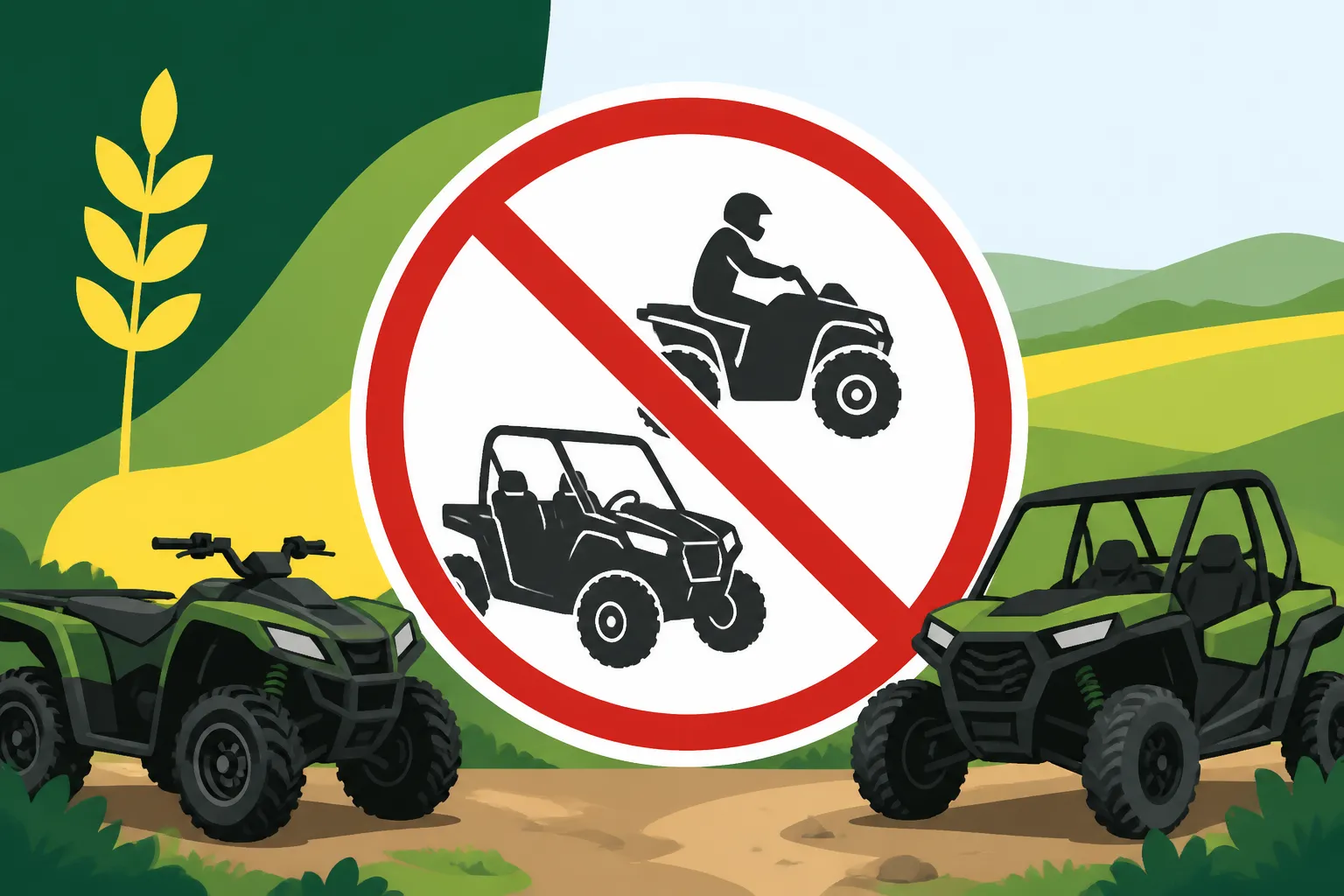
Saskatchewan Sign Requirements for Prohibitions
Riding your ATV or UTV in Saskatchewan can be an incredible way to explore our vast landscapes, but many riders often find themselves scratching their heads when it comes to local road rules. It's especially frustrating when you're unsure if a particular route or area is off-limits, often due to confusing or non-existent signage. This comprehensive guide aims to clear up that confusion by detailing the specific sign requirements for prohibitions under Saskatchewan's regulations, helping you understand what makes a prohibition legally binding and how to ride with confidence.
The Frustration of Unclear ATV Road Rules in Saskatchewan
Saskatchewan offers incredible opportunities for ATV and UTV enthusiasts, from working the land on a farm to hitting the trails for recreation. However, one of the most common headaches riders face is the sheer inconsistency of rules and regulations once they leave private land and venture onto public roads or municipal property. It’s a frustrating situation that can turn a fun day of riding into an anxious one, always wondering if you're about to run afoul of a local bylaw you didn't even know existed.
The Patchwork of Local Bylaws
Unlike a single, universal rulebook for the entire province, ATV and UTV operation on roads and within municipal boundaries in Saskatchewan is often governed by a complex, sometimes seemingly contradictory, patchwork of local bylaws. One town might have specific streets or routes designated for ATV access, perhaps even welcoming them as part of their community spirit or for access to local businesses. You might see signs permitting their use, or even nothing at all, which can sometimes imply a certain leniency depending on local enforcement attitudes.
However, venture just a few kilometres down the highway into the next village or rural municipality, and you could find yourself in a completely different regulatory landscape. That next community might have bylaws in place that strictly prohibit ATV use on all roads, within town limits, or even on roadside ditches, without any clear indication beyond a general assumption. This inconsistency is a major pain point for riders. It's easy to assume that if you can ride in one place, you can ride in a similar place nearby, but that’s a gamble that often doesn’t pay off. This lack of uniformity means that what's perfectly legal in one spot could earn you a ticket in another, simply because the local authorities have adopted a different stance.
Why Clarity is Crucial for Riders
For anyone who loves hitting the trails or using their ATV for practical tasks, clarity around road rules isn't just a matter of convenience; it’s essential for both safety and legal compliance. Nobody wants to be the rider who accidentally trespasses or breaks a bylaw they didn't even know existed. We're all trying to be responsible operators, but that becomes incredibly difficult when the rules aren't clearly communicated. Without distinct and proper signage, it's virtually impossible for riders, especially those visiting from out of town or exploring new areas, to know where they stand.
This ambiguity can lead to real stress. Imagine planning a weekend trip to a new area, excited to explore, only to spend half your time wondering if you're about to make an expensive mistake. It also impacts the overall perception of ATV use. When riders are seen operating in prohibited areas—even if unknowingly—it can fuel negative sentiment from residents and local officials, potentially leading to even stricter bylaws and further restrictions down the line. Clear rules, clearly posted, empower riders to make informed decisions, ensuring they can enjoy their machines responsibly and respectfully within the communities they visit and reside in.
Understanding Saskatchewan's Provincial ATV Act on Roads
While it often feels like you're navigating a maze of local rules, it's important to remember that there is a foundational provincial framework in place. The [Saskatchewan's All Terrain Vehicles Act] lays out many of the overarching principles for ATV and UTV operation across the province. However, like many pieces of legislation, it also contains provisions that allow for local variation, giving municipalities the power to tailor regulations to their unique community needs.
The General Rules and Their Limitations
At the provincial level, the All Terrain Vehicles Act establishes some fundamental rules that apply generally across Saskatchewan. For instance, it touches on aspects like age requirements for operators, mandatory helmet use, and basic lighting requirements for night riding. The Act also provides a framework for where ATVs can generally be operated, such as on private property with permission, or on designated trails. You can dive deeper into these overarching principles in our guide on [Saskatchewan ATV Road Rules Explained]. These are the baseline expectations that every rider should be familiar with, regardless of where they are in the province.
However, the provincial Act isn't a one-size-fits-all solution for every single road and pathway. It acknowledges that local conditions, traffic volumes, and community preferences vary significantly from one municipality to another. For example, while the Act provides general guidance on [Saskatchewan Ditch Riding and the 2-Metre Rule], a local bylaw might completely override this within specific urban or rural areas if they deem it unsafe or inappropriate for their community. This is where the limitations of the general provincial rules become apparent; they provide a foundation, but local authorities have significant leeway to build upon or modify those rules within their own jurisdiction.
When Provincial Law Hands Off to Local Control
This is the critical juncture where provincial law explicitly grants power to municipalities to establish their own rules. The Act, in its wisdom, understands that local communities are best positioned to assess the specific needs and concerns of their residents. Therefore, it allows villages, towns, and rural municipalities to enact their own bylaws governing ATV and UTV use on roads, streets, and other public property within their boundaries. This delegation of authority means that while the province sets a general framework, the day-to-day reality of riding on or near roads is often shaped by [Saskatchewan Municipal Bylaws on Roads].
These local bylaws can either open up certain areas to ATV traffic or, conversely, prohibit it entirely. For example, a municipality might choose to permit ATVs on certain low-traffic grid roads to allow access to recreational areas, or they might ban them outright from all paved streets for safety reasons. This is precisely why understanding local signage becomes paramount. When a municipality decides to prohibit ATV use in a specific area, they are exercising the authority granted by the provincial Act, and that prohibition, when properly communicated through signage, carries the full weight of the law. Without clear, legally compliant signs, however, enforcing these local prohibitions can become a significant challenge, both for law enforcement and for the unsuspecting rider.
The Specifics of Prohibition Signs in Saskatchewan
It's not enough for a local council to simply decide that ATVs are prohibited on a certain street or in a particular ditch. For that prohibition to be legally enforceable and for riders to actually know the rules, it must be communicated clearly and consistently through official signage. Saskatchewan's regulations are quite specific about what constitutes a valid prohibition sign, ensuring that there’s no room for misinterpretation or unofficial, unenforced warnings.
Mandatory Dimensions and Colour Schemes
When a municipality or authorized body wants to prohibit ATV use, they must adhere to strict guidelines regarding the physical attributes of the signs they post. The law is quite particular about what constitutes a valid prohibition sign, ensuring consistency and clear communication across the province. First and foremost, any sign prohibiting ATV use must be at least 60 centimetres square. This isn't an arbitrary number; it's a minimum size designed to make the sign noticeable and easily readable, even at a reasonable distance. You can imagine how easy it would be to miss a smaller, less prominent sign, especially when you’re focused on the road or trail ahead. This specific requirement is detailed in documents like [Prohibition Signs Must Be 60 Centimetres Square].
Beyond size, the colour scheme is also strictly mandated: the sign must feature a white background with black lettering. This high-contrast combination is universally recognized for clarity and legibility, making the message stand out against various backgrounds and in different lighting conditions. This uniformity in colour and size prevents confusion, ensuring that riders immediately recognize it as an official prohibition. This specific aesthetic is enshrined in guidelines like [White With Black Lettering], ensuring that all official prohibition signs in Saskatchewan share a common, easily identifiable appearance, no matter which community you're riding through.
What a Valid Prohibition Sign Communicates
A proper prohibition sign isn't just a casual suggestion or a polite request; it's a legally binding declaration that explicitly states, "Do not ride your ATV here." The text on the sign must be unambiguous and leave no doubt about the restriction. Typically, you'll see clear phrasing such as "ATV PROHIBITED," "NO ATVS BEYOND THIS POINT," or similar explicit language. It might also include specific vehicle types if the prohibition applies only to certain off-road vehicles. The intent is to eliminate any misinterpretation, ensuring that anyone reading the sign understands the legal consequence of proceeding past it.
The power of such a sign lies in its clear, direct message. It acts as a legal boundary, marking a zone where the operation of an ATV or UTV becomes an infraction of local bylaws. This clear communication is vital because it places the onus on the rider to observe and comply. Without this direct communication, enforcement becomes difficult, and riders are left guessing, which can lead to accidental violations. Therefore, when you encounter a sign with the specified dimensions and colour scheme, emblazoned with clear prohibition text, understand that it represents an active and enforceable municipal bylaw.
Placement and Visibility Requirements
The effectiveness of a prohibition sign relies not just on its physical characteristics and wording, but crucially, on its placement. A sign, no matter how perfectly compliant in size and colour, is useless if it's hidden from view. Saskatchewan's regulations implicitly require that these signs be placed in positions where they are clearly visible to oncoming ATV traffic, particularly at points of entry to a prohibited area. This means you should expect to see them where a rider would reasonably enter a restricted zone, such as at the start of a road, a trail head, or where a ditch riding area terminates.
Imagine pulling off a grid road into a small village; if there's a prohibition, that sign needs to be right there, in plain sight, not tucked behind a cluster of poplar trees or half-buried in a snowdrift. The sign should not be obscured by foliage, other signage, or any temporary obstruction that might prevent a reasonable person from seeing it. The intent is to give fair warning. This requirement is why guidelines exist to ensure [Signs That Make a Ban Enforceable], emphasizing visibility and strategic placement. Without proper visibility, even a perfectly crafted sign can fail in its purpose, leading to frustrated riders and potentially unenforceable tickets.
Here's a quick reference table to help you identify a valid prohibition sign:
| Feature | Valid Prohibition Sign (Saskatchewan Act) | Invalid/Unenforceable Sign (Examples) |
|---|---|---|
| Minimum Size | 60 centimetres square | Smaller, hand-drawn, or unofficial signs |
| Colour Scheme | White background with black lettering | Any other colour scheme (e.g., red and white) |
| Text/Symbol | Clearly states "ATV PROHIBITED" or similar | Vague symbols, "No Trespassing" (for general use) |
| Placement | Clearly visible at entry points | Obscured, hidden, or poorly placed |
| Authority | Posted by municipality or authorized body | Posted by private individual without authority |
What Happens if You Ignore a Proper Sign?
Riding past a properly posted prohibition sign isn't just a minor oversight; it's a direct violation of a municipal bylaw, which carries legal consequences. Many riders, especially those new to an area, might hope that a quick apology or a claim of ignorance will suffice if they're caught. Unfortunately, the law doesn't always see it that way, particularly when the municipality has gone through the effort to clearly communicate its rules.
Penalties and Enforcement by Local Authorities
When a municipality has correctly posted signs adhering to all the specified requirements, those signs transform the area into a legally restricted zone. Operating an ATV or UTV beyond such a sign becomes an offence under the local bylaw. Enforcement typically falls to local peace officers, members of the RCMP, or designated bylaw enforcement officers, all of whom have the authority to issue tickets and impose penalties. An officer responding to a complaint, or simply on patrol, has the authority to issue tickets if you're found operating your ATV where a properly posted sign prohibits it.
The penalties for such infractions can vary depending on the specific municipal bylaw and the severity of the offense, but they are often financial in nature. While exact figures fluctuate, these fines can be substantial. It's good to know that the [Saskatchewan Fines Capped at $1,000] by the provincial Act means there's a limit, but even a few hundred dollars can quickly put a damper on your riding season. Beyond the monetary penalty, repeated infractions could lead to further consequences, and the incident will be recorded, which can be an unnecessary hassle down the road.
The "I Didn't See It" Defence (and Why It Fails)
It's a common human reaction: if you get caught violating a rule, you might instinctively say, "But I didn't see the sign!" While this might be genuinely true from your perspective, it's generally not a valid legal defence if the sign meets all the provincial and municipal requirements. The law often operates under the principle that if a reasonable person, exercising due diligence, could have seen the sign, then you are deemed to have been adequately warned.
This means that if the sign was of the correct size and colour, had clear lettering, and was placed prominently at the entry point of the prohibited area, then the argument that you simply missed it is unlikely to hold up in court. The onus is on the rider to be aware of their surroundings and to observe posted signage. This is especially true when riding in unfamiliar territory. While a kind officer might offer a warning in some circumstances, relying on the "I didn't see it" excuse is a risky gamble. It underscores the importance of being observant and doing your homework before you head out, especially when [When a Council Shuts the Ditch to Riders] or any other area.
Navigating Municipalities with Varied Rules and Signs
Given the decentralized nature of ATV rules on roads in Saskatchewan, successful and compliant riding often comes down to proactive planning and community engagement. You can’t just assume the rules are the same everywhere; instead, you need to approach each new riding area with a fresh perspective and a willingness to understand the local landscape.
Researching Bylaws Before You Ride
The absolute best defence against accidentally violating a local bylaw is proactive research. Before you trailer your machine to a new riding spot, especially if it involves entering a village, town, or specific rural municipality, a little homework goes a long way. Many municipalities have their bylaws published on their official websites. A quick search for "[Municipality Name] ATV bylaw" can often yield the information you need. If you can't find anything online, don't hesitate to call the municipal office directly. A brief phone call can save you a lot of headache and potentially a hefty fine. They can clarify where ATVs are permitted, where they're prohibited, and what signage is in place.
Checking these resources is a vital step for any responsible rider. It allows you to plan your route, understand access points, and avoid areas where you might inadvertently cause an issue. This pre-ride check is particularly important for areas that might have recently updated their bylaws or where local residents are sensitive to ATV noise and traffic. Our guide on [Saskatchewan Bylaw Lookups Before You Ride] offers more tips on how to effectively conduct this research, ensuring you’re well-informed before you even start your engine.
The Role of Community Engagement and Local Trail Advocacy
Instead of simply feeling frustrated by a bylaw that closes a favourite route, consider engaging with your local council and community. Many communities are open to dialogue, especially if it means finding solutions that benefit both residents and responsible riders. Joining a local ATV club or association can be a powerful way to make your voice heard. These organizations often work directly with municipalities, advocating for designated trails, clearer signage, and more consistent rules. They can help bridge the gap between riders and local government, fostering understanding and finding common ground.
Participating in community meetings, offering to help with trail maintenance, or simply demonstrating responsible riding practices can all contribute positively. If a municipality sees that ATV riders are willing to be part of the solution, they might be more receptive to creating designated routes or reviewing existing bylaws. This collaborative approach can lead to better outcomes for everyone, creating more opportunities for safe and legal riding, rather than simply dealing with prohibitions after they've been put in place. It's about building relationships and showing that the ATV community is a responsible and valuable part of the broader provincial landscape.
Equipping Your ATV for Compliance and Safety
Riding an ATV or UTV in Saskatchewan isn't just about knowing the rules of the road; it's also about ensuring your machine is properly equipped for the journey. While signs tell you where you can't go, other regulations and best practices dictate how your machine needs to be equipped even where riding is permitted. Being prepared contributes directly to both your safety and your ability to comply with regulations, reducing the chances of any issues, including those related to road use.
Essential Gear for Visibility and Legal Riding
Regardless of where you’re riding, certain equipment is universally beneficial for safety and legal compliance. Functional headlights and taillights are crucial, especially if there's any chance you'll be riding near dusk, dawn, or in low-light conditions. Many municipal bylaws for permitted road use will specifically require these. Similarly, having proper mirrors can drastically improve your situational awareness, allowing you to see traffic or other riders behind you, which is invaluable on shared pathways. [Saskatchewan Equipment Checks by Officers] will often include these basics. Beyond lights, ensuring your tires are in good condition and are appropriate for the terrain you'll encounter helps maintain control, which is a key aspect of safe operation, whether you're on a trail or a permitted road section.
Keeping your machine well-maintained isn't just about longevity; it's about reliable performance when you need it most. A properly running engine, functional brakes, and good steering all contribute to safe operation, allowing you to react effectively to unexpected situations. These fundamental equipment checks aren't just about avoiding tickets; they're about ensuring you and anyone else on the trail or road can ride safely. For serious riders, a sturdy winch can be a lifesaver in unexpected stuck situations, while a well-stocked first aid kit should always be part of your essentials, preparing you for any eventuality.
Upgrading for Durability on Saskatchewan Terrain
For those of us who ride hard on Saskatchewan's varied terrain, from muddy tracks to rocky bush trails, having a machine that can handle it all is crucial. Beyond just meeting basic legal requirements, investing in quality upgrades can enhance your ATV's durability, performance, and overall safety. For instance, heavy-duty axles and enhanced suspension systems can make a huge difference, allowing your machine to absorb impacts better and maintain stability on rough terrain. A robust skid plate, perhaps from a reputable brand like SuperATV, is practically essential for protecting the underside of your machine from rocks, stumps, and other hidden hazards that are common on our trails and off-road routes.
These kinds of upgrades not only prolong the life of your ATV or UTV but also contribute to safer riding. Improved handling and control mean you're less likely to lose control, even in challenging conditions. Brighter, more reliable LED lighting kits, also available from specialists like SuperATV, ensure your machine is seen, especially if you're riding at dusk or in adverse weather on permitted routes, reducing the chance of accidental infractions. Furthermore, a high-quality aftermarket windshield, such as those offered by SuperATV, can protect you from flying debris and the elements, improving comfort and visibility. Equipping your machine with durable, reliable components allows you to focus on the ride and the rules, rather than worrying about breakdowns, making your Saskatchewan adventures more enjoyable and compliant.
Disclaimer
This article is for general informational purposes only and does not constitute professional advice. Laws, prices and regulations vary by location and change over time. Consult a qualified professional for guidance on your specific situation.