Saskatchewan Vehicles Registered Under Traffic Safety
It's incredibly frustrating when you're trying to figure out the rules for riding your ATV or UTV in Saskatchewan, only to get conflicting information or feel like you're navigating a legal labyrinth. Many riders mistakenly believe their off-road machines need to be registered under the same Traffic Safety Act that governs cars and trucks, leading to endless confusion about plates, permits, and what paperwork you actually need. This guide will clarify the distinct laws that apply to ATVs and UTVs in Saskatchewan, helping you understand why your quad isn't registered like your car and what provincial and local rules do impact your ride.
The All Terrain Vehicles Act Versus the Traffic Safety Act
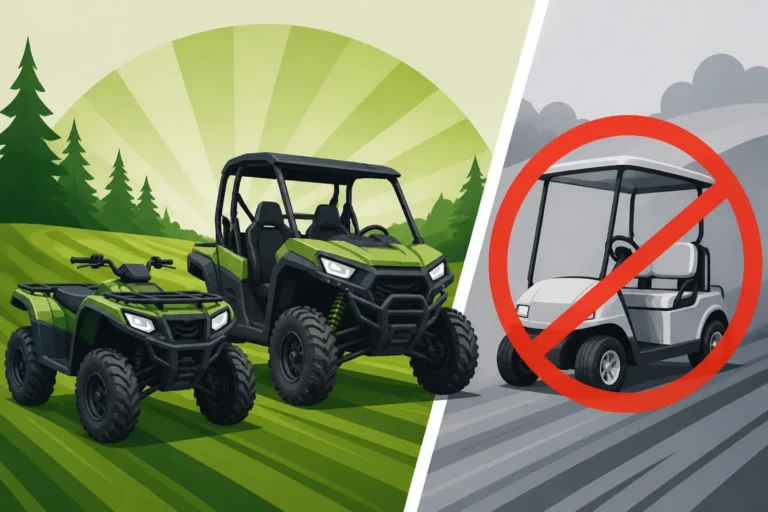
Let's cut right to the chase: in Saskatchewan, ATVs and UTVs are primarily governed by The All Terrain Vehicles Act, not the Traffic Safety Act. This is where a lot of the confusion stems from, because almost every other vehicle you own – your car, your truck, your motorcycle – falls squarely under the Traffic Safety Act. It's natural to assume your quad would too, especially when you're operating it on or near public roads. However, the provincial government made a deliberate choice decades ago to treat ATVs as distinct machines, setting them apart from road-going vehicles.
Different Purposes, Different Vehicles
The core difference lies in the fundamental purpose each piece of legislation addresses. The Traffic Safety Act is designed for vehicles primarily intended for highway use, focusing on licensing, registration, insurance, and roadworthiness to ensure safety on public roadways. It's about regulating the flow of traffic, maintaining safe speeds, and ensuring every vehicle has a paper trail for ownership and liability. This act covers everything from the lights on your car to the validity of your driver's licence when you're driving to the grocery store.
On the other hand, [Saskatchewan's All Terrain Vehicles Act] was specifically created to regulate the safe operation of off-road vehicles. It acknowledges that ATVs and UTVs are often used for recreation, utility work, or accessing remote areas where traditional traffic rules don't quite fit. Instead of focusing on provincial registration and highway travel, it emphasizes operator age, helmet use, speed limits in specific contexts, and safe practices when ATVs interact with public infrastructure, like crossing a highway or riding in a ditch. It’s a specialized law for a specialized kind of machine.
Why the Confusion Lingers for Riders
The confusion isn't just understandable; it's persistent. Riders often encounter scenarios where the lines blur. For instance, while your ATV isn't registered under the Traffic Safety Act, many of its rules regarding operator conduct—like holding a valid driver's licence, not riding while impaired, and reporting accidents—still very much apply when you operate your quad. You're not registering your quad like a car, but you still need to act responsibly like a driver, particularly when you're anywhere near public roads or property.
Another source of misunderstanding comes from the visual aspect. Many other provinces do require ATVs to be registered and display a plate, much like a car. When riders from out-of-province visit, or when Saskatchewan residents compare notes with neighbours in Alberta or Manitoba, they often hear about provincial ATV registration requirements. This leads to the natural assumption that Saskatchewan must have something similar, even if it's less visible. However, our province has consistently maintained a different approach, relying on other methods to regulate and identify machines.
What Doesn't Get Registered Under the Traffic Safety Act
One of the biggest eye-openers for new ATV and UTV owners in Saskatchewan is learning that there's no provincial registration for these machines. You won't be heading to a provincial motor vehicle office to get a plate or a certificate of registration for your quad, and you certainly won't find it under the purview of the Traffic Safety Act in that regard. This is a fundamental difference from how cars, trucks, and even snowmobiles are handled in the province.
No Provincial Registration for ATVs
Let's make this crystal clear: [Saskatchewan Does Not Register ATVs] or UTVs at the provincial level. Unlike the process for a car, where you provide proof of ownership, pay a fee, and receive a registration document and licence plate, there is no comparable system for quads. This means there's no central database of ATV owners maintained by the province, no annual renewal fees for registration, and no provincial licence plate to display on your machine. This decision has a long history, as detailed in discussions around [Why Saskatchewan Never Built a Quad Registry], and it continues to be the prevailing approach.
This can feel strange, especially if you're used to the rigorous paperwork involved with other vehicles. You might wonder how authorities track ownership or stolen machines without a formal registry. This lack of registration also means that when you buy or sell an ATV, the process for transferring ownership is very different from that of a car, where a title transfer is usually a key step. You might also find that some financial institutions approach loans for unregistered machines differently, which is something to keep in mind if you're planning to finance your purchase.
What Serves as Proof of Ownership Instead
Given the absence of provincial registration, the importance of proper documentation for proving ownership shifts entirely to your bill of sale. Your bill of sale isn't just a receipt; it's your primary legal document establishing that you own your ATV or UTV. When you buy a machine, whether from a dealer or a private seller, securing a detailed and accurate bill of sale is paramount. This document needs to contain specific information to be truly effective as proof of ownership.
A good bill of sale should clearly identify both the buyer and the seller, including their full names and contact information. It needs to accurately describe the ATV or UTV, including its make, model, year, and—critically—its Vehicle Identification Number (VIN) or serial number. The purchase price and date of sale should also be recorded. This detailed record is essential for multiple reasons: for insurance purposes, to prove you lawfully own the machine if questioned by law enforcement, and for future resale. Using a template, perhaps from a reputable source like LawDepot, can help ensure all necessary details are included and that the document is legally sound. This formalizes the transaction, offering peace of mind to both parties. [Saskatchewan Bills of Sale Do the Work] of establishing ownership, and having a well-drafted one is key to being able to [How to Prove You Own an ATV in Saskatchewan].
Here's a quick comparison of how ATVs are treated under Saskatchewan's two primary acts:
| Feature | The All Terrain Vehicles Act (ATV Act) | The Traffic Safety Act |
|---|---|---|
| Primary Focus | Safe operation of off-road vehicles | Regulation of highway vehicles and traffic |
| Provincial Registration | No | Yes (for cars, trucks, motorcycles) |
| Licence Plate Issued | No (province-wide) | Yes |
| Primary Proof of Ownership | Bill of Sale | Registration, Title/Transfer |
| Operator Licencing | Driver's licence generally required (or supervisor for youth) | Driver's licence required |
| Insurance Requirement | Yes, minimum liability | Yes, minimum liability |
| Accident Reporting | Yes, to police if damage/injury | Yes, to police/SGI |
| Designated Riding Areas | Off-road, ditches (with rules), private land | Highways, public roads |
How the Traffic Safety Act Still Affects ATV Use
Even though your ATV or UTV isn't registered under the Traffic Safety Act, you can't just ignore it entirely. There are very specific circumstances where the rules and principles of the Traffic Safety Act intersect with, and sometimes override, the regulations set out in The All Terrain Vehicles Act. This is particularly true when you're operating your machine in environments that bring you into proximity with public roads or other traffic. Understanding these intersections is crucial for staying safe and avoiding penalties.
Rules of the Road on Public Land
When you're operating your ATV or UTV on or near public roads, things get a bit more complex. While you might be riding in a ditch, crossing a highway, or even on a rural grid road where local bylaws permit it, you're now interacting with the domain traditionally governed by the Traffic Safety Act. In these situations, several of the rules of the road that apply to other vehicles will also apply to you. This includes fundamental concepts like obeying stop signs, yielding to traffic, and signalling turns. You can't just assume that because your machine isn't registered, these basic tenets of road safety don't apply.
For instance, when you approach a highway crossing, [Saskatchewan Rules for Crossing a Highway] state that all passengers must dismount, and you must cross by the shortest, most direct route, only after ensuring it's safe. These are principles deeply rooted in traffic safety. Furthermore, if you're riding on a grid road where it's permitted, you're expected to maintain awareness of other vehicles, agricultural machinery, and potential hazards, much like any other driver. You're part of the flow, even if you're not officially "registered" in that flow.
Driver's Licences, Age, and Impaired Operation
Here’s another critical point of intersection: operator qualifications. While your ATV itself isn't registered under the Traffic Safety Act, the person operating it almost certainly needs to comply with certain provisions of that act. For instance, [Saskatchewan Requires a Driver's Licence] for anyone operating an ATV or UTV, with specific exceptions for youth under supervision or those who have completed an approved safety course. This driver's licence is issued under the Traffic Safety Act, meaning your ability to legally operate a quad is tied directly to your compliance with that broader legislation.
Similarly, the Traffic Safety Act's stringent rules against impaired driving extend directly to ATV and UTV operation. You absolutely cannot operate an off-road machine while under the influence of alcohol or drugs. The penalties for impaired riding are just as severe as those for impaired driving of a car or truck, including licence suspensions and significant fines. The province has also set clear age restrictions, with [Saskatchewan Bans Riders Under 16] from operating ATVs without specific supervision or training, reflecting a commitment to safety that aligns with the principles of the Traffic Safety Act. Finally, you must always carry adequate [Saskatchewan Insurance Requirements for Riders] for liability, a requirement that is consistent across all types of vehicles interacting with the public.
Municipal Bylaws and Local Variations
While the province doesn't register ATVs, local authorities—meaning cities, towns, villages, and rural municipalities—have the power to create their own bylaws that significantly impact where and how you can ride your ATV or UTV. This adds another layer of rules that can vary greatly from one community to the next, making it essential for riders to do their homework before heading out. What's perfectly legal in one RM might be strictly prohibited just a few kilometres down the road.
When Local Rules Supplement Provincial Law
[Saskatchewan Municipal Bylaws on Roads] can either open up or shut down areas for ATV use within their jurisdiction. Some rural municipalities, recognizing the utility and recreational value of ATVs for their residents, might pass bylaws that permit the use of ATVs on certain municipal roads or within town limits, often with specific speed limits or time restrictions. These bylaws effectively create local exceptions to the provincial rules that generally restrict ATV access on public roadways. This is a huge benefit for farmers, ranchers, or residents who use their quads for daily tasks, allowing them to travel between properties or to local businesses more easily.
Conversely, other municipalities, especially those with residential areas or concerns about noise and safety, may enact bylaws that prohibit ATV use on all public roads, in ditches, or even within specific areas like parks or residential subdivisions. These local prohibitions are legally binding and supersede any general allowances in The All Terrain Vehicles Act for riding in ditches, for example. It's truly a patchwork, and a rider who doesn't check local bylaws could easily find themselves facing a fine or other enforcement action, even if they're following the provincial act to the letter.
The Role of Municipal Plates and Permits
In response to the provincial lack of registration, some municipalities have taken it upon themselves to create their own local permitting or plating schemes for ATVs. These are not provincial registrations; they are local administrative programs designed to help the municipality manage ATV use within its specific boundaries. For example, some resort villages or rural municipalities around popular recreational areas might require you to purchase a permit or display a municipal plate to ride on their designated trails or approved roads. [Saskatchewan Municipal Plates Explained] are a solution many towns and villages have adopted to gain better control over ATV operation and generate revenue for local trail maintenance.
These municipal plates or permits typically come with a fee and are often valid for a specific period, usually a year. They help local law enforcement identify machines that are authorized to be in certain areas and ensure that operators are aware of local rules. If you plan to ride frequently in a particular municipality that has such a scheme, like the District of Lakeland or Candle Lake, it's absolutely necessary to acquire the required permit or plate. While the province might not have a registry, these local efforts reflect a growing trend toward structured ATV management at the community level. Always check with the specific municipality you plan to ride in to see if they have any local requirements before you unload your machine.
Essential Paperwork and Best Practices for Riders
Given the unique legal landscape for ATVs and UTVs in Saskatchewan, being prepared with the right paperwork and adopting smart practices is crucial. Without a provincial registration system, the responsibility for proving ownership, carrying insurance, and understanding the rules falls more heavily on the rider. It's about being proactive and ensuring you have all your bases covered before you hit the trail or head out for a day of work.
What to Carry When You Ride
Since there's no provincial registration for your ATV, you won't have a registration card to show to an officer. However, you absolutely need to have proof of ownership readily available. This means carrying your bill of sale, or a clear copy of it, whenever you're operating your machine off your own private land. A handwritten note might not cut it; a formal document, perhaps generated using a template from a service like LawDepot, provides solid evidence. This document is crucial if you're ever stopped by law enforcement or need to make an insurance claim. Without it, proving that the machine belongs to you could become a significant hassle. [How to Prove You Own an ATV in Saskatchewan] often comes down to this single document.
Beyond proof of ownership, you must always carry proof of your liability insurance. [Saskatchewan Insurance Requirements for Riders] are non-negotiable, and every ATV or UTV operated in the province must have at least the minimum required liability coverage. This protects you and others in case of an accident. While some riders might rely on their existing home or farm insurance policies for coverage, it's wise to ensure your policy specifically covers ATV use and to have the insurance card or certificate with you. Additionally, if you're a youth rider operating under supervision or with a safety course certificate, carrying documentation of your age and/or certificate is a smart move. And of course, always have your valid driver's licence on hand, as it's required to operate an ATV in most circumstances.
Documenting Ownership for Peace of Mind
The lack of a provincial title or registration system means that good record-keeping is your best friend when it comes to ATV ownership. When you purchase an ATV, whether new from a dealer or used from a private seller, pay close attention to the details on your bill of sale. Ensure the VIN is accurately recorded and matches the number on the machine itself. Take photographs of the VIN plate as an extra layer of protection. This detailed record is essential for several reasons, including dealing with potential disputes, proving ownership for insurance, and establishing a clear chain of title if you decide to sell the machine later.
For private sales, where there isn't a dealer handling the paperwork, both the buyer and seller should ensure [What Your Bill of Sale Needs to Cover] is thorough and unambiguous. Consider using a standardized bill of sale form, which can be found online or through legal document services like LawDepot, to ensure no critical information is missed. This helps prevent misunderstandings and protects both parties. Proper documentation isn't just about meeting a legal requirement; it's about safeguarding your investment and providing peace of mind. It’s the closest thing you’ll get to a "title" in Saskatchewan’s unique system, and it's invaluable if you ever face questions about your machine.
Disclaimer
This article is for general informational purposes only and does not constitute professional advice. Laws, prices and regulations vary by location and change over time. Consult a qualified professional for guidance on your specific situation.