Selling to an Out-of-Province Buyer in Saskatchewan
Selling an ATV or UTV to someone who lives outside of Saskatchewan can feel like navigating a maze blindfolded. Unlike most provinces and states, Saskatchewan doesn't have a provincial registration or title system for these off-road machines, which often leaves out-of-province buyers scratching their heads and wondering how they'll prove ownership back home. This guide is here to untangle that confusion, walking you through everything you need to know to ensure a smooth, secure, and legally sound transaction when selling your quad or side-by-side to a buyer from Alberta, Manitoba, or even further afield.
Understanding Saskatchewan's Unique No-Registration System for ATVs and UTVs
It’s true, and it often surprises people: Saskatchewan operates differently when it comes to ATVs and UTVs. While other provinces might issue a registration certificate or a vehicle title, our system relies heavily on a different, much older form of proof. This unique approach means that while selling locally might be straightforward once you understand it, an out-of-province buyer will likely come with a lot of questions.
The Core Difference: No Provincial Registry or Title
The biggest hurdle you'll face is explaining to an out-of-province buyer that there's simply no provincial registry for ATVs and UTVs in Saskatchewan. This isn't an oversight or a mistake; it's how the system has been designed. There's no central government database tracking who owns what ATV, no annual sticker to renew, and definitely no "pink slip" like you might find for a car. This can be a huge source of anxiety for buyers accustomed to formal registration processes in their home provinces, where a clear title or registration document is the standard. It sounds wild, right? Especially if you're used to the clear-cut systems in Alberta or Manitoba where a registration certificate is par for the course. For more background on why this is the case, you might find it helpful to read [Why Saskatchewan Never Built a Quad Registry].
Because there’s no provincial registry, there's no official "plate" or "decal" to transfer either. Your buyer won't be receiving a registration document from Saskatchewan because none exists to be issued in the first place. This is a fundamental difference compared to how snowmobiles are handled in the province, which do require registration. This distinction means that your out-of-province buyer will need to understand that the burden of proof for ownership rests squarely on the strength of the sales documents you provide. You can clarify for them that [Saskatchewan Does Not Register ATVs] provincially.
What Proves Ownership in Saskatchewan? Your Bill of Sale
In Saskatchewan, the bill of sale is king. It is the absolute cornerstone of proving ownership for an ATV or UTV. Without a provincial registry to lean on, this document becomes the official record of transfer from seller to buyer. For an out-of-province buyer, this document is even more critical because it will be the primary piece of evidence they present to their own provincial authorities to register the machine in their name.
This means a simple handwritten note on a scrap of paper, while sometimes used for local sales, might not cut it for someone crossing provincial lines. The bill of sale needs to be comprehensive, clear, and legally robust. It essentially takes the place of what would be a "title transfer" in other jurisdictions, clearly stating that ownership has been exchanged for monetary value. To understand exactly what needs to be in this document, refer to [What Your Bill of Sale Needs to Cover].
Every detail matters here. The bill of sale must accurately identify both the seller and the buyer, fully describe the machine being sold, and clearly state the purchase price and date of sale. It’s also wise to include statements about the condition of the machine and whether it’s sold "as is." This document effectively stands in for all the registration paperwork an out-of-province buyer might expect from a government office, so its accuracy and completeness are paramount. You can explain to your buyer that [Saskatchewan Bills of Sale Do the Work].
Essential Paperwork for an Out-of-Province Sale
When you're dealing with a buyer from another province, the need for airtight documentation becomes even more pronounced. What might be acceptable for a casual, local sale within Saskatchewan could lead to headaches and delays for someone trying to register their new-to-them ATV in Alberta or Manitoba.
Crafting a Comprehensive Bill of Sale
Your bill of sale isn't just a receipt; it's the legal backbone of your transaction. For an out-of-province buyer, this document is their golden ticket. It must be professional, legible, and contain specific information to be considered valid and acceptable by another province's registration authority. Start by including the full legal names, current addresses, and contact information for both you (the seller) and the buyer. This detail is crucial for proving the legitimate transfer of ownership.
Next, fully describe the ATV or UTV itself. This includes the make, model, year, and—most importantly—the Vehicle Identification Number (VIN) or serial number. Do not leave this out or assume it's implied. Double-check that the VIN on the bill of sale matches the VIN physically located on the machine. Any discrepancy here could cause significant issues for your buyer when they attempt to register their new machine back home. If applicable, also include the odometer reading or engine hours.
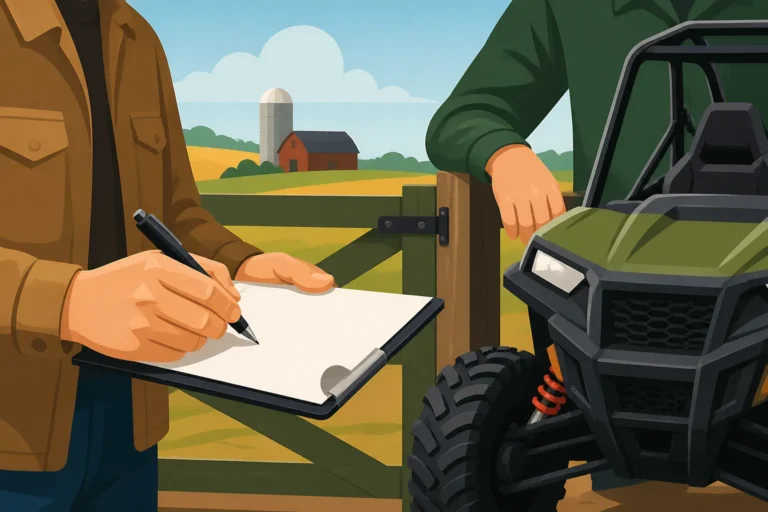
Finally, clearly state the purchase price in Canadian dollars, the date of the sale, and include a clause noting that the machine is sold "as is, where is" if that is your agreement. Both you and the buyer should sign and date two identical copies of the bill of sale, with each of you retaining one original copy. This isn't a step to rush. Using a reputable template from a service like LawDepot can ensure you don't miss any critical details, giving both you and your buyer peace of mind. For more detailed guidance, see [Saskatchewan Bills of Sale for a Quad] and [Saskatchewan ATV Paperwork for a Buyer].
Beyond the Bill of Sale: Supporting Documents
While the bill of sale is primary, other documents can significantly bolster the buyer's confidence and smooth their process, especially when they're dealing with a different provincial government. If you have the original purchase receipt from when you bought the machine, providing a copy can help establish a clear chain of ownership. This is particularly useful if the machine has only had one or two owners.
Another absolutely critical piece of information, particularly for the buyer, is a lien check. Even though Saskatchewan doesn't have a provincial registry for ATVs, a lien can still be placed on a machine if it was financed through a bank or credit union. A lien means someone else has a financial claim to the machine. If you sell a machine with an outstanding lien, the buyer could legally lose the machine if the original loan isn't paid off. While it's ultimately the buyer's due diligence, as a seller, it's wise to provide proof that the machine is free of liens or, if there was one, that it has been fully discharged. The Personal Property Registry (PPR) is where these checks are typically done in Saskatchewan. Providing this extra layer of transparency can prevent major headaches down the road. You can learn more about this by looking at [Saskatchewan Liens on an Unregistered Machine].
Service records, owner's manuals, and any records of aftermarket parts or repairs also add value and build trust. While not legally required, they offer a history of the machine's care and can reassure a buyer, especially one who is travelling a distance to purchase from you. Think of these as adding credibility to the story the bill of sale tells. Having all your paperwork organized and ready to present will make you appear professional and trustworthy.
Navigating the Out-of-Province Buyer's Concerns
Buyers coming from provinces like Alberta or Manitoba often have ingrained expectations about vehicle ownership paperwork. When they hear Saskatchewan has no ATV registration, their first thought is usually, "How do I register it back home?" It's a valid concern, and as the seller, being prepared to answer these questions transparently will make all the difference.
Addressing Registration Expectations in Their Home Province
Your out-of-province buyer will need to register or title their new ATV/UTV in their home province. Whether it's the Alberta Registries system, Manitoba Public Insurance, or another provincial authority, they will have their own set of requirements. The crucial point is that they will use your comprehensive Saskatchewan bill of sale as the primary document to prove ownership. Without a Saskatchewan registration or title to present, the bill of sale effectively becomes their "proof of acquisition" when they walk into their local registry office.
You might encounter buyers who are hesitant or even suspicious because they've never dealt with a no-registration system before. They might ask for a Saskatchewan "title" or "certificate" that simply doesn't exist. Reassure them that the detailed bill of sale, perhaps even accompanied by a lien check from Saskatchewan’s Personal Property Registry, is the accepted form of proof. You can tell them that [Your Bill of Sale Stands In for a Registration]. It can be helpful for them to understand how [Saskatchewan Registration Compared to Alberta] or [Saskatchewan Registration Compared to Manitoba] differs, as this context often alleviates their concerns.
It's also worth discussing with the buyer whether their province requires a safety inspection or other certifications before registration. While not your responsibility as the seller, being knowledgeable about general expectations can demonstrate goodwill and make the transaction smoother. You're not just selling a machine; you're helping them navigate a unique cross-provincial situation.
Facilitating a Smooth Transaction Across Borders
Payment is always a critical point in any sale, but especially when dealing with an out-of-province buyer where you might not have the same recourse as with a local. Secure payment methods are non-negotiable. Avoid personal cheques, as these can bounce, leaving you without your machine and without payment. Bank drafts (certified cheques) or wire transfers are much safer options. Always verify the funds with your bank before releasing the machine. If a buyer insists on cash for a large amount, arrange to complete the transaction at your bank, where funds can be verified immediately.
Transportation is another consideration. Is the buyer trailering the machine themselves, or are they arranging a carrier? Confirming these logistics beforehand avoids any last-minute confusion. Who is responsible for any insurance during transit? Typically, once the machine is sold, it becomes the buyer's responsibility, but clear communication helps.
Perhaps the most confusing part for both parties when selling across provincial lines is sales tax. In Saskatchewan, Provincial Sales Tax (PST) generally applies to the sale of ATVs and UTVs. As the seller, you are typically responsible for collecting Saskatchewan PST from the buyer at the time of sale. The buyer, once they register the machine in their home province, will then pay their provincial sales tax (if applicable) there. They will likely be given a credit for any PST you collected in Saskatchewan, avoiding double taxation. For instance, you collect Saskatchewan PST from an Albertan buyer, who then registers in Alberta and might pay GST, and then the PST portion is reconciled. This often requires research by both parties, and you can point them to information on [Saskatchewan PST at Purchase] and [Saskatchewan GST at Purchase]. LawDepot's bill of sale templates can also be customized to clearly outline sales tax responsibilities, ensuring both parties are on the same page.
Practical Steps for the Seller
Preparing your machine and yourself for an out-of-province sale involves a bit more than just slapping a "for sale" sign on it. Taking these extra steps can not only ensure a quicker sale but also protect you legally and financially.
Preparing Your Machine for Sale
First impressions matter, especially when a buyer is travelling a significant distance. Give your ATV or UTV a thorough cleaning, inside and out. Remove any personal belongings, wash off mud and grime, and clean the plastics and seats. A clean machine suggests it's been well-cared for. Beyond aesthetics, perform basic maintenance checks. Top up fluids, check tire pressure, and ensure all lights are working. If there are any known mechanical issues, be transparent about them. Honesty builds trust and prevents disputes after the sale.
Gather all relevant documentation. This includes the comprehensive bill of sale you've prepared, any previous purchase receipts, service records, and the owner's manual. Have these documents organized in a folder, ready to present. Being prepared shows you're a serious seller and instills confidence in your buyer.
Finally, take clear, well-lit photographs of the machine from multiple angles. Crucially, photograph the Vehicle Identification Number (VIN) or serial number clearly. This visual proof, alongside the detailed description in your bill of sale, helps the buyer confirm the identity of the machine and can be important for their records. For more on this, you can check [Photographing the VIN at a Saskatchewan Sale].
Completing the Sale Securely
When it comes to the actual transaction, safety and security should be your top priorities. If you are selling privately and meeting a buyer you don't know well, consider arranging the meeting in a public place during daylight hours. Some police stations even offer safe transaction zones. If the meeting is at your home, have another person present.
Verify the buyer's identity, especially if they are travelling from out of province. Ask for a driver's license or another form of government-issued ID. Similarly, be prepared to show your own ID to establish trust.
Once you’ve agreed on the price and the payment method is secure, it’s time to finalize the bill of sale. Ensure all sections are accurately filled out, double-check the VIN, and make sure both parties sign and date both copies. Emphasize to the buyer that their copy of this bill of sale is their official proof of ownership and will be vital for registering the machine in their home province. Reiterate that resources like LawDepot offer robust templates to guide this process, helping prevent omissions that could cause issues later.
Before the buyer departs with the machine, take a moment to snap a photo of the completed, signed bill of sale for your own records. This simple step provides an undeniable record of the transaction. For additional advice on private sales, consult [Selling a Quad Privately in Saskatchewan]. While Saskatchewan doesn't have a formal registration system, having a solid paper trail means you've done your part to ensure a clear transfer of ownership, protecting both yourself and your out-of-province buyer.
Here's a quick overview of key differences and expectations:
| Feature | Saskatchewan (Seller's Perspective) | Out-of-Province (Buyer's Expectation) |
|---|---|---|
| Provincial Registration | No provincial registration or title | Typically expects a provincial registration or title |
| Proof of Ownership | Comprehensive Bill of Sale | Provincial title/registration, or strong Bill of Sale |
| Provincial Plates/Decals | None issued provincially | Often expects a plate or decal for on-road/trail use |
| Lien Checks | Personal Property Registry (PPR) | Often done through provincial vehicle registry |
| Sales Tax (PST) | Seller typically collects SK PST | Buyer pays provincial sales tax in home province (may get credit for SK PST) |
| Transfer Process | Handover of signed Bill of Sale | Registration/titling process at provincial registry |
While Saskatchewan's approach to ATV and UTV ownership might seem unconventional to those from other provinces, it's a system built on the principle of clear contractual agreements between parties. By understanding these nuances and meticulously preparing your documentation, especially that all-important bill of sale, you can confidently sell your off-road machine to an out-of-province buyer, ensuring a smooth and transparent transaction for everyone involved. The key is communication and thoroughness; explain the Saskatchewan way, provide robust paperwork, and help your buyer understand what they'll need for their own provincial processes.
Disclaimer
This article is for general informational purposes only and does not constitute professional advice. Laws, prices and regulations vary by location and change over time. Consult a qualified professional for guidance on your specific situation.