Saskatchewan Permit Rules at Moose Mountain
Planning an ATV or UTV ride at Moose Mountain means sorting out more than where the trails begin. Riders need to understand the park’s permit process, which routes are open to machines, and what documents or conditions may apply on the day. Here’s how to prepare, what to confirm before travelling, and how to avoid treating a park permit as permission to ride anywhere.
What the Moose Mountain permit covers
Moose Mountain Provincial Park has designated trails for off-highway machines, including a trail system described as about 47 kilometres long. A park trail permit is part of using those designated routes. It is not a province-wide ATV registration, a general licence to ride throughout the park, or permission to use trails that are closed or not designated for machines.
The key distinction is between access to the park’s machine trails and access to the park as a whole. A permit does not turn hiking trails, roads, beaches, campground areas, or other restricted places into ATV routes. Follow the posted signs and current park instructions even if a route appears on an older map or was open during a previous visit.
The permit is described as free, but getting it involves steps. Riders should expect to complete the required park information process and sign an ATV use acknowledgement form before receiving a permit. The process is covered in Saskatchewan Free Permits at Moose Mountain and The Info Session That Comes Before Your Permit. Confirm with the park where and when the current information session is available; a permit process that requires an in-person step can affect your arrival time and riding plans.
| Before riding | What to do | Why it matters |
|---|---|---|
| Park permit | Complete the required information and use-form steps | A free permit still has a process riders must complete |
| Route | Use designated ATV trails and follow current signs | A permit does not open every route or park area |
| Insurance | Have proof of liability insurance available | Park staff may ask to see it |
| Machine | Wash it as directed before riding | Cleaning helps reduce the spread of invasive species |
| Youth riders | Confirm supervision requirements before the trip | Park rules may apply in addition to general riding rules |
| Conditions | Check current closures and operating information | Fire, weather, or trail conditions can change access |
If you are uncertain whether your machine, route, or planned activity is covered, ask the park office before unloading. A trail permit should be treated as one part of the visit requirements—not as an all-purpose pass.
Where to get the permit and what to ask
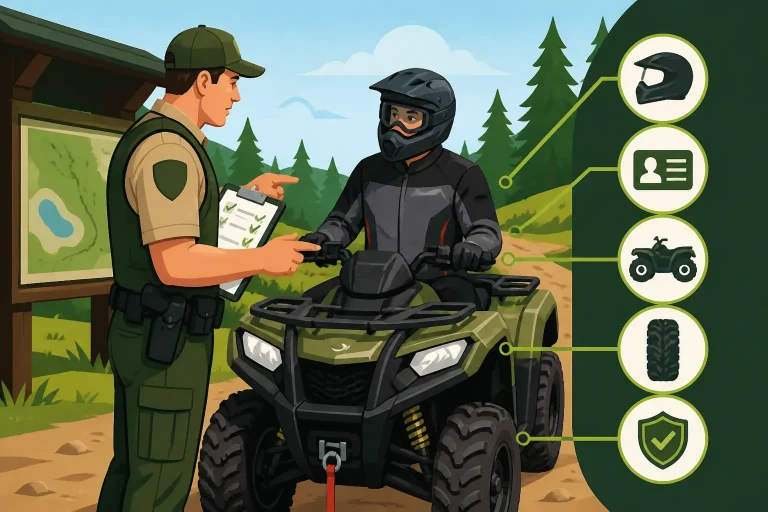
The permit process can involve an information session and a signed use form. Because the place and timing for completing those steps can affect your schedule, contact the park before travelling and ask:
- Where is the required information session held?
- Is the session available on the day you plan to arrive?
- Where do riders complete and sign the use form?
- Where is the permit issued or picked up?
- Does every rider need to complete a step, or is any part handled by a group organizer?
- Are there current trail closures or route changes?
- What proof should you have with you while riding?
The list of articles about Signing the Use Form at a District Office and Picking Up a Trail Permit at the Campground Office can help you understand the kinds of steps involved. Still, use current park instructions to confirm the actual process for your visit. Office hours, service arrangements, and seasonal operations can change.
Do not assume that arriving at the trailhead is enough to complete the process. If you need to attend an information session or speak with park staff, plan that step before you commit to a long ride. For a group, agree in advance who will confirm the process and make sure every rider knows what to bring.
A park permit is not a municipal plate
Saskatchewan does not issue a province-wide registration plate for ATVs in the same way it does for some other vehicle types. Some municipalities operate local plate or permit systems, but those local schemes do not automatically replace a park permit. The details are explained in Saskatchewan Municipal ATV Plates Explained.
Likewise, a municipal plate should not be treated as authorization to ride Moose Mountain’s designated trails. The park’s permit process applies to the park, while local bylaws and permits apply in the places covered by that municipality. If your trip includes riding in a nearby community as well as the park, check the requirements for each area separately.
Keep ownership paperwork distinct from access paperwork, too. A bill of sale or other proof of ownership may help establish that a machine belongs to you, but it is not a park trail permit. Riders who are preparing documents for a machine can review Saskatchewan Proof of Ownership Without a Registry. Having ownership documents available can be sensible, but it does not substitute for the park’s required permit steps or insurance proof.
What to prepare before you ride
A smooth visit begins before the machine is on the trailer. Confirm the permit process, review the current park information, and make sure the people in your group understand the route and operating rules. It is especially important to check the details close to your trip rather than relying on an old post, map, or another rider’s memory.
Confirm access and trail conditions
The 47-kilometre figure gives a sense of the trail network, not a promise that every kilometre will be open on a particular day. Weather, maintenance, fire conditions, or other park decisions may affect access. Check the park’s current notices and ask about closures before travelling. For broader planning, Moose Mountain Provincial Park ATV Trails and Moose Mountain’s Season Dates in Saskatchewan are useful starting points, but current park directions should guide your visit.
Make sure your map or navigation information matches the current designated routes. If a route is marked closed, unsigned, or unclear, do not assume that the permit makes it acceptable to continue. Stop and check with park staff rather than taking an unmarked shortcut.
Have insurance proof ready
Park information identifies liability insurance as something riders may need to produce on demand. Carry proof where it can be reached without digging through luggage or leaving the trail to retrieve it from a vehicle. A digital copy may be convenient, but it is sensible to know whether you can access it where you are riding and to follow any instructions from park staff about acceptable proof.
This is separate from the permit. Completing the permit steps does not itself provide insurance. Riders who need to understand the insurance side can read Saskatchewan Insurance Requirements for Riders and Saskatchewan Insurance Proof on the Trail. Confirm your own coverage with your insurer, including whether it applies to the machine and the kind of riding you plan to do.
Clean the machine and respect park boundaries
Park guidance includes washing machines to help prevent the spread of invasive species. Clean mud, plant material, and debris from the machine before heading to the park, and follow any cleaning instructions provided for the visit. Pay attention to tires, underbody areas, racks, and other places where soil or seeds can collect.
Once on site, remain on designated ATV trails and obey signs, barriers, and instructions from park staff. Do not ride on a hiking trail, through a campground, or across an area simply because it looks like a convenient connection. If a trail is closed or a sign is difficult to interpret, stop and get clarification.
A permit also does not override a temporary closure. Fire restrictions, trail maintenance, or changing conditions may limit where machines can go. Check Saskatchewan Wildfire Season Rules for Riders if your visit falls during fire season, and confirm any current park restrictions before setting out.
Plan for young riders and groups
Park guidance says riders aged 12 to 16 need supervision. Make sure a young rider’s plan meets the applicable requirements before the trip, including who will supervise and whether that person is riding with the group. Do not assume that a parent being somewhere else in the park is enough. For the wider provincial rules, see Saskatchewan ATV Age Requirements.
Groups should also agree on basic riding plans: who leads, who rides at the back, where the group will stop, and what to do if someone becomes separated. Keep the group together at intersections and trail junctions, and pause before entering a section where signs or conditions are uncertain. These steps do not replace the park’s rules, but they make it easier to follow them.
A practical pre-ride checklist
Use this checklist when organizing a trip. It is not a substitute for park instructions, but it can help catch common oversights before the trailer is loaded.
- Confirm the current permit process. Ask whether an information session and signed use form are required for your visit, where they are completed, and when staff are available.
- Check that the permit has been issued. Do not treat an appointment, a past visit, or a permit held by someone else as proof that your own current requirements are complete.
- Review current trail information. Verify which machine routes are designated and whether any sections are closed.
- Bring insurance proof. Make it accessible to the rider who may be asked to show it.
- Clean the machine. Remove mud and plant material before arriving and follow any park cleaning directions.
- Confirm the group’s age and supervision plan. Pay particular attention to riders aged 12 to 16.
- Check the conditions again before unloading. Fire restrictions, weather, or park notices may change between the time you plan the trip and the time you arrive.
- Know the limits of your permit. Stay on designated routes and follow posted directions, even when a shortcut seems obvious.
If a requirement is unclear, ask the park office rather than relying on a general Saskatchewan rule or a permit from another location. Different places can have different access systems. A local plate, a permit from another park, or permission to use private land should not be assumed to satisfy Moose Mountain’s requirements.
Keep the permit and insurance proof accessible during the ride, and make sure the group knows where the documents are. If a park officer or staff member asks for proof or gives a direction, respond promptly and follow the instruction. The most useful preparation is simple: complete the park’s process, confirm the open routes, bring proof of insurance, and stay on the trails designated for machines.
Disclaimer
This article is for general informational purposes only and does not constitute professional advice. Laws, prices and regulations vary by location and change over time. Consult a qualified professional for guidance on your specific situation.