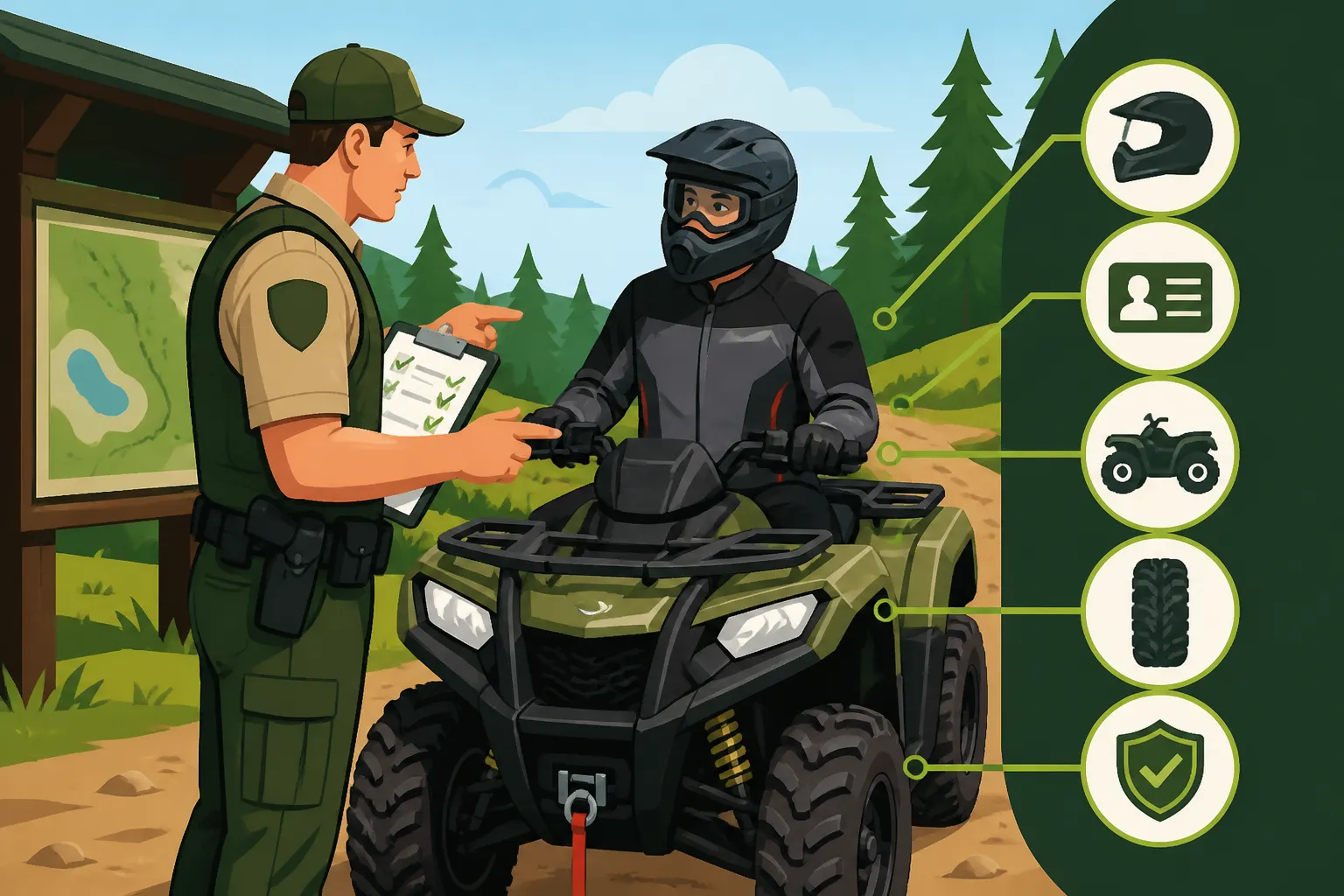
What a Park Officer Checks at a Trailhead
A trailhead check can catch riders off guard, especially when a Saskatchewan park has its own permit process on top of general riding rules. The exact checks depend on the park and the ride, but a little preparation makes the stop straightforward. Here’s what to have ready, what staff may look at, and what to confirm before unloading your ATV or UTV.
Start with the park’s permit and trail rules
There isn’t one permit rule that applies to every Saskatchewan riding area. Some provincial parks require riders to complete a park-specific process; others may not require a trail permit. Municipal plates, park permits and provincial ATV registration are separate things, so having one does not automatically satisfy the others.
At parks with a designated permit process, staff may check whether you have completed the required steps and whether your permit is displayed as directed. Moose Mountain and Great Blue Heron have free park permit processes, but riders should confirm the current instructions with the park before travelling. Depending on the process, you may need to attend an information session, sign an ATV use acknowledgement form or pick up a permit at a particular office. See How to Get a Saskatchewan Park Trail Permit and Signing the ATV Use Acknowledgement Form First for more detail.
| What staff may check | What to do before you arrive |
|---|---|
| Whether the park requires a permit | Check the specific park’s current instructions |
| Whether you completed required steps | Confirm any information session or acknowledgement form |
| Whether the permit is displayed correctly | Follow the park’s directions for where to display it |
| Whether you are riding on designated trails | Check the park map and current trail notices |
| Whether insurance can be shown | Keep proof accessible, even if it is stored electronically |
A park permit is not the same as permission to ride anywhere in the park. Trails can be limited to designated routes, and roads, hiking trails, campgrounds, beaches or boat launches may be closed to machines. A staff member may ask where you plan to ride or remind you to stay on signed ATV routes. If a route is closed or not designated for machines, don’t assume that a permit makes it open. Check Saskatchewan Parks With Designated Trails Only and Saskatchewan Trails Closed Inside Parks before choosing a route.
The permit process can also vary within a park. Some parks require riders to visit an office or attend an information session before riding; other riding areas may have a different process or no park permit requirement. Verify the instructions for the park you are visiting rather than relying on what a friend did at another trail system.
Have insurance and rider information ready
A park officer may ask you to produce proof of liability insurance. Saskatchewan’s general ATV requirements and a park’s own operating rules are related but distinct. Carry evidence that lets you identify the insured machine and policy, and make sure the coverage applies to the riding you plan to do. For a closer look at what to carry, see Saskatchewan Insurance Proof on the Trail and Saskatchewan Insurance Requirements for Riders.
If your proof is on a phone, make sure you can open it without a signal. Download the document before leaving service, and keep your phone charged and protected from water. A paper copy is useful as a backup. A small waterproof document pouch can keep paper records together in a gear bag; if you shop for one, Amazon is one possible source, but the important thing is that the information stays readable and accessible.
The staff member may also ask who is operating the machine, particularly if a rider appears young or is riding with a group. Saskatchewan’s age and supervision rules can affect whether a young person may operate independently or needs an eligible supervisor. A park’s rules may add practical requirements for the area, so check both the general rule and the park’s directions. The relevant details are covered in Saskatchewan ATV Age Requirements and Riders 12 to 16 Need Supervision in a Park.
For a supervised ride, be ready to identify the supervisor and explain the arrangement. Don’t assume that an adult riding somewhere else in the group satisfies a supervision requirement. The responsible adult should be close enough to supervise as required, and both the young rider and the supervisor should understand the route and the park’s instructions.
Staff may also ask about the machine or its intended use. A passenger, for example, should only ride on a machine designed to carry one. If your group includes different types of machines or riders, check that each person’s setup complies with the applicable rules before heading out.
Expect a practical look at the machine and the route
A trailhead check is not necessarily a full mechanical inspection. Still, staff may look over the ATV or UTV, check that it appears suitable for the permitted route, or point out a park-specific requirement. You should arrive with a machine that is safe to operate and prepared for the conditions rather than waiting for an officer to identify a problem.
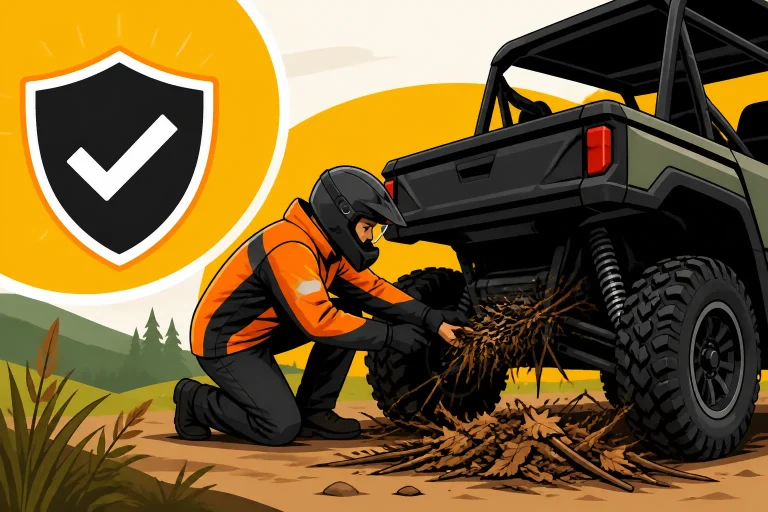
At some parks, cleaning requirements are part of the process for reducing the spread of invasive species. If the park directs riders to wash machines before entering or provides a wash station, follow that instruction. Mud and plant material carried from another area can undermine those precautions. Check Saskatchewan Machines Washed Before a Park Ride for background, and confirm where washing is required for your destination.
Staff may also ask whether you have checked current closures, trail conditions or fire restrictions. Trails can close because of weather, maintenance, wildfire risk or other local conditions. A trail shown on an older map is not proof that it is open today. Before you unload, check the park’s current notices and look carefully at signs at the entrance and along the route. See Saskatchewan Trail Conditions Before You Haul and Saskatchewan Wildfire Closures and Riding.
Here are useful items to keep within easy reach:
- Park permit or other required park documentation
- Proof of liability insurance
- A phone with downloaded documents and the current trail map
- A paper backup for essential records
- Contact details for the park office or the person coordinating your group
- Any equipment the park specifically requires for the route or season
A staff member may be especially interested in the route if your group is heading toward a boundary, a closed area or a trail junction that is easy to miss. Know the trail name or route you intend to follow. If you are unsure whether a road or track is open to machines, ask before setting out instead of treating the map’s appearance as permission.
The same caution applies to Crown land, municipal trails and private land near a park. A park permit does not authorize access to land beyond the park’s permitted area. Check land status, posted signs and any required permission before crossing a boundary. Saskatchewan Crown Land Riding Permission and Saskatchewan Private Land Permission explain why access must be confirmed separately.
Make the stop quick with a pre-ride routine
Most trailhead checks are easier when the group arrives organized. Before unloading, agree on who has the permit, who can show insurance, and where the group will meet if someone is delayed. Don’t leave one rider to search through every bag while the rest of the group blocks the entrance.
Use this sequence before the day’s ride:
- Check the park’s current requirements. Confirm whether a permit is needed, how to obtain it and whether an information session or signed form is part of the process.
- Review the route and closures. Use current park information, not just an old map or a route saved from a previous trip.
- Prepare documents. Make the permit and insurance proof easy to open or find, and save electronic copies for offline use.
- Check the group. Make sure young riders have the required supervision and each machine is being used as designed.
- Follow signs and staff directions. If the trailhead instructions differ from what you expected, stop and ask before riding.
If an officer asks for something you do not have, stay calm and explain what you do have. Don’t ride into the park while someone in the group goes looking for paperwork unless staff have clearly told you that is acceptable. Ask what needs to be resolved and whether there is an office or process to complete it. If you cannot meet a requirement, the practical answer may be to delay the ride until you can.
A park check is also a good moment to ask about conditions that are not obvious from the entrance: a temporary closure, a trail washout, a restricted section or a change in the permit process. Keep the question specific, and follow the answer even if it changes your planned route. Park rules and trail availability can differ from one riding area to another, so Rules That Differ Between Two Parks is worth reviewing when you are planning a trip to a new destination.
The simplest approach is to treat the trailhead as a final check, not the place to begin figuring out the rules. Confirm the permit process, bring insurance proof, use designated trails, and follow any park-specific directions. That gives staff what they need to verify and lets your group spend less time sorting out paperwork after the trailer is parked.
Disclaimer
This article is for general informational purposes only and does not constitute professional advice. Laws, prices and regulations vary by location and change over time. Consult a qualified professional for guidance on your specific situation.