Saskatchewan Game Retrieval by Machine
Recovering harvested game with an ATV or UTV can save a long carry, but the machine does not automatically make a route legal. In Saskatchewan, you need to consider the hunt, the land, and the route separately. This guide explains how to plan retrieval, avoid common access mistakes, and transport game and equipment with care.
A machine can retrieve game, but it does not create hunting or access rights
The first distinction is between using a machine to recover an animal that has already been lawfully harvested and using it to pursue, harass, or locate wildlife for a shot. Treat these as different activities. An ATV or UTV is not a substitute for following the rules for the species, season, hunting area, weapon, and method of hunting.
Do not use a machine to chase or drive an animal toward a hunter. Before a trip, check the current Saskatchewan hunting rules for the species and area you plan to hunt, including any restrictions on motorized access, hunting methods, and firearm transport. If a situation is not clear, ask the appropriate provincial office or a conservation officer before relying on a machine to get you there or retrieve game.
A legal harvest also does not make every route to the animal legal. Access rights and motorized-use rules are separate questions:
- Are you allowed to hunt on the land?
- Are you allowed to enter the land with a motorized machine?
- Are you allowed to ride on the particular road, trail, ditch, or field?
- Is the route open at the time you plan to travel?
A landowner may grant permission to hunt without granting permission to drive across the property. Likewise, a route that is open to hunting access may still be closed to ATVs. Get clear permission for machine travel, not just permission to hunt. For background on how the questions differ, see Saskatchewan Hunting Access by Machine and Saskatchewan Private Land Permission.
The same caution applies on public land. Public access is not a blanket authorization to ride anywhere. Crown land can have access conditions, closures, or limits on motorized travel. Some land is occupied or leased, and a person who holds an interest in the land may need to provide permission. Check Saskatchewan Crown Land Riding Explained and Saskatchewan Crown Land Occupant Permission before planning a recovery route.
| Location or route | What to confirm before taking a machine in |
|---|---|
| Private land | Permission to hunt and separate permission to drive the route |
| Crown land | Whether motorized access is allowed and whether restrictions or closures apply |
| Grazing lease | Whether the route is open and whether the leaseholder’s permission is needed |
| Road, ditch, or municipal area | Whether local bylaws allow ATV or UTV travel there |
| Park or protected area | Whether machines are allowed at all, and whether the route is designated for them |
| Frozen lake or river | Whether the relevant rules permit access and whether conditions are safe |
A common mistake is to assume that permission to retrieve a carcass overrides a closure, trespass restriction, or local rule. It does not. If the animal is beyond a boundary you cannot legally cross, stop and arrange another lawful way to recover it. Do not cut a fence, drive around a gate, or treat a short distance as an exception.
Plan the route before the hunt
A retrieval route is easiest to sort out before there is an animal to move. Identify the likely access points, confirm who controls the land, and ask specifically whether an ATV or UTV may travel there. If you are relying on a landholder’s permission, make sure everyone in the hunting party understands where the permission begins and ends.
For Crown land, look for current notices and access information. An area may be subject to restrictions that are not obvious from a map or from the fact that other people have ridden there before. For grazing leases, contact the leaseholder where required and respect gates, livestock, and seasonal conditions. The details are covered in Saskatchewan Grazing Lease Access Rules.
Also check local municipal rules. A road or ditch that looks like a convenient connection may not be open to machines, and rules can differ from one municipality to another. Review Saskatchewan ATV Road Rules Explained and confirm local bylaws for the specific place you intend to travel. Do not assume that a route is legal just because it is a grid road, a ditch, or a well-used trail.
Consider the machine’s legal status and the riding conditions, too. Saskatchewan does not have a general provincial ATV registration system, but that does not mean a rider can ignore operating rules, insurance, or local plate requirements. Municipal plate schemes and route permissions are separate matters. If you are unsure what paperwork applies where you will ride, see Saskatchewan Proof of Ownership on the Trail and Saskatchewan Municipal ATV Plates Explained.
Before leaving, make sure you can navigate back without improvising. Share the planned route with someone who is not in the hunting party, and note boundaries, gates, water crossings, and places where a machine must be left behind. A paper map or offline map can be useful where phone coverage is unreliable, but a map does not prove that a route is open. Posted signs, landholder instructions, and current closures take priority over a line on a screen.
For a hunt that may involve a long carry, plan alternatives. You might be able to recover the animal by hand, use a pack frame, make multiple trips, or contact the landholder for a permitted access solution. Having a backup plan is safer than trying to force a machine through wet ground, brush, a fence opening, or a route that is not authorized.
Recover and transport the animal carefully
Once the animal is down, confirm that the harvest is lawful and follow the applicable rules for identifying, tagging, reporting, and transporting it. Requirements can vary by species and hunting circumstances, so check the current official hunting information rather than assuming that one approach applies to every animal. Keep any required documentation and identification with the game as directed.
Before moving the machine, confirm that the route remains within the permission you were given. If the carcass is on private land, ask before crossing a field or using a farm track, even if you already have permission to hunt there. On leased or occupied land, be especially careful not to disturb livestock, crops, fences, or equipment. A recovery trip can create problems for the landholder even when the hunt itself was authorized.
Use a machine only where the surface and conditions can support it. Wet soil, muskeg, steep banks, and soft field edges can be damaged quickly by spinning tires. Getting stuck can also turn a short recovery into a bigger problem and may lead riders to cross land or cut brush without permission. If the route is soft or unsafe, stop and choose a lower-impact method.
Keep the load secure and within the machine’s capacity. An awkward carcass can shift weight, obstruct the operator, or make steering and braking unpredictable. Use suitable tie-downs, avoid blocking lights or controls, and do not carry more passengers or cargo than the machine is designed to handle. For a UTV, arrange the load so it stays low and stable; for an ATV, do not let a heavy load compromise balance or control.
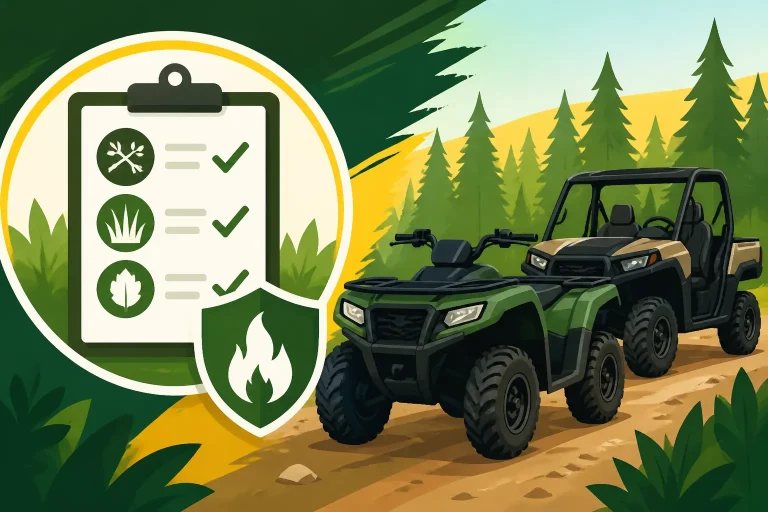
A practical recovery checklist:
- Confirm the animal has been lawfully harvested and follow the applicable tagging or reporting directions.
- Recheck the route and land permissions before starting the machine.
- Choose a route that avoids sensitive ground, livestock, fences, and closed areas.
- Secure the carcass and equipment so the load cannot shift or interfere with operating the machine.
- Travel at a controlled pace and stop if the route becomes unsafe or unauthorized.
- Leave gates as instructed, remove your equipment, and avoid leaving waste or damage behind.
Firearms and other hunting equipment need separate attention. Follow current rules for transporting firearms, and use safe handling practices while loading or unloading a machine. As a precaution, keep firearms unloaded during machine travel and secured so they cannot shift or be accessed accidentally. Never treat the machine’s cargo area as a safe place for a firearm unless it is properly secured and handled in accordance with the applicable rules.
If the machine cannot reach the animal without leaving an authorized route, do not push farther simply because the remaining distance looks short. Return to the landholder or relevant authority and ask about an acceptable recovery option. A difficult retrieval is frustrating, but it is not a reason to trespass, cross a closure, or damage land.
Common mistakes to avoid
Confusing hunting permission with machine permission. Ask directly whether you may ride the route. A landholder’s yes to hunting does not necessarily include driving through a field or along a private access road.
Treating public land as open to every kind of vehicle use. Public land can have restrictions, closures, or specific access conditions. Confirm that motorized travel is allowed where and when you plan to ride.
Assuming the shortest route is the best route. A direct line may cross private property, leased land, a closed trail, or sensitive terrain. Use a route that is both authorized and practical.
Using a machine to help pursue wildlife. Keep recovery distinct from pursuit. Do not use an ATV or UTV to chase, harass, or drive an animal toward a hunter. Check the current hunting rules for any species-specific restrictions.
Ignoring local bylaws. A provincial rule does not necessarily answer whether a particular town, village, or rural municipality allows riding on a road or ditch. Check the local rules before you go.
Relying on what worked last season. Access conditions, posted restrictions, landholder permissions, and fire-related closures can change. Confirm the route shortly before the hunt and again if conditions change.
If you are uncertain about a particular route, describe the exact location and the intended machine use when asking for guidance. “Can I hunt here?” and “Can I take my UTV to retrieve an animal here?” are different questions. A clear answer before the hunt can prevent a trespass issue, a damaged field, or an unsafe recovery.
Disclaimer
This article is for general informational purposes only and does not constitute professional advice. Laws, prices and regulations vary by location and change over time. Consult a qualified professional for guidance on your specific situation.