Saskatchewan Safety Course Length
A Saskatchewan ATV safety course is commonly planned as a full-day commitment, but the exact schedule depends on the provider and course format. If you are booking training for a young rider, the bigger question is whether the course is approved for the legal exception you need. Here is what to expect, what the course can do, and what to confirm before signing up.
How long a Saskatchewan ATV safety course takes
Plan for about 6 to 8 hours for an ATV safety course in Saskatchewan. That is a useful estimate for arranging a day, not a fixed legal duration that every provider must follow. The advertised time may include classroom instruction, practical riding, breaks and an assessment, or some of those parts may be scheduled separately.
A course can take less or more time depending on its format, class size, location, weather and how the provider handles the practical portion. A course that combines instruction and riding may need a different schedule from one that delivers some material another way. Ask whether the stated duration means time in instruction or the full time you should expect to be on site.
Before booking, get clear answers to these questions:
- What are the start and finish times?
- Is there a separate practical riding session?
- Are breaks included in the quoted duration?
- Does the course require you to bring or provide a machine?
- Is there an assessment, and is extra time allowed for it?
- What happens if weather or trail conditions affect the riding portion?
The time estimate is especially helpful when arranging transportation or booking a course for a young rider who needs an adult to accompany them. It also helps avoid assuming that a short online lesson or an informal orientation is equivalent to a complete course.
The course provider’s schedule is the best source for the actual time commitment. If you need training to meet a legal requirement, confirm not only the hours but also whether the course and certificate qualify for that purpose. The duration alone does not establish that a course is approved.
What the course time is used for
A course is intended to build practical knowledge and safe operating habits, not simply to provide a certificate. The precise content and order vary by provider, so ask for a course outline if you need to know what a particular class covers. As a general expectation, instruction may include machine controls, basic riding skills, protective equipment, hazard awareness and the responsibilities that apply when operating an ATV.
A useful course should make time for questions and practice, rather than treating the day as a race to finish a checklist. The practical portion matters because operating a machine involves judgment as well as knowing rules: riders need to understand how speed, terrain, passengers and visibility affect control and stopping distance.
| Course element | What it may cover | What to confirm |
|---|---|---|
| Basic machine knowledge | Controls, starting and stopping, and equipment checks | Whether your machine type is covered |
| Safe riding practice | Position, speed control and basic manoeuvres | Whether riding practice is included and how it is scheduled |
| Hazard awareness | Terrain, visibility and changing conditions | Whether the course uses a practical outdoor component |
| Rules and responsibilities | Rider duties, protective equipment and operating limits | Whether Saskatchewan-specific rules are included |
| Assessment or completion steps | Demonstrating knowledge or skills | What counts as successful completion and what proof you receive |
This table describes common areas to ask about, not a standardized provincial timetable. A provider may use different lesson names or divide the material differently. Some courses may also focus on a particular kind of rider or machine. If the course is for a side-by-side, ask specifically whether the instruction and riding exercises apply to that vehicle, rather than assuming that an ATV course automatically covers every UTV.
Courses may also differ in what they require participants to bring. One provider might supply equipment or a machine; another may have instructions for participants. Do not assume that a helmet, boots, gloves or a suitable machine will be supplied. Ask before the course date, and follow the provider’s requirements for clothing and safety gear.
If your reason for taking a course is to meet a youth riding rule, check the legal qualification before paying. A certificate from a course that is not accepted for that purpose may not provide the result you expected, even if the course itself is useful. See Which ATV Training Courses the Administrator Has Approved and Saskatchewan Youth Training Requirements for the approval question.
Who may need a course for Saskatchewan riding
Saskatchewan does not impose one general ATV safety-course requirement on every adult rider. A course can still be worthwhile for an adult who is new to ATVs, has not ridden for a long time or wants structured practice. But voluntary training and training that satisfies a specific legal exception are not the same thing.
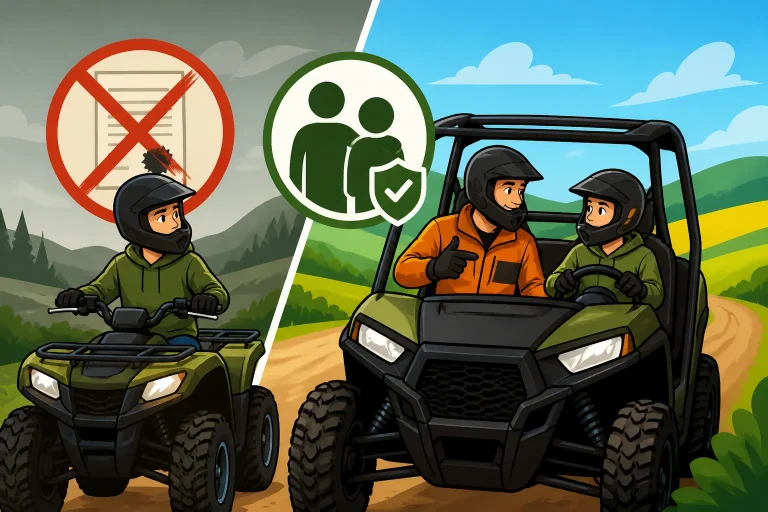
The course question is most important for young riders. Saskatchewan has age-related operating rules, and eligible younger riders may need either an appropriate supervisor or qualifying training, depending on their circumstances. The course must meet the applicable approval requirement if it is being used instead of supervision. Read Saskatchewan ATV Age Requirements and How a Safety Course Replaces a Supervisor before relying on a certificate.
A course does not erase other requirements. It does not, by itself, provide permission to ride on private land, open a road or trail to ATV use, supply insurance, or waive equipment rules. Riders still need to follow the rules for the place and type of riding they plan to do. For example, review Saskatchewan’s 365-Day Supervisor Rule if a young rider will ride with an adult, and check Saskatchewan ATV Insurance Requirements and Saskatchewan ATV Helmet Law as separate requirements.
The same distinction matters for visitors and families with more than one machine. A certificate may be relevant to the rider who completed it, but it is not a registration document for the ATV and does not automatically make another rider qualified. Keep the training proof associated with the person who earned it, and check whether the provider or the applicable rules specify how that proof should be shown.
For a 12-year-old, the details deserve particular care. Do not rely on a general statement that “kids can ride after a course.” Check the age rule, whether the rider must meet the course approval standard, and what other operating conditions still apply. Saskatchewan Rules for a 12-Year-Old Rider provides a more focused look at that age group.
How to choose a course and plan the day
Start by defining the reason for the training. A new adult rider may mainly want hands-on instruction. A parent arranging training for a young rider may need a course that satisfies a legal requirement. A UTV owner may want to know whether the instruction applies to a side-by-side. Those goals can lead to different questions, even when the advertised course length is similar.
Use this checklist when contacting a provider:
- Ask whether the course is approved for your purpose. If a young rider needs the certificate to satisfy an operating rule, ask directly whether this specific course qualifies. Do not treat a course title or completion card as proof of approval.
- Confirm the full schedule. Ask whether the estimated 6 to 8 hours includes registration, breaks, practice and any assessment. Find out whether all components happen on the same day.
- Check the machine coverage. Explain whether the rider will use an ATV or UTV and ask whether that machine type is included in the instruction.
- Ask what participants must bring. Confirm equipment, clothing, footwear, documents and whether the provider supplies the machine.
- Find out how completion is recorded. Ask what certificate or other proof is issued, when it is available and how to replace it if it is lost.
- Clarify what happens if the rider needs more practice. A course may have a set schedule, but participants can differ in experience. Ask how the provider handles a participant who is not ready to demonstrate a skill within the planned time.
- Check the location and conditions. Practical training may depend on the site and weather. Confirm where to arrive and whether the provider will contact participants if the schedule changes.
When comparing courses, do not choose on duration alone. A shorter schedule is not necessarily a better fit, and a longer schedule is not automatically proof of better instruction. Consider the practical content, instructor guidance, machine suitability and whether the course meets the specific approval requirement you have.
Make a realistic plan for the full day. Arrive with time to check in, bring the items the provider requested, and avoid arranging a tight pickup based only on the advertised course hours. If the practical portion is outdoors, ask what clothing is appropriate for the expected conditions. A rider who is cold, tired or distracted may have a harder time concentrating on instruction.
After completion, keep the certificate or other proof somewhere it can be found. If the rider will be asked to demonstrate that training, having the document available can prevent confusion. For operating requirements beyond training, use Saskatchewan Rules of Operation on a Trail and the relevant local rules for the actual riding area.
The practical takeaway is straightforward: set aside roughly 6 to 8 hours, but treat that as a planning estimate rather than a guaranteed schedule. Before booking, confirm the provider’s full timetable and, if the course is meant to satisfy a youth rule, verify that the course is approved for that purpose. Training is one part of safe and lawful riding; it does not replace the other rules that apply to the rider and the place they ride.
Disclaimer
This article is for general informational purposes only and does not constitute professional advice. Laws, prices and regulations vary by location and change over time. Consult a qualified professional for guidance on your specific situation.