Saskatchewan Fire Season Riding Restrictions
Fire season does not automatically close every Saskatchewan trail, but wildfire danger can change where an ATV or UTV may go with little notice. The practical challenge is separating seasonal precautions from an actual closure. Here’s how to check current restrictions, reduce fire risk from your machine and avoid riding into a closed area.
What fire season means for ATV and UTV riders
Saskatchewan’s wildfire season generally runs from April 1 through October 31. That period calls for extra care, but it does not by itself mean all off-road riding is prohibited. A fire ban, a closure order or a park-specific rule may restrict access to particular land, trails or activities.
The key is to check the rules for the place and date of your ride. A trail that was open on your last visit may be closed now, while a restriction in one area may not apply to another. Conditions can change quickly during dry, windy weather, and restrictions may be added or lifted as the risk changes.
| What you encounter | What it means for your ride | What to check |
|---|---|---|
| Fire season | A period when riders should take added care; it is not automatically a province-wide riding closure | Current alerts and rules for your destination |
| Fire ban | Restrictions on specified activities in the area covered by the ban | Which area and activities the ban covers |
| Crown land closure or order | Access may be restricted on the affected Crown land | The order’s boundaries, dates and conditions |
| Park or trail closure | Access is controlled by the park or trail authority | Park notices, trailhead signs and office updates |
| Municipal restriction | Local land or roads may have separate limits | The municipality’s current bylaws and notices |
A fire ban and a land closure are not necessarily the same thing. A ban may prohibit certain fire-related activities without closing every trail. A closure order may limit entry or use of a particular area. Read the notice rather than assuming that a familiar trail remains open or that a ban applies everywhere.
For Crown land, check current restrictions before unloading. The rules can depend on the specific location and may change during a fire emergency. See Saskatchewan Crown Land Access Rules and Saskatchewan Fire Ban Lookups for the access and alert checks to make part of your planning.
Parks and organized trail systems can also have their own restrictions. A provincial park may close designated trails or restrict machine use even if nearby land remains open. Confirm the park’s current notices and machine rules, and don’t rely only on an old map or a previous visit. Saskatchewan Park Regulations for Machines explains why park rules need to be checked separately.
Check restrictions before you haul
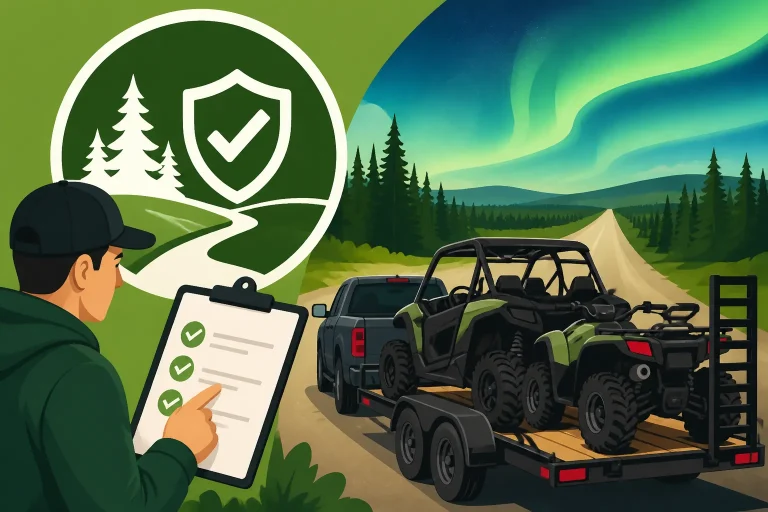
Make fire conditions part of trip planning, not a last-minute check after you reach the trailhead. Before leaving, check official wildfire alerts and any closure information for the exact area you intend to ride. Then check the land manager’s or park’s notices, as well as relevant local bylaws if your route uses municipal land or roads.
A practical check has four parts:
- Confirm the destination and land type. Identify whether you’ll be on Crown land, a designated park trail, private land, a grazing lease or a route controlled by a municipality. Different authorities may set different conditions.
- Look for current fire alerts and restrictions. Check for bans, closures, orders and any listed dates or boundaries. If the notice is unclear, contact the responsible office before travelling.
- Check again close to departure. Conditions and restrictions can change between planning and riding day. A saved screenshot from an earlier date is not proof that an area is still open.
- Read signs at the access point. Trailhead notices, barriers and posted orders can provide important local information. If a sign conflicts with what you expected, stop and clarify before continuing.
This is especially important for longer trips. A route may cross different land types or jurisdictions, and an open trailhead does not necessarily mean every connected segment is open. If the route passes through a restricted area, do not assume you can cross it because your destination is beyond the closure.
A fire ban can also have conditions that are easy to miss. Read what is prohibited, where the rule applies and whether it includes vehicle use, access or particular activities. If a restriction is issued for Crown land, follow its specific terms rather than treating it as a general advisory. For more on how those orders affect riding, see Saskatchewan Administrator Orders on Crown Land and Orders That Close Crown Land to Quads.
If you’re riding in a park, check the park’s information directly. Some parks require riders to use designated routes, and a closure may affect only certain trails or facilities. A route shown on an older map may not reflect a temporary closure. Saskatchewan Wildfire Closures and Riding and Saskatchewan Trail Conditions Before You Haul can help you think through the kinds of updates to look for before setting out.
When you cannot confirm that the area is open, choose another destination. That may be inconvenient, but it is safer than entering an area that has been closed for fire risk or emergency response.
Reduce the chance your machine starts a fire
Even when riding is allowed, a hot machine or debris caught against it can create a hazard. Dry grass, leaves and other combustible material can collect near hot components, particularly during off-trail use or in areas with heavy vegetation. Check the machine before you leave and during the day, not just when you return to the trailer.
A sensible fire-risk routine includes:
- Remove dry grass, leaves and mud mixed with vegetation from areas around hot components.
- Inspect the machine again after riding through tall, dry grass or brush.
- Stop in a safe place if you smell burning, see smoke or notice debris near a hot part.
- Avoid parking a hot machine in dry vegetation.
- Stay on established trails where required, and avoid shortcuts through grass or brush.
- Follow any posted instructions about fire suppression equipment or vehicle access.
Saskatchewan’s wildfire rules place responsibilities on people using equipment in fire-prone conditions. Don’t treat a quick visual check at the start of the day as enough if you continue riding through debris. Your Legal Duty to Check for Combustible Debris and Inspecting Your Machine Throughout a Day of Riding cover why repeated checks matter.
Carry appropriate emergency equipment and know how to use it. A shovel and fire extinguisher are commonly recommended items for riders, but the equipment required can depend on the location, current order or land manager’s conditions. Check the rule that applies to your destination; do not assume a general recommendation replaces a posted requirement. See Fire Suppression Gear on a Machine and Carrying a Shovel and an Extinguisher on Board for practical equipment considerations.
Equipment is not a reason to ride into a closed area or to continue when conditions are unsafe. If you see smoke or a new fire, leave the area by a safe route and report it through the appropriate emergency channel. Don’t approach the fire to investigate or try to cross its path. If an authority or emergency worker directs you to leave, follow that instruction promptly.
What to do if restrictions change during the ride
Restrictions can change while you’re already out. Keep a way to receive updates if service is available, but don’t rely on mobile reception in remote areas. Before the trip, note your route, identify alternate exits and carry an offline map or other navigation backup. A phone alert is useful, but it may not arrive where there is no coverage.
If you learn that a closure has been issued for your area:
- Stop and check the notice carefully, including its boundary and effective time.
- Do not continue farther into the affected area to see whether the restriction applies.
- Leave by a safe route that does not take you deeper into the closed area.
- Follow posted directions and instructions from officials.
- Update your route only after confirming that the alternative is open.
If you encounter a barrier, closure sign or official instruction, don’t ride around it. A detour across private land or a grazing lease is not automatically permitted just because a public trail is closed. Get permission where required and check the rules for the alternative route. Saskatchewan Grazing Lease Permission and Saskatchewan Private Land Permission explain why access needs to be confirmed rather than assumed.
Keep your group together when changing plans. Agree on a meeting point, make sure each rider understands the new route and avoid splitting up to search for an exit. If someone has limited fuel, navigation or communication equipment, account for that before leaving the original trail.
The simplest rule is to make the ride conditional on access: check before departure, check again at the destination and turn around if the area is closed or the status cannot be confirmed. Seasonal fire precautions are part of responsible riding, but current orders and local conditions decide where you can ride on a particular day.
Disclaimer
This article is for general informational purposes only and does not constitute professional advice. Laws, prices and regulations vary by location and change over time. Consult a qualified professional for guidance on your specific situation.