Displaying a Permit Where an Officer Can See It
A permit is useful only if it is valid for the place you are riding and an officer can readily check it. In Saskatchewan, “permit” can mean different things, from a park trail permit to a local municipal plate. Here’s how to display the right one, keep its proof accessible and avoid assuming one document covers every riding area.
First, identify what kind of permit you have
Saskatchewan does not issue a province-wide ATV registration plate, so a municipal plate or a park trail permit should not be mistaken for provincial registration. Each serves a different purpose, and its display instructions may come from a different authority. Before attaching anything to your machine, check who issued it and where it is valid.
A municipal plate or permit is tied to the local scheme that issued it. It does not automatically authorize riding in another municipality. A park trail permit is for the applicable park and its designated trails; it is not a general licence to ride elsewhere. The distinction matters if an officer asks to see your permit outside the area where it was issued.
| Document | What it generally relates to | What to check before riding |
|---|---|---|
| Municipal plate or permit | A local municipality’s rules and riding areas | Whether the municipality requires it, where it is valid, and how it must be displayed |
| Park trail permit | Use of specified trails in a park | Whether your machine needs one, whether it is valid for that park, and the park’s display instructions |
| Permit paperwork or acknowledgement form | A permit process or related conditions | Whether the document itself must be carried, displayed, or both |
| Insurance proof | Insurance coverage, not a riding permit | That it is current and available to show when requested |
| Bill of sale or other ownership record | Evidence of ownership, not permission to ride | That the details match your machine and are easy to retrieve |
Some Saskatchewan parks require a permit for designated ATV trails, while other parks may have different requirements. A permit obtained for one park should not be assumed to work in another. Check the park’s current instructions before travelling, including whether you need to attend an information session, sign a use form, collect a permit from an office, or display a specific item on the machine. How to Get a Saskatchewan Park Trail Permit explains the permit process, and Saskatchewan Parks That Need No Permit covers the fact that park requirements are not all the same.
Municipal rules also vary. A plate issued by one community is not a province-wide ATV plate, and local requirements can include restrictions on roads, areas, or machine use. Start with Which Municipalities Actually Sell You a Quad Plate if you are unsure whether the place you plan to ride has a local scheme. For a broader explanation of the limits, see Saskatchewan Municipal ATV Plates Explained.
The practical point is simple: read the issuing authority’s directions, not just the word “permit” on the document. If the instructions say to display a decal, carrying the paperwork in a pocket may not satisfy that direction. If the permit is issued as paperwork and the authority says to carry it, attaching a photocopy to the ATV may not be appropriate either.
How to display a permit so it can be checked
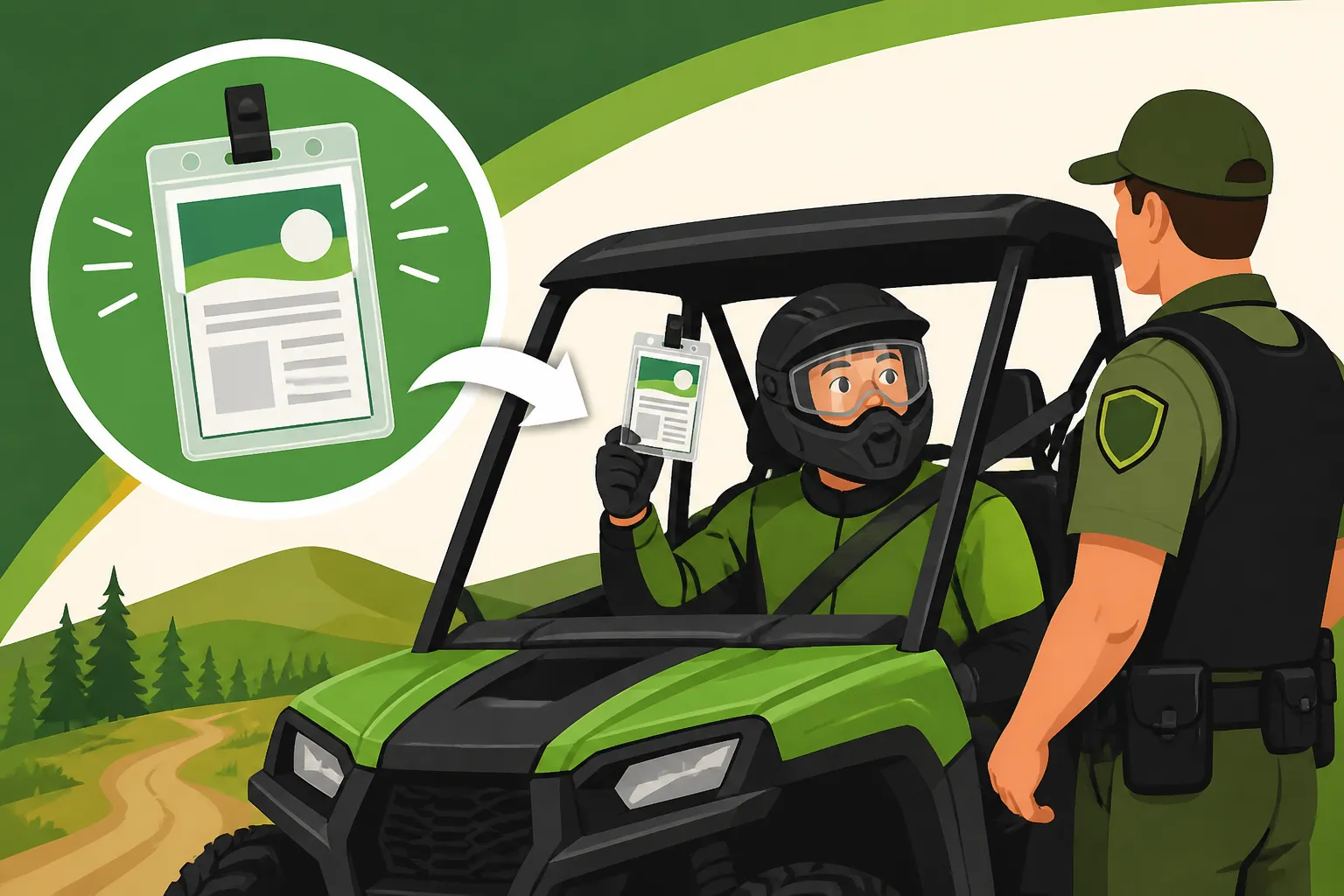
Follow the issuer’s instructions first. If it provides a decal or plate for the machine, attach it where the instructions say and keep it visible. If the permit is a paper document or a form, check whether it must be carried, displayed, or both. Do not assume that the same placement rules apply to a park permit and a municipal plate.
When the issuer does not give a precise location, choose a stable, unobstructed place that an officer can see without having to take the machine apart or search through your gear. The permit should remain readable and attached during ordinary riding. Avoid placing it where mud, a storage bag, a rack, a passenger, or a cover will routinely hide it.
A useful preparation routine is:
- Check the permit’s instructions. Look for wording about display, placement, visibility, expiration, and the locations where it is accepted.
- Confirm it matches your riding area. Check the park, municipality, or other authority that issued it. Do not rely on a plate or permit from a different area.
- Choose an appropriate spot. If it is a decal or plate, use the location directed by the issuer. If no location is specified, keep it clear of moving parts, hot surfaces, controls, lights, and anything that could cover it.
- Attach it securely. Use the method allowed by the issuer. Make sure it is not likely to peel off, swing loose, or be lost in mud or brush.
- Check it before leaving. From a reasonable viewing angle, make sure it is present and legible. Recheck after a muddy ride or any repair that might have moved or covered it.
- Carry related paperwork separately. Keep any permit instructions, insurance proof, and ownership records protected and easy to reach.
Visibility is not only about placement. A decal covered with grime may be hard to read even if it is technically in the right spot. A plate hidden behind a cargo box may be physically attached but not readily visible. If you carry a passenger or add accessories, make sure the setup does not block the permit.
Do not cover a vehicle identification or serial number with a permit, and do not place a permit where it interferes with safe operation. It should not block the rider’s view, obscure lights, or create a snag hazard. If the issuer’s specified placement conflicts with a machine feature or accessory, ask the issuer how to handle it rather than improvising.
Keep photographs or copies as a backup if the issuing authority permits that, but do not treat a photo as a substitute for a required display. A backup may help you recover the permit details if the original is damaged or lost; it does not necessarily satisfy a rule requiring the issued item to be on the machine. For questions about an actual local plate, How to Buy a Saskatchewan Municipal Plate and Saskatchewan Plate Rules for Visitors can help clarify the local scheme and its limits.
What to keep available when an officer asks
A visible permit is only one part of being prepared for a check. Depending on where you are riding, an officer may also ask about insurance, your authority to use the land, or information that identifies the machine. Keep the relevant documents accessible, but do not assume they are interchangeable.
A park permit does not prove that you own the ATV. A bill of sale does not give permission to ride a closed trail. Insurance proof does not replace a municipal plate or park permit where one is required. Having each item ready makes it easier to answer questions clearly and avoid a long search through a trailer or storage box.
Consider keeping a small document pouch in a secure, dry compartment. It can hold copies of your bill of sale, insurance proof, permit instructions, and any landowner permission you need. Keep original documents safe when practical, and avoid leaving paperwork exposed to rain, mud, fuel, or heat. If a document contains personal information, store it securely rather than displaying it on the machine.
Your paperwork should match the machine. Check that the serial number or VIN on the bill of sale and insurance documents corresponds to the machine you are riding. If you bought the ATV used and have only limited ownership records, organize what you do have before the ride. Saskatchewan Proof of Ownership on the Trail explains the role of ownership documents, and Saskatchewan Insurance Proof on the Trail covers what insurance evidence can help you show.
The land itself matters as much as the document. A permit does not necessarily open private land, an occupied Crown land site, or a grazing lease. Confirm access separately and keep any required permission available. Saskatchewan Crown Land Riding Permission and Saskatchewan Grazing Lease Access Rules explain why a permit for one purpose should not be treated as permission for every parcel or trail.
If you are visiting from outside Saskatchewan, do not assume that a plate or registration from home satisfies every Saskatchewan requirement. Likewise, a Saskatchewan municipal plate may not have authority outside the municipality that issued it. Check the riding area’s rules, the visitor requirements, and the permit conditions before setting off. Saskatchewan Plate Rules for Visitors is a useful starting point.
If a permit is missing, damaged, or hard to read
If your permit is lost, torn, faded, or detached, contact the issuing authority before you ride again in an area where it is required. Ask whether it can be replaced, whether a temporary proof is accepted, and whether you need to bring identification or details from the original application. Replacement procedures and local office arrangements can differ, so confirm them directly rather than relying on a rider’s experience from another municipality or park.
If a permit is damaged but still attached, avoid trying to recreate it yourself. A homemade copy, handwritten number, or photocopy might not be accepted in place of the issued item. Ask the issuer what it considers valid proof and whether the permit should be removed while a replacement is arranged.
If you arrive at a trailhead and realize the permit is hidden, stop somewhere safe and make it visible before continuing, if the issuer’s directions allow you to reposition it. Do not ride on the assumption that you can explain the issue later. If the permit is not valid for that location or cannot be shown in the required way, pause and contact the park office or municipality for direction.
Before hauling your machine, make a quick document and display check:
- Is the permit current and issued for this area?
- Is it displayed in the way the issuer requires?
- Can someone see and read it without moving cargo or dismantling equipment?
- Do you have any paperwork that must be carried as well?
- Are your insurance and ownership records accessible?
- Do you have permission to use the land and trail?
- Have you checked for local restrictions or closures?
A few minutes at home can prevent confusion at the trailhead. If you ride in more than one area, keep a short checklist for each one; the required plate, permit, and access conditions may differ. Confirm instructions with the issuing office when something is unclear, especially before a long drive or group ride. A visible permit helps an officer verify the item quickly, but only the right permit, displayed as directed and paired with the required access and safety documents, addresses the whole question.
Disclaimer
This article is for general informational purposes only and does not constitute professional advice. Laws, prices and regulations vary by location and change over time. Consult a qualified professional for guidance on your specific situation.